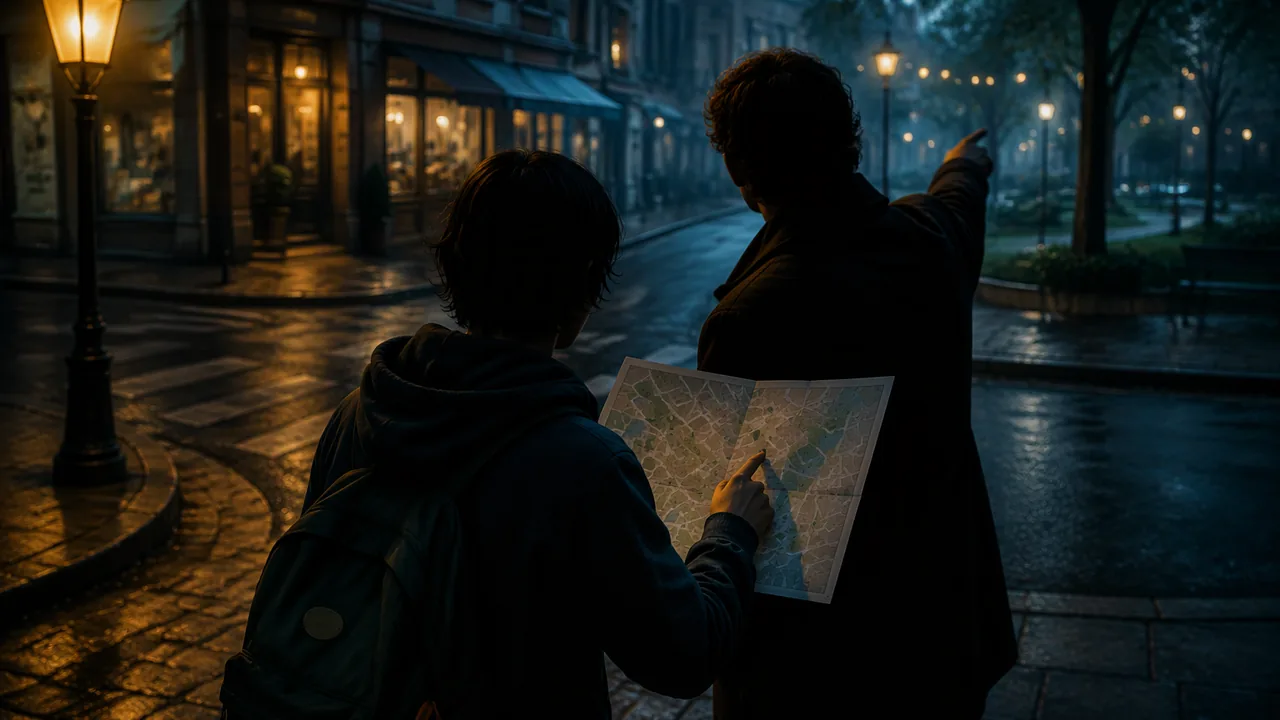
ask where places are and give simple directions, using estar and prepositions of place, and approach a stranger politely.
Instruction
Estar (to be) is Spanish’s second verb for to be. You have used ser for identity and traits. Estar is used for location and for how someone is right now (you have said ¿Cómo estás? since the first day).
| yo estoy | nosotros / nosotras estamos |
| tú estás | vosotros / vosotras estáis |
| él / ella / usted está | ellos / ellas / ustedes están |
Watch the accents: estás, está, estáis, están. Without its accent, esta means “this.”
Location. ¿Dónde está la farmacia? — Está en la calle Main. ¿Dónde están mis amigos? — Están en el parque. A common error is La farmacia es en la calle Main; places and people are located with estar. (One exception to note for later: events use ser, as in La fiesta es en mi casa.)
Prepositions of place. cerca de (near), lejos de (far from), al lado de (next to), enfrente de (across from, facing), detrás de (behind), delante de (in front of), entre (between), en la esquina de (on the corner of), a la derecha de (to the right of), a la izquierda de (to the left of). Most end in de, so remember de + el = del: La panadería está al lado del banco.
Giving directions. Spanish speakers often give directions in the present tense, as if describing the walk: Vas derecho dos cuadras. (You go straight two blocks.) Doblas a la derecha en la calle Olive. (You turn right on Olive.) La biblioteca está a la izquierda. In Mexico you will also hear das vuelta a la derecha for “you turn right.” Una cuadra is a city block in Latin America (in Spain, una manzana). Commands such as siga derecho are also used; you will learn them in Spanish 2, and you will recognize them from context.
Approaching a stranger. Asking a stranger for directions is a moment where register matters. Start with Disculpe or Perdone (excuse me, usted form), greet, and use usted: Disculpe, buenas tardes. ¿Sabe dónde está la estación de tren? (Do you know where the train station is?) End with Muchas gracias, muy amable. (Thank you, very kind of you.) Skipping the greeting and jumping straight to the question can sound rude in many Spanish-speaking communities.
The information gap (on your own, recorded). You have two maps of the same illustrative town, Villa Esperanza. Map A is missing four places that Map B shows, and Map B is missing four that Map A shows. Cover Map B. For each blank on Map A, ask the question aloud (¿Dónde está el correo?), then uncover Map B, answer aloud in a full sentence with a preposition, and label Map A. Then do the same the other way round. Next, record a direction exchange in both roles: as the visitor, choose a starting point and politely ask how to get to a place; as the resident, give the directions; then trace the route and name the place. Switch roles with a new destination. If a family member or another adult you know is willing, they can play the visitor by reading the English prompt card while you answer in Spanish.
Model. — Disculpe, ¿dónde está el correo? — Está en la calle Libertad, enfrente del parque. — ¿Está lejos? — No, está cerca. Vas derecho una cuadra y doblas a la izquierda. — Muchas gracias, muy amable. — De nada.
📖 Read for this lesson
The reading opens over the lesson; close it to come back to exactly where you were. The checks below draw on it.
Formative check
Work through these before moving on. They are not graded — they tell you whether the standard below has landed yet.
Complete the present tense of estar. Accents count.
| yo | estoy |
|---|---|
| tú | |
| él / ella / usted | |
| nosotros / nosotras | |
| vosotros / vosotras | estáis Spain; recognize it |
| ellos / ellas / ustedes |
Listen to the directions. Where is the library?
Show transcript
Vas derecho dos cuadras y doblas a la derecha. La biblioteca está al lado del banco.
Missouri standard: WL.2.1c.I
Ask a stranger politely: “Excuse me, do you know where the post office is?”
Type it instead
Say it in Spanish.
The bakery is between the bank and the pharmacy.
How confident are you that you can ask where places are, give simple directions and approach a stranger politely?
Practice
Work these on paper or in your notebook, then open Check your answer. Aim for all of Fluency and Application; try at least one Challenge.
Printable version: this unit’s practice workbook (PDF)
Fluency
Build speed and accuracy with the core skill.
- Conjugate estar in the present with accents: yo, tú, él/ella/usted, nosotros, ellos/ellas/ustedes.
Check your answer
Answer: estoy, estás, está, estamos, están. (vosotros: estáis)Accents count: without its accent, esta means “this.” - Translate: (a) cerca de; (b) lejos de; (c) al lado de; (d) enfrente de; (e) detrás de; (f) entre.
Check your answer
Answer: (a) near; (b) far from; (c) next to; (d) across from / facing; (e) behind; (f) between.Most prepositions of place end in de, so de + el = del. Entre takes no de. - Translate into English: Vas derecho dos cuadras y doblas a la izquierda.
Check your answer
Answer: You go straight two blocks and you turn left.Directions are often given in the present tense, as if describing the walk. Una cuadra is a city block (in Spain, una manzana).
Application
Use the skill in context. Show your reasoning.
- Complete with the correct form of estar or ser: (a) La farmacia ____ en la calle Main. (b) Mis amigos ____ en el parque. (c) La fiesta ____ en mi casa.
Check your answer
Answer: (a) está; (b) están; (c) es.Places and people are located with estar. Events are the exception the lesson notes: they use ser. - Look at this street, from left to right: el banco – la panadería – la farmacia; across the street from the panadería is el parque. Write three sentences: where the panadería is (two ways) and where the parque is.
Check your answer
Answer: La panadería está entre el banco y la farmacia. La panadería está al lado del banco (or al lado de la farmacia). El parque está enfrente de la panadería.Use estar for location; al lado del banco (de + el = del); entre takes no de. - Write a polite question to a stranger asking where the train station is. Include the opening, a greeting and the closing thanks.
Check your answer
Answer: Disculpe, buenas tardes. ¿Sabe dónde está la estación de tren? … Muchas gracias, muy amable.Use usted (disculpe, sabe). Skipping the greeting can sound rude in many Spanish-speaking communities. Perdone is also correct. - Write the directions in Spanish: go straight three blocks, turn right on Olive, and the library is on the left.
Check your answer
Answer: Vas derecho tres cuadras y doblas a la derecha en la calle Olive. La biblioteca está a la izquierda. (In Mexico also: das vuelta a la derecha.)Present tense for directions; estar for the location at the end.
Challenge
Stretch problems. Expect to think before you write.
- Write a six-line direction exchange: a visitor politely asks a resident where the post office is and if it is far; the resident says it is near, across from the park, and gives one direction; the visitor thanks them; the resident answers.
Check your answer
Answer: Model: — Disculpe, ¿dónde está el correo? — Está en la calle Libertad, enfrente del parque. — ¿Está lejos? — No, está cerca. Vas derecho una cuadra y doblas a la izquierda. — Muchas gracias, muy amable. — De nada.A strong exchange uses usted to open, estar for every location, at least one preposition with del, a direction in the present tense and a polite closing. Your own street names are fine.
Review
Keep earlier skills sharp.
- Review (Lesson 2.2): answer in Spanish: (a) ¿Adónde vas el sábado? (the bakery) (b) ¿Dónde está la panadería? (next to the bank). Explain why the two answers use different verbs.
Check your answer
Answer: (a) Voy a la panadería. (b) Está al lado del banco. ¿Adónde? asks where someone is going, so the answer uses ir; ¿Dónde? asks where something is, so the answer uses estar.From Lesson 2.2: movement → adónde + ir; location → dónde + estar.
Pedir direcciones con cortesía
SLS original text for Spanish 1B, Lesson 2.3 (Level 1 Spanish, present tense) · SLS original
En muchas comunidades hispanohablantes, no está bien preguntarle algo a un desconocido sin saludar primero. Antes de preguntar, decimos: «Disculpe» o «Perdone», y después saludamos: «Buenas tardes.»
Ejemplo: «— Disculpe, buenas tardes. ¿Sabe dónde está la farmacia? — Sí, está cerca. Está al lado del banco, en la calle Principal. — ¿Está lejos de aquí? — No, está a dos cuadras. Va derecho y dobla a la izquierda. — Muchas gracias, muy amable. — De nada.»
Las preposiciones de lugar son importantes: «al lado de» significa un lugar muy cerca; «enfrente de» significa el lugar opuesto, del otro lado de la calle; «entre» significa en medio de dos lugares; «detrás de» y «delante de» describen lugares atrás y adelante.
En Latinoamérica, una cuadra es una sección de una calle entre dos esquinas. En España, se dice «manzana».
Recuerda: los lugares y las personas usan el verbo estar para decir dónde están. Por ejemplo: «La biblioteca está en el centro» y «Mis amigos están en el parque.»