trace two themes of Hamlet across Acts 1-3, write a thesis about how they interact, plan an essay whose sections build on one another, and choose transitions that make each relationship between ideas explicit.
Instruction
11-12.RL.1.D asks you to determine two or more themes and analyze how they interact and build on one another. That word interact is what separates a senior essay from a list. An essay that says “Hamlet is about revenge, and it is also about madness” has named two themes. An essay that says how the play’s account of madness complicates its account of revenge has an argument.
Step 1 — State themes as ideas, not topics. Revenge is a topic. A theme is a claim the play explores: revenge requires a certainty that no one in the play can reach. Appearance and reality is a topic. A theme: in a court built on performance, even sincerity must be staged to be believed. Phrase each theme as a sentence.
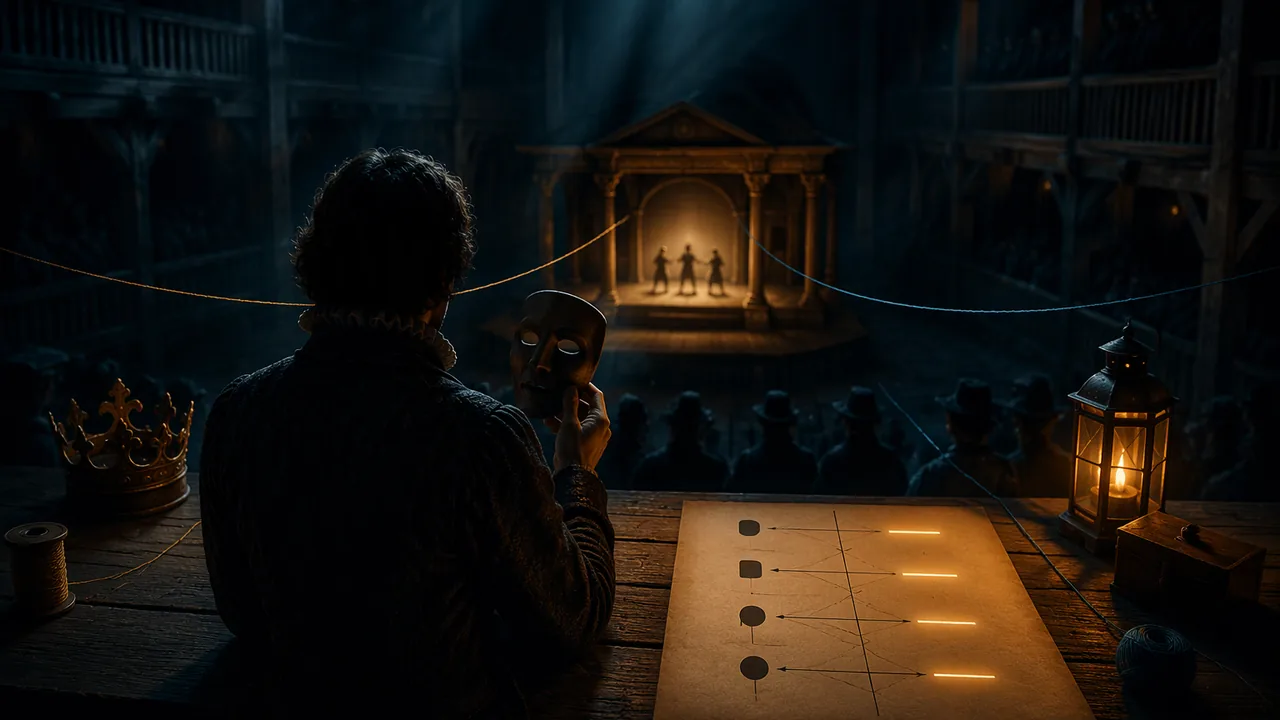
Step 2 — Track each theme across the acts. Build a tracker with one row per act and two columns, one per theme. Fill in Acts 1-3 now, and complete Acts 4 and 5 as you read them in the next two lessons. For each, note a moment and a quotation. You will see each theme develop — and you will see where the two meet. In Hamlet, they often meet in the play within the play: Hamlet uses a staged fiction (appearance) to test a real guilt (reality) so that he can be certain enough to take revenge.
Step 3 — Write a thesis about interaction. A useful pattern: In Hamlet, [theme A] and [theme B] are bound together: because …, …; the play’s ending suggests …. Example: In Hamlet, the demand for revenge and the uncertainty of appearances are bound together: because nothing in Elsinore can be known from its surface, Hamlet can act only when he stops trying to be certain, and the play’s ending suggests that this readiness is both his wisdom and his defeat.
Step 4 — Organize so each section builds (11-12.W.2.A). Do not write one section per theme. Organize by stages of the interaction: how the themes first meet; how they intensify; how the ending resolves or refuses to resolve them. Each section should depend on the one before.
Step 5 — Choose significant evidence (11-12.W.2.A). Evidence from every act you have read so far (the finished essay needs at least four acts); one soliloquy analyzed closely (not just quoted); and one passage that leaves the matter uncertain — for example, Hamlet’s claim in Act 1 that “It is an honest ghost” set against his fear in Act 2 that the spirit “May be the devil,” or Gertrude’s answer in Act 3 that she sees “Nothing at all” when the Ghost appears to her son.
Step 6 — Link the stages with transitions (11-12.W.3.A.d). An essay about interaction lives or dies in its transitions, because a transition is where you state the relationship between two ideas. The standard asks for appropriate and varied transitions and syntax that link the major sections, create cohesion and clarify the relationships among complex ideas. Choose the word for the relationship you mean. Cause and effect: because, so, as a result, therefore. Contrast and concession: yet, however, although, even so. Condition: only when, unless, as long as. Stage or time: at first, once, by Act 3, no longer. Escalation: not only … but, more than that. A transition between sections should name both sides of the link: not “Next, in Act 3,” but “Once the Mousetrap gives Hamlet the certainty he asked for, the delay can no longer be blamed on doubt.” That sentence closes one stage and opens the next. Syntax can do the same work: a subordinate clause (“Although the Ghost’s command is clear, …”) holds two ideas in one sentence and makes their relationship visible. Draft a transition map: one bridging sentence for each move between the sections of your outline, with the word that names the relationship underlined.
Applying reading standards in writing (11-12.RL.1.A). This standard asks you to apply the grades 11-12 reading standards to literature in your writing, including knowledge of how works draw on and transform source material. You may note that Shakespeare transformed older revenge stories — an earlier Hamlet play, now lost, was known on the London stage — but keep that brief and sourced.
Cite by act and scene. Line numbers differ between editions. Cite act, scene and line from your edition (3.1.56), and name the edition in Works Cited.
Revision (11-12.W.3.A). Your Stage 2 reader will look for one thing first: does each section depend on the one before, or could they be shuffled? Your transitions are the evidence: if a bridging sentence could be moved to another place in the essay, the sections are not yet linked.
📖 Before this lesson, read: Hamlet, Acts 1-3
The reading opens over the lesson; close it to come back to exactly where you were.
Reading: A mentor paragraph, a tracker, transitions and a revision model for the theme essay
A. C. Bradley, Shakespearean Tragedy (London: Macmillan, 1904), Project Gutenberg eBook #16966; Samuel Taylor Coleridge, Literary Remains, vol. 2 (1836), Project Gutenberg eBook #8533; Hamlet, Project Gutenberg eBook #1524. Retrieved 2026-09-26. · SLS original; quoted passage is public domain (A. C. Bradley, Shakespearean Tragedy, 1904)
The mentor paragraph is from Bradley’s lecture on the structure of Shakespearean tragedy; the model, the before and after, and the criteria are SLS original.
The mentor paragraph is quoted from A. C. Bradley, Shakespearean Tragedy (1904), Project Gutenberg #16966, retrieved 2026-09-26. The student model, the revision and the criteria are SLS original. The mentor shows what to copy: an argument that moves by stages, each depending on the last.
Part 1. A mentor paragraph
An example will make the point clear. In Hamlet the conflict begins with the hero’s feigning to be insane from disappointment in love, and we are shown his immediate success in convincing Polonius. Let us call this an advance of A. The next scene shows the King’s great uneasiness about Hamlet’s melancholy, and his scepticism as to Polonius’s explanation of its cause: advance of B. Hamlet completely baffles Rosencrantz and Guildenstern, who have been sent to discover his secret, and he arranges for the test of the play-scene: advance of A. But immediately before the play-scene his soliloquy on suicide fills us with misgiving; and his words to Ophelia, overheard, so convince the King that love is not the cause of his nephew’s strange behaviour, that he determines to get rid of him by sending him to England: advance of B. The play-scene proves a complete success: decided advance of A. Directly after it Hamlet spares the King at prayer, and in an interview with his mother unwittingly kills Polonius, and so gives his enemy a perfect excuse for sending him away (to be executed): decided advance of B. I need not pursue the illustration further.
Notice what Bradley does. He does not summarize the plot. Every sentence names a move for one side (A, Hamlet’s plan) or for the other (B, the King’s counter-plan), and the sequence shows the balance shifting. The paragraph is organized by stages of interaction, not by character or by act.
Part 2. A theme tracker with one completed row (SLS original)
| Act | Theme A: revenge needs certainty | Theme B: appearance and reality | Where they meet |
|---|---|---|---|
| 1 | The Ghost demands revenge but is a voice at night (1.5). | Hamlet says he knows not “seems” while the Court is dressed for a wedding (1.2). | Hamlet cannot act on the Ghost until he can trust what he saw. |
| 2 | |||
| 3 | |||
| 4 | |||
| 5 |
Fill in rows 2 and 3 now with one moment and one quotation for each cell, cited by act and scene; complete rows 4 and 5 after Lessons 1.7 and 1.8.
Part 3. A student model paragraph (SLS original)
The demand for revenge and the uncertainty of appearances are bound together in the first two acts. Because the Ghost appears only at night and speaks only to Hamlet, its command to avenge can be believed only if Hamlet trusts what he saw, and Hamlet himself suspects that the spirit could be a devil in a pleasing shape. He therefore stages a play to test the King, which turns a performance into evidence. The result is that in Act 3 Hamlet has the certainty he asked for and still does not act. This shows the two themes working against each other: the more careful the search for the truth, the longer the deed is put off.
Part 4. Before and after (SLS original)
Before. Hamlet has many themes such as revenge and madness. In Act 1 there is revenge. In Act 2 there is madness. In Act 3 there is more of both. Both themes are important.
After. Hamlet’s revenge depends on knowing the truth, and the truth in Elsinore is hard to know, so the two themes drive each other. In Act 1 the command to avenge comes from a Ghost that may deceive; in Act 2 Hamlet decides he needs grounds “More relative than this”; yet in Act 3, once the Mousetrap gives him proof, he still does not strike. What changes is not the amount of revenge or madness but the excuse for waiting: first doubt, then the wish for a more damning moment.
Why the “after” is better: it names an interaction (revenge depends on knowledge) rather than listing topics; it follows three stages; it says what changes; its transitions (so, yet, once) name the relationships; and it has no filler such as “Both themes are important”.
Part 5. Transitions that name relationships (SLS original)
| Relationship | Transitions | Example from a Hamlet essay |
|---|---|---|
| Cause and effect | because, so, therefore, as a result | Because the Ghost speaks only to Hamlet, its command is only as strong as Hamlet’s trust in what he saw. |
| Contrast or concession | yet, however, although, even so | Although the Mousetrap convinces Hamlet, he spares the King minutes later. |
| Condition | only when, unless, if | Hamlet will strike only when Claudius’s soul is unfit for heaven. |
| Stage or time | at first, once, by Act 3, no longer | Once the King rises from the play, doubt can no longer explain the delay. |
| Escalation | not only … but, more than that | The play is not only a test of Claudius but a performance Hamlet stages for the whole court. |
A weak link and a strong one. Weak: “Next, in Act 3, Hamlet sees the King praying.” Strong: “Yet proof does not end the delay; once Hamlet finds the King alone, certainty only supplies a new reason to wait.” The strong version names the relationship (yet), recalls the stage just finished (proof) and states the claim of the stage that begins (a new reason to wait).
Part 6. Criteria for the Stage 1 plan
- Two themes, each stated as a full sentence and not a topic.
- A tracker that gives a moment and a quotation for Acts 1-3, cited by act and scene, with rows 4 and 5 left ready for Lessons 1.7 and 1.8.
- A thesis that says how the themes interact (because, so, only when) and what the ending suggests.
- An outline whose sections are stages of the interaction. If two sections could be swapped without changing the argument, reorder them.
- Evidence from all three acts read so far, one soliloquy analyzed for the movement of its reasoning, and one passage that could be read two ways.
- A transition map: one bridging sentence for each move between sections, with the word that names the relationship underlined.
Formative check
Work through these before moving on. They are not graded — they tell you whether the standard below has landed yet.
Which thesis states how two themes interact?
An essay organized as one section on each theme is the best structure for showing interaction.
Which sentence best links a section on the Mousetrap to a section on the prayer scene?
Submit Stage 1: two themes stated as sentences; a theme tracker for Acts 1-3, with rows for Acts 4 and 5 to complete after Lessons 1.7 and 1.8; a thesis about their interaction; a three-section outline organized by stages; evidence from every act read so far, including one soliloquy and one uncertain passage, cited by act, scene and line; and a transition map with one bridging sentence for each move between sections, the relationship word underlined.
How confident are you that you can trace two themes across a play and argue how they interact?
Hamlet, Acts 1-3
Hamlet, Acts 1-3 so far Bridge summary — not the primary text
A recap of what you have already read, written for this course, so the reading check below does not require re-opening every earlier popover.
Act 1 sets the task: the Ghost of the old King tells Hamlet that Claudius, now king and married to Gertrude, poisoned him, and Hamlet swears revenge while warning his friends that he may put on an antic disposition. In Act 2, Polonius blames Hamlet’s strange behavior on love for Ophelia, Claudius sets Rosencrantz and Guildenstern to watch him, and Hamlet, shamed by an actor’s tears, plans a play to test the King. In Act 3, Hamlet speaks “To be, or not to be” and turns on Ophelia while the King and Polonius listen, and Claudius decides to send him to England. The Mousetrap makes the King rise in alarm; Hamlet then finds Claudius trying to pray and spares him, and in his mother’s room he kills Polonius through the arras, rebukes Gertrude, and sees the Ghost again.