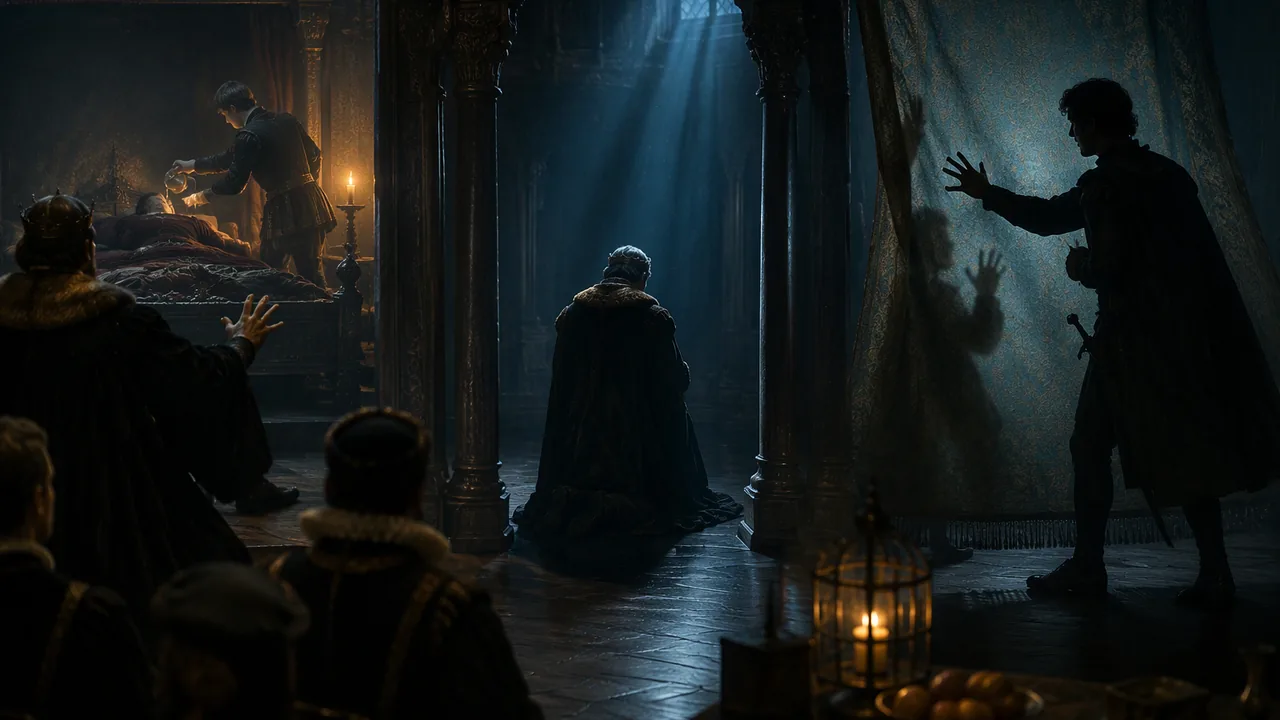
analyze how Shakespeare structures the center of the play, from the Mousetrap through the prayer scene to the killing of Polonius, so that Hamlet’s proof and his chance to act arrive together and end in the wrong deed.
Instruction
Act 3 is the hinge of Hamlet. In one night, in three scenes in a row, Hamlet gets the proof he asked for, finds his enemy alone and unguarded, and kills a man. The man is the wrong one. 11-12.RL.2.A asks you to analyze how an author’s choices about structuring specific parts of a text contribute to its overall meaning. Here the choice is sequence: Shakespeare puts the test, the chance and the mistake back to back, so that the center of the play turns on a missed moment.
The Mousetrap (scene 2). The scene begins with theory. Hamlet coaches the players: “Suit the action to the word, the word to the action,” because the purpose of playing is “to hold as ’twere the mirror up to nature.” Then he asks Horatio, the one man he calls “not passion’s slave,” to watch the King’s face during the play. The performance comes twice: first a dumb show, a wordless version of the whole murder, to which the text gives Claudius no reaction at all; then the spoken play, which Hamlet keeps interrupting with jokes to Ophelia and comments to the court. Asked what she thinks of the Player Queen’s vows never to remarry, Gertrude answers, “The lady protests too much, methinks.” Hamlet names the play The Mousetrap. When Lucianus, “nephew to the King,” pours poison in the sleeping king’s ear, Claudius rises and calls for lights. Hamlet is jubilant: “I’ll take the ghost’s word for a thousand pound.” Notice the detail Shakespeare chose: the murderer in the play is the king’s nephew, not his brother. To the court, the play could look like a threat from Hamlet to his uncle as much as a picture of Claudius’s crime.
The recorders. Rosencrantz and Guildenstern come to summon Hamlet to his mother. He hands Guildenstern a recorder and asks him to play; when Guildenstern says he cannot, Hamlet turns the instrument into an accusation: “You would play upon me; you would seem to know my stops.” Then, alone, he speaks like a revenger at last: “Now could I drink hot blood.” But the speech bends toward his mother, not the King: “I will speak daggers to her, but use none.”
The prayer (scene 3, summarized in the reading card and printed below). Claudius, now sure that Hamlet knows, arranges to send him to England. Left alone, he confesses to the audience for the first time: “O, my offence is rank, it smells to heaven.” He tries to pray and cannot, because he still has “My crown, mine own ambition, and my queen.” Hamlet enters, sees him kneeling, and draws: “Now might I do it pat, now he is praying.” Then he reasons himself out of it. A man killed at prayer goes to heaven, and that would be “hire and salary, not revenge.” He will wait for a moment when Claudius’s soul is damned. The scene ends with the sharpest irony in the play: “My words fly up, my thoughts remain below. / Words without thoughts never to heaven go.” The prayer Hamlet would not interrupt was never a prayer at all.
The closet (scene 4). Polonius hides behind the arras in Gertrude’s private room. When Gertrude cries out for help and Polonius calls out too, Hamlet stabs through the hanging without looking: “How now? A rat?” Then he asks, “Is it the King?” The man who would not kill a praying king kills a hidden counselor on a guess. He confronts his mother with two pictures, his father and Claudius, and speaks so savagely that she begs, “These words like daggers enter in mine ears.” The Ghost appears, visible to Hamlet but not to Gertrude, to “whet thy almost blunted purpose.” Hamlet ends the scene by dragging out Polonius’s body, knowing he must sail for England with two schoolfellows “Whom I will trust as I will adders fang’d.”
Reading the structure. Track three questions through the three scenes: What does Hamlet now know? What chance to act does he have? What does he actually do? The answers do not line up, and that mismatch is the shape of the tragedy.
📖 Before this lesson, read: Hamlet, Act 3, Scenes 2-4
The reading opens over the lesson; close it to come back to exactly where you were.
Reading: The prayer scene up close: Claudius and Hamlet in Act 3, scene 3
William Shakespeare, Hamlet (c. 1600), modern-spelling text as published by Project Gutenberg, eBook #1524 (https://www.gutenberg.org/ebooks/1524), retrieved 2026-09-26. Cited by act and scene; line numbers vary between editions, so none are given. · SLS original; quoted passages are public domain (William Shakespeare, Hamlet)
Act 3, scene 3 is a bridge scene in the reading card; its two central speeches are printed here because the lesson reads them closely. Quotations are copied from the source and checked verbatim; the commentary is SLS original.
Act 3, scene 3 is summarized in the reading card above. Because it is the scene where delay looks most like a choice, its two central speeches are given here in full. Quotation blocks are Shakespeare’s own text; the commentary is SLS original.
The King’s speech comes first, so that Hamlet’s reasoning is heard against it.
The King at prayer (Act 3.3)
O, my offence is rank, it smells to heaven;
It hath the primal eldest curse upon’t,—
A brother’s murder! Pray can I not,
Though inclination be as sharp as will:
My stronger guilt defeats my strong intent,
And, like a man to double business bound,
I stand in pause where I shall first begin,
And both neglect. What if this cursed hand
Were thicker than itself with brother’s blood,
Is there not rain enough in the sweet heavens
To wash it white as snow? Whereto serves mercy
But to confront the visage of offence?
And what’s in prayer but this twofold force,
To be forestalled ere we come to fall,
Or pardon’d being down? Then I’ll look up.
My fault is past. But O, what form of prayer
Can serve my turn? Forgive me my foul murder!
That cannot be; since I am still possess’d
Of those effects for which I did the murder,—
My crown, mine own ambition, and my queen.
May one be pardon’d and retain th’offence?
In the corrupted currents of this world
Offence’s gilded hand may shove by justice,
And oft ’tis seen the wicked prize itself
Buys out the law. But ’tis not so above;
There is no shuffling, there the action lies
In his true nature, and we ourselves compell’d
Even to the teeth and forehead of our faults,
To give in evidence. What then? What rests?
Try what repentance can. What can it not?
Yet what can it, when one cannot repent?
O wretched state! O bosom black as death!
O limed soul, that struggling to be free,
Art more engag’d! Help, angels! Make assay:
Bow, stubborn knees; and heart with strings of steel,
Be soft as sinews of the new-born babe.
All may be well.
Hamlet, standing behind him (Act 3.3)
Now might I do it pat, now he is praying.
And now I’ll do’t. And so he goes to heaven;
And so am I reveng’d. That would be scann’d:
A villain kills my father, and for that
I, his sole son, do this same villain send
To heaven. O, this is hire and salary, not revenge.
He took my father grossly, full of bread,
With all his crimes broad blown, as flush as May;
And how his audit stands, who knows save heaven?
But in our circumstance and course of thought,
’Tis heavy with him. And am I then reveng’d,
To take him in the purging of his soul,
When he is fit and season’d for his passage? No.
Up, sword, and know thou a more horrid hent:
When he is drunk asleep; or in his rage,
Or in th’incestuous pleasure of his bed,
At gaming, swearing; or about some act
That has no relish of salvation in’t,
Then trip him, that his heels may kick at heaven,
And that his soul may be as damn’d and black
As hell, whereto it goes. My mother stays.
This physic but prolongs thy sickly days.
The King rises (Act 3.3)
My words fly up, my thoughts remain below.
Words without thoughts never to heaven go.
Reading the pair (SLS original). Claudius describes himself “like a man to double business bound,” standing “in pause”; a few lines later Hamlet pauses too. Ask what each man’s pause is made of. Claudius cannot repent because he will not give up what the murder gained him; Hamlet will not strike because the moment is not damning enough. Then ask which of the two is more honest with himself, and which of them the audience knows more about than the other does.
Formative check
Work through these before moving on. They are not graded — they tell you whether the standard below has landed yet.
Why does Hamlet decide not to kill Claudius when he finds him kneeling in Act 3, scene 3?
When Hamlet stabs through the arras in his mother’s room, he knows it is Polonius behind it.
Hamlet asks Horatio to watch the King because Horatio is a man who is “not passion’s “; after the play he says, “I’ll take the ghost’s word for a thousand .”
Build a turning-point chart for Act 3, scenes 2-4 with three rows (the Mousetrap, the prayer, the closet) and three columns: what Hamlet now knows, what chance to act he has, and what he actually does, each with a short quotation. Then write a paragraph on the prayer scene: how does placing it between the Mousetrap and the killing of Polonius change what Hamlet’s reasons for waiting mean?
How confident are you that you can explain how the order of scenes at the center of a play shapes its meaning?
Hamlet, Act 3, Scenes 2-4
Hamlet, Act 3, Scene 2: A hall in the Castle.
Source: William Shakespeare, The Tragedy of Hamlet, Prince of Denmark (c. 1600), Project Gutenberg eBook #1524 (gutenberg.org) · Public domain
Enter Hamlet and certain Players.
HAMLET.
Speak the speech, I pray you, as I pronounced it to you, trippingly on
the tongue. But if you mouth it, as many of your players do, I had as
lief the town-crier spoke my lines. Nor do not saw the air too much
with your hand, thus, but use all gently; for in the very torrent,
tempest, and, as I may say, whirlwind of passion, you must acquire and
beget a temperance that may give it smoothness. O, it offends me to the
soul to hear a robustious periwig-pated fellow tear a passion to
tatters, to very rags, to split the ears of the groundlings, who, for
the most part, are capable of nothing but inexplicable dumb shows and
noise. I would have such a fellow whipped for o’erdoing Termagant. It
out-Herods Herod. Pray you avoid it.
FIRST PLAYER.
I warrant your honour.
HAMLET.
Be not too tame neither; but let your own discretion be your tutor.
Suit the action to the word, the word to the action, with this special
observance, that you o’erstep not the modesty of nature; for anything
so overdone is from the purpose of playing, whose end, both at the
first and now, was and is, to hold as ’twere the mirror up to nature;
to show virtue her own feature, scorn her own image, and the very age
and body of the time his form and pressure. Now, this overdone, or come
tardy off, though it make the unskilful laugh, cannot but make the
judicious grieve; the censure of the which one must in your allowance
o’erweigh a whole theatre of others. O, there be players that I have
seen play—and heard others praise, and that highly—not to speak it
profanely, that, neither having the accent of Christians, nor the gait
of Christian, pagan, nor man, have so strutted and bellowed that I have
thought some of Nature’s journeymen had made men, and not made them
well, they imitated humanity so abominably.
FIRST PLAYER.
I hope we have reform’d that indifferently with us, sir.
HAMLET.
O reform it altogether. And let those that play your clowns speak no
more than is set down for them. For there be of them that will
themselves laugh, to set on some quantity of barren spectators to laugh
too, though in the meantime some necessary question of the play be then
to be considered. That’s villainous, and shows a most pitiful ambition
in the fool that uses it. Go make you ready.
[Exeunt Players.]
Enter Polonius, Rosencrantz and Guildenstern.
How now, my lord? Will the King hear this piece of work?
POLONIUS.
And the Queen too, and that presently.
HAMLET.
Bid the players make haste.
[Exit Polonius.]
Will you two help to hasten them?
ROSENCRANTZ and GUILDENSTERN. We will, my lord.
[Exeunt Rosencrantz and Guildenstern.]
HAMLET.
What ho, Horatio!
Enter Horatio.
HORATIO.
Here, sweet lord, at your service.
HAMLET.
Horatio, thou art e’en as just a man
As e’er my conversation cop’d withal.
HORATIO.
O my dear lord.
HAMLET.
Nay, do not think I flatter;
For what advancement may I hope from thee,
That no revenue hast, but thy good spirits
To feed and clothe thee? Why should the poor be flatter’d?
No, let the candied tongue lick absurd pomp,
And crook the pregnant hinges of the knee
Where thrift may follow fawning. Dost thou hear?
Since my dear soul was mistress of her choice,
And could of men distinguish, her election
Hath seal’d thee for herself. For thou hast been
As one, in suffering all, that suffers nothing,
A man that Fortune’s buffets and rewards
Hast ta’en with equal thanks. And blessed are those
Whose blood and judgement are so well co-mingled
That they are not a pipe for Fortune’s finger
To sound what stop she please. Give me that man
That is not passion’s slave, and I will wear him
In my heart’s core, ay, in my heart of heart,
As I do thee. Something too much of this.
There is a play tonight before the King.
One scene of it comes near the circumstance
Which I have told thee, of my father’s death.
I prithee, when thou see’st that act a-foot,
Even with the very comment of thy soul
Observe mine uncle. If his occulted guilt
Do not itself unkennel in one speech,
It is a damned ghost that we have seen;
And my imaginations are as foul
As Vulcan’s stithy. Give him heedful note;
For I mine eyes will rivet to his face;
And after we will both our judgements join
In censure of his seeming.
HORATIO.
Well, my lord.
If he steal aught the whilst this play is playing,
And ’scape detecting, I will pay the theft.
HAMLET.
They are coming to the play. I must be idle.
Get you a place.
Danish march. A flourish. Enter King, Queen, Polonius, Ophelia, Rosencrantz, Guildenstern and others.
KING.
How fares our cousin Hamlet?
HAMLET.
Excellent, i’ faith; of the chameleon’s dish: I eat the air,
promise-crammed: you cannot feed capons so.
KING.
I have nothing with this answer, Hamlet; these words are not mine.
HAMLET.
No, nor mine now. [To Polonius.] My lord, you play’d once i’
th’university, you say?
POLONIUS.
That did I, my lord, and was accounted a good actor.
HAMLET.
What did you enact?
POLONIUS.
I did enact Julius Caesar. I was kill’d i’ th’ Capitol. Brutus killed
me.
HAMLET.
It was a brute part of him to kill so capital a calf there. Be the
players ready?
ROSENCRANTZ.
Ay, my lord; they stay upon your patience.
QUEEN.
Come hither, my dear Hamlet, sit by me.
HAMLET.
No, good mother, here’s metal more attractive.
POLONIUS.
[To the King.] O ho! do you mark that?
HAMLET.
Lady, shall I lie in your lap?
[Lying down at Ophelia’s feet.]
OPHELIA.
No, my lord.
HAMLET.
I mean, my head upon your lap?
OPHELIA.
Ay, my lord.
HAMLET.
Do you think I meant country matters?
OPHELIA.
I think nothing, my lord.
HAMLET.
That’s a fair thought to lie between maids’ legs.
OPHELIA.
What is, my lord?
HAMLET.
Nothing.
OPHELIA.
You are merry, my lord.
HAMLET.
Who, I?
OPHELIA.
Ay, my lord.
HAMLET.
O God, your only jig-maker! What should a man do but be merry? For look
you how cheerfully my mother looks, and my father died within’s two
hours.
OPHELIA.
Nay, ’tis twice two months, my lord.
HAMLET.
So long? Nay then, let the devil wear black, for I’ll have a suit of
sables. O heavens! die two months ago, and not forgotten yet? Then
there’s hope a great man’s memory may outlive his life half a year. But
by’r lady, he must build churches then; or else shall he suffer not
thinking on, with the hobby-horse, whose epitaph is ‘For, O, for O, the
hobby-horse is forgot!’
Trumpets sound. The dumb show enters.
_Enter a King and a Queen very lovingly; the Queen embracing him and he her. She kneels, and makes show of protestation unto him. He takes her up, and declines his head upon her neck. Lays him down upon a bank of flowers. She, seeing him asleep, leaves him. Anon comes in a fellow, takes off his crown, kisses it, pours poison in the King’s ears, and exits. The Queen returns, finds the King dead, and makes passionate action. The Poisoner with some three or four Mutes, comes in again, seeming to lament with her. The dead body is carried away. The Poisoner woos the Queen with gifts. She seems loth and unwilling awhile, but in the end accepts his love._
[Exeunt.]
OPHELIA.
What means this, my lord?
HAMLET.
Marry, this is miching mallecho; it means mischief.
OPHELIA.
Belike this show imports the argument of the play.
Enter Prologue.
HAMLET.
We shall know by this fellow: the players cannot keep counsel; they’ll
tell all.
OPHELIA.
Will they tell us what this show meant?
HAMLET.
Ay, or any show that you’ll show him. Be not you ashamed to show, he’ll
not shame to tell you what it means.
OPHELIA.
You are naught, you are naught: I’ll mark the play.
PROLOGUE.
_For us, and for our tragedy,
Here stooping to your clemency,
We beg your hearing patiently._
HAMLET.
Is this a prologue, or the posy of a ring?
OPHELIA.
’Tis brief, my lord.
HAMLET.
As woman’s love.
Enter a King and a Queen.
PLAYER KING.
Full thirty times hath Phoebus’ cart gone round
Neptune’s salt wash and Tellus’ orbed ground,
And thirty dozen moons with borrow’d sheen
About the world have times twelve thirties been,
Since love our hearts, and Hymen did our hands
Unite commutual in most sacred bands.
PLAYER QUEEN.
So many journeys may the sun and moon
Make us again count o’er ere love be done.
But, woe is me, you are so sick of late,
So far from cheer and from your former state,
That I distrust you. Yet, though I distrust,
Discomfort you, my lord, it nothing must:
For women’s fear and love holds quantity,
In neither aught, or in extremity.
Now what my love is, proof hath made you know,
And as my love is siz’d, my fear is so.
Where love is great, the littlest doubts are fear;
Where little fears grow great, great love grows there.
PLAYER KING.
Faith, I must leave thee, love, and shortly too:
My operant powers their functions leave to do:
And thou shalt live in this fair world behind,
Honour’d, belov’d, and haply one as kind
For husband shalt thou—
PLAYER QUEEN.
O confound the rest.
Such love must needs be treason in my breast.
In second husband let me be accurst!
None wed the second but who kill’d the first.
HAMLET.
[Aside.] Wormwood, wormwood.
PLAYER QUEEN.
The instances that second marriage move
Are base respects of thrift, but none of love.
A second time I kill my husband dead,
When second husband kisses me in bed.
PLAYER KING.
I do believe you think what now you speak;
But what we do determine, oft we break.
Purpose is but the slave to memory,
Of violent birth, but poor validity:
Which now, like fruit unripe, sticks on the tree,
But fall unshaken when they mellow be.
Most necessary ’tis that we forget
To pay ourselves what to ourselves is debt.
What to ourselves in passion we propose,
The passion ending, doth the purpose lose.
The violence of either grief or joy
Their own enactures with themselves destroy.
Where joy most revels, grief doth most lament;
Grief joys, joy grieves, on slender accident.
This world is not for aye; nor ’tis not strange
That even our loves should with our fortunes change,
For ’tis a question left us yet to prove,
Whether love lead fortune, or else fortune love.
The great man down, you mark his favourite flies,
The poor advanc’d makes friends of enemies;
And hitherto doth love on fortune tend:
For who not needs shall never lack a friend,
And who in want a hollow friend doth try,
Directly seasons him his enemy.
But orderly to end where I begun,
Our wills and fates do so contrary run
That our devices still are overthrown.
Our thoughts are ours, their ends none of our own.
So think thou wilt no second husband wed,
But die thy thoughts when thy first lord is dead.
PLAYER QUEEN.
Nor earth to me give food, nor heaven light,
Sport and repose lock from me day and night,
To desperation turn my trust and hope,
An anchor’s cheer in prison be my scope,
Each opposite that blanks the face of joy,
Meet what I would have well, and it destroy!
Both here and hence pursue me lasting strife,
If, once a widow, ever I be wife.
HAMLET.
[To Ophelia.] If she should break it now.
PLAYER KING.
’Tis deeply sworn. Sweet, leave me here awhile.
My spirits grow dull, and fain I would beguile
The tedious day with sleep.
[Sleeps.]
PLAYER QUEEN.
Sleep rock thy brain,
And never come mischance between us twain.
[Exit.]
HAMLET.
Madam, how like you this play?
QUEEN.
The lady protests too much, methinks.
HAMLET.
O, but she’ll keep her word.
KING.
Have you heard the argument? Is there no offence in’t?
HAMLET.
No, no, they do but jest, poison in jest; no offence i’ th’ world.
KING.
What do you call the play?
HAMLET.
The Mousetrap. Marry, how? Tropically. This play is the image of a
murder done in Vienna. Gonzago is the Duke’s name, his wife Baptista:
you shall see anon; ’tis a knavish piece of work: but what o’ that?
Your majesty, and we that have free souls, it touches us not. Let the
gall’d jade wince; our withers are unwrung.
Enter Lucianus.
This is one Lucianus, nephew to the King.
OPHELIA.
You are a good chorus, my lord.
HAMLET.
I could interpret between you and your love, if I could see the puppets
dallying.
OPHELIA.
You are keen, my lord, you are keen.
HAMLET.
It would cost you a groaning to take off my edge.
OPHELIA.
Still better, and worse.
HAMLET.
So you mistake your husbands.—Begin, murderer. Pox, leave thy damnable
faces, and begin. Come, the croaking raven doth bellow for revenge.
LUCIANUS.
Thoughts black, hands apt, drugs fit, and time agreeing,
Confederate season, else no creature seeing;
Thou mixture rank, of midnight weeds collected,
With Hecate’s ban thrice blasted, thrice infected,
Thy natural magic and dire property
On wholesome life usurp immediately.
[Pours the poison into the sleeper’s ears.]
HAMLET.
He poisons him i’ th’garden for’s estate. His name’s Gonzago. The story
is extant, and written in very choice Italian. You shall see anon how
the murderer gets the love of Gonzago’s wife.
OPHELIA.
The King rises.
HAMLET.
What, frighted with false fire?
QUEEN.
How fares my lord?
POLONIUS.
Give o’er the play.
KING.
Give me some light. Away.
All. Lights, lights, lights.
[Exeunt all but Hamlet and Horatio.]
HAMLET.
Why, let the strucken deer go weep,
The hart ungalled play;
For some must watch, while some must sleep,
So runs the world away.
Would not this, sir, and a forest of feathers, if the rest of my
fortunes turn Turk with me; with two Provincial roses on my razed
shoes, get me a fellowship in a cry of players, sir?
HORATIO.
Half a share.
HAMLET.
A whole one, I.
For thou dost know, O Damon dear,
This realm dismantled was
Of Jove himself, and now reigns here
A very, very—pajock.
HORATIO.
You might have rhymed.
HAMLET.
O good Horatio, I’ll take the ghost’s word for a thousand pound. Didst
perceive?
HORATIO.
Very well, my lord.
HAMLET.
Upon the talk of the poisoning?
HORATIO.
I did very well note him.
HAMLET.
Ah, ha! Come, some music. Come, the recorders.
For if the king like not the comedy,
Why then, belike he likes it not, perdie.
Come, some music.
Enter Rosencrantz and Guildenstern.
GUILDENSTERN.
Good my lord, vouchsafe me a word with you.
HAMLET.
Sir, a whole history.
GUILDENSTERN.
The King, sir—
HAMLET.
Ay, sir, what of him?
GUILDENSTERN.
Is in his retirement, marvellous distempered.
HAMLET.
With drink, sir?
GUILDENSTERN.
No, my lord; rather with choler.
HAMLET.
Your wisdom should show itself more richer to signify this to the
doctor, for me to put him to his purgation would perhaps plunge him
into far more choler.
GUILDENSTERN.
Good my lord, put your discourse into some frame, and start not so
wildly from my affair.
HAMLET.
I am tame, sir, pronounce.
GUILDENSTERN.
The Queen your mother, in most great affliction of spirit, hath sent me
to you.
HAMLET.
You are welcome.
GUILDENSTERN.
Nay, good my lord, this courtesy is not of the right breed. If it shall
please you to make me a wholesome answer, I will do your mother’s
commandment; if not, your pardon and my return shall be the end of my
business.
HAMLET.
Sir, I cannot.
GUILDENSTERN.
What, my lord?
HAMLET.
Make you a wholesome answer. My wit’s diseased. But, sir, such answer
as I can make, you shall command; or rather, as you say, my mother.
Therefore no more, but to the matter. My mother, you say,—
ROSENCRANTZ.
Then thus she says: your behaviour hath struck her into amazement and
admiration.
HAMLET.
O wonderful son, that can so stonish a mother! But is there no sequel
at the heels of this mother’s admiration?
ROSENCRANTZ.
She desires to speak with you in her closet ere you go to bed.
HAMLET.
We shall obey, were she ten times our mother. Have you any further
trade with us?
ROSENCRANTZ.
My lord, you once did love me.
HAMLET.
And so I do still, by these pickers and stealers.
ROSENCRANTZ.
Good my lord, what is your cause of distemper? You do surely bar the
door upon your own liberty if you deny your griefs to your friend.
HAMLET.
Sir, I lack advancement.
ROSENCRANTZ.
How can that be, when you have the voice of the King himself for your
succession in Denmark?
HAMLET.
Ay, sir, but while the grass grows—the proverb is something musty.
Re-enter the Players with recorders.
O, the recorders. Let me see one.—To withdraw with you, why do you go about to recover the wind of me, as if you would drive me into a toil?
GUILDENSTERN.
O my lord, if my duty be too bold, my love is too unmannerly.
HAMLET.
I do not well understand that. Will you play upon this pipe?
GUILDENSTERN.
My lord, I cannot.
HAMLET.
I pray you.
GUILDENSTERN.
Believe me, I cannot.
HAMLET.
I do beseech you.
GUILDENSTERN.
I know no touch of it, my lord.
HAMLET.
’Tis as easy as lying: govern these ventages with your finger and
thumb, give it breath with your mouth, and it will discourse most
eloquent music. Look you, these are the stops.
GUILDENSTERN.
But these cannot I command to any utterance of harmony. I have not the
skill.
HAMLET.
Why, look you now, how unworthy a thing you make of me! You would play
upon me; you would seem to know my stops; you would pluck out the heart
of my mystery; you would sound me from my lowest note to the top of my
compass; and there is much music, excellent voice, in this little
organ, yet cannot you make it speak. ’Sblood, do you think I am easier
to be played on than a pipe? Call me what instrument you will, though
you can fret me, you cannot play upon me.
Enter Polonius.
God bless you, sir.
POLONIUS.
My lord, the Queen would speak with you, and presently.
HAMLET.
Do you see yonder cloud that’s almost in shape of a camel?
POLONIUS.
By the mass, and ’tis like a camel indeed.
HAMLET.
Methinks it is like a weasel.
POLONIUS.
It is backed like a weasel.
HAMLET.
Or like a whale.
POLONIUS.
Very like a whale.
HAMLET.
Then will I come to my mother by and by.—They fool me to the top of my
bent.—I will come by and by.
POLONIUS.
I will say so.
[Exit.]
HAMLET.
By and by is easily said. Leave me, friends.
[Exeunt all but Hamlet.]
’Tis now the very witching time of night, When churchyards yawn, and hell itself breathes out Contagion to this world. Now could I drink hot blood, And do such bitter business as the day Would quake to look on. Soft now, to my mother. O heart, lose not thy nature; let not ever The soul of Nero enter this firm bosom: Let me be cruel, not unnatural. I will speak daggers to her, but use none; My tongue and soul in this be hypocrites. How in my words somever she be shent, To give them seals never, my soul, consent.
[Exit.]
Hamlet, Act 3, Scene 3: A room in the Castle. Bridge summary — not the primary text
This is a short recap written for this course, not William Shakespeare’s own words, so you can follow the story between close-reading lessons.
{summary}Hamlet, Act 3, Scene 4: Another room in the Castle.
Source: William Shakespeare, The Tragedy of Hamlet, Prince of Denmark (c. 1600), Project Gutenberg eBook #1524 (gutenberg.org) · Public domain
Enter Queen and Polonius.
POLONIUS.
He will come straight. Look you lay home to him,
Tell him his pranks have been too broad to bear with,
And that your Grace hath screen’d and stood between
Much heat and him. I’ll silence me e’en here.
Pray you be round with him.
HAMLET.
[Within.] Mother, mother, mother.
QUEEN.
I’ll warrant you, Fear me not.
Withdraw, I hear him coming.
[Polonius goes behind the arras.]
Enter Hamlet.
HAMLET.
Now, mother, what’s the matter?
QUEEN.
Hamlet, thou hast thy father much offended.
HAMLET.
Mother, you have my father much offended.
QUEEN.
Come, come, you answer with an idle tongue.
HAMLET.
Go, go, you question with a wicked tongue.
QUEEN.
Why, how now, Hamlet?
HAMLET.
What’s the matter now?
QUEEN.
Have you forgot me?
HAMLET.
No, by the rood, not so.
You are the Queen, your husband’s brother’s wife,
And, would it were not so. You are my mother.
QUEEN.
Nay, then I’ll set those to you that can speak.
HAMLET.
Come, come, and sit you down, you shall not budge.
You go not till I set you up a glass
Where you may see the inmost part of you.
QUEEN.
What wilt thou do? Thou wilt not murder me?
Help, help, ho!
POLONIUS.
[Behind.] What, ho! help, help, help!
HAMLET.
How now? A rat? [Draws.]
Dead for a ducat, dead!
[Makes a pass through the arras.]
POLONIUS.
[Behind.] O, I am slain!
[Falls and dies.]
QUEEN.
O me, what hast thou done?
HAMLET.
Nay, I know not. Is it the King?
[Draws forth Polonius.]
QUEEN.
O what a rash and bloody deed is this!
HAMLET.
A bloody deed. Almost as bad, good mother,
As kill a king and marry with his brother.
QUEEN.
As kill a king?
HAMLET.
Ay, lady, ’twas my word.—
[To Polonius.] Thou wretched, rash, intruding fool, farewell!
I took thee for thy better. Take thy fortune,
Thou find’st to be too busy is some danger.—
Leave wringing of your hands. Peace, sit you down,
And let me wring your heart, for so I shall,
If it be made of penetrable stuff;
If damned custom have not braz’d it so,
That it is proof and bulwark against sense.
QUEEN.
What have I done, that thou dar’st wag thy tongue
In noise so rude against me?
HAMLET.
Such an act
That blurs the grace and blush of modesty,
Calls virtue hypocrite, takes off the rose
From the fair forehead of an innocent love,
And sets a blister there. Makes marriage vows
As false as dicers’ oaths. O such a deed
As from the body of contraction plucks
The very soul, and sweet religion makes
A rhapsody of words. Heaven’s face doth glow,
Yea this solidity and compound mass,
With tristful visage, as against the doom,
Is thought-sick at the act.
QUEEN.
Ay me, what act,
That roars so loud, and thunders in the index?
HAMLET.
Look here upon this picture, and on this,
The counterfeit presentment of two brothers.
See what a grace was seated on this brow,
Hyperion’s curls, the front of Jove himself,
An eye like Mars, to threaten and command,
A station like the herald Mercury
New lighted on a heaven-kissing hill:
A combination and a form indeed,
Where every god did seem to set his seal,
To give the world assurance of a man.
This was your husband. Look you now what follows.
Here is your husband, like a mildew’d ear
Blasting his wholesome brother. Have you eyes?
Could you on this fair mountain leave to feed,
And batten on this moor? Ha! have you eyes?
You cannot call it love; for at your age
The hey-day in the blood is tame, it’s humble,
And waits upon the judgement: and what judgement
Would step from this to this? Sense sure you have,
Else could you not have motion; but sure that sense
Is apoplex’d, for madness would not err
Nor sense to ecstacy was ne’er so thrall’d
But it reserv’d some quantity of choice
To serve in such a difference. What devil was’t
That thus hath cozen’d you at hoodman-blind?
Eyes without feeling, feeling without sight,
Ears without hands or eyes, smelling sans all,
Or but a sickly part of one true sense
Could not so mope. O shame! where is thy blush?
Rebellious hell,
If thou canst mutine in a matron’s bones,
To flaming youth let virtue be as wax,
And melt in her own fire. Proclaim no shame
When the compulsive ardour gives the charge,
Since frost itself as actively doth burn,
And reason panders will.
QUEEN.
O Hamlet, speak no more.
Thou turn’st mine eyes into my very soul,
And there I see such black and grained spots
As will not leave their tinct.
HAMLET.
Nay, but to live
In the rank sweat of an enseamed bed,
Stew’d in corruption, honeying and making love
Over the nasty sty.
QUEEN.
O speak to me no more;
These words like daggers enter in mine ears;
No more, sweet Hamlet.
HAMLET.
A murderer and a villain;
A slave that is not twentieth part the tithe
Of your precedent lord. A vice of kings,
A cutpurse of the empire and the rule,
That from a shelf the precious diadem stole
And put it in his pocket!
QUEEN.
No more.
HAMLET.
A king of shreds and patches!—
Enter Ghost.
Save me and hover o’er me with your wings, You heavenly guards! What would your gracious figure?
QUEEN.
Alas, he’s mad.
HAMLET.
Do you not come your tardy son to chide,
That, laps’d in time and passion, lets go by
The important acting of your dread command?
O say!
GHOST.
Do not forget. This visitation
Is but to whet thy almost blunted purpose.
But look, amazement on thy mother sits.
O step between her and her fighting soul.
Conceit in weakest bodies strongest works.
Speak to her, Hamlet.
HAMLET.
How is it with you, lady?
QUEEN.
Alas, how is’t with you,
That you do bend your eye on vacancy,
And with the incorporal air do hold discourse?
Forth at your eyes your spirits wildly peep,
And, as the sleeping soldiers in the alarm,
Your bedded hairs, like life in excrements,
Start up and stand an end. O gentle son,
Upon the heat and flame of thy distemper
Sprinkle cool patience. Whereon do you look?
HAMLET.
On him, on him! Look you how pale he glares,
His form and cause conjoin’d, preaching to stones,
Would make them capable.—Do not look upon me,
Lest with this piteous action you convert
My stern effects. Then what I have to do
Will want true colour; tears perchance for blood.
QUEEN.
To whom do you speak this?
HAMLET.
Do you see nothing there?
QUEEN.
Nothing at all; yet all that is I see.
HAMLET.
Nor did you nothing hear?
QUEEN.
No, nothing but ourselves.
HAMLET.
Why, look you there! look how it steals away!
My father, in his habit as he liv’d!
Look where he goes even now out at the portal.
[Exit Ghost.]
QUEEN.
This is the very coinage of your brain.
This bodiless creation ecstasy
Is very cunning in.
HAMLET.
Ecstasy!
My pulse as yours doth temperately keep time,
And makes as healthful music. It is not madness
That I have utter’d. Bring me to the test,
And I the matter will re-word; which madness
Would gambol from. Mother, for love of grace,
Lay not that flattering unction to your soul
That not your trespass, but my madness speaks.
It will but skin and film the ulcerous place,
Whilst rank corruption, mining all within,
Infects unseen. Confess yourself to heaven,
Repent what’s past, avoid what is to come;
And do not spread the compost on the weeds,
To make them ranker. Forgive me this my virtue;
For in the fatness of these pursy times
Virtue itself of vice must pardon beg,
Yea, curb and woo for leave to do him good.
QUEEN.
O Hamlet, thou hast cleft my heart in twain.
HAMLET.
O throw away the worser part of it,
And live the purer with the other half.
Good night. But go not to mine uncle’s bed.
Assume a virtue, if you have it not.
That monster custom, who all sense doth eat,
Of habits evil, is angel yet in this,
That to the use of actions fair and good
He likewise gives a frock or livery
That aptly is put on. Refrain tonight,
And that shall lend a kind of easiness
To the next abstinence. The next more easy;
For use almost can change the stamp of nature,
And either curb the devil, or throw him out
With wondrous potency. Once more, good night,
And when you are desirous to be bles’d,
I’ll blessing beg of you. For this same lord
[Pointing to Polonius.]
I do repent; but heaven hath pleas’d it so,
To punish me with this, and this with me,
That I must be their scourge and minister.
I will bestow him, and will answer well
The death I gave him. So again, good night.
I must be cruel, only to be kind:
Thus bad begins, and worse remains behind.
One word more, good lady.
QUEEN.
What shall I do?
HAMLET.
Not this, by no means, that I bid you do:
Let the bloat King tempt you again to bed,
Pinch wanton on your cheek, call you his mouse,
And let him, for a pair of reechy kisses,
Or paddling in your neck with his damn’d fingers,
Make you to ravel all this matter out,
That I essentially am not in madness,
But mad in craft. ’Twere good you let him know,
For who that’s but a queen, fair, sober, wise,
Would from a paddock, from a bat, a gib,
Such dear concernings hide? Who would do so?
No, in despite of sense and secrecy,
Unpeg the basket on the house’s top,
Let the birds fly, and like the famous ape,
To try conclusions, in the basket creep
And break your own neck down.
QUEEN.
Be thou assur’d, if words be made of breath,
And breath of life, I have no life to breathe
What thou hast said to me.
HAMLET.
I must to England, you know that?
QUEEN.
Alack,
I had forgot. ’Tis so concluded on.
HAMLET.
There’s letters seal’d: and my two schoolfellows,
Whom I will trust as I will adders fang’d,—
They bear the mandate, they must sweep my way
And marshal me to knavery. Let it work;
For ’tis the sport to have the enginer
Hoist with his own petard, and ’t shall go hard
But I will delve one yard below their mines
And blow them at the moon. O, ’tis most sweet,
When in one line two crafts directly meet.
This man shall set me packing.
I’ll lug the guts into the neighbour room.
Mother, good night. Indeed, this counsellor
Is now most still, most secret, and most grave,
Who was in life a foolish prating knave.
Come, sir, to draw toward an end with you.
Good night, mother.
[Exit Hamlet dragging out Polonius.]