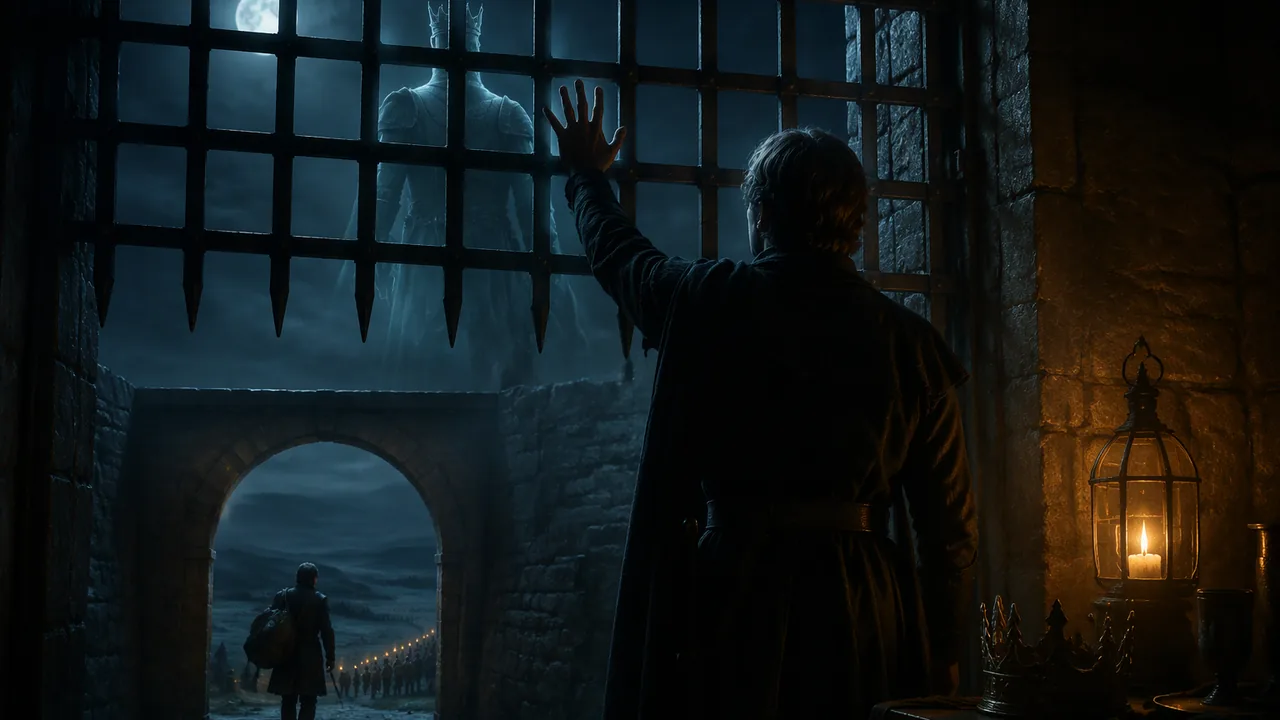
analyze how Shakespeare develops and relates the characters and plots of Act 1, especially through foils and parallel parent-and-child scenes, so that the Ghost’s command arrives already shadowed by delay.
Instruction
Hamlet is a revenge play in which the revenge takes five acts. In Act 1 the Ghost of Hamlet’s father tells him that his brother Claudius murdered him, took the crown, and married his widow, Gertrude. Hamlet swears to act at once. Readers have argued for four centuries about why he does not. This lesson gives you a way into the argument through Act 1 alone: look at how Shakespeare builds the opening, because the delay is designed before it begins.
The situation. The play opens at midnight on the castle walls, with sentries who cannot see who is approaching (“Who’s there?”) and a figure in armor that looks like the dead King and will not speak. Denmark has a new king, a hurried royal wedding, and a threat from Norway. Hamlet, a student kept home from Wittenberg, is grieving and disgusted before the Ghost ever speaks to him: his first soliloquy wishes his flesh would melt away and condemns his mother for remarrying within two months. It ends not in a plan but in silence: “But break, my heart, for I must hold my tongue.”
Foils. A foil is a character whose situation mirrors another’s so that the differences stand out. Act 1 introduces two. Young Fortinbras of Norway, “hot and full,” has gathered “a list of lawless resolutes” to win back the lands his father lost to Hamlet’s father: a son who answers a father’s death with an army. Laertes, Polonius’s son, asks the King’s leave to return to France and gets it at once, while Hamlet is refused leave to go back to school. 11-12.RL.2.D asks you to analyze the impact of an author’s choices about how to develop and relate the elements of a drama. Set side by side, these sons make Hamlet’s situation readable: one acts at once, one moves freely, and Hamlet is held in place. More foils will arrive as the play goes on.
Parents who give orders. Act 1 is built from scenes in which a parent tells a child what to do. In scene 2 Claudius asks Hamlet to think of him “As of a father” and to stay in Denmark, and Hamlet answers his mother, “I shall in all my best obey you, madam.” In scene 3 Polonius sends Laertes off with a string of precepts (“Give thy thoughts no tongue”) and then orders Ophelia to stop speaking with Hamlet; she answers, “I shall obey, my lord.” In scene 5 a dead father gives his son a single commandment: “Revenge his foul and most unnatural murder,” and then, “Remember me.” Placing these scenes side by side is a choice about relating plots. Ophelia’s obedience and Hamlet’s oath are both promises to a father, and the rest of the play tests what each costs.
The seeds of delay. Hamlet answers the Ghost by promising to “sweep to my revenge” with “wings as swift / As meditation or the thoughts of love,” an odd image of speed, since meditation is thought. Minutes later, after making his friends swear secrecy, he warns them he may “put an antic disposition on,” and he ends the act with a groan rather than a battle cry: “The time is out of joint. O cursed spite, / That ever I was born to set it right.” He has also already asked the question that will slow him: is the figure “a spirit of health or goblin damn’d”? Strong readings do not name one cause for the delay; they notice that the play has planted several before Act 1 is over.
Reading the language (11-12.RL.1.B / 11-12.RI.1.B). Use context first. When Hamlet tells his friends “It is an honest ghost,” honest means genuine, telling the truth; later in the play the same word is used of women to mean chaste. Note such words for the Language Lab.
Reading complex text (11-12.RL.3.D). Read the assigned scenes with a public-domain audio recording at first, then alone. Keep a scene log: one line for what happens, one for what Hamlet learns, one quotation.
Your task. Build a character and plot web for Act 1 showing the two foils and the parent-and-child scenes, then annotate one soliloquy for how Hamlet reasons.
📖 Before this lesson, read: Hamlet, Act 1
The reading opens over the lesson; close it to come back to exactly where you were.
Reading: Act 1 up close: two foils, two soliloquies and a worked model
William Shakespeare, Hamlet (c. 1600), modern-spelling text as published by Project Gutenberg, eBook #1524 (https://www.gutenberg.org/ebooks/1524), retrieved 2026-09-26. Cited by act and scene; line numbers vary between editions, so none are given. · SLS original; quoted passages are public domain (William Shakespeare, Hamlet)
Passages for the foil map and the soliloquy annotation. Quotations are copied from the source and checked verbatim; the framing and the model are SLS original.
Act 1 is assigned in full in the reading card above. Everything in a quotation block below is Shakespeare’s own text, copied from the source named in the note; the commentary around it is SLS original. Use it to build the character and plot web and to annotate one soliloquy.
Part 1. Two foils
A foil is a character whose situation mirrors another’s so that the differences stand out. Read these passages beside Hamlet’s own situation.
Fortinbras, as Horatio describes him (Act 1.1)
Now, sir, young Fortinbras,
Of unimproved mettle, hot and full,
Hath in the skirts of Norway, here and there,
Shark’d up a list of lawless resolutes,
For food and diet, to some enterprise
That hath a stomach in’t; which is no other,
As it doth well appear unto our state,
But to recover of us by strong hand
And terms compulsatory, those foresaid lands
So by his father lost.
Laertes asks leave to go; Hamlet is asked to stay (Act 1.2)
Your leave and favour to return to France,
From whence though willingly I came to Denmark
To show my duty in your coronation;
For your intent
In going back to school in Wittenberg,
It is most retrograde to our desire:
Polonius sends Laertes off (Act 1.3)
Give thy thoughts no tongue,
Nor any unproportion’d thought his act.
This above all: to thine own self be true;
And it must follow, as the night the day,
Thou canst not then be false to any man.
In Act 1 Laertes still has a living father, and he is free to go; Hamlet has a dead one and is kept at court. Keep Laertes on your web: the foil sharpens once he too has a father to avenge.
Part 2. Two soliloquies
Choose one for the annotation. The first comes before Hamlet has heard of the Ghost; the second comes the moment the Ghost leaves him.
Soliloquy 1 (Act 1.2): “O that this too too solid flesh”
O that this too too solid flesh would melt,
Thaw, and resolve itself into a dew!
Or that the Everlasting had not fix’d
His canon ’gainst self-slaughter. O God! O God!
How weary, stale, flat, and unprofitable
Seem to me all the uses of this world!
Fie on’t! Oh fie! ’tis an unweeded garden
That grows to seed; things rank and gross in nature
Possess it merely. That it should come to this!
But two months dead—nay, not so much, not two:
So excellent a king; that was to this
Hyperion to a satyr; so loving to my mother,
That he might not beteem the winds of heaven
Visit her face too roughly. Heaven and earth!
Must I remember? Why, she would hang on him
As if increase of appetite had grown
By what it fed on; and yet, within a month—
Let me not think on’t—Frailty, thy name is woman!
A little month, or ere those shoes were old
With which she followed my poor father’s body
Like Niobe, all tears.—Why she, even she—
O God! A beast that wants discourse of reason
Would have mourn’d longer,—married with mine uncle,
My father’s brother; but no more like my father
Than I to Hercules. Within a month,
Ere yet the salt of most unrighteous tears
Had left the flushing in her galled eyes,
She married. O most wicked speed, to post
With such dexterity to incestuous sheets!
It is not, nor it cannot come to good.
But break, my heart, for I must hold my tongue.
Soliloquy 2 (Act 1.5): “O all you host of heaven”
O all you host of heaven! O earth! What else?
And shall I couple hell? O, fie! Hold, my heart;
And you, my sinews, grow not instant old,
But bear me stiffly up. Remember thee?
Ay, thou poor ghost, while memory holds a seat
In this distracted globe. Remember thee?
Yea, from the table of my memory
I’ll wipe away all trivial fond records,
All saws of books, all forms, all pressures past,
That youth and observation copied there;
And thy commandment all alone shall live
Within the book and volume of my brain,
Unmix’d with baser matter. Yes, by heaven!
O most pernicious woman!
O villain, villain, smiling damned villain!
My tables. Meet it is I set it down,
That one may smile, and smile, and be a villain!
At least I am sure it may be so in Denmark.
Part 3. The oath and the warning (Act 1.5)
Here, as before, never, so help you mercy,
How strange or odd soe’er I bear myself,—
As I perchance hereafter shall think meet
To put an antic disposition on—
The time is out of joint. O cursed spite,
That ever I was born to set it right.
Part 4. A worked model
One row of the character and plot web (SLS original). Foil: Fortinbras. What he shows: a son who answers a father’s death and lost lands at once, by gathering men and marching. What that does to Hamlet’s position: it shows that a prince in his situation could act openly, and it makes Hamlet’s private grief look like inaction even before the Ghost speaks. Plot connection: in scene 2 Claudius sends ambassadors to Norway to stop him, so the Norway plot runs beside the Danish one and will return.
Annotating a soliloquy, step by step (SLS original, using Soliloquy 1). Number the sentences. Then answer four questions for each: what does Hamlet want or feel here? What reason does he give? What does he do with the reason, accept it, push it away or break off? What word carries the most weight? Applied to the first sentences: Hamlet wishes his body would dissolve (feeling); he says only that God has forbidden self-slaughter (the reason, which he accepts); he then turns to the world as an unweeded garden (a shift from himself to the world); and the speech ends with a decision not to speak: “I must hold my tongue.” Notice that the reasoning ends in silence, not action. Then repeat for Soliloquy 2, where Hamlet promises to wipe his memory clean of everything but the Ghost’s commandment, and ask what he does in the very next lines: he reaches for his writing tables and sets something down.
Checklist for the paragraph on delay. Name one sign of delay that Act 1 already plants, quote the words, and say what in the same scene pulls against it. In scene 5, for example, Hamlet promises to sweep to his revenge, then spends the rest of the scene on oaths of secrecy and a warning about the strange manner he may put on.
Formative check
Work through these before moving on. They are not graded — they tell you whether the standard below has landed yet.
Act 1 introduces Fortinbras, who gathers an army to win back the lands his dead father lost, and Laertes, who is free to leave Denmark. Before you read on: what do you expect Shakespeare uses them for?
When the Ghost charges Hamlet to take revenge, what does it forbid him to do?
Hamlet ends Act 1 eager and certain, with no sign of reluctance about the task the Ghost has given him.
Build your Act 1 character and plot web: Fortinbras and Laertes as foils and what each shows about Hamlet; then the parent-and-child scenes (Claudius and Gertrude with Hamlet in scene 2, Polonius with Laertes and Ophelia in scene 3, the Ghost with Hamlet in scene 5) and what each parent demands. Then annotate one soliloquy (“O that this too too solid flesh” in scene 2, or “O all you host of heaven” in scene 5) for the steps in Hamlet’s reasoning, and write a paragraph on what it suggests about how he will carry out the Ghost’s command.
How confident are you that you can analyze how Shakespeare uses foils and parallel scenes in Act 1 to set up Hamlet’s delay?
Printable: Unit 1 Student Workbook
Every organizer for this unit in one booklet — the reading schedule, the vocabulary pages, all five lesson organizers, the peer review sheet and the scoring rubric. Print it before the unit starts and bring the page to each lesson.
Read the complete work: Hamlet
This unit only close-reads part of the text in any one lesson. The complete, unabridged public-domain text of Hamlet is also here as a single printable PDF, for anyone who wants to read ahead or read it straight through.
Hamlet, Act 1
Hamlet, Act 1, Scene 1: Elsinore. A platform before the Castle. Bridge summary — not the primary text
This is a short recap written for this course, not William Shakespeare’s own words, so you can follow the story between close-reading lessons.
{summary}Hamlet, Act 1, Scene 2: Elsinore. A room of state in the Castle.
Source: William Shakespeare, The Tragedy of Hamlet, Prince of Denmark (c. 1600), Project Gutenberg eBook #1524 (gutenberg.org) · Public domain
Enter Claudius King of Denmark, Gertrude the Queen, Hamlet, Polonius, Laertes, Voltemand, Cornelius, Lords and Attendant.
KING.
Though yet of Hamlet our dear brother’s death
The memory be green, and that it us befitted
To bear our hearts in grief, and our whole kingdom
To be contracted in one brow of woe;
Yet so far hath discretion fought with nature
That we with wisest sorrow think on him,
Together with remembrance of ourselves.
Therefore our sometime sister, now our queen,
Th’imperial jointress to this warlike state,
Have we, as ’twere with a defeated joy,
With one auspicious and one dropping eye,
With mirth in funeral, and with dirge in marriage,
In equal scale weighing delight and dole,
Taken to wife; nor have we herein barr’d
Your better wisdoms, which have freely gone
With this affair along. For all, our thanks.
Now follows, that you know young Fortinbras,
Holding a weak supposal of our worth,
Or thinking by our late dear brother’s death
Our state to be disjoint and out of frame,
Colleagued with this dream of his advantage,
He hath not fail’d to pester us with message,
Importing the surrender of those lands
Lost by his father, with all bonds of law,
To our most valiant brother. So much for him.
Now for ourself and for this time of meeting:
Thus much the business is: we have here writ
To Norway, uncle of young Fortinbras,
Who, impotent and bed-rid, scarcely hears
Of this his nephew’s purpose, to suppress
His further gait herein; in that the levies,
The lists, and full proportions are all made
Out of his subject: and we here dispatch
You, good Cornelius, and you, Voltemand,
For bearers of this greeting to old Norway,
Giving to you no further personal power
To business with the King, more than the scope
Of these dilated articles allow.
Farewell; and let your haste commend your duty.
CORNELIUS and VOLTEMAND. In that, and all things, will we show our duty.
KING.
We doubt it nothing: heartily farewell.
[Exeunt Voltemand and Cornelius.]
And now, Laertes, what’s the news with you? You told us of some suit. What is’t, Laertes? You cannot speak of reason to the Dane, And lose your voice. What wouldst thou beg, Laertes, That shall not be my offer, not thy asking? The head is not more native to the heart, The hand more instrumental to the mouth, Than is the throne of Denmark to thy father. What wouldst thou have, Laertes?
LAERTES.
Dread my lord,
Your leave and favour to return to France,
From whence though willingly I came to Denmark
To show my duty in your coronation;
Yet now I must confess, that duty done,
My thoughts and wishes bend again toward France,
And bow them to your gracious leave and pardon.
KING.
Have you your father’s leave? What says Polonius?
POLONIUS.
He hath, my lord, wrung from me my slow leave
By laboursome petition; and at last
Upon his will I seal’d my hard consent.
I do beseech you give him leave to go.
KING.
Take thy fair hour, Laertes; time be thine,
And thy best graces spend it at thy will!
But now, my cousin Hamlet, and my son—
HAMLET.
[Aside.] A little more than kin, and less than kind.
KING.
How is it that the clouds still hang on you?
HAMLET.
Not so, my lord, I am too much i’ the sun.
QUEEN.
Good Hamlet, cast thy nighted colour off,
And let thine eye look like a friend on Denmark.
Do not for ever with thy vailed lids
Seek for thy noble father in the dust.
Thou know’st ’tis common, all that lives must die,
Passing through nature to eternity.
HAMLET.
Ay, madam, it is common.
QUEEN.
If it be,
Why seems it so particular with thee?
HAMLET.
Seems, madam! Nay, it is; I know not seems.
’Tis not alone my inky cloak, good mother,
Nor customary suits of solemn black,
Nor windy suspiration of forc’d breath,
No, nor the fruitful river in the eye,
Nor the dejected haviour of the visage,
Together with all forms, moods, shows of grief,
That can denote me truly. These indeed seem,
For they are actions that a man might play;
But I have that within which passeth show;
These but the trappings and the suits of woe.
KING.
’Tis sweet and commendable in your nature, Hamlet,
To give these mourning duties to your father;
But you must know, your father lost a father,
That father lost, lost his, and the survivor bound
In filial obligation, for some term
To do obsequious sorrow. But to persevere
In obstinate condolement is a course
Of impious stubbornness. ’Tis unmanly grief,
It shows a will most incorrect to heaven,
A heart unfortified, a mind impatient,
An understanding simple and unschool’d;
For what we know must be, and is as common
As any the most vulgar thing to sense,
Why should we in our peevish opposition
Take it to heart? Fie, ’tis a fault to heaven,
A fault against the dead, a fault to nature,
To reason most absurd, whose common theme
Is death of fathers, and who still hath cried,
From the first corse till he that died today,
‘This must be so.’ We pray you throw to earth
This unprevailing woe, and think of us
As of a father; for let the world take note
You are the most immediate to our throne,
And with no less nobility of love
Than that which dearest father bears his son
Do I impart toward you. For your intent
In going back to school in Wittenberg,
It is most retrograde to our desire:
And we beseech you bend you to remain
Here in the cheer and comfort of our eye,
Our chiefest courtier, cousin, and our son.
QUEEN.
Let not thy mother lose her prayers, Hamlet.
I pray thee stay with us; go not to Wittenberg.
HAMLET.
I shall in all my best obey you, madam.
KING.
Why, ’tis a loving and a fair reply.
Be as ourself in Denmark. Madam, come;
This gentle and unforc’d accord of Hamlet
Sits smiling to my heart; in grace whereof,
No jocund health that Denmark drinks today
But the great cannon to the clouds shall tell,
And the King’s rouse the heaven shall bruit again,
Re-speaking earthly thunder. Come away.
[Exeunt all but Hamlet.]
HAMLET.
O that this too too solid flesh would melt,
Thaw, and resolve itself into a dew!
Or that the Everlasting had not fix’d
His canon ’gainst self-slaughter. O God! O God!
How weary, stale, flat, and unprofitable
Seem to me all the uses of this world!
Fie on’t! Oh fie! ’tis an unweeded garden
That grows to seed; things rank and gross in nature
Possess it merely. That it should come to this!
But two months dead—nay, not so much, not two:
So excellent a king; that was to this
Hyperion to a satyr; so loving to my mother,
That he might not beteem the winds of heaven
Visit her face too roughly. Heaven and earth!
Must I remember? Why, she would hang on him
As if increase of appetite had grown
By what it fed on; and yet, within a month—
Let me not think on’t—Frailty, thy name is woman!
A little month, or ere those shoes were old
With which she followed my poor father’s body
Like Niobe, all tears.—Why she, even she—
O God! A beast that wants discourse of reason
Would have mourn’d longer,—married with mine uncle,
My father’s brother; but no more like my father
Than I to Hercules. Within a month,
Ere yet the salt of most unrighteous tears
Had left the flushing in her galled eyes,
She married. O most wicked speed, to post
With such dexterity to incestuous sheets!
It is not, nor it cannot come to good.
But break, my heart, for I must hold my tongue.
Enter Horatio, Marcellus and Barnardo.
HORATIO.
Hail to your lordship!
HAMLET.
I am glad to see you well:
Horatio, or I do forget myself.
HORATIO.
The same, my lord,
And your poor servant ever.
HAMLET.
Sir, my good friend;
I’ll change that name with you:
And what make you from Wittenberg, Horatio?—
Marcellus?
MARCELLUS.
My good lord.
HAMLET.
I am very glad to see you.—Good even, sir.—
But what, in faith, make you from Wittenberg?
HORATIO.
A truant disposition, good my lord.
HAMLET.
I would not hear your enemy say so;
Nor shall you do my ear that violence,
To make it truster of your own report
Against yourself. I know you are no truant.
But what is your affair in Elsinore?
We’ll teach you to drink deep ere you depart.
HORATIO.
My lord, I came to see your father’s funeral.
HAMLET.
I prithee do not mock me, fellow-student.
I think it was to see my mother’s wedding.
HORATIO.
Indeed, my lord, it follow’d hard upon.
HAMLET.
Thrift, thrift, Horatio! The funeral bak’d meats
Did coldly furnish forth the marriage tables.
Would I had met my dearest foe in heaven
Or ever I had seen that day, Horatio.
My father,—methinks I see my father.
HORATIO.
Where, my lord?
HAMLET.
In my mind’s eye, Horatio.
HORATIO.
I saw him once; he was a goodly king.
HAMLET.
He was a man, take him for all in all,
I shall not look upon his like again.
HORATIO.
My lord, I think I saw him yesternight.
HAMLET.
Saw? Who?
HORATIO.
My lord, the King your father.
HAMLET.
The King my father!
HORATIO.
Season your admiration for a while
With an attent ear, till I may deliver
Upon the witness of these gentlemen
This marvel to you.
HAMLET.
For God’s love let me hear.
HORATIO.
Two nights together had these gentlemen,
Marcellus and Barnardo, on their watch
In the dead waste and middle of the night,
Been thus encounter’d. A figure like your father,
Armed at point exactly, cap-à-pie,
Appears before them, and with solemn march
Goes slow and stately by them: thrice he walk’d
By their oppress’d and fear-surprised eyes,
Within his truncheon’s length; whilst they, distill’d
Almost to jelly with the act of fear,
Stand dumb, and speak not to him. This to me
In dreadful secrecy impart they did,
And I with them the third night kept the watch,
Where, as they had deliver’d, both in time,
Form of the thing, each word made true and good,
The apparition comes. I knew your father;
These hands are not more like.
HAMLET.
But where was this?
MARCELLUS.
My lord, upon the platform where we watch.
HAMLET.
Did you not speak to it?
HORATIO.
My lord, I did;
But answer made it none: yet once methought
It lifted up it head, and did address
Itself to motion, like as it would speak.
But even then the morning cock crew loud,
And at the sound it shrunk in haste away,
And vanish’d from our sight.
HAMLET.
’Tis very strange.
HORATIO.
As I do live, my honour’d lord, ’tis true;
And we did think it writ down in our duty
To let you know of it.
HAMLET.
Indeed, indeed, sirs, but this troubles me.
Hold you the watch tonight?
MARCELLUS and BARNARDO. We do, my lord.
HAMLET.
Arm’d, say you?
Both. Arm’d, my lord.
HAMLET.
From top to toe?
BOTH.
My lord, from head to foot.
HAMLET.
Then saw you not his face?
HORATIO.
O yes, my lord, he wore his beaver up.
HAMLET.
What, look’d he frowningly?
HORATIO.
A countenance more in sorrow than in anger.
HAMLET.
Pale, or red?
HORATIO.
Nay, very pale.
HAMLET.
And fix’d his eyes upon you?
HORATIO.
Most constantly.
HAMLET.
I would I had been there.
HORATIO.
It would have much amaz’d you.
HAMLET.
Very like, very like. Stay’d it long?
HORATIO.
While one with moderate haste might tell a hundred.
MARCELLUS and BARNARDO. Longer, longer.
HORATIO.
Not when I saw’t.
HAMLET.
His beard was grizzled, no?
HORATIO.
It was, as I have seen it in his life,
A sable silver’d.
HAMLET.
I will watch tonight;
Perchance ’twill walk again.
HORATIO.
I warrant you it will.
HAMLET.
If it assume my noble father’s person,
I’ll speak to it, though hell itself should gape
And bid me hold my peace. I pray you all,
If you have hitherto conceal’d this sight,
Let it be tenable in your silence still;
And whatsoever else shall hap tonight,
Give it an understanding, but no tongue.
I will requite your loves. So, fare ye well.
Upon the platform ’twixt eleven and twelve,
I’ll visit you.
ALL.
Our duty to your honour.
HAMLET.
Your loves, as mine to you: farewell.
[Exeunt Horatio, Marcellus and Barnardo.]
My father’s spirit in arms! All is not well; I doubt some foul play: would the night were come! Till then sit still, my soul: foul deeds will rise, Though all the earth o’erwhelm them, to men’s eyes.
[Exit.]
Hamlet, Act 1, Scene 3: A room in Polonius’s house. Bridge summary — not the primary text
This is a short recap written for this course, not William Shakespeare’s own words, so you can follow the story between close-reading lessons.
{summary}Hamlet, Act 1, Scene 4: The platform. Bridge summary — not the primary text
This is a short recap written for this course, not William Shakespeare’s own words, so you can follow the story between close-reading lessons.
{summary}Hamlet, Act 1, Scene 5: A more remote part of the Castle.
Source: William Shakespeare, The Tragedy of Hamlet, Prince of Denmark (c. 1600), Project Gutenberg eBook #1524 (gutenberg.org) · Public domain
Enter Ghost and Hamlet.
HAMLET.
Whither wilt thou lead me? Speak, I’ll go no further.
GHOST.
Mark me.
HAMLET.
I will.
GHOST.
My hour is almost come,
When I to sulph’rous and tormenting flames
Must render up myself.
HAMLET.
Alas, poor ghost!
GHOST.
Pity me not, but lend thy serious hearing
To what I shall unfold.
HAMLET.
Speak, I am bound to hear.
GHOST.
So art thou to revenge, when thou shalt hear.
HAMLET.
What?
GHOST.
I am thy father’s spirit,
Doom’d for a certain term to walk the night,
And for the day confin’d to fast in fires,
Till the foul crimes done in my days of nature
Are burnt and purg’d away. But that I am forbid
To tell the secrets of my prison-house,
I could a tale unfold whose lightest word
Would harrow up thy soul; freeze thy young blood,
Make thy two eyes like stars start from their spheres,
Thy knotted and combined locks to part,
And each particular hair to stand on end
Like quills upon the fretful porpentine.
But this eternal blazon must not be
To ears of flesh and blood. List, list, O, list!
If thou didst ever thy dear father love—
HAMLET.
O God!
GHOST.
Revenge his foul and most unnatural murder.
HAMLET.
Murder!
GHOST.
Murder most foul, as in the best it is;
But this most foul, strange, and unnatural.
HAMLET.
Haste me to know’t, that I, with wings as swift
As meditation or the thoughts of love
May sweep to my revenge.
GHOST.
I find thee apt;
And duller shouldst thou be than the fat weed
That rots itself in ease on Lethe wharf,
Wouldst thou not stir in this. Now, Hamlet, hear.
’Tis given out that, sleeping in my orchard,
A serpent stung me; so the whole ear of Denmark
Is by a forged process of my death
Rankly abus’d; but know, thou noble youth,
The serpent that did sting thy father’s life
Now wears his crown.
HAMLET.
O my prophetic soul!
Mine uncle!
GHOST.
Ay, that incestuous, that adulterate beast,
With witchcraft of his wit, with traitorous gifts,—
O wicked wit, and gifts, that have the power
So to seduce!—won to his shameful lust
The will of my most seeming-virtuous queen.
O Hamlet, what a falling off was there,
From me, whose love was of that dignity
That it went hand in hand even with the vow
I made to her in marriage; and to decline
Upon a wretch whose natural gifts were poor
To those of mine. But virtue, as it never will be mov’d,
Though lewdness court it in a shape of heaven;
So lust, though to a radiant angel link’d,
Will sate itself in a celestial bed
And prey on garbage.
But soft! methinks I scent the morning air;
Brief let me be. Sleeping within my orchard,
My custom always of the afternoon,
Upon my secure hour thy uncle stole
With juice of cursed hebenon in a vial,
And in the porches of my ears did pour
The leperous distilment, whose effect
Holds such an enmity with blood of man
That swift as quicksilver it courses through
The natural gates and alleys of the body;
And with a sudden vigour it doth posset
And curd, like eager droppings into milk,
The thin and wholesome blood. So did it mine;
And a most instant tetter bark’d about,
Most lazar-like, with vile and loathsome crust
All my smooth body.
Thus was I, sleeping, by a brother’s hand,
Of life, of crown, of queen at once dispatch’d:
Cut off even in the blossoms of my sin,
Unhous’led, disappointed, unanel’d;
No reckoning made, but sent to my account
With all my imperfections on my head.
O horrible! O horrible! most horrible!
If thou hast nature in thee, bear it not;
Let not the royal bed of Denmark be
A couch for luxury and damned incest.
But howsoever thou pursu’st this act,
Taint not thy mind, nor let thy soul contrive
Against thy mother aught; leave her to heaven,
And to those thorns that in her bosom lodge,
To prick and sting her. Fare thee well at once!
The glow-worm shows the matin to be near,
And ’gins to pale his uneffectual fire.
Adieu, adieu, adieu. Remember me.
[Exit.]
HAMLET.
O all you host of heaven! O earth! What else?
And shall I couple hell? O, fie! Hold, my heart;
And you, my sinews, grow not instant old,
But bear me stiffly up. Remember thee?
Ay, thou poor ghost, while memory holds a seat
In this distracted globe. Remember thee?
Yea, from the table of my memory
I’ll wipe away all trivial fond records,
All saws of books, all forms, all pressures past,
That youth and observation copied there;
And thy commandment all alone shall live
Within the book and volume of my brain,
Unmix’d with baser matter. Yes, by heaven!
O most pernicious woman!
O villain, villain, smiling damned villain!
My tables. Meet it is I set it down,
That one may smile, and smile, and be a villain!
At least I am sure it may be so in Denmark.
[Writing.]
So, uncle, there you are. Now to my word; It is ‘Adieu, adieu, remember me.’ I have sworn’t.
HORATIO and MARCELLUS. [Within.] My lord, my lord.
MARCELLUS.
[Within.] Lord Hamlet.
HORATIO.
[Within.] Heaven secure him.
HAMLET.
So be it!
MARCELLUS.
[Within.] Illo, ho, ho, my lord!
HAMLET.
Hillo, ho, ho, boy! Come, bird, come.
Enter Horatio and Marcellus.
MARCELLUS.
How is’t, my noble lord?
HORATIO.
What news, my lord?
HAMLET.
O, wonderful!
HORATIO.
Good my lord, tell it.
HAMLET.
No, you’ll reveal it.
HORATIO.
Not I, my lord, by heaven.
MARCELLUS.
Nor I, my lord.
HAMLET.
How say you then, would heart of man once think it?—
But you’ll be secret?
HORATIO and MARCELLUS. Ay, by heaven, my lord.
HAMLET.
There’s ne’er a villain dwelling in all Denmark
But he’s an arrant knave.
HORATIO.
There needs no ghost, my lord, come from the grave
To tell us this.
HAMLET.
Why, right; you are i’ the right;
And so, without more circumstance at all,
I hold it fit that we shake hands and part:
You, as your business and desire shall point you,—
For every man hath business and desire,
Such as it is;—and for my own poor part,
Look you, I’ll go pray.
HORATIO.
These are but wild and whirling words, my lord.
HAMLET.
I’m sorry they offend you, heartily;
Yes faith, heartily.
HORATIO.
There’s no offence, my lord.
HAMLET.
Yes, by Saint Patrick, but there is, Horatio,
And much offence too. Touching this vision here,
It is an honest ghost, that let me tell you.
For your desire to know what is between us,
O’ermaster’t as you may. And now, good friends,
As you are friends, scholars, and soldiers,
Give me one poor request.
HORATIO.
What is’t, my lord? We will.
HAMLET.
Never make known what you have seen tonight.
HORATIO and MARCELLUS. My lord, we will not.
HAMLET.
Nay, but swear’t.
HORATIO.
In faith, my lord, not I.
MARCELLUS.
Nor I, my lord, in faith.
HAMLET.
Upon my sword.
MARCELLUS.
We have sworn, my lord, already.
HAMLET.
Indeed, upon my sword, indeed.
GHOST.
[Cries under the stage.] Swear.
HAMLET.
Ha, ha boy, sayst thou so? Art thou there, truepenny?
Come on, you hear this fellow in the cellarage.
Consent to swear.
HORATIO.
Propose the oath, my lord.
HAMLET.
Never to speak of this that you have seen.
Swear by my sword.
GHOST.
[Beneath.] Swear.
HAMLET.
Hic et ubique? Then we’ll shift our ground.
Come hither, gentlemen,
And lay your hands again upon my sword.
Never to speak of this that you have heard.
Swear by my sword.
GHOST.
[Beneath.] Swear.
HAMLET.
Well said, old mole! Canst work i’ th’earth so fast?
A worthy pioner! Once more remove, good friends.
HORATIO.
O day and night, but this is wondrous strange.
HAMLET.
And therefore as a stranger give it welcome.
There are more things in heaven and earth, Horatio,
Than are dreamt of in your philosophy. But come,
Here, as before, never, so help you mercy,
How strange or odd soe’er I bear myself,—
As I perchance hereafter shall think meet
To put an antic disposition on—
That you, at such times seeing me, never shall,
With arms encumber’d thus, or this head-shake,
Or by pronouncing of some doubtful phrase,
As ‘Well, we know’, or ‘We could and if we would’,
Or ‘If we list to speak’; or ‘There be and if they might’,
Or such ambiguous giving out, to note
That you know aught of me:—this not to do.
So grace and mercy at your most need help you,
Swear.
GHOST.
[Beneath.] Swear.
HAMLET.
Rest, rest, perturbed spirit. So, gentlemen,
With all my love I do commend me to you;
And what so poor a man as Hamlet is
May do t’express his love and friending to you,
God willing, shall not lack. Let us go in together,
And still your fingers on your lips, I pray.
The time is out of joint. O cursed spite,
That ever I was born to set it right.
Nay, come, let’s go together.
[Exeunt.]