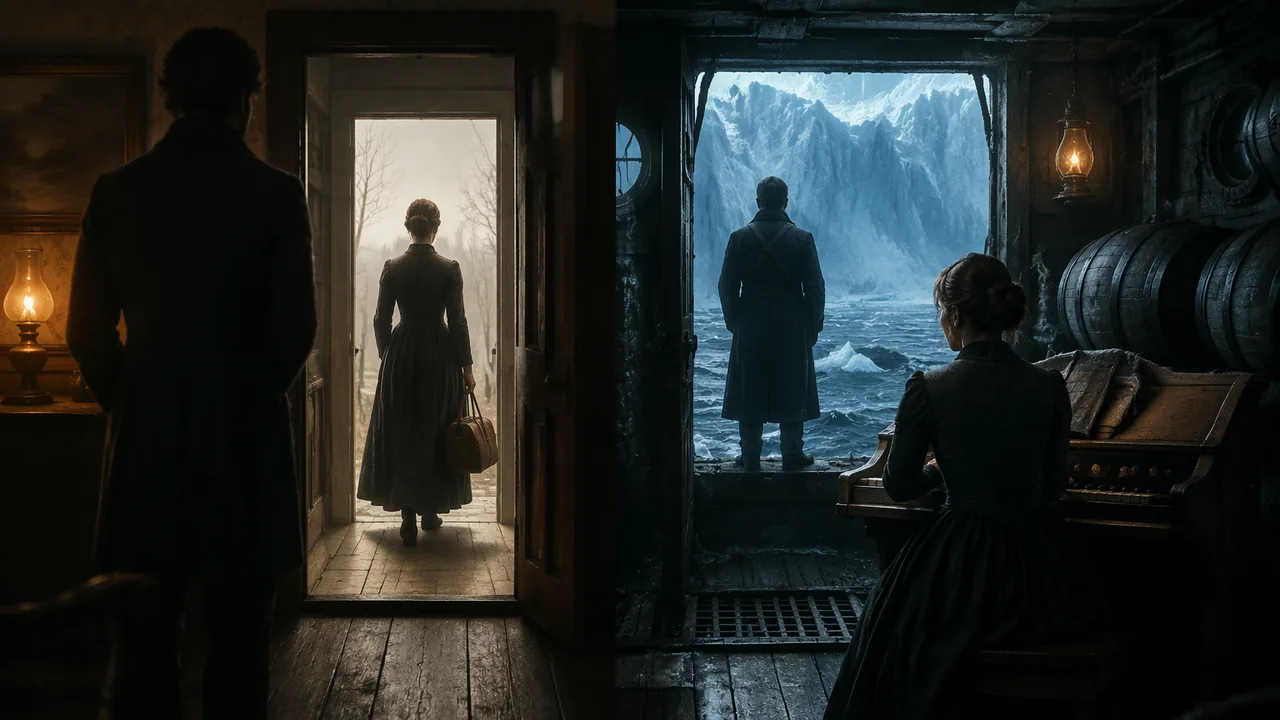
compare how O’Neill’s Ile and Ibsen’s A Doll’s House treat a wife confined by her husband’s pride, and synthesize the seminar’s positions on what the difference reveals.
Instruction
Thirty-eight years after A Doll’s House, a young American playwright wrote a one-act play about another wife in another house she cannot leave. Eugene O’Neill’s Ile was first performed in 1917 by the Provincetown Players, the small theater company in Massachusetts and New York that launched his career and much of modern American drama. O’Neill later became the first American playwright to win the Nobel Prize in Literature. This seminar reads Ile beside Ibsen, and asks what an American dramatist of the next generation did with Ibsen’s problem.
The play. Ile takes place in the captain’s cabin of a whaling ship locked in Arctic ice in the 1890s. The voyage has run far past its term, the crew’s contracts have expired, and the men are near mutiny. Captain David Keeney will not turn for home, because his hold is not yet full of ile — the sailors’ pronunciation of oil, the whale oil that is the voyage’s reason for being. His wife, Annie, came aboard because she wanted to share his life and see the sea she had imagined as romantic. After a year of ice and silence she is close to breaking. She begs him to take her home. For a moment he agrees. Then word comes that the ice is breaking up to the north, and with open water ahead he goes back on his word. The play ends with Annie playing a small organ wildly, her mind gone, as Keeney returns to the hunt. (This is a summary; read the full play, which is short enough to read in one sitting.)
Two husbands’ pride. Torvald’s pride is in respectability: what others will think. Keeney’s is in his reputation among whaling captains: he has never come home without a full ship, and he says he will not now. Both men love their wives in some sense; both put an image of themselves first.
Two endings. Nora leaves. Annie cannot. The door that Nora shuts is not available on a ship in the ice. O’Neill’s ending is not a discussion but a collapse. Is O’Neill answering Ibsen — saying that leaving is a privilege not every trapped woman has? Or is he writing a different kind of play, a naturalistic tragedy in which environment and obsession, not argument, decide the outcome? That is the seminar question.
American literature in its period (11-12.RL.3.B). 11-12.RL.3.B asks you to demonstrate knowledge of foundational American literature of the early twentieth century, including how texts from the same period treat similar themes. The Provincetown Players were staging plays about marriage and confinement in these same years; Susan Glaspell’s Trifles (1916), written for the same company, is an optional companion text for students who want a second American play. Note, too, how O’Neill uses American material — New England whaling, the dialect of its crews — that Ibsen could not.
The seminar. Prepare two quotations from each play. 11-12.SL.1.A asks you to set goals and roles: a facilitator, a timekeeper, and a text-checker who asks “where does it say that?” 11-12.SL.1.C asks you to synthesize all sides and resolve contradictions where possible. Close the seminar by naming what remains unresolved.
Care. Both plays depict mental distress. Discuss the characters as dramatic constructions; you will not be asked to share personal or family experience.
📖 Before this lesson, read: A Doll’s House, The whole play (Acts I-III)
The reading opens over the lesson; close it to come back to exactly where you were.
Reading: Passages from Ile and A Doll’s House, with seminar positions
Eugene O’Neill, Ile, in The Moon of the Caribbees and Six Other Plays of the Sea (New York: Boni and Liveright, 1919), James Huneker, Iconoclasts: A Book of Dramatists (New York: Scribner, 1905), chapter VII, Project Gutenberg 47546 (https://www.gutenberg.org/ebooks/47546), retrieved 2026-09-26. Eugene O’Neill, Ile, pp. 117-143; OCR text of the scanned book, https://archive.org/download/moonofthecaribbe00oneirich/moonofthecaribbe00oneirich_djvu.txt (Internet Archive, retrieved 2026-09-26), with running heads removed and OCR errors repaired; page numbers are shown as [p. N]. Henrik Ibsen, A Doll’s House (1879), translated by R. Farquharson Sharp (1910), Project Gutenberg 2542 (https://www.gutenberg.org/ebooks/2542), retrieved 2026-09-26, cited by act. · SLS original; quoted passages are public domain (Eugene O’Neill, Ile, 1919; Henrik Ibsen, tr. R. Farquharson Sharp, 1910; James Huneker, 1905)
Prepare two quotations from each play. Then use the positions and stems to argue whether O’Neill is answering Ibsen or writing a different kind of play.
You need both plays in front of you to run this seminar. Ibsen is quoted from Sharp’s 1910 translation; O’Neill’s Ile is quoted from the 1919 printing, with the page numbers of that book in square brackets. The play’s phonetic spellings are O’Neill’s, and I have not changed them. The three seminar positions, the protocol, the stems and the model are SLS original. The positions are written for this seminar; they are not quotations from critics.
Part 1. Passages from Ile (1917 play; 1919 text)
The play takes place in Captain Keeney’s cabin on the steam whaler Atlantic Queen, in the ice of the Arctic in 1895. The crew has signed for two years, and the two years are up today.
A. Keeney’s rule: pride and the ile (pp. 128-129)
KEENEY — [His face clouding — rebukingly but not severely] That’s my business, Mr. Slocum. I’ll thank you to steer a clear course o’ that. [A pause] The ice’ll break up soon to no’th’ard. I could see it startin’ to-day. And when it goes and we git some sun Annie’ll perk up. [Another pause — then he bursts forth] It ain’t the damned money what’s keepin’ me up in the Northern seas, Tom. But I can’t go back to Homeport with a measly four hundred barrel of ile. I’d die fust. I ain’t never come back home in all my days without a full ship. Ain’t that truth?
[p. 129] MATE — Yes, sir; but this voyage you been ice bound, an’
KEENEY — [Scornfully.] And d’you s’pose any of ’em would believe that — any o’ them skippers I’ve beaten voyage after voyage? Can’t you hear ’em laughin’ and sneerin’ — Tibbots ‘n’ Harris ‘n’ Simms and the rest — and all o’ Homeport makin’ fun o’ me? “Dave Keeney what boasts he’s the best whalin’ skipper out o’ Homeport comin’ back with a measly four hundred barrel of ile?” [The thought of this drives him into a frenzy, and he smashes his fist down on the marble top of the sideboard.] Hell! I got to git the ile, I tell you. How could I figger on this ice? It’s never been so bad before in the thirty year I been acomin’ here. And now it’s breakin’ up. In a couple o’ days it’ll be all gone. And they’s whale here, plenty of ’em. I know they is and I ain’t never gone wrong yit. I got to git the ile! I got to git it in spite of all hell, and by God, I ain’t agoin’ home till I do git it!
B. Why Annie came, and what she found (pp. 133-134)
MRS. KEENEY — [Hysterically.] All this horrible brutality, and these brutes of men, and this terrible ship, and this prison cell of a room, and the ice all around, and the silence. [After this outburst she calms down and wipes her eyes with her handkerchief]
KEENEY — [After a pause during which he looks down at her with a puzzled frown] Remember, I warn’t hankerin’ to have you come on this voyage, Annie.
MRS. KEENEY — I wanted to be with you, David, don’t you see? I didn’t want to wait back there in the house all alone as I’ve been doing these last six years since we were married — waiting, and watching, and fearing — with nothing to keep my mind occupied — not able to go back teaching school on account of being Dave Keeney’s wife. I used to dream of sailing on the great, wide, glorious ocean. I wanted to be by your side in the danger and vigorous life of it all. I wanted to see you the hero they make you out to be in Homeport. And instead [Her voice grows tremulous] All I find is ice and cold — and brutality! [Her voice breaks.]
[p. 134] KEENEY — I warned you what it’d be, Annie. “Whalin’ ain’t no ladies’ tea party,” I says to you, and “you better stay to home where you’ve got all your woman’s comforts.” [Shaking his head.] But you was so set on it.
C. Whose pride? Annie and Keeney disagree about his reason (pp. 135-136)
MRS. KEENEY — [Wildly.] Because it’s a stupid, stubborn reason. Oh, I heard you talking with the second mate. You’re afraid the other captains will sneer at you because you didn’t come back with a full ship. You want to live up to your silly reputation even if you do have to beat and starve men and drive me mad to do it.
[p. 136] KEENEY — [His jaw set stubbornly.] It ain’t that, Annie. Them skippers would never dare sneer to my face. It ain’t so much what any one’d say — but [He hesitates, struggling to express his meaning.] You see — I’ve always done it — since my first voyage as skipper. I always come back — with a full ship — and — it don’t seem right not to — somehow. I been always first whalin’ skipper out o’ Homeport, and Don’t you see my meaning Annie? [He glances at her. She is not looking at him but staring dully in front of her, not hearing a word he is saying.] Annie! [She comes to her self with a start] Best turn in, Annie, there’s a good woman. You ain’t well.
D. The plea, and the change of wind (pp. 139-141)
Annie’s plea is here. Keeney answers that he will do it, and turns for home. At that moment the Second Mate arrives with news of open water to the north. What follows begins with Annie’s next words.
MRS. KEENEY — [Wildly.] Then do this this once for my sake, for God’s sake — take me home ! It’s killing me, this life — the brutality and cold and horror of it. I’m going mad. I can feel the threat in the air. I can hear the silence threatening me — day after gray day and every day the same. I can’t bear it. [Sobbing.] I’ll go mad, I know I will. Take me home, David, if you love me as you say. I’m afraid. For the love of God, take me home! [She throws her arms around him, weeping against his shoulder. His face betrays the tremendous struggle going on within him. He holds her out at arm’s length, his expression softening. For a moment his shoulders sag, he becomes old, his iron spirit weakens as he looks at her tear-stained face.]
MRS. KEENEY — [With wild joy — kissing him.] God bless you for that, David! [He turns away from her silently and walks toward the companion-way. Just at that moment there is a clatter of footsteps on the stairs and the SECOND MATE enters the cabin.]
MATE — [Excitedly.] The ice is breakin’ up to no’the’ard, sir. There’s a clear passage through the floe, and clear water beyond, the lookout says. [KEENEY straightens himself like a man coming out of a trance. MRS. KEENEY looks at the MATE with terrified eyes.]
KEENEY — [Dazedly — trying to collect his thoughts.] A clear passage? To no’the’ard?
MATE — Yes, sir.
KEENEY — [His voice suddenly grim with determination.] Then get her ready and we’ll drive her through.
MATE — Aye, aye, sir.
MRS. KEENEY — [Appealingly.] David!
KEENEY — [Not heeding her.] Will the men turn to willin’ or must we drag ’em out?
MATE — They’ll turn to willin’ enough. You put the fear o’ God into ’em, sir. They’re meek as lambs.
KEENEY — Then drive ’em — both watches. [With [p. 141] grim determination.] They’s whale t’other side o’ this floe and we’re going to git ’em.
E. The ending (pp. 141-142)
KEENEY — [Ignoring this question — commandingly.] You ain’t well. Go and lay down a mite. [He starts for the door.] I got to git on deck. [He goes out. She cries after him in anguish:] David ! [A pause. She passes her hand across her eyes — then commences to laugh hysterically and goes to the organ. She sits down and starts to play wildly an old hymn. KEENEY reenters from the doorway to the deck and stands looking at her angrily. He comes over and grabs her roughly by the shoulder.]
KEENEY — Woman, what foolish mockin’ is this? [She laughs wildly and he starts back from her in [p. 142] alarm.] Annie! What is it? [She doesn’t answer him. KEENEY’S voice trembles.] Don’t you know me, Annie? [He puts both hands on her shoulders and turns her around so that he can look into her eyes. She stares up at him with a stupid expression, a vague smile on her lips. He stumbles away from her, and she commences softly to play the organ again.]
Part 2. Passages from A Doll’s House for the comparison
HELMER.
It’s shocking. This is how you would neglect your most sacred duties.NORA.
What do you consider my most sacred duties?HELMER.
Do I need to tell you that? Are they not your duties to your husband and your children?NORA.
I have other duties just as sacred.HELMER.
That you have not. What duties could those be?NORA.
Duties to myself.HELMER.
Before all else, you are a wife and a mother.NORA.
I don’t believe that any longer. I believe that before all else I am a reasonable human being, just as you are—or, at all events, that I must try and become one. I know quite well, Torvald, that most people would think you right, and that views of that kind are to be found in books; but I can no longer content myself with what most people say, or with what is found in books. I must think over things for myself and get to understand them.
NORA.
[taking her bag]. Ah, Torvald, the most wonderful thing of all would have to happen.HELMER.
Tell me what that would be!NORA.
Both you and I would have to be so changed that—. Oh, Torvald, I don’t believe any longer in wonderful things happening.HELMER.
But I will believe in it. Tell me! So changed that—?NORA.
That our life together would be a real wedlock. Goodbye. [She goes out through the hall.]HELMER.
[sinks down on a chair at the door and buries his face in his hands]. Nora! Nora! [Looks round, and rises.] Empty. She is gone. [A hope flashes across his mind.] The most wonderful thing of all—?[The sound of a door shutting is heard from below.]
Part 3. Three positions for the seminar (SLS original)
- Position A: O’Neill answers Ibsen. Leaving is a privilege. Nora can shut a door behind her and walk into the street; Annie is on a ship locked in ice with the nearest land months away. Annie calls the cabin a prison cell of a room, with the ice all around, and in the whole play she is never shown outside it. The play shows what the freedom to leave depends on.
- Position B: a different kind of play. Ibsen writes a discussion, where each speaker argues and Nora wins the argument by leaving. O’Neill writes a naturalistic tragedy where argument does not matter. Annie argues well, in passage D, and Keeney’s obsession absorbs the plea in a single stage direction and a change in the ice. What ends the play is the ice and the ile, not a decision.
- Position C: the same husband. Both men need a wife to be a measure of their standing. Torvald wants a doll to shelter, and Keeney needs a wife who does not interfere with his record. Torvald tells Nora Before all else, you are a wife and a mother. and Keeney tells Annie he has to come back — with a full ship. Each man defines himself by a role and needs the wife to fit it.
An attributed position from 1905: James Huneker on Nora’s exit
Before the seminar, read what one American critic of 1905 said about the ending of Ibsen’s play. He is defending the exit as a matter of the play’s logic, and he is describing the public argument that the exit set off. His words are quoted from Iconoclasts (Scribner, 1905). Where he writes of Nora in the language of his time, you should quote only what you need.
This does not mean that he was insincere–Nora’s departure is a logical necessity. Without it the play would be sheer sentimental, and therefore banal, nonsense. Nevertheless, that slammed door reverberated across the roof of the world, and not over the knocking at the gate in Macbeth was there such critical controversy.
Use it to test the positions above. Position A says Nora’s leaving is a privilege. Huneker says it is a logical necessity.. Are these the same claim? What would each of them say about Annie?
Part 4. Protocol and stems
Roles (11-12.SL.1.A). Facilitator (keeps to the question and invites the quiet voices), timekeeper (90 seconds a contribution), evidence checker (reads the line back and says whether it supports the claim). Rules. Every claim gets one quotation from each play and the act or page where it is found. Restate the last speaker’s point before you disagree. Nobody speaks twice until everyone has spoken once.
Question stems. What is the difference between what Nora does and what Annie does? Which detail of setting closes the door? Where does the play give the husband his own reasons, and do we believe them? What does the ending prove and what does it only show? Is the play answering the other, or is it asking a different question? What would have to be true for Annie to leave? What would you need to see in the text to change your mind?
Part 5. A model contribution (about 90 seconds; SLS original)
I think O’Neill is answering Ibsen, and the answer is about circumstance. In Ibsen’s last scene Nora sits down and says It will take some time, and the whole play turns into a conversation. When Torvald tells her that she is neglecting her sacred duties, she has an answer, Duties to myself. In Ile, Annie also pleads, and her plea is as clear as Nora’s: Take me home, David, if you love me as you say. But there is no room in the play for a conversation to win. After Keeney agrees, the Second Mate arrives, and Keeney says Then get her ready and we’ll drive her through. The ice is the door, and it opens in the wrong direction. So the difference between the plays is that Ibsen treats leaving as something a reasoning person decides, and O’Neill treats it as something a wife may not be able to decide at all. My evidence checker can hold me to that: does Annie ever have a choice in the play?
Part 6. A model synthesis note (SLS original)
The strongest position on one side was that O’Neill turns Ibsen’s argument into a trap, and the strongest on the other that Ile is a different kind of play, a tragedy of obsession. They agree that Annie’s plea is clear and reasoned and that it fails. They still disagree about whether it fails because of the ice or because of Keeney’s pride, and the text of passage C gives both, since Annie blames his reputation and Keeney denies it. Evidence that would help: a look at the other plays in the same volume, where O’Neill writes about other sailors, and a look at whether Keeney’s pride is a habit of one man or a code that the whole crew shares.
Formative check
Work through these before moving on. They are not graded — they tell you whether the standard below has landed yet.
What does “ile” refer to in O’Neill’s title?
Annie Keeney, like Nora, ends the play by leaving.
Complete a comparison chart for the two plays: setting as confinement; the husband’s pride; the wife’s attempt at escape; the ending; one quotation each. Then draft a 90-second seminar claim: is O’Neill answering Ibsen, or writing a different kind of play? Use evidence from both.
After the seminar, write a synthesis note: the two strongest positions, where they agree, the contradiction that remains, and what evidence might resolve it.
How confident are you that you can compare an early-twentieth-century American play with its European model in a seminar?
A Doll’s House, The whole play (Acts I-III)
A Doll’s House, The whole play (Acts I-III) so far Bridge summary — not the primary text
A recap of what you have already read, written for this course, so the reading check below does not require re-opening every earlier popover.
In Act I, on Christmas Eve, Nora Helmer confides to her old friend Christine Linde that she secretly borrowed money to save her husband Torvald’s life, and the lender, Krogstad, threatens to expose the signature she forged unless she saves his job at the Bank Torvald now manages. In Act II, Torvald dismisses Krogstad anyway, Krogstad drops a letter revealing everything into the locked letter box, and Nora holds off its discovery by dancing the tarantella while she counts the hours she believes she has left. In Act III, Christine and Krogstad reunite and let the letter stand; Torvald reads it and turns on Nora, then forgives her the moment a second letter returns the bond. Nora sits him down for the first serious conversation of their marriage, tells him she has been a doll-wife, and leaves, and the play ends with the sound of the door shutting behind her.