analyze how Act 4 develops the play’s themes of madness and revenge through three characters who mirror Hamlet, and explain how their stories interact with his while he is offstage.
Instruction
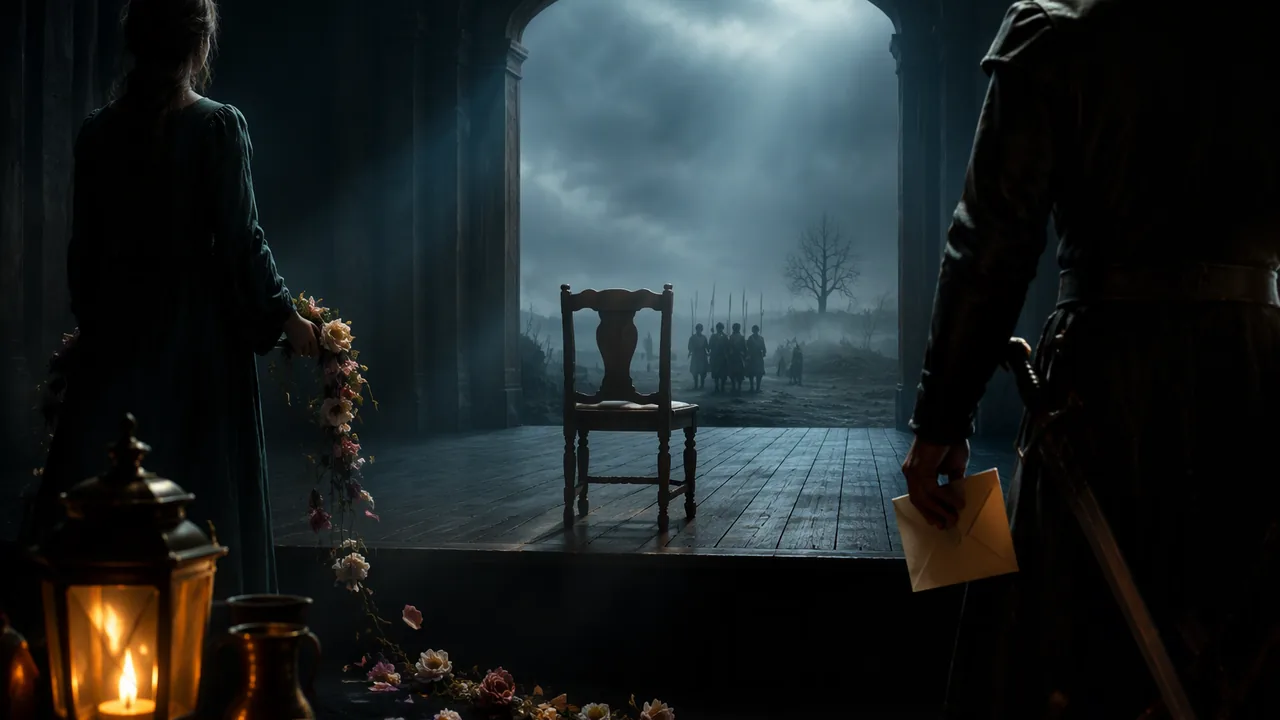
For most of Act 4 Hamlet is absent. After the closet scene Claudius ships him to England, and the stage fills with other people’s stories. That absence is a structural choice worth noticing. While Hamlet is away, Shakespeare shows three other characters living out versions of his situation: a prince who marches to war over almost nothing, a daughter whose madness is real, and a son who wants revenge immediately. 11-12.RL.1.D asks you to analyze how themes develop and interact over the course of a text. In Act 4 the themes of madness and revenge are carried by the mirrors, not by Hamlet.
Hamlet on the way out (scenes 1-4). Gertrude reports the killing to Claudius and calls Hamlet “Mad as the sea and wind,” which keeps the secret Hamlet asked her to keep. Hamlet hides Polonius’s body and taunts the King with a riddle about worms: Polonius is “At supper,” “Not where he eats, but where he is eaten.” Claudius sends him to England with sealed letters that, as he tells the audience alone, demand “The present death of Hamlet.” On his way to the ship Hamlet meets the army of Fortinbras, marching against Poland “to gain a little patch of ground / That hath in it no profit but the name.”
“How all occasions do inform against me.” Hamlet’s last soliloquy measures himself against Fortinbras. Twenty thousand men will die “for a fantasy and trick of fame,” fighting over a plot of ground too small to bury them, while Hamlet, who has “cause, and will, and strength, and means / To do’t,” has let everything sleep. He offers two explanations in one breath, “Bestial oblivion, or some craven scruple / Of thinking too precisely on th’event,” and then admits, “I do not know.” He ends with a vow: “O, from this time forth, / My thoughts be bloody or be nothing worth.” Notice the word thoughts. Even the vow to act is a vow about thinking, and he speaks it as he leaves Denmark under guard. (This soliloquy is printed in the Second Quarto but not in the First Folio, so some productions cut it.)
Ophelia (scene 5). With her father killed by the man she loved and buried, as Claudius admits, “In hugger-mugger,” Ophelia goes mad. She sings fragments of ballads about a dead man in his shroud and a maid betrayed on Saint Valentine’s day, and later hands out flowers: “There’s rosemary, that’s for remembrance.” Hamlet’s madness was announced in advance and is full of pointed wit; Ophelia’s has no plan and no audience she can control. Her brother calls it “A document in madness,” a lesson spelled out in flowers. Set beside Hamlet, she makes us ask what real madness looks like, and whether his ever looked like this.
Laertes (scenes 5 and 7). Laertes returns from France with a mob shouting that he should be king and bursts in on Claudius: “To hell, allegiance! Vows, to the blackest devil!” He will risk damnation itself: “Let come what comes; only I’ll be reveng’d / Most throughly for my father.” This is everything Hamlet accuses himself of not being. Yet Claudius calms him in minutes. In scene 7, after a letter announces that Hamlet is back in Denmark (pirates attacked his ship, as scene 6 reports), the King asks what Laertes would do “To show yourself your father’s son in deed, / More than in words.” Laertes answers, “To cut his throat i’ th’ church.” Together they plan a fencing match with an unblunted sword, poison for its tip, and a poisoned cup in reserve. The scene ends with Gertrude’s report that Ophelia has drowned.
The interaction. Act 4 does not answer the question of Hamlet’s delay; it changes it. Fortinbras shows action without a worthy cause, Laertes shows revenge without thought, and Ophelia shows madness without performance. Each mirror shows something Hamlet is not, and none of them looks simply better. As you read, ask what each mirror adds to the themes you are tracing for your essay.
📖 Before this lesson, read: Hamlet, Act 4
The reading opens over the lesson; close it to come back to exactly where you were.
Formative check
Work through these before moving on. They are not graded — they tell you whether the standard below has landed yet.
What does the Captain tell Hamlet about the land Fortinbras’s army is marching to win?
Ophelia’s madness, like Hamlet’s, is announced ahead of time as a disguise.
Laertes cries, “To hell, !” and later tells the King he would cut Hamlet’s throat “i’ th’ .”
Build a mirror chart with three rows (Fortinbras, Ophelia, Laertes) and three columns: what each character does with a loss or a cause, a quotation, and what the contrast shows about Hamlet. Then write a paragraph on “How all occasions do inform against me”: trace the two explanations Hamlet gives for his delay, and argue whether the vow at the end is a turning point or one more speech in place of action.
How confident are you that you can analyze how a play develops its themes through characters who mirror the hero?
Hamlet, Act 4
Hamlet, Act 4, Scene 1: A room in the Castle. Bridge summary — not the primary text
This is a short recap written for this course, not William Shakespeare’s own words, so you can follow the story between close-reading lessons.
{summary}Hamlet, Act 4, Scene 2: Another room in the Castle. Bridge summary — not the primary text
This is a short recap written for this course, not William Shakespeare’s own words, so you can follow the story between close-reading lessons.
{summary}Hamlet, Act 4, Scene 3: Another room in the Castle. Bridge summary — not the primary text
This is a short recap written for this course, not William Shakespeare’s own words, so you can follow the story between close-reading lessons.
{summary}Hamlet, Act 4, Scene 4: A plain in Denmark.
Source: William Shakespeare, The Tragedy of Hamlet, Prince of Denmark (c. 1600), Project Gutenberg eBook #1524 (gutenberg.org) · Public domain
Enter Fortinbras and Forces marching.
FORTINBRAS.
Go, Captain, from me greet the Danish king.
Tell him that by his license, Fortinbras
Craves the conveyance of a promis’d march
Over his kingdom. You know the rendezvous.
If that his Majesty would aught with us,
We shall express our duty in his eye;
And let him know so.
CAPTAIN.
I will do’t, my lord.
FORTINBRAS.
Go softly on.
[Exeunt all but the Captain.]
Enter Hamlet, Rosencrantz, Guildenstern &c.
HAMLET.
Good sir, whose powers are these?
CAPTAIN.
They are of Norway, sir.
HAMLET.
How purpos’d, sir, I pray you?
CAPTAIN.
Against some part of Poland.
HAMLET.
Who commands them, sir?
CAPTAIN.
The nephew to old Norway, Fortinbras.
HAMLET.
Goes it against the main of Poland, sir,
Or for some frontier?
CAPTAIN.
Truly to speak, and with no addition,
We go to gain a little patch of ground
That hath in it no profit but the name.
To pay five ducats, five, I would not farm it;
Nor will it yield to Norway or the Pole
A ranker rate, should it be sold in fee.
HAMLET.
Why, then the Polack never will defend it.
CAPTAIN.
Yes, it is already garrison’d.
HAMLET.
Two thousand souls and twenty thousand ducats
Will not debate the question of this straw!
This is th’imposthume of much wealth and peace,
That inward breaks, and shows no cause without
Why the man dies. I humbly thank you, sir.
CAPTAIN.
God b’ wi’ you, sir.
[Exit.]
ROSENCRANTZ.
Will’t please you go, my lord?
HAMLET.
I’ll be with you straight. Go a little before.
[Exeunt all but Hamlet.]
How all occasions do inform against me, And spur my dull revenge. What is a man If his chief good and market of his time Be but to sleep and feed? A beast, no more. Sure he that made us with such large discourse, Looking before and after, gave us not That capability and godlike reason To fust in us unus’d. Now whether it be Bestial oblivion, or some craven scruple Of thinking too precisely on th’event,— A thought which, quarter’d, hath but one part wisdom And ever three parts coward,—I do not know Why yet I live to say this thing’s to do, Sith I have cause, and will, and strength, and means To do’t. Examples gross as earth exhort me, Witness this army of such mass and charge, Led by a delicate and tender prince, Whose spirit, with divine ambition puff’d, Makes mouths at the invisible event, Exposing what is mortal and unsure To all that fortune, death, and danger dare, Even for an eggshell. Rightly to be great Is not to stir without great argument, But greatly to find quarrel in a straw When honour’s at the stake. How stand I then, That have a father kill’d, a mother stain’d, Excitements of my reason and my blood, And let all sleep, while to my shame I see The imminent death of twenty thousand men That, for a fantasy and trick of fame, Go to their graves like beds, fight for a plot Whereon the numbers cannot try the cause, Which is not tomb enough and continent To hide the slain? O, from this time forth, My thoughts be bloody or be nothing worth.
[Exit.]
Hamlet, Act 4, Scene 5: Elsinore. A room in the Castle.
Source: William Shakespeare, The Tragedy of Hamlet, Prince of Denmark (c. 1600), Project Gutenberg eBook #1524 (gutenberg.org) · Public domain
Enter Queen, Horatio and a Gentleman.
QUEEN.
I will not speak with her.
GENTLEMAN.
She is importunate, indeed distract.
Her mood will needs be pitied.
QUEEN.
What would she have?
GENTLEMAN.
She speaks much of her father; says she hears
There’s tricks i’ th’ world, and hems, and beats her heart,
Spurns enviously at straws, speaks things in doubt,
That carry but half sense. Her speech is nothing,
Yet the unshaped use of it doth move
The hearers to collection; they aim at it,
And botch the words up fit to their own thoughts,
Which, as her winks, and nods, and gestures yield them,
Indeed would make one think there might be thought,
Though nothing sure, yet much unhappily.
’Twere good she were spoken with, for she may strew
Dangerous conjectures in ill-breeding minds.
QUEEN.
Let her come in.
[Exit Gentleman.]
To my sick soul, as sin’s true nature is, Each toy seems prologue to some great amiss. So full of artless jealousy is guilt, It spills itself in fearing to be spilt.
Enter Ophelia.
OPHELIA.
Where is the beauteous Majesty of Denmark?
QUEEN.
How now, Ophelia?
OPHELIA.
[Sings.]
How should I your true love know
From another one?
By his cockle hat and staff
And his sandal shoon.
QUEEN.
Alas, sweet lady, what imports this song?
OPHELIA.
Say you? Nay, pray you mark.
[Sings.]
He is dead and gone, lady,
He is dead and gone,
At his head a grass green turf,
At his heels a stone.
QUEEN.
Nay, but Ophelia—
OPHELIA.
Pray you mark.
[Sings.]
White his shroud as the mountain snow.
Enter King.
QUEEN.
Alas, look here, my lord!
OPHELIA.
[Sings.]
Larded all with sweet flowers;
Which bewept to the grave did not go
With true-love showers.
KING.
How do you, pretty lady?
OPHELIA.
Well, God dild you! They say the owl was a baker’s daughter. Lord, we
know what we are, but know not what we may be. God be at your table!
KING.
Conceit upon her father.
OPHELIA.
Pray you, let’s have no words of this; but when they ask you what it
means, say you this:
[Sings.]
Tomorrow is Saint Valentine’s day,
All in the morning betime,
And I a maid at your window,
To be your Valentine.
Then up he rose and donn’d his clothes, And dupp’d the chamber door, Let in the maid, that out a maid Never departed more.
KING.
Pretty Ophelia!
OPHELIA.
Indeed la, without an oath, I’ll make an end on’t.
[Sings.]
By Gis and by Saint Charity,
Alack, and fie for shame!
Young men will do’t if they come to’t;
By Cock, they are to blame.
Quoth she, before you tumbled me, You promis’d me to wed. So would I ha’ done, by yonder sun, An thou hadst not come to my bed.
KING.
How long hath she been thus?
OPHELIA.
I hope all will be well. We must be patient. But I cannot choose but
weep, to think they would lay him i’ th’ cold ground. My brother shall
know of it. And so I thank you for your good counsel. Come, my coach!
Good night, ladies; good night, sweet ladies; good night, good night.
[Exit.]
KING.
Follow her close; give her good watch, I pray you.
[Exit Horatio.]
O, this is the poison of deep grief; it springs All from her father’s death. O Gertrude, Gertrude, When sorrows come, they come not single spies, But in battalions. First, her father slain; Next, your son gone; and he most violent author Of his own just remove; the people muddied, Thick, and unwholesome in their thoughts and whispers For good Polonius’ death; and we have done but greenly In hugger-mugger to inter him. Poor Ophelia Divided from herself and her fair judgement, Without the which we are pictures or mere beasts. Last, and as much containing as all these, Her brother is in secret come from France, Feeds on his wonder, keeps himself in clouds, And wants not buzzers to infect his ear With pestilent speeches of his father’s death, Wherein necessity, of matter beggar’d, Will nothing stick our person to arraign In ear and ear. O my dear Gertrude, this, Like to a murdering piece, in many places Gives me superfluous death.
[A noise within.]
QUEEN.
Alack, what noise is this?
KING.
Where are my Switzers? Let them guard the door.
Enter a Gentleman.
What is the matter?
GENTLEMAN.
Save yourself, my lord.
The ocean, overpeering of his list,
Eats not the flats with more impetuous haste
Than young Laertes, in a riotous head,
O’erbears your offices. The rabble call him lord,
And, as the world were now but to begin,
Antiquity forgot, custom not known,
The ratifiers and props of every word,
They cry ‘Choose we! Laertes shall be king!’
Caps, hands, and tongues applaud it to the clouds,
‘Laertes shall be king, Laertes king.’
QUEEN.
How cheerfully on the false trail they cry.
O, this is counter, you false Danish dogs.
[A noise within.]
KING.
The doors are broke.
Enter Laertes, armed; Danes following.
LAERTES.
Where is this king?—Sirs, stand you all without.
Danes. No, let’s come in.
LAERTES.
I pray you, give me leave.
DANES.
We will, we will.
[They retire without the door.]
LAERTES.
I thank you. Keep the door. O thou vile king,
Give me my father.
QUEEN.
Calmly, good Laertes.
LAERTES.
That drop of blood that’s calm proclaims me bastard;
Cries cuckold to my father, brands the harlot
Even here between the chaste unsmirched brow
Of my true mother.
KING.
What is the cause, Laertes,
That thy rebellion looks so giant-like?—
Let him go, Gertrude. Do not fear our person.
There’s such divinity doth hedge a king,
That treason can but peep to what it would,
Acts little of his will.—Tell me, Laertes,
Why thou art thus incens’d.—Let him go, Gertrude:—
Speak, man.
LAERTES.
Where is my father?
KING.
Dead.
QUEEN.
But not by him.
KING.
Let him demand his fill.
LAERTES.
How came he dead? I’ll not be juggled with.
To hell, allegiance! Vows, to the blackest devil!
Conscience and grace, to the profoundest pit!
I dare damnation. To this point I stand,
That both the worlds, I give to negligence,
Let come what comes; only I’ll be reveng’d
Most throughly for my father.
KING.
Who shall stay you?
LAERTES.
My will, not all the world.
And for my means, I’ll husband them so well,
They shall go far with little.
KING.
Good Laertes,
If you desire to know the certainty
Of your dear father’s death, is’t writ in your revenge
That, sweepstake, you will draw both friend and foe,
Winner and loser?
LAERTES.
None but his enemies.
KING.
Will you know them then?
LAERTES.
To his good friends thus wide I’ll ope my arms;
And, like the kind life-rendering pelican,
Repast them with my blood.
KING.
Why, now you speak
Like a good child and a true gentleman.
That I am guiltless of your father’s death,
And am most sensibly in grief for it,
It shall as level to your judgement ’pear
As day does to your eye.
DANES.
[Within.] Let her come in.
LAERTES.
How now! What noise is that?
Re-enter Ophelia, fantastically dressed with straws and flowers.
O heat, dry up my brains. Tears seven times salt, Burn out the sense and virtue of mine eye. By heaven, thy madness shall be paid by weight, Till our scale turn the beam. O rose of May! Dear maid, kind sister, sweet Ophelia! O heavens, is’t possible a young maid’s wits Should be as mortal as an old man’s life? Nature is fine in love, and where ’tis fine, It sends some precious instance of itself After the thing it loves.
OPHELIA.
[Sings.]
They bore him barefac’d on the bier,
Hey non nonny, nonny, hey nonny
And on his grave rain’d many a tear.—
Fare you well, my dove!
LAERTES.
Hadst thou thy wits, and didst persuade revenge,
It could not move thus.
OPHELIA.
You must sing ‘Down a-down, and you call him a-down-a.’ O, how the
wheel becomes it! It is the false steward that stole his master’s
daughter.
LAERTES.
This nothing’s more than matter.
OPHELIA.
There’s rosemary, that’s for remembrance; pray love, remember. And
there is pansies, that’s for thoughts.
LAERTES.
A document in madness, thoughts and remembrance fitted.
OPHELIA.
There’s fennel for you, and columbines. There’s rue for you; and here’s
some for me. We may call it herb of grace o’ Sundays. O you must wear
your rue with a difference. There’s a daisy. I would give you some
violets, but they wither’d all when my father died. They say he made a
good end.
[Sings.]
For bonny sweet Robin is all my joy.
LAERTES.
Thought and affliction, passion, hell itself
She turns to favour and to prettiness.
OPHELIA.
[Sings.]
And will he not come again?
And will he not come again?
No, no, he is dead,
Go to thy death-bed,
He never will come again.
His beard was as white as snow, All flaxen was his poll. He is gone, he is gone, And we cast away moan. God ha’ mercy on his soul.
And of all Christian souls, I pray God. God b’ wi’ ye.
[Exit.]
LAERTES.
Do you see this, O God?
KING.
Laertes, I must commune with your grief,
Or you deny me right. Go but apart,
Make choice of whom your wisest friends you will,
And they shall hear and judge ’twixt you and me.
If by direct or by collateral hand
They find us touch’d, we will our kingdom give,
Our crown, our life, and all that we call ours
To you in satisfaction; but if not,
Be you content to lend your patience to us,
And we shall jointly labour with your soul
To give it due content.
LAERTES.
Let this be so;
His means of death, his obscure burial,—
No trophy, sword, nor hatchment o’er his bones,
No noble rite, nor formal ostentation,—
Cry to be heard, as ’twere from heaven to earth,
That I must call’t in question.
KING.
So you shall.
And where th’offence is let the great axe fall.
I pray you go with me.
[Exeunt.]
Hamlet, Act 4, Scene 6: Another room in the Castle. Bridge summary — not the primary text
This is a short recap written for this course, not William Shakespeare’s own words, so you can follow the story between close-reading lessons.
{summary}Hamlet, Act 4, Scene 7: Another room in the Castle. Bridge summary — not the primary text
This is a short recap written for this course, not William Shakespeare’s own words, so you can follow the story between close-reading lessons.
{summary}