If genes are inherited from parents, what are the different ways new combinations of traits and entirely new traits appear in offspring?
model meiosis with crossing over, calculate the number of chromosome combinations in gametes, and defend a claim about how meiosis, replication errors and environmental mutagens produce heritable variation.
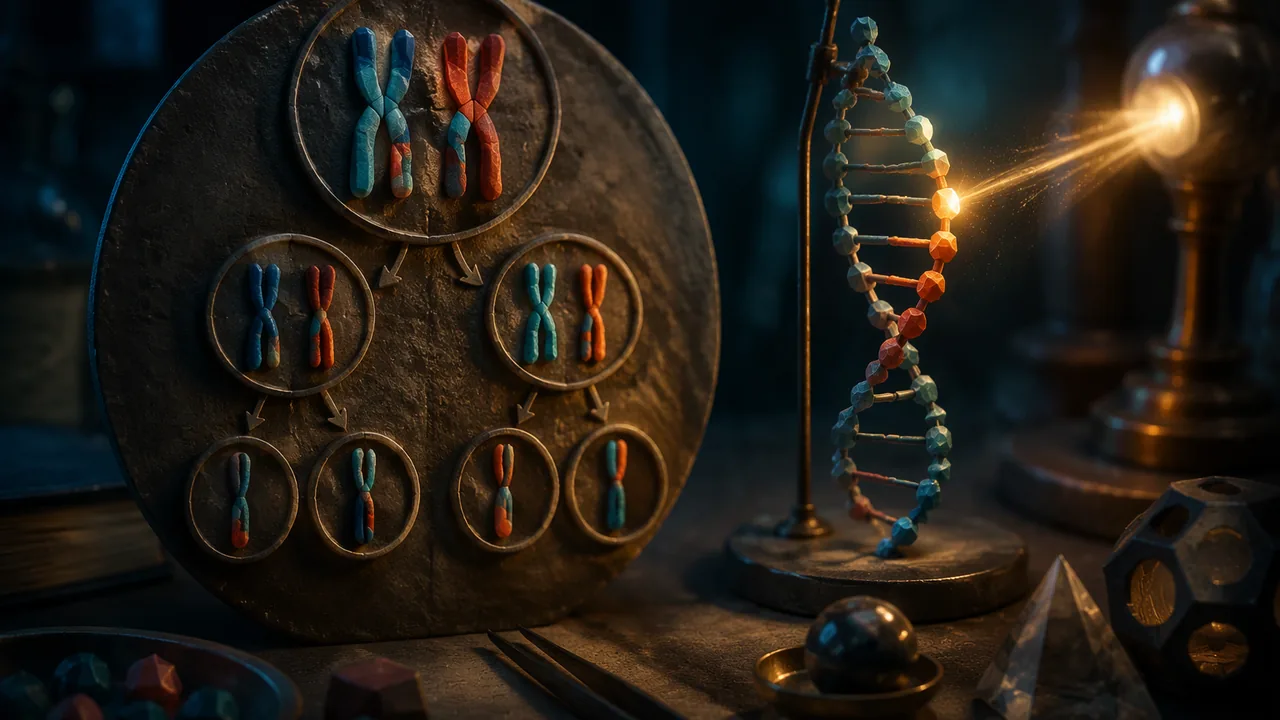
Three sources of new variation. Siblings with the same parents are not identical (except identical twins). 9-12.LS3.B.3 names three ways heritable variation arises: new combinations of alleles during meiosis, errors made when DNA is copied, and mutations caused by the environment. Each is backed by different evidence.
Meiosis, errors in DNA replication, and environmental mutagens are the three primary sources of new heritable variation in organisms.
📖 Read for this lesson
The reading opens over the lesson; close it to come back to exactly where you were. The checks below draw on it.
Considering that all humans share most of their DNA, what do you think accounts for the wide range of unique traits we observe among individuals?
An organism with 4 pairs of chromosomes can make chromosome combinations in its gametes by independent assortment alone; onion, with 8 pairs, can make .
1. New combinations in meiosis
Because of independent assortment and crossing over during meiosis, each gamete a person produces is almost certainly genetically unique.
Meiosis has two divisions. In meiosis I, homologous chromosomes pair up and then separate, one to each cell. Which way each pair faces at the cell’s equator is random, and each pair lines up independently of the others. With 2 pairs of chromosomes there are 22 = 4 possible combinations in the gametes; with n pairs there are 2n. Humans have 23 pairs, so one person can make 223 = 8,388,608 chromosome combinations. Two parents together can produce 8,388,608 × 8,388,608 ≈ 7.0 × 10¹³ combinations in a child, before counting the next process. In meiosis II the sister chromatids separate, as in mitosis, giving four haploid cells.
Early in meiosis I, homologous chromosomes also exchange segments, a process called crossing over. A chromosome that carried alleles A and B on one homolog and a and b on the other can produce Ab and aB chromosomes that neither parent carried. Crossing over multiplies the combinations far beyond 223.
Exchange of segments between homologous chromosomes during meiosis I, producing new allele combinations on a chromosome.
A person gets a sunburn that causes a mutation in a skin cell. Can the mutation be passed to their children?
2. Errors in replication
DNA polymerase copies billions of bases each time a cell divides. It proofreads its work and other enzymes repair mismatches, so after repair errors are very rare: estimates are on the order of one uncorrected error per billion bases copied (OpenStax Biology 2e, section 14.6, describes proofreading and repair). But a human cell copies about 6 billion bases each time, so a few new changes can appear in each division. A change in a cell that becomes an egg or sperm can be passed on.
Mutations happen because an organism needs to adapt to its environment.
Mutations occur randomly, independent of an organism’s needs; their effects can be harmful, helpful, or neutral depending on the specific environment.
Crossing over can produce a chromosome carrying a combination of alleles that neither of the organism’s parents carried on a single chromosome.
3. Mutations caused by the environment
Some agents damage DNA directly. Ultraviolet light from the sun can join two neighboring thymine bases into a thymine dimer, which distorts the helix; if it is not repaired, a wrong base can be copied in. The National Cancer Institute identifies UV radiation and chemicals in tobacco smoke as causes of DNA damage that can lead to cancer. Note the important difference: a mutation in a skin cell affects that person but is not inherited; only mutations in cells that form gametes are passed to offspring.
Write your claim about the most important source of new variation in the case you chose (two corn plants from the same cross, or a new allele in a population), with two pieces of evidence and one rebuttal.
Not every mutation matters
Many changes fall outside genes or are silent; some are harmful, and a few are helpful in a particular environment. Mutation is random with respect to need: an organism does not produce the mutation it needs.
Building the argument
Today you will make a claim about which source of variation best explains a given case, choosing one of two: how two corn plants with the same parents can give ears with different kernel combinations, or how a new allele can appear in a population that never had it. Use your pipe-cleaner model, your calculation and a cited text as evidence, and rebut one alternative.
Key terms
Random, independent orientation of each homologous pair in meiosis I, giving 2n possible chromosome combinations.
An environmental agent, such as ultraviolet light or some chemicals in tobacco smoke, that damages DNA and can cause mutations.
A mutation in a cell that forms gametes, which can be passed to offspring.
Lab: Pipe-cleaner meiosis with crossing over
Question. How do independent assortment and crossing over produce gametes with new combinations of alleles?
Materials
- Pipe cleaners in two colors (one color per parent), four of each color, in two lengths; or strips of paper in two colors (or marked with two pen colors)
- Small colored beads, sticky labels or a pen to mark alleles (A/a on the long pair, B/b and D/d on the short pair)
- A paper plate or a large sheet of paper labeled as the cell, and a phone camera or drawing paper
- Pipe-cleaner ends are sharp; bend the tips over before you start.
- Keep beads off the floor to avoid slips.
Procedure
- Build two homologous pairs: a long pair carrying A and a, and a short pair carrying B/b and D/d near opposite ends. Twist a copy onto each chromosome to show replicated sister chromatids.
- Model meiosis I: pair the homologs, then twist a segment of one short chromatid onto its partner to model crossing over between the B and D positions. Photograph or draw the result.
- Line the pairs up at the equator in one orientation, separate them into two cells, then model meiosis II to make four gametes. Record the alleles in each gamete.
- Repeat with the other orientation of the long pair and with no crossing over. Record the gametes again.
- Do at least four runs in all (both orientations, with and without crossing over). List every distinct allele combination your runs produced, and mark which combinations required crossing over.
Data
| Run | Orientation | Crossing over? (Y/N) | Gamete 1 | Gamete 2 | Gamete 3 | Gamete 4 |
|---|---|---|---|---|---|---|
| 1 | ||||||
| 2 | ||||||
| 3 |
Analysis
- How many different gamete combinations did your runs produce with and without crossing over? Compare with 2n for your number of pairs.
- Write your argument: which source of variation best explains why two siblings (or two corn plants from the same cross) differ? Cite your model data and one text source.
- Rebut this claim with evidence: all mutations are harmful and are caused by the environment.
- Identify one way the pipe-cleaner model misrepresents real meiosis and why it matters.
If you cannot do this lab in person: Cut chromosome strips from any paper, label the alleles with a pen, and model the same steps on a tabletop; photograph or draw each stage. The analysis questions are the same.
Practice
Work these on paper or in your notebook, then open Check your answer. Aim for all of Fluency and Application; try at least one Challenge.
Printable version: this unit’s practice workbook (PDF)
Fluency
Build speed and accuracy with the core skill.
- How many chromosome combinations can independent assortment produce in gametes for an organism with 3 pairs of chromosomes?
Check your answer
Answer: 823 = 8. - How many combinations for 23 pairs (humans)?
Check your answer
Answer: 8,388,608223 = 8,388,608. - Name the three sources of new heritable variation in 9-12.LS3.B.3.
Check your answer
Answer: New combinations of alleles in meiosis (independent assortment and crossing over), errors in DNA replication, and mutations caused by environmental factorsOnly changes in cells that form gametes are inherited. - Does crossing over happen in meiosis I or meiosis II?
Check your answer
Answer: Meiosis I (while homologous chromosomes are paired)Homologs pair and exchange segments early in meiosis I.
Application
Use the skill in context. Show your reasoning.
- Two human parents each make 8,388,608 chromosome combinations in their gametes. How many combinations are possible in a child, before crossing over?
Check your answer
Answer: About 7.0 × 10¹³ (70 trillion)8,388,608 × 8,388,608 = 70,368,744,177,664. - If about one uncorrected error occurs per billion bases copied, and a body cell copies about 6.2 billion bases before dividing, about how many new changes arise per division?
Check your answer
Answer: About 66.2 × 109 × 10−9 = 6.2. - A chromosome carries AB and its homolog ab. Which gamete chromosomes are possible (a) without crossing over and (b) with one crossover between the genes?
Check your answer
Answer: (a) AB and ab; (b) AB, ab, Ab and aBA crossover swaps the segments beyond the break point, joining A with b and a with B.
Challenge
Stretch problems. Expect to think before you write.
- Evaluate the claim: “Organisms mutate when they need to, so bacteria exposed to an antibiotic create resistance mutations.” Use what you know about the causes of mutation.
Check your answer
Answer: Not supported. Mutations arise from copying errors and environmental damage whether or not they are useful. Some bacteria already carry resistance mutations; the antibiotic kills the others, so resistant ones become common. The environment selects existing variation rather than directing mutation.Separate the cause of mutation (random with respect to need) from the cause of its spread (selection).
Review
Keep earlier skills sharp.
- An ear from a test cross (Pp × pp) has 214 purple and 186 yellow kernels. Is it consistent with 1 : 1?
Check your answer
Answer: Yes: χ2 = 1.96, df = 1, below 3.84.Expected 200 each: 196/200 + 196/200 = 1.96.
On a sunny Missouri summer afternoon, ultraviolet light can damage the DNA in exposed skin cells, which is why sunscreen matters; but only mutations in cells that form eggs or sperm are passed to future generations.
How does understanding the multiple sources of genetic variation change your perspective on evolution or inherited traits?
How confident are you that you can explain and defend how meiosis, replication errors and environmental mutagens produce heritable variation?
The Shift
- Meiosis shuffles existing alleles.
- DNA replication errors introduce new changes.
- Environmental mutagens damage DNA.
Three Sources of New Heritable Variation
SLS reading for RLP Biology A, drawing on MedlinePlus Genetics, the National Cancer Institute and CDC pages on antimicrobial resistance · SLS original
Why siblings differ
Two brothers with the same parents can look quite different; two corn plants from the same cross can bear ears with different kernel combinations. Only identical twins, who come from a single fertilized egg, share the same DNA. The high school life science standards name three sources of new heritable variation, and each rests on different evidence:
- new combinations of alleles made during meiosis (independent assortment and crossing over);
- errors that slip through when DNA is copied;
- mutations caused by environmental factors.
1a. Independent assortment
Meiosis has two divisions. In meiosis I, the homologous chromosomes pair up and then separate, one of each pair to each new cell. How each pair is lined up at the middle of the cell is random, and every pair lines up independently of the others. With one pair there are 2 possible gamete combinations; with 2 pairs, 2 × 2 = 4; with n pairs, 2n. In meiosis II the sister chromatids separate, much as in mitosis, giving four cells, each with one chromosome from every pair.
| Pairs of chromosomes (n) | 3 | 4 | 5 | 8 (onion) | 23 (human) |
|---|---|---|---|---|---|
| Combinations (2n) | 8 | 16 | 32 | 256 | 8,388,608 |
A child gets one gamete from each parent, so the combinations multiply: 8,388,608 × 8,388,608 = 70,368,744,177,664, about 7.0 × 10¹³ (70 trillion) possible chromosome combinations, before crossing over is even counted. MedlinePlus Genetics describes meiosis as allowing genetic variation through a process of gene shuffling.
1b. Crossing over
Early in meiosis I, while homologous chromosomes are paired side by side, they can break and exchange matching segments. This is crossing over. Suppose one chromosome carries alleles A and B, and its homolog carries a and b.
- Without crossing over, gametes receive either the AB chromosome or the ab chromosome.
- With one crossover between the two genes, the swapped segments produce two new chromosomes, Ab and aB. Gametes can now carry AB, ab, Ab or aB.
The new chromosomes carry combinations that neither of the organism’s parents carried on a single chromosome. Because crossovers can happen at many positions on every chromosome, they multiply the possibilities far beyond 223. Your pipe-cleaner or paper-strip model shows this: the combinations that appear only when you swap a segment are the ones that required crossing over.
2. Errors in copying DNA
Before every cell division, the enzyme DNA polymerase copies the entire genome. It proofreads as it goes, and other repair enzymes fix most mismatches afterward, so uncorrected errors are rare; estimates are on the order of one per billion bases copied. But a human body cell copies about 6.2 billion bases before each division, so 6.2 × 109 × 10−9 ≈ 6 new changes may appear each time a cell divides. MedlinePlus Genetics notes that such errors can occur as DNA copies itself during cell division.
3. Mutations caused by the environment
Some environmental agents, called mutagens, damage DNA directly. Ultraviolet (UV) radiation from the sun can fuse two neighboring thymine bases on the same strand into a thymine dimer, which kinks the helix; if the damage is not repaired before the DNA is copied, a wrong base can be put in. The National Cancer Institute warns that UV exposure causes skin damage that can lead to skin cancer, and it identifies chemicals in tobacco smoke as causes of DNA damage as well.
Which mutations are inherited?
This is the distinction the whole unit turns on. MedlinePlus Genetics explains that germline variants are present in egg or sperm cells, so they are passed to children and appear in virtually every cell of the child’s body. Somatic variants arise in other body cells during a person’s life and cannot be passed to the next generation. A sunburn that mutates a skin cell affects that person only; skin cells do not form gametes. A copying error in a cell that will become a sperm or egg can be inherited. So environmental mutagens add heritable variation only when they affect germ-line cells.
Not all mutations matter, and none arrive on demand
Many changes land outside genes or are silent (the redundant genetic code means some base changes leave the amino acid unchanged). Some are harmful; a few turn out to be helpful in a particular environment. The claim that all mutations are harmful and all are caused by the environment fails on both counts: copying errors happen with no environmental cause, and a mutation’s effect depends on where it lands and on the environment the organism lives in.
Mutation is also random with respect to need. Consider the claim “bacteria exposed to an antibiotic create resistance mutations.” The CDC explains that antibiotics kill susceptible germs while resistant ones survive, multiply and pass on their resistance. The resistance mutations arose from copying errors or damage, whether or not they were useful; the drug did not create them. It selected them, so resistant bacteria became common. Separate the cause of a mutation from the cause of its spread.
Building your argument
Match the source to the case. Two corn plants from the same cross differ mainly because of new allele combinations from independent assortment and crossing over in their parents’ meiosis; cite your model’s gamete list and the 2n calculation. A brand-new allele appearing in a population that never had it needs a mutation, from a copying error or a mutagen, in a germ-line cell. A good rebuttal names the strongest alternative, then shows why the evidence does not support it for this case.
One limitation of the pipe-cleaner model to note: real crossovers can occur at many points, real cells have many more chromosomes, and the model cannot show copying errors at all.
Review
A test-cross ear (Pp × pp) with 214 purple and 186 yellow kernels has expected counts of 200 and 200, so χ2 = 196/200 + 196/200 = 1.96, below 3.84 with 1 degree of freedom: consistent with 1 : 1.
Sources: MedlinePlus Genetics: How are gene variants involved in health and disease? (medlineplus.gov); MedlinePlus Genetics: How do cells divide? (medlineplus.gov); NHGRI Talking Glossary: Crossing Over (genome.gov); National Cancer Institute: Sunlight and cancer risk (cancer.gov); National Cancer Institute: Tobacco and cancer risk (cancer.gov); CDC: About Antimicrobial Resistance (cdc.gov)