Why is maintaining a specific body temperature so critical for life?
explain how an enzyme’s shape determines its function, measure how temperature affects catalase activity, and use the data to model why the body holds its temperature in a narrow range.
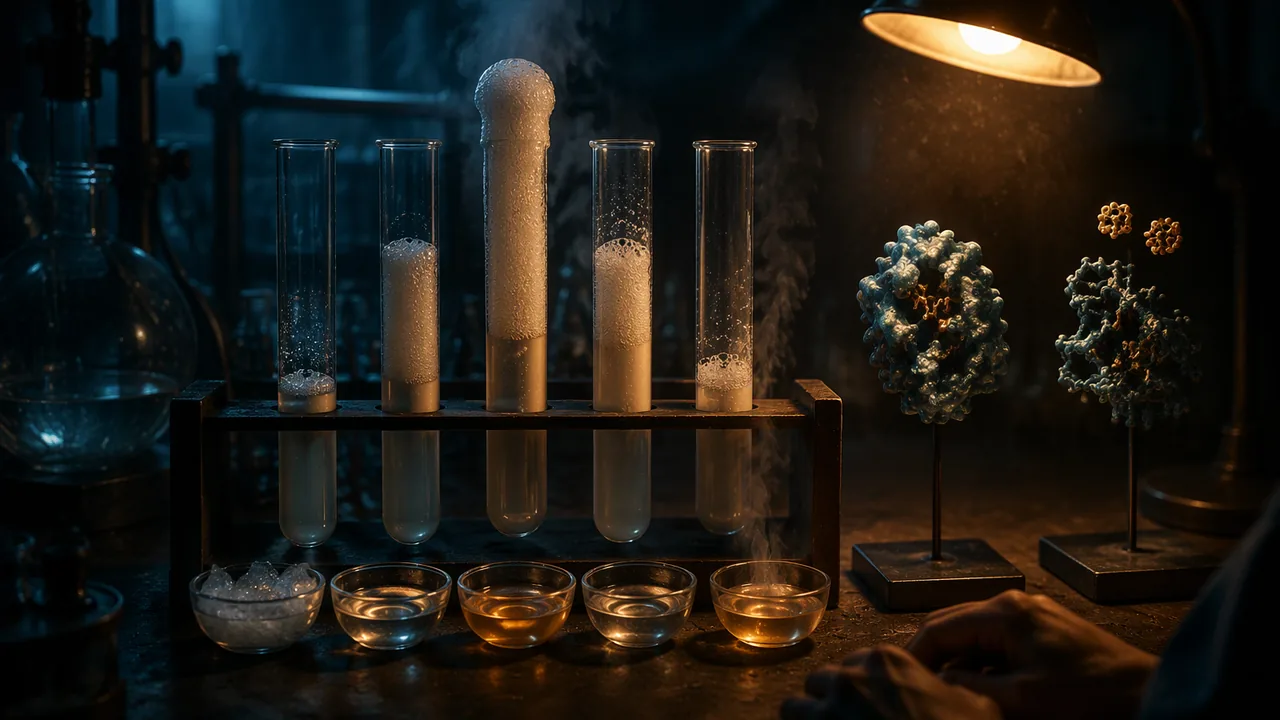
Proteins do the work. Almost every job inside a cell is done by a protein: enzymes speed reactions, channel proteins let ions cross membranes, hemoglobin carries oxygen, and keratin toughens skin. A protein is a chain of amino acids, and the sequence of amino acids, set by a gene, determines how the chain folds into a particular three-dimensional shape. Shape determines function. This is the idea you will build on in Unit 3, where you trace how DNA sets the amino acid sequence.
An enzyme’s specific three-dimensional shape is essential for its function, and extreme temperatures can destroy that shape.
📖 Read for this lesson
The reading opens over the lesson; close it to come back to exactly where you were. The checks below draw on it.
A protein that speeds up a specific chemical reaction without being used up.
Why do you think your body works hard to keep its temperature steady, even when it’s cold outside?
You boil a yeast suspension, cool it to 37 °C, and add hydrogen peroxide. What will happen?
How enzymes work
Enzymes can increase the rate of chemical reactions by factors of millions or even billions.
An enzyme is a protein catalyst: it speeds a reaction without being used up. The molecule it acts on, the substrate, fits into a pocket called the active site, where the enzyme’s shape stresses the substrate’s bonds and lowers the energy needed for the reaction to start. Because each active site has a specific shape, each enzyme acts on one substrate or a few similar ones.
The region of an enzyme whose shape fits its substrate and where the reaction happens.
The molecule an enzyme acts on.
What determines the shape of an enzyme’s active site?
Catalase
Cells produce hydrogen peroxide (H2O2) as a by-product of normal chemistry, and it damages cell parts. The enzyme catalase breaks it down: 2H2O2 → 2H2O + O2. Yeast cells are full of catalase, so when you mix yeast with 3% hydrogen peroxide, oxygen bubbles form foam. The height of the foam in a set time is a measure of enzyme activity.
High temperatures simply slow down enzymes by making them ‘tired’ or ‘less active’.
High temperatures can permanently change an enzyme’s shape, preventing it from functioning at all, a process called denaturing.
Foam height rose from 25 mm at 22 °C to 38 mm at 37 °C, a rate of about mm per °C (to two decimal places).
Temperature and shape
Warming speeds molecules, so enzyme and substrate collide more often and the reaction goes faster, up to a point. Above an optimum, the weak bonds holding the protein in shape break, the active site loses its shape, and the enzyme is denatured. Denaturing is often permanent: a cooked egg white does not become clear again when it cools. Here is an illustrative data set for yeast catalase (foam height after 60 s): 4 °C, 12 mm; 22 °C, 25 mm; 37 °C, 38 mm; 50 °C, 20 mm; 80 °C, 3 mm. Activity roughly triples from 4 °C to 37 °C, then falls sharply. Between 22 and 37 °C foam rose 13 mm over 15 °C, or about 0.87 mm per °C; between 37 and 50 °C it fell 18 mm over 13 °C, about 1.4 mm per °C. The fall after the optimum is steeper than the rise before it, because denaturing destroys enzymes rather than just slowing them.
To lose the folded shape of a protein, and with it the protein’s function, because of heat, acidity or other conditions.
Draw your three-panel enzyme model (cold, optimum, hot) and write three sentences linking it to why the hypothalamus triggers sweating when core temperature rises.
Building the model
A good model has parts, interactions and a mechanism. Draw the enzyme with its active site at three temperatures: cold (correct shape, slow collisions), near the optimum (correct shape, fast collisions) and hot (unfolded, the substrate no longer fits). Then link the model to the phenomenon. Human enzymes work best near 37 °C. At a core temperature of 40 °C and above, some proteins begin to lose their shape, cells stop working properly, and the brain, which controls the feedback loop, is among the first organs affected. That is why the negative feedback you measured in Lesson 1.3 is not a luxury: it protects the shapes of the proteins that keep you alive.
Reading a graph honestly
Five temperatures cannot locate an optimum exactly. The data show it lies somewhere between 22 and 50 °C, most likely near 37 °C. To narrow it, you would add trials at 30, 40 and 45 °C and repeat each at least three times.
Key terms
The temperature at which an enzyme is most active.
Lab: Catalase activity in yeast at different temperatures
Question. How does temperature affect the activity of the enzyme catalase?
Materials
- Dry baker’s yeast mixed with warm water (1 packet in 100 mL) and allowed to stand 10 minutes
- 3% hydrogen peroxide (drugstore strength)
- Five clear cups or test tubes, a ruler and a 10 mL measuring syringe or spoon
- Ice water bath, room-temperature water, warm tap water (about 37 °C), hot tap water (about 50 °C) and an electric kettle for 80 °C water, operated by a parent or guardian
- Kitchen thermometer (or use the bath temperatures as given), stopwatch or phone timer, safety glasses or goggles
- Wear safety glasses or goggles throughout. 3% hydrogen peroxide can irritate eyes and skin; rinse with plenty of water if contact occurs.
- Only a parent or guardian handles the kettle and any water above 50 °C; wait for them to pour.
- No open flames. Work on a tray or at the kitchen sink, wipe spills at once and wash hands after the lab.
Procedure
- Pour 5 mL of yeast suspension into each of five tubes and place one in each water bath (about 4, 22, 37, 50 and 80 °C) for five minutes. Record the actual temperatures.
- Measure 5 mL of hydrogen peroxide into each of five matching tubes and warm or cool them in the same baths.
- Pour the peroxide into the yeast for one temperature, start the stopwatch, and after 60 seconds measure the foam height in millimeters above the liquid.
- Repeat for each temperature, keeping volumes, timing and tube size the same.
- Repeat the whole set two more times with fresh yeast suspension and peroxide, and calculate the mean foam height for each temperature.
Data
| Temperature (°C) | Trial 1 foam (mm) | Trial 2 (mm) | Trial 3 (mm) | Mean (mm) |
|---|---|---|---|---|
| about 4 | ||||
| about 22 | ||||
| about 37 | ||||
| about 50 | ||||
| about 80 |
Analysis
- Graph mean foam height against temperature. Where does the optimum appear to be, and how confident are you given your number of temperatures and trials?
- Explain the rise and the fall of the curve using enzyme shape, collisions and denaturing.
- Name the independent, dependent and three controlled variables. Identify one uncontrolled variable and how it might affect the results.
- Use your graph to explain why a core temperature of 40 °C or more is dangerous to a person.
If you cannot do this lab in person: Use the provided illustrative data set (4 °C 12 mm, 22 °C 25 mm, 37 °C 38 mm, 50 °C 20 mm, 80 °C 3 mm) and the worked analysis in this lesson’s reading to complete the graph and analysis.
Practice
Work these on paper or in your notebook, then open Check your answer. Aim for all of Fluency and Application; try at least one Challenge.
Printable version: this unit’s practice workbook (PDF)
Fluency
Build speed and accuracy with the core skill.
- For the data 11, 12, 12, 16, 25, 25, 33, 37: find the mean, median, range and interquartile range. (Find the quartiles as the medians of the lower and upper halves, leaving out the overall median when the count is odd.)
Check your answer
Answer: mean = 21.38; median = 20.5; range = 26; IQR = 17.0 (Q1 = 12.0, Q3 = 29.0) - Three trials of catalase at 37 °C gave foam heights of 36, 41 and 37 mm. Find the mean.
Check your answer
Answer: 38 mm(36 + 41 + 37) ÷ 3 = 114 ÷ 3 = 38. - Name the substrate and the products of the reaction catalase speeds up.
Check your answer
Answer: Substrate: hydrogen peroxide (H2O2); products: water and oxygen gas2H2O2 → 2H2O + O2; the oxygen makes the foam.
Application
Use the skill in context. Show your reasoning.
- Illustrative data: mean foam 12 mm at 4 °C, 25 mm at 22 °C, 38 mm at 37 °C, 20 mm at 50 °C and 3 mm at 80 °C. Express the activity at 50 °C and at 80 °C as a percentage of the maximum.
Check your answer
Answer: About 53% at 50 °C and about 8% at 80 °C20 ÷ 38 = 0.526; 3 ÷ 38 = 0.079. - Explain why activity is low at 4 °C and also low at 80 °C, but for different reasons.
Check your answer
Answer: At 4 °C molecules move slowly and collide less often, but the enzyme keeps its shape. At 80 °C the enzyme is denatured: its shape, including the active site, is changed, so it cannot bind the substrate.Structure determines function; heat breaks the weak bonds that hold a protein’s shape. - For the catalase lab, name the independent variable, the dependent variable and two controlled variables.
Check your answer
Answer: Independent: temperature. Dependent: foam height after 60 s. Controlled (any two): volume of yeast, volume and strength of peroxide, time, tube size.Only one variable is changed on purpose; the others are kept the same.
Challenge
Stretch problems. Expect to think before you write.
- A student cools the 80 °C tube back to 37 °C and adds fresh peroxide; almost no foam forms. Another cools the 4 °C tube to 37 °C and gets about 38 mm. Explain the difference and connect it to why a fever above 40 °C is dangerous.
Check your answer
Answer: Denaturing at 80 °C is largely irreversible, so the enzyme stays inactive; cold only slows the enzyme, and activity returns on warming. At high body temperatures, proteins can begin to lose shape, so the body’s enzymes and control systems can fail.Compare reversible slowing (cold) with a change of shape (heat).
Review
Keep earlier skills sharp.
- Convert 37 km to m.
Check your answer
Answer: 37,000.00 m
Staying hydrated and cool in Missouri’s hot, humid summers helps protect the enzymes that keep your body working, as extreme heat can cause them to denature.
How does the idea that ‘shape determines function’ help explain why a high fever can be so dangerous?
How confident are you that you can explain how an enzyme’s shape determines its function and why high temperature destroys that function?
The Shift
- Enzymes are proteins whose shape determines their specific function.
- Enzyme activity increases with temperature up to an optimum.
- Above the optimum, enzymes denature, permanently losing their shape and function.
Enzymes: Shape, Substrate and the Limits of Heat
SLS reading for RLP Biology A, drawing on the NHGRI Talking Glossary, MedlinePlus Genetics on proteins and the MedlinePlus Genetics CAT gene page; retrieved November 5, 2026 · SLS original
From amino acid sequence to working shape
A protein starts as a chain of amino acids, linked end to end like beads on a string. There are 20 kinds of amino acid, and a gene specifies the order in which they are joined. That order matters because the amino acids differ in size, electric charge and whether they attract or avoid water. As the chain is made it folds: water-avoiding amino acids tuck inside, charged ones face outward, and weak attractions (hydrogen bonds and similar forces) between distant parts of the chain lock it into a particular three-dimensional shape. Change the sequence and you can change the fold. Change the fold and you change what the protein can do. This is the central rule of the lesson: structure determines function.
Proteins do almost every job in a cell. Enzymes speed up reactions; channel proteins let ions cross membranes; hemoglobin carries oxygen; keratin toughens skin and hair; insulin carries a signal between organs. Each job depends on a shape that fits a partner molecule.
How an enzyme speeds a reaction
An enzyme is a protein that speeds up a chemical reaction without being used up, so one enzyme molecule can act on thousands of molecules one after another. The molecule it acts on is its substrate. The substrate fits into a pocket on the enzyme called the active site, a region whose shape and chemistry match that substrate and few others. Once bound, the substrate’s bonds are strained and positioned so that the reaction needs much less energy to get started. The products leave, and the active site is free again.
Catalase is the enzyme in this lab. Cells make hydrogen peroxide (H2O2) as a by-product of normal chemistry; at high levels it is toxic. Catalase, found in cells and tissues throughout the body and in yeast, breaks it down:
2H2O2 → 2H2O + O2
The substrate is hydrogen peroxide; the products are water and oxygen gas. The oxygen bubbles make foam, so foam height after a fixed time is a measure of how fast the enzyme is working.
Why temperature matters in two different ways
- Cold slows collisions. At 4 °C molecules move slowly, so substrate molecules bump into active sites less often. The enzyme still has its correct shape; it is simply idling. Warm it up and activity returns.
- Warmth speeds collisions. As temperature rises toward the optimum, collisions become more frequent and more energetic, and the rate climbs.
- Too much heat destroys shape. Above the optimum, molecular jostling breaks the weak bonds that hold the fold. The active site loses its shape and the substrate no longer fits. The enzyme is denatured. Usually this is permanent: cooling does not refold it, just as a cooked egg white never turns clear again.
That difference predicts two lab results. Yeast boiled and then cooled to 37 °C gives very little foam, because its catalase was denatured. Yeast chilled at 4 °C and then warmed to 37 °C gives about the same foam as fresh yeast at 37 °C, because cold only slowed it.
Analyzing the data
| Temperature (°C) | 4 | 22 | 37 | 50 | 80 |
|---|---|---|---|---|---|
| Mean foam height after 60 s (mm), illustrative | 12 | 25 | 38 | 20 | 3 |
| Percent of maximum activity | 32% | 66% | 100% | 53% | 8% |
- Means. The 37 °C value comes from three trials of 36, 41 and 37 mm: (36 + 41 + 37) ÷ 3 = 114 ÷ 3 = 38 mm. Repeating trials and averaging reduces the effect of any one odd result.
- Rate of rise. From 22 to 37 °C foam rose 38 − 25 = 13 mm over 15 °C: 13 ÷ 15 = 0.87 mm per °C.
- Rate of fall. From 37 to 50 °C it fell 18 mm over 13 °C: about 1.38 mm per °C. The fall is steeper than the rise because denaturing removes working enzyme molecules rather than just slowing them.
- Percent of maximum. 20 ÷ 38 = 0.526, about 53% at 50 °C; 3 ÷ 38 = 0.079, about 8% at 80 °C.
- Percent increase. From 22 to 37 °C: (38 − 25) ÷ 25 = 0.52, a 52% increase. From 4 to 37 °C activity roughly triples (38 ÷ 12 ≈ 3.2).
Be honest about what five temperatures can show. The optimum lies somewhere between 22 and 50 °C, most likely near 37 °C, but the peak could be at 32 or 42 °C and the graph could not tell. Adding temperatures such as 30, 40 and 45 °C, with at least three trials each, would narrow it.
For a data set like the five means (3, 12, 20, 25, 38 in order), the mean is 98 ÷ 5 = 19.6, the median is 20 and the range is 35. With an odd count, leave the median out to form the halves: Q1 = median of (3, 12) = 7.5 and Q3 = median of (25, 38) = 31.5, so the IQR is 24.
Designing a fair test
The independent variable is the one you change on purpose: temperature. The dependent variable is what you measure: foam height after 60 s. Controlled variables are kept the same in every tube: volume of yeast suspension, volume and strength of peroxide, timing, tube size and how long each tube sat in its bath. An uncontrolled variable, such as a tube cooling while you pour, would blur the results. Temperature conversions may appear in practice: kelvin = °C + 273.15, so 37 °C is 310.15 K.
From yeast to people: the three-panel model
Draw the same enzyme three times. Cold: correct shape, few collisions, slow. Near 37 °C: correct shape, frequent collisions, fast. Hot: an unfolded chain with a distorted active site that the substrate cannot enter. Then connect it to the body. Human enzymes are adapted to work best near 37 °C. When core temperature climbs toward 40 °C and beyond, some proteins begin to lose their shape, and the brain, which runs the cooling loop, is among the first organs to be affected. So when temperature sensors report a rise, the hypothalamus triggers sweating and vasodilation to bring the core back down before the body’s own proteins are damaged. The feedback loop you measured with pulse data protects the protein shapes you measured with yeast.
Sources: NHGRI Talking Glossary: Enzyme (genome.gov); NHGRI Talking Glossary: Protein (genome.gov); MedlinePlus Genetics: What are proteins and what do they do? (medlineplus.gov); MedlinePlus Genetics: CAT gene (catalase) (medlineplus.gov)