Do specialized cells really keep all the genetic instructions for an entire organism?
extract DNA from strawberry cells, describe how DNA is organized into chromosomes and genes, and argue from evidence whether specialized cells keep their whole genome.
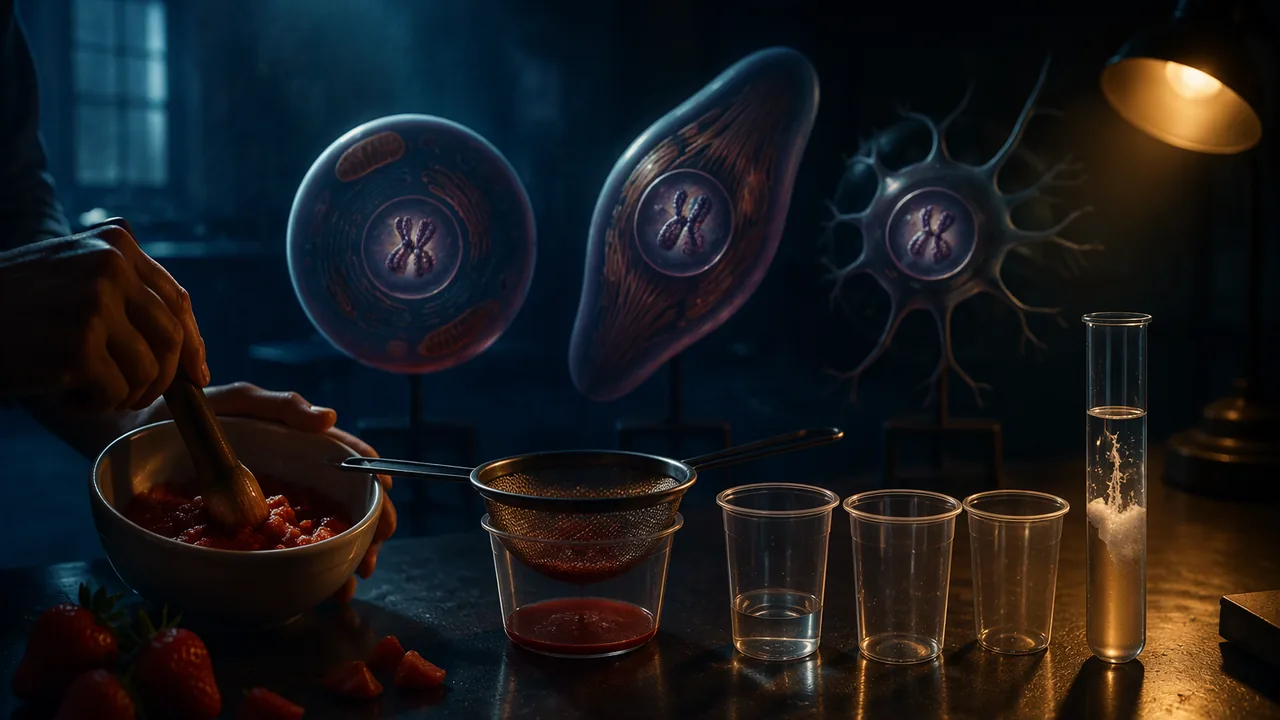
DNA, genes and chromosomes. DNA is a double helix: two strands of nucleotides twisted around each other. Each nucleotide carries one of four bases: adenine (A), thymine (T), guanine (G) or cytosine (C). The strands are held together by base pairs, and pairing follows a rule: A pairs with T, and G pairs with C. That rule has a testable consequence, first measured by Erwin Chargaff: in double-stranded DNA the amount of A equals the amount of T, and G equals C. If 30% of the bases in a sample are A, then 30% are T, and the remaining 40% is split equally, so 20% are G and 20% are C.
A gene is a stretch of DNA that carries the instructions for a product, usually a protein. A chromosome is one very long DNA molecule wound around proteins. The National Human Genome Research Institute describes the human genome as about 3 billion base pairs, carrying roughly 20,000 protein-coding genes, packaged into 23 pairs of chromosomes in almost every cell. Stretched out, the DNA in one human cell would be about 2 meters long, which gives you a sense of how tightly it is packed.
Almost every cell in an organism contains the complete set of DNA, and specialized cells arise from switching specific genes on and off.
📖 Read for this lesson
The reading opens over the lesson; close it to come back to exactly where you were. The checks below draw on it.
A segment of DNA that carries the instructions for making a product, usually a protein.
A long DNA molecule wound with proteins; human body cells have 23 pairs.
The complete set of DNA in an organism’s cells.
Specialized cells only have the genes they need to do their job, and they get rid of the rest.
Almost every specialized cell contains the full genome, but it only expresses the genes needed for its specific role, switching others on and off.
When you look at your own skin cells versus muscle cells, what questions come to mind about their genetic material?
A DNA sample is 22% adenine. It is % thymine and % guanine.
Why strawberries?
While the human genome contains about 3 billion base pairs, only a small portion of it consists of protein-coding genes.
Cultivated strawberries are octoploid: each cell has eight sets of chromosomes, so the fruit is rich in DNA. In the lab, you mash the fruit to break cell walls, add soap to dissolve the lipid membranes around the cell and the nucleus, add salt to help DNA strands clump, filter out the debris, and pour cold isopropyl alcohol on top. DNA does not dissolve in alcohol, so it comes out of solution as white strands at the boundary. You are seeing millions of DNA molecules clumped together, not a single strand and not individual genes.
Which evidence most directly supports the claim that a specialized cell still carries the whole genome?
The argument: do specialized cells keep all their genes?
A muscle cell and a skin cell look and act nothing alike. Claim A: each cell type keeps only the genes it needs and loses the rest. Claim B: almost every cell keeps the whole genome, and cell types differ because they switch different genes on and off. Consider the evidence.
- Plant cuttings. A strawberry runner or a single cut stem can grow into a whole new plant, with roots, leaves, flowers and fruit. The cells in the cutting still carried the instructions for every other cell type.
- Nuclear transfer. In 1962 John Gurdon transplanted the nucleus of a specialized intestinal cell from a tadpole into a frog egg whose own nucleus had been destroyed, and some developed into tadpoles. In 1996 Dolly the sheep was cloned from the nucleus of an adult mammary-gland cell.
- Gene expression data. Researchers measure which genes are being read in each tissue; the same gene can be active in liver and silent in muscle.
A strong argument also handles the exceptions honestly. Mammalian red blood cells lose their nucleus as they mature, and some immune cells cut and rejoin segments of their antibody genes. These are real exceptions, and they do not overturn the general pattern. Evidence decides: a single cell’s DNA must still hold the instructions for a whole organism if a whole organism can grow from it.
The process by which a gene’s instructions are used to make its product; cells switch genes on and off.
Key terms
The rule that in DNA adenine pairs with thymine and guanine pairs with cytosine.
Check your understanding
Not graded: these tell you whether the standard has landed yet.
Muscle cells and skin cells differ mainly because they contain different genes.
Write the rebuttal paragraph of your argument: state the strongest piece of evidence for the claim you reject, then explain with evidence why it does not overturn your claim.
Lab: Extracting DNA from strawberries
Question. Can we isolate DNA from plant cells, and what does each step of the extraction do?
Materials
- One fresh or thawed frozen strawberry in a zip-top bag
- Extraction buffer: 90 mL water, 10 mL clear dish soap and 1/2 teaspoon table salt, premixed in a cup
- Coffee filter or cheesecloth, a funnel and a clear glass, cup or narrow jar
- Ice-cold 70-91% isopropyl (rubbing) alcohol, chilled in a capped bottle in the home freezer by an adult
- Wooden coffee stirrer, toothpick or bamboo skewer
- Safety glasses or goggles
- Do this lab with an adult present. Wear safety glasses or goggles throughout; isopropyl alcohol irritates eyes.
- Isopropyl alcohol is flammable: work away from the stove, candles and any other flame or heat source. An adult pours the alcohol and caps the bottle again right away.
- Do not eat the strawberry or taste any solution; wipe spills at once and wash your hands at the end.
Procedure
- Remove the green top, seal the strawberry in the bag, and mash it with your fingers for two minutes until no large lumps remain.
- Add 10 mL of extraction buffer, reseal and mash gently for one more minute without making lots of foam.
- Pour the mixture through the filter in the funnel and collect about 5 mL of liquid in the cup or tube.
- Tilt the tube and slowly pour an equal volume of ice-cold alcohol down the side so it forms a separate layer on top. Do not mix.
- Watch the boundary for two minutes and record what you see. Twirl the stirrer at the boundary to spool the white strands.
- Record observations for each step. Have the supervising adult dispose of the used alcohol mixture as the bottle’s label directs, and wash all equipment.
Data
| Step | What we did | What we observed | Purpose of the step (our explanation) |
|---|---|---|---|
| Mashing | |||
| Soap and salt buffer | |||
| Filtering | |||
| Cold alcohol |
Analysis
- Explain the purpose of the soap, the salt and the cold alcohol, citing the structure of the cell and the properties of DNA.
- Someone tells you the white strands are individual genes. Use what you know about the size of DNA molecules and the number of cells in a strawberry to evaluate the claim.
- Write your argument for Claim A or Claim B with at least three pieces of evidence, and rebut one piece of evidence for the other claim.
- Identify two variables that could change how much DNA you collect and how you would test one of them.
If you cannot do this lab in person: If you cannot get the materials, use the step-by-step table in this lesson’s reading (what each step does and what the DNA looks like at the boundary) to complete the observation table, marking which entries come from the reading rather than your own observation, and write the same argument.
Practice
Work these on paper or in your notebook, then open Check your answer. Aim for all of Fluency and Application; try at least one Challenge.
Printable version: this unit’s practice workbook (PDF)
Fluency
Build speed and accuracy with the core skill.
- A DNA sample is 30% adenine. Give the percentages of T, G and C.
Check your answer
Answer: T 30%, G 20%, C 20%A = T; the remaining 40% splits equally between G and C. - A DNA sample is 18% adenine. Give the percentages of T, G and C.
Check your answer
Answer: T 18%, G 32%, C 32%100 − 36 = 64; 64 ÷ 2 = 32. - A DNA sample is 35% adenine. Give the percentages of T, G and C.
Check your answer
Answer: T 35%, G 15%, C 15%100 − 70 = 30; 30 ÷ 2 = 15. - Write the complementary DNA strand for 5′-ATGCCGTA-3′.
Check your answer
Answer: 3′-TACGGCAT-5′A pairs with T, G with C.
Application
Use the skill in context. Show your reasoning.
- Each base pair adds about 0.34 nm to the length of DNA. Estimate the length of the 3.1 billion base pairs in one set of human chromosomes, and of the two sets in a body cell.
Check your answer
Answer: About 1.05 m for one set and about 2.1 m for a body cell3.1 × 109 × 0.34 × 10−9 m = 1.054 m; doubled = 2.108 m. - Cultivated strawberries have eight sets of 7 chromosomes. How many chromosomes are in a body cell, and why does this help the extraction lab?
Check your answer
Answer: 56; with eight sets, each cell holds more DNA, so more DNA clumps out of solution.8 × 7 = 56. - State the purpose of the soap, the salt and the cold alcohol in the DNA extraction.
Check your answer
Answer: Soap dissolves the lipid membranes of the cell and nucleus; salt helps DNA strands clump together; DNA does not dissolve in cold alcohol, so it comes out of solution at the boundary.Link each step to a cell structure or a property of DNA.
Challenge
Stretch problems. Expect to think before you write.
- A student argues: “Red blood cells have no nucleus, so specialized cells lose their genes.” Write a two-sentence rebuttal using evidence from the lesson.
Check your answer
Answer: Sample: Mammalian red blood cells are an exception that loses its nucleus as it matures, but most specialized cells keep the whole genome. A nucleus from an adult mammary-gland cell produced Dolly the sheep, and stem cuttings grow whole plants, which is only possible if specialized cells still carry all the genes.Acknowledge the exception, then show that the general pattern rests on stronger evidence.
Review
Keep earlier skills sharp.
- How many moles are in 50.0 g of C6H12O6?
Check your answer
Answer: 0.278 molDivide by the molar mass, 180.16 g/mol.
The ability of a single cell to contain all genetic information for an organism is foundational to agricultural practices like plant cloning, allowing farmers and nurseries to propagate desirable plants, such as strawberries from runners, from cuttings, and also to medical research into stem cells.
Based on the evidence presented, explain how one specialized cell, like a skin cell, could theoretically grow into a whole new organism.
How confident are you that you can explain how DNA is organized into genes and chromosomes and argue why specialized cells keep their whole genome?
The Shift
- DNA forms genes and chromosomes.
- Cells specialize by turning genes on or off.
- Almost all specialized cells keep their whole genome.
DNA, Genes and Why Every Cell Keeps the Whole Genome
SLS reading for Biology A, drawing on NHGRI fact sheets on DNA and cloning and the NHGRI strawberry DNA extraction activity · SLS original
The structure of DNA
DNA is built from units called nucleotides. Each nucleotide has three parts: a phosphate group, a sugar (deoxyribose) and one of four nitrogen-containing bases: adenine (A), thymine (T), guanine (G) and cytosine (C). Sugars and phosphates link into a long backbone, and the bases stick out to one side. Two such strands pair up, bases facing inward, and twist into a double helix, like a ladder twisted along its length. The rungs are base pairs, and pairing follows a strict rule: A pairs with T, and G pairs with C.
That rule lets you write one strand from the other. The complement of 5′-ATGCCGTA-3′ is 3′-TACGGCAT-5′. (The 5′ and 3′ labels mark the two ends of a strand; the paired strands run in opposite directions.)
Chargaff’s rule: a pairing rule you can calculate
Because every A is paired with a T and every G with a C, double-stranded DNA always contains equal amounts of A and T, and equal amounts of G and C. Erwin Chargaff measured this before the double helix was known. Given one base’s percentage, you can find the rest:
- Its partner has the same percentage.
- Subtract both from 100%.
- Split what is left equally between the other pair.
| Given | A | T | G | C |
|---|---|---|---|---|
| 30% A | 30 | 30 | 20 | 20 |
| 22% A | 22 | 22 | 28 | 28 |
| 18% A | 18 | 18 | 32 | 32 |
| 35% A | 35 | 35 | 15 | 15 |
| 26% G | 24 | 24 | 26 | 26 |
For 22% A: T = 22%; 100 − 44 = 56; 56 ÷ 2 = 28% each for G and C. For 26% G: C = 26%; 100 − 52 = 48; A and T are 24% each.
Genes, chromosomes and genomes
A gene is a stretch of DNA carrying the instructions for a product, usually a protein. A chromosome is one very long DNA molecule wound around proteins, carrying hundreds or thousands of genes. The genome is the complete set of DNA in a cell. The National Human Genome Research Institute describes the human genome as about 3 billion bases and about 20,000 genes on 23 pairs of chromosomes.
How long is that DNA? Each base pair adds about 0.34 nm (0.34 × 10⁻⁹ m) to the length of the helix. One set of about 3.1 billion base pairs is 3.1 × 109 × 0.34 × 10−9 m ≈ 1.05 m long. A body cell has two sets, one from each parent, so about 2.1 m of DNA is packed into a nucleus a few micrometers across. That is only possible because the DNA is wound tightly around proteins.
What happens in the strawberry extraction
Cultivated strawberries are octoploid: their cells carry eight sets of 7 chromosomes, 8 × 7 = 56 in all, so the fruit is rich in DNA and ripe fruit is soft and easy to mash.
| Step | What it does |
|---|---|
| Mashing | Breaks up the tissue and the cell walls, exposing the cells |
| Soap | Dissolves the lipid membranes around the cell and the nucleus, releasing the DNA |
| Salt | Helps the DNA strands clump together so they can come out of solution |
| Filtering | Removes seeds, cell walls and other debris |
| Ice-cold alcohol | DNA does not dissolve in alcohol, so it comes out of solution as white strands where the layers meet; cold makes this happen faster |
What you spool on the stirrer is not a single molecule and certainly not an individual gene. A single DNA molecule is only about 2 nm wide, far too thin to see. The visible strands are millions of long DNA molecules from many thousands of cells, tangled together.
The argument: do specialized cells keep every gene?
Claim A: each cell type keeps only the genes it needs and loses the rest. Claim B: almost every cell keeps the whole genome; cell types differ because they switch different genes on and off. The evidence strongly favors B.
- Plant cuttings. A strawberry runner or a single cut stem can grow a whole new plant with roots, leaves, flowers and fruit. The cells of a stem still held instructions for every other cell type.
- Nuclear transfer in frogs. In 1962 John Gurdon transplanted the nucleus of a specialized intestinal cell from a tadpole into a frog egg whose own nucleus had been destroyed; some of these eggs developed into tadpoles.
- Dolly the sheep. In 1996 researchers cloned the first mammal from a cell taken from an adult: a mammary-gland (udder) cell of a 6-year-old sheep. NHGRI notes it took 276 attempts. The low success rate shows the method is difficult, but even one success proves that the specialized nucleus still contained every instruction needed to build a whole sheep. This is the most direct evidence for Claim B.
- Gene expression data. When researchers measure which genes are being read in each tissue, the same gene can be active in liver and silent in muscle, even though both tissues contain it.
Handling the exceptions
A strong argument deals honestly with counter-evidence. Mammalian red blood cells lose their nucleus as they mature, so they really do lack genes. Some immune cells cut and rejoin pieces of their antibody genes. These are genuine exceptions, but they are special cases in a few cell types. A rebuttal paragraph can say so directly: red blood cells do lose their nucleus, but that is one exception; a nucleus from an adult mammary-gland cell produced a whole sheep, and stem cuttings grow whole plants, which is only possible if specialized cells still carry all the genes. Two separate lines of evidence outweigh one special case, and the general rule is that differences between cells come from gene expression, not from different genes. Muscle cells and skin cells differ because they express different genes, not because they contain different ones.
Review: grams and moles
To convert a mass to moles, divide by the molar mass. For glucose (180.16 g/mol), 36 g is 36 ÷ 180.16 = 0.200 mol; for water (18.015 g/mol), 4.5 g is 0.250 mol.
Sources: NHGRI: Deoxyribonucleic Acid (DNA) Fact Sheet (genome.gov); NHGRI: Cloning Fact Sheet (genome.gov); NHGRI teaching tool: Strawberry DNA Extraction (genome.gov); USDA ARS AgLab: Extracting DNA From Strawberries (aglab.ars.usda.gov); A roadmap for research in octoploid strawberry (PubMed, NIH) (pubmed.ncbi.nlm.nih.gov)