How can a small stump of cells rebuild skin, muscle, cartilage, nerves, and blood vessels, and why is the result different from the original?
describe the stages of the cell cycle, explain why growth and repair require both cell division and differentiation, and ask testable questions about tail regrowth in lizards.
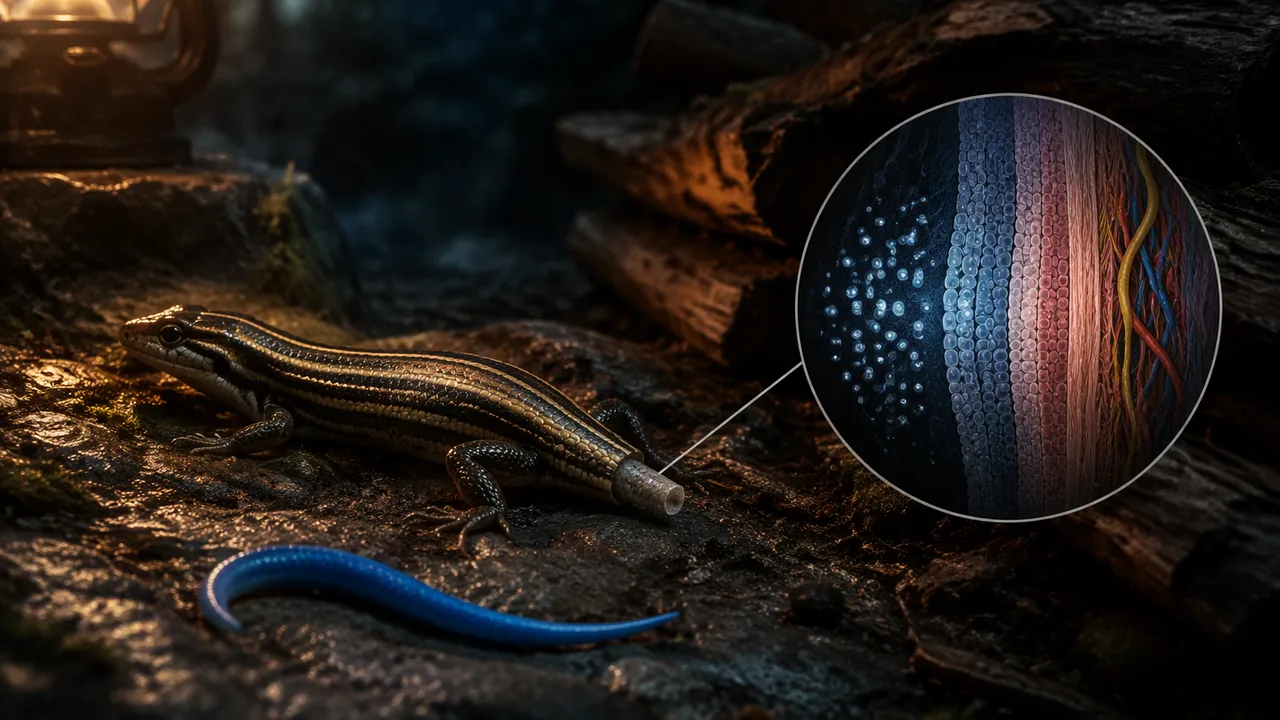
The phenomenon. The common five-lined skink is, according to the Missouri Department of Conservation (MDC), one of the most abundant lizards in Missouri. It lives nearly statewide, in open woods, on rocky hillsides and around rock piles, woodpiles and patios, and its young have a bright blue tail, which is why it is also called the blue-tailed skink. It has an escape trick. When a predator, such as the domestic cats that MDC notes prey heavily on lizards, grabs its tail, the tail breaks off easily. The break happens at a weak plane inside a vertebra, muscles pinch off the blood vessels so very little blood is lost, and the wriggling tail distracts the predator while the skink runs. Over the following weeks a new tail grows from the stump. It is not an exact copy: MDC describes the regrown portion of a five-lined skink’s tail as shorter than the original and a drab gray, and in lizards that have been studied closely inside, such as the green anole, the new tail is supported by a tube of cartilage instead of a chain of bony vertebrae. Our question for the unit: how can a small stump of cells rebuild skin, muscle, cartilage, nerves and blood vessels, and why is the result different from the original?
Growth and repair, such as a lizard regrowing its tail, depend on both the division of cells and their differentiation into specialized types.
📖 Read for this lesson
The reading opens over the lesson; close it to come back to exactly where you were. The checks below draw on it.
What aspects of the skink’s tail regrowth seem most surprising or puzzling to you?
A regrown lizard tail is supported by a cartilage tube instead of bony vertebrae, and a five-lined skink’s regrown tail is shorter and drab gray. What does that tell you about regrowth?
More cells: the cell cycle
Some animals, like axolotls, can regenerate entire limbs, including bone, muscle, nerves, and blood vessels.
A tail is made of cells, so growing one means making new cells. Cells reproduce by the cell cycle. Most of the cycle is interphase, when the cell grows (G1), copies every chromosome (S phase) and prepares to divide (G2). After the S phase each chromosome consists of two identical sister chromatids joined at a centromere. Then comes mitosis, the division of the nucleus, in four stages: in prophase the chromosomes condense and become visible; in metaphase they line up across the middle of the cell; in anaphase the sister chromatids are pulled to opposite ends; in telophase two new nuclei form. Cytokinesis then splits the cytoplasm. The result is two daughter cells with the same chromosomes as the parent cell.
The sequence of growth, DNA copying and division that a cell goes through to produce two daughter cells.
Division of the nucleus into two nuclei with identical sets of chromosomes, in four stages: prophase, metaphase, anaphase and telophase.
The two identical copies of a chromosome made during S phase, joined at the centromere until anaphase.
In which stage do sister chromatids separate and move to opposite ends of the cell?
How many divisions?
Each round of division can double the number of cells, so after n rounds one cell could become 2n cells. One widely cited 2013 estimate puts the number of cells in an adult human body at about 37 trillion (3.7 × 10¹³). Because log2(3.7 × 10¹³) ≈ 45, it would take at least 45 rounds of doubling to get there from a single fertilized egg. The real number of divisions is far larger, because many cells die and are replaced throughout life.
When a lizard regrows its tail, all the new cells are identical copies of the original cells in the stump.
New cells not only divide but also differentiate, becoming specialized cells like muscle, cartilage, skin, or nerve cells, each with a different structure and function.
After 10 rounds of doubling, one cell could become cells.
Division is not enough: differentiation
If mitosis made only copies, a regrowing tail would be a ball of identical cells. Instead, new cells differentiate: they become muscle, cartilage, skin or nerve cells with different shapes and jobs. Almost every cell in the lizard carries the same DNA. What differs is which genes are switched on. A muscle cell makes large amounts of the proteins actin and myosin, while a skin cell makes keratin. Cells that can still divide and become several cell types are called stem cells, and lizard tail regrowth depends on cells near the wound that behave this way.
An unspecialized cell that can divide and give rise to one or more types of specialized cell.
Draw an initial model of the stump of a skink’s tail two weeks after it was dropped. Show where you think cells are dividing and where they are becoming specialized. Then write two testable questions your model raises.
Division under control
Cells check for damaged DNA and for correctly attached chromosomes at checkpoints before they move on. When those controls fail and a cell divides without limits, the result can be cancer, as the National Cancer Institute explains. Regrowth has to start, and it also has to stop.
Questions to test
Why can lizards regrow tails? is a starting point. Are there more dividing cells near the tip of a growing onion root than 5 mm behind it? is testable, and you will test a version of it in the next lab.
Key terms
The process by which a cell becomes specialized in structure and function by expressing a particular set of genes.
Practice
Work these on paper or in your notebook, then open Check your answer. Aim for all of Fluency and Application; try at least one Challenge.
Printable version: this unit’s practice workbook (PDF)
Fluency
Build speed and accuracy with the core skill.
- Put the stages in order, starting after interphase: anaphase, prophase, telophase, metaphase.
Check your answer
Answer: prophase, metaphase, anaphase, telophaseChromosomes condense, line up, separate, and then two nuclei form. - In which part of the cell cycle is DNA copied?
Check your answer
Answer: The S (synthesis) phase of interphaseAfter S phase each chromosome has two sister chromatids. - Starting from one cell, how many cells could there be after 20 rounds of doubling?
Check your answer
Answer: 1,048,576 (220)Each round doubles the number: 220. - A body cell of an onion has 16 chromosomes. How many chromosomes does each daughter cell have after mitosis?
Check your answer
Answer: 16Mitosis produces daughter cells with the same chromosome number as the parent.
Application
Use the skill in context. Show your reasoning.
- Cells in a wound divide every 20 hours. How long would it take one cell to produce about 1,000 cells, and about how many days is that?
Check your answer
Answer: 10 divisions, 200 hours, about 8.3 days210 = 1,024 ≈ 1,000; 10 × 20 = 200 h; 200 ÷ 24 ≈ 8.3 days. - About how many rounds of doubling are needed to turn one cell into one million cells?
Check your answer
Answer: About 20 (220 ≈ 1.05 million)log2(1,000,000) ≈ 19.9, so 20 rounds. - A muscle cell and a skin cell from the same lizard have the same DNA. Explain why they make different proteins.
Check your answer
Answer: Each cell type expresses a different set of genes; the muscle cell transcribes genes for actin and myosin, the skin cell genes for keratin.Differentiation is a matter of gene expression, not of different DNA.
Challenge
Stretch problems. Expect to think before you write.
- A regrowing tail needs roughly 108 cells (an illustrative figure), starting from about 104 dividing cells at the wound. If every cell divides once every 24 hours and none die, how many days would regrowth take? Why is the real time longer?
Check your answer
Answer: About 14 days (log2(104) ≈ 13.3, so 14 doublings). Real regrowth is slower because not all cells divide at once, some die, cells must differentiate, and division slows as the tail forms.Needed increase = 108/104 = 104; log2(104) = 13.3; round up to 14 × 24 h = 14 days.
Review
Keep earlier skills sharp.
- Using 6CO2 + 6H2O → C6H12O6 + 6O2, how many molecules of CO2 are needed to make 3 molecules of glucose?
Check your answer
Answer: 186 CO2 per glucose × 3 = 18.
Understanding how animals like Missouri’s common five-lined skink regrow parts can help scientists research new ways to repair human tissues or understand uncontrolled cell growth in diseases like cancer.
Based on what you’ve learned about cell division and differentiation, how do you think the skink controls when and where different types of cells are made during tail regrowth?
How confident are you that you can describe the cell cycle and explain why regrowth needs both division and differentiation?
The Shift
- Cells divide through the cell cycle and mitosis.
- Cells specialize in structure and function through differentiation.
- Stem cells are unspecialized cells essential for growth and repair.
The Cell Cycle, Differentiation and a New Tail
SLS reading for RLP Biology A, drawing on the Missouri Department of Conservation field guide (common five-lined skink), NIH Stem Cell Information, the National Cancer Institute, the NHGRI Talking Glossary and a PubMed Central study of lizard tail autotomy; Missouri facts retrieved November 5, 2026 · SLS original
A tail built to break
The common five-lined skink (Plestiodon fasciatus) is, in the words of the Missouri Department of Conservation (MDC), one of the most abundant lizards in Missouri and is often seen by people. It lives nearly statewide, in open woods, along wooded bluffs and on rocky hillsides, and also around farm buildings, rock piles, firewood piles and patios. Hatchlings and young adults are black with five yellow stripes and a bright blue tail, which is why it is also called the blue-tailed skink; adults reach 5 to 8¾ inches in total length. Like most skinks, it can drop its tail when a predator grabs it. This self-amputation, called autotomy, happens at built-in weak planes, and the dropped tail keeps wriggling for a while, distracting the predator while the skink escapes. MDC notes that very little blood is lost and that a new tail eventually grows back, though the regrown portion is shorter than the original and a drab gray. Rebuilding one requires two things: a great many new cells, and cells of the right kinds in the right places. The first comes from cell division; the second from differentiation.
The cell cycle
A dividing cell spends most of its time in interphase. In G1 it grows and does its normal work. In the S phase (synthesis) it copies its DNA, so each chromosome becomes two identical sister chromatids joined at a centromere. In G2 it checks the copies and prepares to divide. Then comes mitosis, the division of the nucleus:
| Stage | What you would see |
|---|---|
| Prophase | Chromosomes condense into visible threads; the nuclear envelope breaks down |
| Metaphase | Chromosomes line up across the middle of the cell |
| Anaphase | Sister chromatids separate and are pulled to opposite ends |
| Telophase | Two new nuclei form around the two sets of chromosomes |
Finally cytokinesis divides the cytoplasm, making two daughter cells. A memory aid for the order is P-M-A-T. Because each daughter gets one chromatid of every chromosome, both have exactly the parent’s chromosome number: an onion body cell with 16 chromosomes produces daughters with 16. That is why DNA must be copied first; without the S phase there would be nothing to split between the two cells.
How fast can cells add up?
If every cell divides, the number doubles each round. After n rounds, one cell could become 2n cells.
| Rounds of doubling | 1 | 2 | 3 | 10 | 20 |
|---|---|---|---|---|---|
| Cells from one cell | 2 | 4 | 8 | 1,024 | 1,048,576 |
To run this backward, ask how many doublings reach a target: that is log2 of the growth factor. One million cells needs log2(1,000,000) ≈ 19.9, so about 20 rounds. If wound cells divide every 20 hours, about 1,000 cells (210 = 1,024) takes 10 × 20 = 200 hours, about 8.3 days. For a whole human body, one widely cited 2013 estimate is about 37 trillion cells; log2(3.7 × 10¹³) ≈ 45, so at least about 45 rounds from a single fertilized egg. Real bodies need far more divisions, because cells die and are replaced throughout life.
Try it on a tail. Suppose (illustrative figures) about 104 cells at the wound must become 108. The growth factor is 108 ÷ 104 = 104, and log2(104) ≈ 13.3, so 14 doublings. At one division per 24 hours, that is 14 days. Real regrowth is slower, because not every cell divides at once, some die, cells must stop to differentiate, and division slows as the tail takes shape.
Division is not enough: differentiation
If mitosis were the whole story, the stump would grow a ball of identical cells. Instead, new cells differentiate, becoming muscle, cartilage, skin, nerve or blood-vessel cells with different shapes and jobs. The surprising part is that they do this without changing their DNA. Almost every cell in the lizard carries the same genes. What differs is which genes are switched on, or expressed. A muscle cell expresses the genes for the contractile proteins actin and myosin; a skin cell expresses genes for keratin. Same instructions, different pages being read.
Cells that can still divide and give rise to one or more specialized cell types are called stem cells. The NIH distinguishes pluripotent stem cells, which can become any cell type of the adult body, from adult (tissue) stem cells, which produce the specialized cells of their own tissue or organ. Tail regrowth depends on cells near the wound that behave in this stem-like way.
Why the new tail is different
The five-lined skink’s regrown tail is shorter and a drab gray. In lizards whose regrown tails have been studied closely inside, such as the green anole, the new tail is supported by a tube of cartilage instead of a chain of bony vertebrae, and its scales and color may differ. The new cells carry the same DNA as the rest of the lizard, so the difference cannot be different genes. It comes from differentiation following a different path: the signals that guide cells in an adult wound are not the same as those that guided cells in the developing embryo, so different sets of genes are switched on and a different tissue forms. Exactly which signals are involved is still being researched.
Division under control
Cells pass through checkpoints that ask, in effect, “Is the DNA undamaged? Is it fully copied? Are the chromosomes attached correctly?” before moving on. According to the National Cancer Institute, cancer is a disease in which some cells grow uncontrollably; it can begin when changes in genes that control division let cells divide when they should not. Regeneration shows the other side of the same controls: growth must start after an injury, and it must stop when the job is done.
Asking testable questions
“Why can lizards regrow tails?” is too broad to test directly. “Are there more dividing cells near the tip of a growing onion root than 5 mm behind it?” names what to compare and what to count, so it is testable, and you will test a version of it next lesson.
Review
From 6CO2 + 6H2O → C6H12O6 + 6O2, each glucose needs 6 CO2, so 3 glucose molecules need 3 × 6 = 18 CO2.
Sources: Missouri Department of Conservation Field Guide: Common Five-Lined Skink (mdc.mo.gov); NIH Stem Cell Information: Stem Cell Basics (stemcells.nih.gov); National Cancer Institute: What Is Cancer? (cancer.gov); NHGRI Talking Glossary: Mitosis (genome.gov); Unique Structural Features Facilitate Lizard Tail Autotomy (PubMed Central, NIH) (pmc.ncbi.nlm.nih.gov)