How does something as massive as a 400-year-old bur oak grow from invisible air, and where does all that carbon eventually end up?
construct and defend an explanation, with a matter-and-energy model and calculations, of how a giant bur oak built its mass and where its carbon goes.
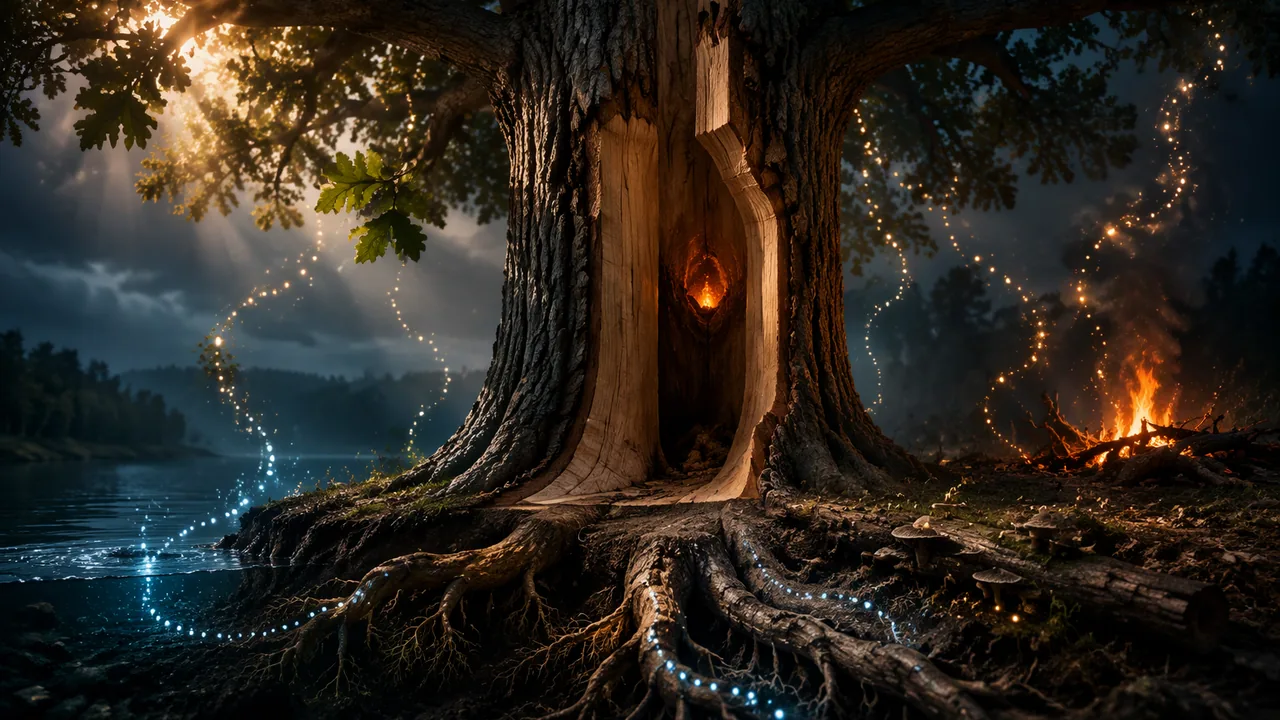
The question. How did a giant bur oak build its enormous mass from air, water and light, and where does its carbon go when it respires, dies, decays or burns?
All the matter that makes up a giant bur oak, and the energy that sustains it, can be tracked as it moves through different forms and reservoirs.
📖 Read for this lesson
The reading opens over the lesson; close it to come back to exactly where you were. The checks below draw on it.
What does it mean for something to ‘build its mass’ from invisible gases and water?
A tree adds 250 kg of dry wood (about half carbon). About how much CO2 did it remove from the air?
What your explanation must include
The carbon in the McBaine bur oak’s oldest wood has been locked away for centuries; the National Park Service estimates the tree is 350 to 400 years old.
- Inputs and the equation. The balanced photosynthesis equation, with a mass check using molar masses, and a sentence explaining which atoms come from carbon dioxide and which from water. Remember: the oxygen gas released comes from water.
- From sugar to wood. How glucose becomes cellulose, and how its carbon, hydrogen and oxygen combine with nitrogen and phosphorus from the soil to make proteins and nucleic acids.
- A carbon calculation. Use the relationship from Lesson 2.4: dry wood is roughly half carbon, and each kilogram of carbon came from 3.664 kg of CO2. For example, if a tree adds 250 kg of dry wood in a decade, that is about 125 kg of carbon, drawn from about 125 × 3.664 ≈ 458 kg of CO2. Choose your own figure and show every step; label it illustrative unless you have a source.
- Energy. Trace light energy into chemical bonds and then, through respiration, into ATP and heat. Explain why the tree must respire day and night.
- Where the carbon goes. Explain at least two exits: respiration by the living tree; decomposition by fungi and bacteria after death (aerobic or, in waterlogged ground, anaerobic); and combustion in a fire, which releases stored carbon quickly. Bur oaks are highly fire adapted: thick bark insulates the living tissue beneath it, so mature trees usually survive low-severity fire. But in October 2020 lightning struck the McBaine bur oak and left hot spots smoldering in the middle of its trunk, which firefighters had to cut into the trunk to reach. Say how each process moves carbon between reservoirs.
- Evidence. Use your leaf-disk data (photosynthesis depends on light energy), your yeast data (respiration releases CO2; anaerobic pathways yield less energy), and the Mauna Loa seasonal cycle (the biosphere visibly exchanges carbon with the atmosphere).
Rapid reaction of fuel with oxygen, releasing energy as heat and light and carbon as CO2.
Plants get their food from the soil through their roots.
Plants produce their own food (sugars) through photosynthesis, using carbon dioxide from the air and water. They absorb minerals from the soil, but not their energy-rich food.
When oak wood burns, in a wildfire or smoldering inside a lightning-struck trunk, the carbon in it returns to the atmosphere mainly as carbon dioxide.
A model worth drawing
Four boxes (atmosphere, bur oak, soil and decomposers, ocean) with arrows labeled photosynthesis, respiration, decomposition, combustion and dissolving. Use one color for matter arrows and another for energy arrows. Energy arrows should start at the Sun and end as heat leaving the system.
Write the energy part of your explanation in four sentences: where energy enters, where it is stored, how it is released, and where it ends up.
Common errors to avoid
Saying plants get their food from the soil; saying energy is recycled; saying plants photosynthesize instead of respiring; and giving numbers without units. Your reviewer, or your own self-check, will look for all four.
Presentation
Four minutes, recorded (or given live to a parent or guardian and recorded). Walk through your model and answer one question on how matter or energy is tracked in it.
Key terms
An accounting of the carbon entering and leaving a system, such as a tree or a forest.
The mass of living or once-living material.
Unit 2 checkpoint
Do this before you start the task. It covers the whole unit and tells you what to review first.
Most of the dry mass of a giant bur oak came from:
In 6CO2 + 6H2O → C6H12O6 + 6O2, each side has oxygen atoms.
The oxygen gas released in photosynthesis comes from:
If ET50 = 16 minutes, the rate 1/ET50 is per minute.
Plants carry out photosynthesis instead of cellular respiration.
Which is produced by alcoholic fermentation but not by aerobic respiration?
In cellular respiration, energy is released because:
Each kilogram of carbon in wood came from about kg of carbon dioxide.
Energy cycles through an ecosystem in the same way carbon does.
Which element must a plant take from the soil to turn sugar into amino acids?
Why does the Mauna Loa CO2 record fall each Northern Hemisphere summer?
Submit: The Bur Oak’s Carbon Budget (900-1,300 words with matter-and-energy model) + four-minute presentation
Task: Explain, with a labeled matter-and-energy model and at least one carbon calculation, how a giant bur oak built its mass from carbon dioxide, water and light energy, how sugar carbon becomes the tree’s other molecules, and where the carbon goes through respiration, decomposition and fire. Use evidence from the leaf-disk lab, the yeast lab and the NOAA Mauna Loa record. Hand-drawn models are fully acceptable.
Submission workflow
- Stage 1 — Plan. A first-draft model, your carbon calculation with units, and a list of the lab evidence you will use for each part.
- Stage 2 — Reviewed draft. A reviewer (a parent, guardian or other adult reader) uses the checklist to check atom and mass balances, the direction of every arrow, and the four common errors; if no reviewer is available, set the draft aside for a day and complete the checklist yourself. Submit the checklist notes and your revision plan.
- Stage 3 — Final explanation. 900-1,300 words with the revised model, calculations, data displays and citations.
- Stage 4 — Presentation and defense. Four minutes, recorded, ending with your answer to the question provided with the task about matter or energy in your model.
How it is scored
| Criterion | What proficient looks like |
|---|---|
| Photosynthesis model (9-12.LS1.C.1) | Balanced equation with a correct mass check; explains the sources of each atom and the role of light energy. |
| Sugar to biomolecules (9-12.LS1.C.3) | Explains how sugar carbon forms cellulose, proteins and other molecules, including the elements from soil. |
| Respiration and energy (9-12.LS1.C.2) | Explains respiration as bonds broken and re-formed with net energy transfer to ATP and heat, day and night. |
| Carbon cycling (9-12.LS2.B.3) | Model shows reservoirs and processes, including decomposition and combustion, with arrows in the right direction. |
| Mathematics (SEP.5) | Carbon calculation correct with units and clearly stated assumptions. |
| Evidence and communication (RST.9-10.1) | Claims tied to lab data and the NOAA record; presentation answers a question accurately. |
When lightning struck the McBaine bur oak on October 23, 2020, hot spots smoldered inside its trunk, a small-scale example of how fire rapidly returns stored carbon to the atmosphere.
How does tracking carbon and energy help us understand the interconnectedness of living things and Earth’s systems?
How confident are you that you can explain with a model and calculation how a tree builds its mass and where its carbon goes?
The Shift
- Trees build mass using air, water, light.
- Carbon and energy are tracked in a budget.
- Fire quickly releases stored carbon.
A Bur Oak’s Carbon Budget: Deposits and Withdrawals
SLS reading for RLP Biology A, drawing on the Missouri Department of Conservation and National Park Service accounts of the McBaine champion bur oak, the USDA Forest Products Laboratory Wood Handbook, the USDA Forest Service Fire Effects Information System, KOMU News (October 23, 2020), the USDA Forest Service Missouri forest inventory and the NOAA Mauna Loa record; retrieved November 5, 2026 · SLS original
A carbon budget is an account book
A bank statement lists money coming in, money going out and the balance. A carbon budget does the same for carbon atoms. For a giant bur oak the main deposit is photosynthesis; the withdrawals are respiration while the tree lives and, after it dies, decomposition or fire. The balance is the carbon stored in its wood, bark, roots and leaves. Your explanation has to track two things through this account: matter, which is conserved and cycles, and energy, which flows through once and leaves as heat.
Deposits: building a tree from air
Start with the balanced equation and a mass check per mole of glucose:
6CO2 + 6H2O + light energy → C6H12O6 + 6O2
Reactants: 6(44.009) + 6(18.015) = 372.144 g. Products: 180.156 + 6(31.998) = 372.144 g. Say where the atoms come from: the carbon in sugar comes only from CO2; the hydrogen comes from water; the oxygen gas released comes from water, split in the light-dependent reactions. Your leaf-disk data are evidence that light energy drives the process: in the illustrative data set the rate fell from 0.154 per minute at 10 cm to 0.048 per minute at 40 cm, and disks kept in the dark should stay sunk (check your own dark cup).
Then follow sugar into wood. Glucose units are chained into cellulose, the bulk of cell walls and wood, and into starch. Sugar carbon is rearranged into lipids. With nitrogen taken from the soil, it becomes amino acids and proteins; with phosphorus from the soil, it becomes DNA and ATP. Soil supplies these elements, but in small amounts compared with the carbon, hydrogen and oxygen from air and water.
Doing the carbon calculation
Two relationships from Lesson 2.4: dry wood is roughly half carbon, and each kilogram of carbon came from 44.009 ÷ 12.011 = 3.664 kg of CO2.
| Step | Small tree (illustrative) | McBaine bur oak lower trunk (estimate) |
|---|---|---|
| Dry wood | 250 kg added in a decade | 20.1 m3 (cylinder 7.493 m around, 4.5 m tall, assumed) × 580 kg/m3 ≈ 11,660 kg |
| Carbon (half) | 125 kg | ≈ 5,830 kg |
| CO2 removed (× 3.664) | ≈ 458 kg | ≈ 21,400 kg (about 21 tonnes) |
The trunk circumference, 295 inches (7.493 m), is the Missouri Department of Conservation’s measurement, and the density comes from bur oak’s specific gravity of 0.58 (green volume) in the U.S. Forest Products Laboratory’s Wood Handbook; the cylinder shape, the 4.5 m height and the half-carbon fraction are assumptions. Label them that way. A calculation with stated assumptions and units is science; the same number without them is a guess. A common error is to forget the factor of 3.664 and report the carbon mass as if it were the CO2 mass.
Energy: in, stored, released, lost
Here is the energy story in four sentences, the shape your own paragraph should take. Energy enters the tree as sunlight absorbed by chlorophyll. It is stored in the chemical bonds of glucose and the molecules built from it. It is released when cells break those bonds in cellular respiration, making ATP that powers growth, transport and repair. Every transfer loses some energy as heat, and all of it eventually leaves the tree as heat, which is why energy flows through the system instead of cycling.
The tree must respire day and night. Its cells need ATP at all times, and at night there is no light for photosynthesis. Your yeast lab supports the chemistry: living cells break down sugar and release CO2, and without oxygen they get far less energy (2 ATP per glucose instead of about 30).
Withdrawals: where the carbon goes
- Respiration by the living tree. Some of the sugar each year is broken back down to CO2 and water. Biosphere → atmosphere.
- Decomposition. When needles, branches or the whole tree die, fungi and bacteria digest the wood and respire its carbon as CO2. In well-drained forest soil this is aerobic; in waterlogged ground it is anaerobic and much slower, which is how organic soil builds up in Missouri’s spring-fed Ozark fens. Biosphere → soil → atmosphere.
- Combustion. Fire reacts wood with oxygen, returning its carbon to the air mainly as CO2 (with some carbon monoxide and smoke particles) in hours instead of centuries. The overall chemistry resembles respiration, but the energy is released all at once as heat and light, not captured as ATP.
- Dissolving. Some atmospheric CO2, including carbon that came from trees, dissolves in the ocean, where algae can take it up by photosynthesis.
Bur oaks and fire
According to the U.S. Forest Service’s Fire Effects Information System, bur oak is highly fire adapted. The thick bark of mature trees insulates the living cambium beneath it from heat; in one Illinois study the thickest bark measured was 2.9 inches (7.4 cm), on a tree 52.9 inches in diameter. Ecologists class bur oak as a fire “resister” that typically survives low-severity fire, and in most of its habitats it needs frequent fire to persist, because fire clears out the trees that would otherwise shade it. Fire can still reach the carbon inside. On the morning of October 23, 2020, witnesses saw lightning strike the McBaine bur oak during a storm, and smoke began coming out of its trunk. KOMU News reported that the Boone County Fire District spent the morning putting out hot spots in the middle of the trunk and planned to remove sections of it to find any that remained. In carbon terms, that smoldering heartwood was combustion: wood that had stored carbon for centuries reacting with oxygen and leaving as CO2 in a few hours. The tree survived; the Missouri Department of Conservation still featured it as the state champion in 2021.
Scale the account up and the same arithmetic covers a whole state. The U.S. Forest Service’s inventory Missouri Forests 2013 estimated 15.5 million acres of forest land in Missouri. Every acre is running the same budget: deposits by photosynthesis, withdrawals by respiration, decomposition and fire.
A third line of evidence
The Mauna Loa CO2 record shows the biosphere’s account being settled every year. CO2 falls from a May peak to a September or October low by about 5 to 6 ppm as Northern Hemisphere plants photosynthesize, then rises again in winter as respiration and decay dominate. Use it as evidence that the exchange between trees and air is large enough to measure from a mountaintop in the middle of the Pacific.
Four errors your reviewer will look for
- “Plants get their food from the soil.” They make it from CO2 and water; soil gives minerals.
- “Energy is recycled.” Matter cycles; energy enters as light and leaves as heat.
- “Plants photosynthesize instead of respiring.” They do both; respiration never stops.
- Numbers without units, or illustrative figures presented as measurements.
In your model, draw boxes for the atmosphere, the bur oak, soil and decomposers, and the ocean; label arrows for photosynthesis, respiration, decomposition, combustion and dissolving; and use a different color for energy arrows running from the Sun to heat leaving the system.
Sources: Missouri Department of Conservation, Xplor (September 2021): Big Tree Hunters (McBaine champion bur oak: 74 ft tall, 295 in around, 129 ft crown spread) (mdc.mo.gov); National Park Service, Lewis and Clark National Historic Trail: McBaine Burr Oak (nps.gov); USDA Forest Products Laboratory, Wood Handbook (FPL-GTR-190), Chapter 5, Table 5-3a: bur oak specific gravity 0.58 (green) (research.fs.usda.gov); USDA Forest Service, Fire Effects Information System: Quercus macrocarpa (bur oak) (fs.usda.gov); KOMU 8 News (Columbia, Mo.), October 23, 2020: Smoke comes from Big Tree after witnesses say lightning struck it (komu.com); USDA Forest Service, Missouri Forests 2013 (Resource Bulletin, 2016) (research.fs.usda.gov); NOAA Global Monitoring Laboratory: Trends in Atmospheric Carbon Dioxide (Mauna Loa) (gml.noaa.gov); Missouri Department of Conservation, Missouri Conservationist (July 2024): Nature Lab, karst fen soils (mdc.mo.gov)