What makes plant leaves produce oxygen, and how can we measure what speeds it up or slows it down?
measure the rate of photosynthesis with floating leaf disks, control variables, and explain how light intensity affects the rate.
Inside the chloroplast. Photosynthesis happens in two linked stages. In the light-dependent reactions, on the thylakoid membranes, chlorophyll absorbs light energy. That energy splits water molecules, releasing oxygen gas, and is stored temporarily in two energy carriers, ATP and NADPH. In the Calvin cycle, in the fluid around the thylakoids (the stroma), the enzyme rubisco attaches carbon dioxide to an existing five-carbon sugar, and ATP and NADPH power the steps that turn the product into three-carbon sugars, which the plant uses to build glucose. The oxygen released comes from water, not carbon dioxide; experiments in the 1940s using heavy oxygen isotopes showed this.
The rate at which plants photosynthesize depends on the available light, which can be measured by observing oxygen production.
📖 Read for this lesson
The reading opens over the lesson; close it to come back to exactly where you were. The checks below draw on it.
The first stage of photosynthesis, on the thylakoid membranes, in which light energy splits water, releases oxygen, and makes ATP and NADPH.
The second stage of photosynthesis, in the stroma, in which carbon dioxide is fixed into sugar using ATP and NADPH.
What connections can you imagine between the amount of sunlight a plant gets and how well it grows?
If ET50 is 13.5 minutes, the rate 1/ET50 is about per minute (three decimal places).
How the disks work
The enzyme rubisco, which fixes carbon dioxide in the Calvin cycle, is the most abundant protein on Earth.
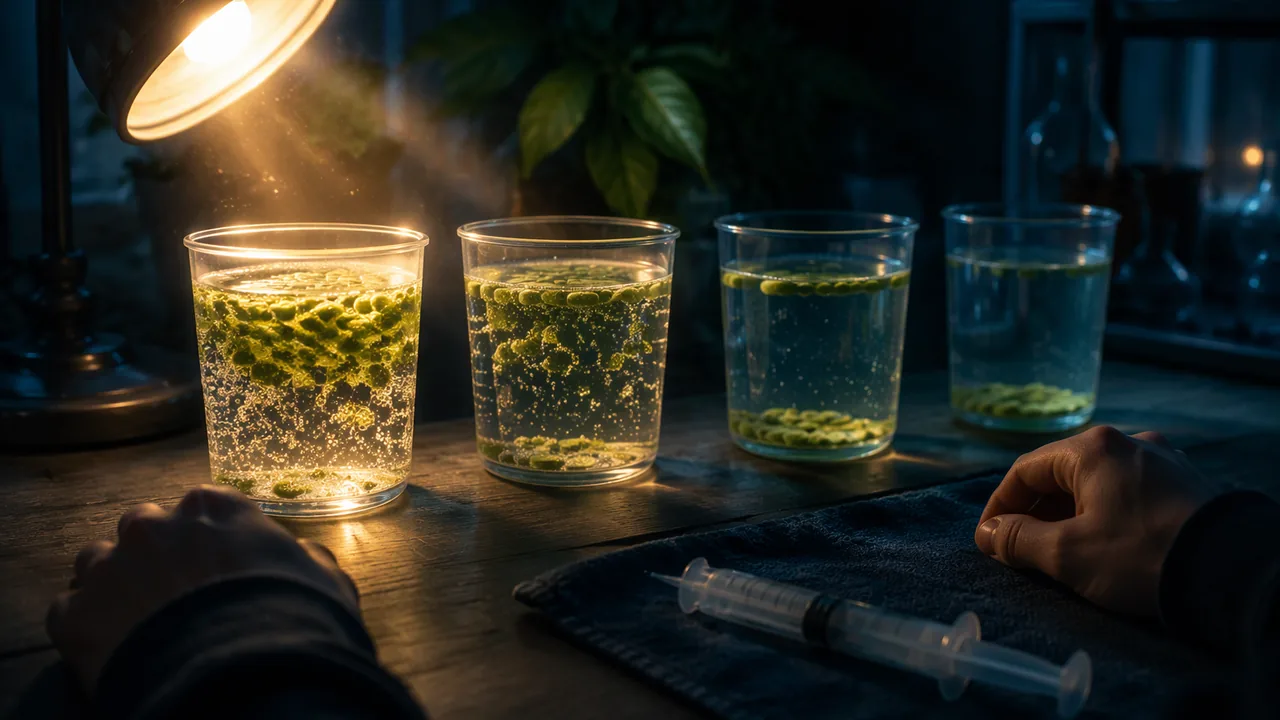
A leaf is full of air spaces, which is why a leaf floats. If you pull the air out with a syringe and replace it with a weak solution of baking soda (sodium bicarbonate, a source of dissolved carbon dioxide), the disks sink. In light, they photosynthesize: oxygen collects in the air spaces and the disks float back up. The faster the photosynthesis, the sooner they rise. A convenient measure is ET50, the elapsed time until half the disks float. A shorter ET50 means a faster rate, so we use 1/ET50 as a rate.
The oxygen that makes the leaf disks float comes from which molecule?
A worked example (illustrative data)
A student placed cups of ten disks at four distances from a lamp: at 10 cm ET50 was 6.5 min, at 20 cm 9.0 min, at 30 cm 13.5 min and at 40 cm 21.0 min. The rates 1/ET50 are 0.154, 0.111, 0.074 and 0.048 per minute. Moving the lamp from 10 cm to 40 cm cut the rate to less than a third. Light intensity falls with distance, so less energy reaches the chlorophyll and the light-dependent reactions slow. Notice the reasoning: the variable changed (distance), the effect was measured (ET50), and the mechanism (light energy drives water splitting and oxygen release) connects them.
Plants release oxygen from the carbon dioxide they take in.
In photosynthesis, oxygen is released when light energy splits water molecules, not from carbon dioxide.
A lamp placed very close to the cup can change both light intensity and temperature, so a heat shield is needed to test light alone.
Controlling variables
The independent variable is light intensity (lamp distance). The dependent variable is ET50. Everything else must be held constant: the plant (fresh spinach from one bag), disk size (one hole punch), the bicarbonate concentration, the volume of solution, the number of disks and, often forgotten, temperature. A lamp close to the cup also warms it, so a heat shield (a clear container of water between lamp and cup) or an LED bulb keeps temperature from changing along with light. If you skip this, you cannot tell which variable caused the change.
Disks in plain water (no bicarbonate) under bright light barely rise. Best explanation?
A control
One cup of disks in plain water (no bicarbonate) under the brightest light shows what happens without a carbon dioxide source: the disks should rise slowly or not at all, because the Calvin cycle cannot run and the light reactions soon stall. Another cup in the dark shows what happens with no light.
Limits
Doubling light does not double the rate forever. At high intensity, something else becomes limiting: carbon dioxide supply or enzyme speed. Your graph may begin to level off near the lamp.
Key terms
The elapsed time until half of the leaf disks float; a shorter ET50 means faster photosynthesis.
A condition kept the same in every trial so that it cannot explain differences in the results.
The input in shortest supply, which sets the maximum rate of a process.
Lab: Floating leaf disks and light intensity
Question. How does light intensity affect the rate of photosynthesis in spinach leaf disks?
Materials
- Fresh spinach leaves
- Baking soda (sodium bicarbonate) and a drop of dish soap in 300 mL water (about 1/8 teaspoon baking soda)
- 10 mL plastic oral-medicine syringe with no needle (sold at pharmacies), single-hole paper punch
- Clear plastic cups, a desk lamp with an LED bulb, a meter stick or tape measure and a stopwatch
- A clear water-filled container to act as a heat shield, and a thermometer
- Work with a parent or guardian nearby. Wear safety glasses or goggles when working with the bicarbonate solution and syringe, which can spray.
- Keep water away from the lamp’s cord and plug; dry spills at once.
- LED bulbs stay cool, but do not touch any bulb that has been on; let it cool first.
- Do not taste any solution or eat the leaves used; pour solutions down the sink and wash your hands.
Procedure
- Punch 10 disks per cup from spinach leaves, avoiding large veins.
- Put the disks in the syringe with 5 mL of bicarbonate solution, push out the air, cover the tip with a finger and pull back the plunger to make a vacuum for 10 seconds. Release and repeat until the disks sink.
- Pour the sunken disks into a cup with 3 cm of bicarbonate solution. Prepare one cup for each lamp distance (10, 20, 30 and 40 cm), a cup in plain water with no bicarbonate, and a cup kept in the dark.
- Place the heat shield between lamp and cup. Start the timer and record the number of floating disks every minute for 20 minutes. Record the water temperature at the start and end.
- Find ET50 for each cup, the time when 5 of the 10 disks are floating, and calculate the rate as 1/ET50.
Data
| Cup | Floating disks at minute 1, 2, 3 … 20 | ET50 (min) | Rate 1/ET50 (per min) | Start/end temp (°C) |
|---|---|---|---|---|
| 10 cm | ||||
| 20 cm | ||||
| 30 cm | ||||
| 40 cm | ||||
| No bicarbonate | ||||
| Dark |
Analysis
- Graph rate (1/ET50) against lamp distance. Describe the pattern with numbers from your data.
- Claim-evidence-reasoning: how does light intensity affect the rate of photosynthesis? Explain the mechanism using the light-dependent reactions.
- What did the no-bicarbonate and dark cups show? Explain each result in terms of the inputs to photosynthesis.
- Identify two sources of error (for example, temperature change or uneven disks) and how you controlled or could control them.
If you cannot do this lab in person: Use the provided illustrative data set (ET50 of 6.5, 9.0, 13.5 and 21.0 minutes at 10, 20, 30 and 40 cm) in place of your own timings; complete the rate calculations, graph and analysis.
Practice
Work these on paper or in your notebook, then open Check your answer. Aim for all of Fluency and Application; try at least one Challenge.
Printable version: this unit’s practice workbook (PDF)
Fluency
Build speed and accuracy with the core skill.
- Find the rate 1/ET50 for ET50 = 8.0 minutes.
Check your answer
Answer: 0.125 per minute1 ÷ 8.0 = 0.125. - Find the rate 1/ET50 for ET50 = 12.5 minutes.
Check your answer
Answer: 0.080 per minute1 ÷ 12.5 = 0.08. - Find the rate 1/ET50 for ET50 = 20 minutes.
Check your answer
Answer: 0.050 per minute1 ÷ 20 = 0.05. - In the leaf-disk lab, what gas makes the disks float, and which molecule is it released from?
Check your answer
Answer: Oxygen, released from water in the light-dependent reactionsLight energy splits water; the oxygen collects in the leaf’s air spaces.
Application
Use the skill in context. Show your reasoning.
- Illustrative data: ET50 = 8.0 min at 10 cm, 11.5 min at 20 cm, 16.0 min at 30 cm and 22.0 min at 40 cm. Calculate each rate to three decimals.
Check your answer
Answer: 0.125, 0.087, 0.063 and 0.045 per minute1/8 = 0.125; 1/11.5 = 0.0870; 1/16 = 0.0625; 1/22 = 0.0455. - Light from a small lamp spreads out so that intensity is proportional to 1/distance2. Compared with 10 cm, what fraction of the light reaches cups at 20, 30 and 40 cm?
Check your answer
Answer: 1/4 (0.25), 1/9 (about 0.11) and 1/16 (about 0.063)(10/20)2 = 0.25; (10/30)2 = 0.111; (10/40)2 = 0.0625. - Disks in water with no baking soda barely float, even in bright light. Explain.
Check your answer
Answer: Baking soda supplies dissolved CO2. Without it the Calvin cycle cannot fix carbon, ATP and NADPH are not used up, and the light reactions soon slow, so little oxygen is released.Both stages must run together; carbon dioxide is a limiting factor.
Challenge
Stretch problems. Expect to think before you write.
- Using the two previous problems, light at 10 cm is 16 times as intense as at 40 cm, but the rate is only about 2.75 times as fast. Give a biological explanation.
Check your answer
Answer: At high light, another factor limits the rate, such as the supply of CO2 from the baking soda or the speed of the Calvin cycle enzymes, so extra light adds less and less.0.125 ÷ 0.0455 ≈ 2.75. A rate levels off when a different factor becomes limiting.
Review
Keep earlier skills sharp.
- In the catalase lab (Unit 1), mean foam was 38 mm at 37 °C and 25 mm at 22 °C. By what percentage did activity increase from 22 to 37 °C?
Check your answer
Answer: 52%(38 − 25) ÷ 25 = 13/25 = 0.52.
Missouri growers depend on photosynthesis rates: greenhouse growers add light in winter, and corn and soybean farmers choose row spacing and planting dates so leaves capture as much sunlight as possible.
How might understanding limiting factors for photosynthesis help us understand other complex processes, in biology or even in daily life?
How confident are you that you can measure a photosynthesis rate with leaf disks and explain how light intensity changes it?
The Shift
- Photosynthesis happens in two stages, producing oxygen and then sugar.
- The rate of photosynthesis can be measured by how quickly oxygen gas collects.
- Light intensity is a key limiting factor, and controlling other variables is crucial for accurate experiments.
Measuring Photosynthesis: Light, Limits and Controls
SLS reading for Biology A, drawing on NASA Earth Observatory’s photosynthesis and carbon cycle features · SLS original
Two stages inside the chloroplast
A chloroplast is packed with stacks of flattened membrane sacs called thylakoids, surrounded by a fluid called the stroma. Photosynthesis happens in two linked stages, one in each place.
| Light-dependent reactions | Calvin cycle | |
|---|---|---|
| Where | Thylakoid membranes | Stroma |
| Inputs | Light, water, ADP, NADP+ | Carbon dioxide, ATP, NADPH |
| What happens | Chlorophyll absorbs light; the energy splits water, releasing O2, and is stored in ATP and NADPH | The enzyme rubisco attaches CO2 to a five-carbon sugar; ATP and NADPH power the steps that make three-carbon sugars, used to build glucose |
| Outputs | O2 gas, ATP, NADPH | Sugar, plus ADP and NADP+ returned to the thylakoids |
The two stages depend on each other. The light reactions supply the energy carriers; the Calvin cycle spends them and returns the “empty” forms to be recharged. If either stage stops, the other soon stops too. Keep one fact firmly in mind: the oxygen gas comes from water, split in the light reactions. The carbon from CO2 ends up in sugar. Experiments in the 1940s that labeled oxygen atoms with a heavy isotope confirmed this.
How floating leaf disks measure the rate
A spinach leaf floats because its inner tissue is full of air spaces. Draw the air out with a syringe and replace it with a weak baking-soda (sodium bicarbonate) solution, and the disks sink. The bicarbonate is a source of dissolved carbon dioxide for the Calvin cycle; a drop of soap helps the solution wet the leaf surface. Under light, the disks photosynthesize, oxygen collects in the air spaces, and the disks float up one by one. The faster the photosynthesis, the sooner they rise.
The standard measure is ET50, the elapsed time until half the disks (5 of 10) are floating. A shorter ET50 means a faster rate, so we use its reciprocal, 1/ET50, as the rate. Always divide 1 by the time in minutes:
| ET50 (min) | 8.0 | 10 | 12.5 | 13.5 | 16 | 20 |
|---|---|---|---|---|---|---|
| Rate 1/ET50 (per min) | 0.125 | 0.100 | 0.080 | 0.074 | 0.0625 | 0.050 |
Two worked data sets (illustrative)
| Lamp distance (cm) | 10 | 20 | 30 | 40 |
|---|---|---|---|---|
| Set A: ET50 (min) | 6.5 | 9.0 | 13.5 | 21.0 |
| Set A: rate (per min) | 0.154 | 0.111 | 0.074 | 0.048 |
| Set B: ET50 (min) | 8.0 | 11.5 | 16.0 | 22.0 |
| Set B: rate (per min) | 0.125 | 0.087 | 0.063 | 0.045 |
| Light relative to 10 cm | 1 | 1/4 = 0.25 | 1/9 ≈ 0.11 | 1/16 ≈ 0.063 |
In set A, moving the lamp from 10 to 40 cm cut the rate from 0.154 to 0.048 per minute, to about 31%, less than a third. Why does distance matter so much? Light from a small lamp spreads over a larger and larger area, so its intensity falls with the square of distance: intensity is proportional to 1/d2. Compared with 10 cm, the light at 20 cm is (10/20)2 = 1/4, at 30 cm (10/30)2 = 1/9, and at 40 cm (10/40)2 = 1/16. Less light energy reaches the chlorophyll, so less water is split and less oxygen is released.
But look closely at set B. Light at 10 cm is 16 times as intense as at 40 cm, yet the rate is only 0.125 ÷ 0.0455 ≈ 2.75 times as fast. When light is plentiful, something else becomes the bottleneck: the supply of CO2 from the bicarbonate, or how fast the Calvin cycle enzymes can work. The input in shortest supply is the limiting factor, and it sets the maximum rate. That is why the graph of rate against light tends to level off near the lamp.
Controlling variables
The independent variable is light intensity, set by lamp distance. The dependent variable is ET50 (converted to a rate). Everything else is a controlled variable: leaves from the same bag of spinach, one hole punch for equal disk size, the same bicarbonate concentration and volume, ten disks per cup, and the same temperature. Temperature is the one students forget. A lamp close to a cup warms it, and since photosynthesis is run by enzymes, warming alone can speed it up. If light and temperature both change, you cannot tell which caused the faster rate. A clear container of water between lamp and cup (a heat shield), an LED bulb, and a thermometer reading at the start and end solve the problem.
What the control cups show
- Plain water, bright light. There is no dissolved CO2 source, so the Calvin cycle cannot fix carbon. ATP and NADPH are not used up, the carriers stay “full,” and the light reactions soon slow down. Little oxygen is released, so the disks barely rise. CO2 is limiting.
- Bicarbonate, dark. No light energy reaches the chlorophyll, water is not split and no oxygen is released. The disks stay down. Light is limiting.
Each control removes one input and shows that the result depends on it, which is stronger evidence than the light series alone.
Writing the conclusion
Claim: higher light intensity increases the rate of photosynthesis, up to a limit. Evidence: quote the rates at each distance, and the dark and no-bicarbonate cups. Reasoning: light energy drives the splitting of water and the release of oxygen that floats the disks; at high intensity another factor limits the rate. Then name sources of error, such as uneven disks, a temperature change, or disks sticking to the cup wall, and say how you controlled or would control each.
Connecting to Unit 1
Enzymes run both stages, so the same temperature rules apply. In the catalase lab, mean foam rose from 25 mm at 22 °C to 38 mm at 37 °C: (38 − 25) ÷ 25 = 0.52, a 52% increase in activity.
Sources: NASA Earth Observatory: Photosynthesis (earthobservatory.nasa.gov); NASA Earth Observatory: The Carbon Cycle (earthobservatory.nasa.gov)