How can a lizard rebuild a complex body part that’s different from the original, even though all its cells have the same genetic instructions?
construct and defend an evidence-based explanation, with a labeled model, of how a lizard regrows its tail through cell division, differentiation and gene expression.
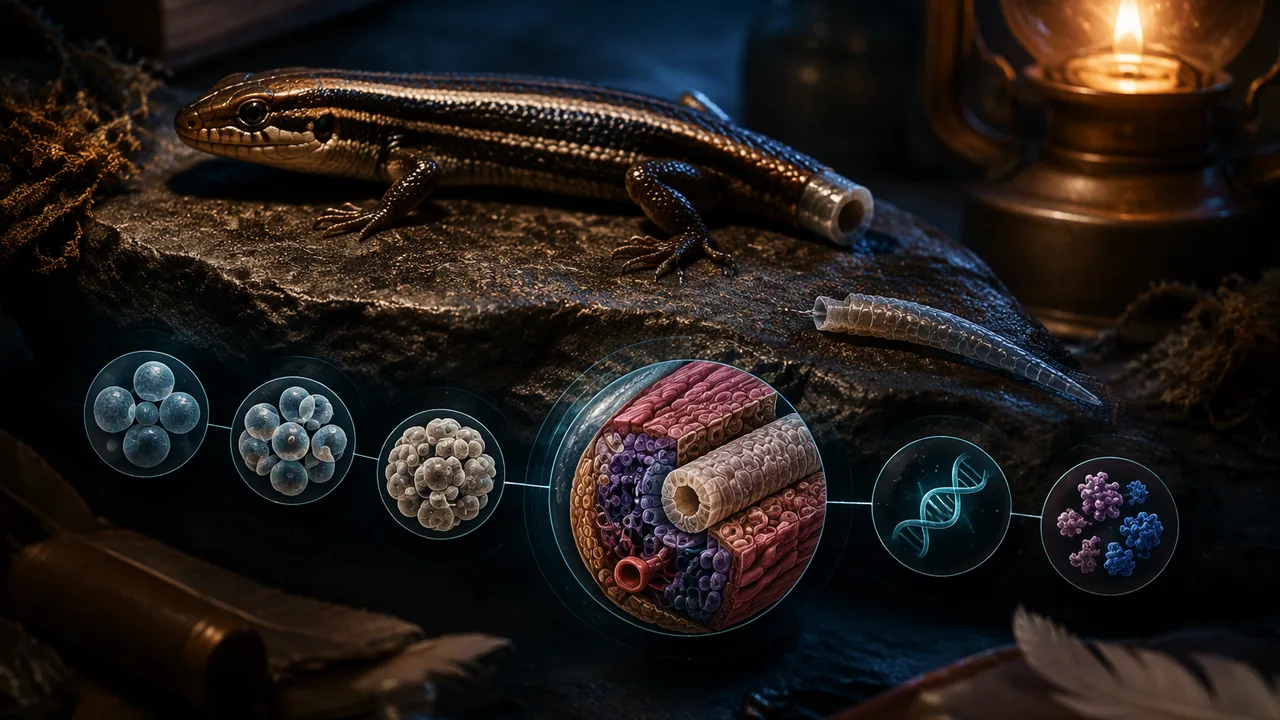
The question. How does a common five-lined skink rebuild a tail from a small stump of cells, and why is the new tail different from the old one?
Lizards regenerate tails through coordinated cell division, differentiation, and gene expression, leading to a functional but anatomically distinct replacement.
📖 Read for this lesson
The reading opens over the lesson; close it to come back to exactly where you were. The checks below draw on it.
Considering the complexity of a tail, what are some key biological processes that must be perfectly coordinated for it to regrow?
Which sequence correctly traces how a gene affects a lizard’s regrown tail?
What a strong explanation contains
Some organisms, like planarian flatworms, can regenerate their entire head and body even if cut into multiple pieces, showcasing remarkable regenerative abilities.
Your explanation must connect three levels, and the links between them matter as much as the levels themselves.
- Cells: division. Explain how the cell cycle produces new cells with identical chromosomes. Use your onion root tip data: the mitotic index shows where division happens, and the phase fractions show how the cycle is spent. Explain why a regrowing region, like a root meristem, should have a high mitotic index.
- Cells: differentiation. Explain how identical daughter cells become muscle, cartilage, skin and blood vessel cells. Use the evidence from the strawberry DNA argument (cuttings, nuclear transfer) to show that specialized cells keep the whole genome and differ in which genes they express.
- Molecules: DNA to protein. Pick one protein a new tail needs, such as collagen in cartilage or keratin in scales, and explain how the sequence of its gene determines its amino-acid sequence, its shape and its function. Use your transcription-translation model, and explain what a point mutation in that gene could do.
- The difference. Explain, using the ideas above, why a new tail that is shorter and drab gray, with a cartilage tube instead of vertebrae, is possible even though every cell has the same DNA. Be clear about what is known and what is still being researched: scientists are still working out exactly which signals guide lizard regeneration.
Regrowth of a lost or damaged body part from remaining cells.
When a lizard regrows its tail, it’s an exact copy of the original, built by special cells that only have the genes for a tail.
A regrown lizard tail is functional but anatomically different from the original, and all body cells, including those forming the new tail, contain the complete set of an organism’s DNA, but they specialize by expressing different genes.
The regrown tail’s cells have different DNA from the lizard’s other cells, which is why the tail looks different.
A worked example of one link
Claim: the stump regrows because cells near the wound divide rapidly. Evidence: in the root tip, the mitotic index in the meristem was far higher than 2 mm back, showing that growth is concentrated where cells divide. Reasoning: each division doubles the number of cells in a lineage, so a small group of dividing cells can supply the thousands of cells a new tail needs, and mitosis gives each new cell the same chromosomes. Every link in your explanation needs this structure.
Write one link of your explanation as claim, evidence and reasoning, citing a number from your onion root tip data or a specific result from the protein synthesis model.
Sources
Your lab data or the count records you used, the Missouri Department of Conservation field guide entry for the five-lined skink, OpenStax Biology 2e chapters 10 and 15, and NHGRI or NCI pages. Cite every source, and say where a fact came from if you did not measure it.
Presentation
Record a four-minute talk walking through your model from gene to tissue, then answer one of the defense questions in this lesson’s reading at the end of the recording.
Key terms
The self-amputation of a body part, such as a lizard’s tail, usually to escape a predator.
A model that links processes at different scales, such as gene, protein, cell and tissue.
Unit 3 checkpoint
Do this before you start the task. It covers the whole unit and tells you what to review first.
In which stage do chromosomes line up across the middle of the cell?
Mitosis produces two daughter cells with the same chromosomes as the parent cell.
If 18 of 200 cells are in mitosis, the mitotic index is %.
Why is the fraction of cells in a stage used to estimate the stage’s duration?
Muscle and skin cells in the same animal differ mainly because:
If DNA is 26% guanine, it is % cytosine and % adenine.
A gene is best described as:
The DNA template TAC GGA CTT codes for the mRNA .
A mutation changes a codon to UAG. What type is it?
Changing one amino acid can change a protein’s shape and function.
Where does translation take place?
Submit: The Lizard’s New Tail (900-1,300 words with a multi-level model) + four-minute presentation
Task: Write an evidence-based explanation of how a common five-lined skink regrows its tail. Include a labeled model that connects the gene, protein, cell and tissue levels; explain mitosis, differentiation and gene expression; trace one named protein from gene to function; and explain why the new tail differs from the old one. Use evidence from the onion root tip lab (your own counts or the records you used), the strawberry DNA argument and the protein synthesis model. Hand-drawn models, photographed or scanned, are fully acceptable.
Submission workflow
- Stage 1 — Plan. A first-draft model, the protein you will trace, and a table listing which lab evidence supports each link in your explanation.
- Stage 2 — Checked draft. Check every link of your draft against the review checklist in this lesson’s reading: evidence for each link, your mitotic index and transcription-translation examples recalculated, and any claim made without support marked. If you can, have a parent, guardian or other adult reader mark anything unclear. Submit the completed checklist and your revision plan.
- Stage 3 — Final explanation. 900-1,300 words with the revised model, data displays, citations and a short paragraph on what is still unknown about lizard regeneration.
- Stage 4 — Presentation and defense. A recorded four-minute presentation that ends with your answer to one of the defense questions in this lesson’s reading.
How it is scored
| Criterion | What proficient looks like |
|---|---|
| Cell division (9-12.LS1.B.1) | Explains the cell cycle and mitosis accurately and uses mitotic-index data as evidence of where growth happens. |
| Differentiation (9-12.LS1.B.1, CCC.6) | Explains that specialized cells keep the whole genome and differ in gene expression, with evidence from cuttings or nuclear transfer. |
| DNA to protein (9-12.LS1.A.1, 9-12.LS3.A.1) | Traces a named protein from gene sequence through transcription and translation to shape and function, including the effect of a mutation. |
| Model (SEP.2) | Model connects the gene, protein, cell and tissue levels with labeled links. |
| Stability and change (CCC.7, SEP.6) | Explains why the regrown tail differs from the original and states what is still unknown. |
| Use of evidence (RST.9-10.1) | Claims tied to lab data and cited sources; calculations are correct; the presentation answers a defense question accurately. |
Common five-lined skinks, among the most abundant lizards in Missouri, drop their tails to escape predators and regrow a shorter, drab gray replacement, a real-world case of regeneration helping an animal survive.
How does understanding gene expression and cell differentiation help explain both the successful regrowth of a lizard’s tail and the anatomical differences in the new tail?
How confident are you that you can build and defend an explanation of regeneration that connects genes, proteins, cells and tissues?
The Shift
- Cell division provides new cells for growth.
- Differentiation, guided by gene expression, specializes cells.
- Lizard tail regeneration connects gene-level instructions to tissue repair.
Explaining Regeneration: Linking Gene, Protein, Cell and Tissue
SLS reading for RLP Biology A, drawing on the Missouri Department of Conservation field guide (common five-lined skink), NHGRI, MedlinePlus Genetics, NIH Stem Cell Information, the National Heart, Lung, and Blood Institute and the National Cancer Institute; retrieved November 5, 2026 · SLS original
What your explanation must connect
The task question is: how does a common five-lined skink rebuild a tail from a small stump of cells, and why is the new tail different from the old one? The Missouri Department of Conservation describes the phenomenon: as with most skinks, the tail breaks off easily so the lizard can escape a predator, very little blood is lost, and a new tail grows back that is shorter than the original and a drab gray. A strong answer is a multi-level model. It links four levels, and the links carry as much weight as the levels:
gene (DNA) → mRNA → protein → specialized cell → tissue → regrown tail
Read left to right, this is the correct direction of cause. Genes are transcribed into mRNA; mRNA is translated into protein; proteins give each specialized cell its shape and job; many such cells form a tissue. Arrows pointing the other way, such as tissue → DNA, are a common error.
Level 1: making enough cells
New tissue needs new cells, and they come from the cell cycle. In interphase the cell grows and, in the S phase, copies every chromosome into two sister chromatids. In mitosis the chromatids are separated (prophase, metaphase, anaphase, telophase) and cytokinesis splits the cell. Each daughter receives the same chromosomes as the parent, so every new tail cell carries the lizard’s full, unchanged genome.
Your onion root tip data (your own counts or the records you used) are evidence of where growth happens. In the illustrative 250-cell record the meristem had a mitotic index of 45 ÷ 250 = 18%, while cells 2 mm back had 3 ÷ 50 = 6%, so division was three times as common in the growing tip. A regrowing tail stump should likewise have a zone of high division near the wound. The same data show how a cycle is spent: 82% of cells were in interphase, so most of a dividing cell’s time goes into growing and copying DNA, not into mitosis itself.
Doubling explains how a small group of cells can supply a whole tail. After n divisions one cell can produce 2n cells: 1,024 after 10 and over a million after 20. With illustrative figures of 104 starting cells and 108 needed, log2(104) ≈ 13.3, so about 14 rounds of doubling would do it.
Level 2: making the right kinds of cells
Division alone would build a lump of identical cells. Differentiation turns daughter cells into muscle, cartilage, skin, nerve and blood-vessel cells. Your strawberry DNA argument supplies the evidence that differentiated cells keep their whole genome:
- stem cuttings regrow whole plants;
- a nucleus from a specialized frog intestinal cell, placed in an egg with its own nucleus removed, directed development into a tadpole (Gurdon, 1962);
- Dolly the sheep grew from the nucleus of an adult mammary-gland cell (1996).
So cells differ in which genes they express, not in which genes they contain. Transcription factors switch particular genes on in particular cells. In tail regrowth, cells near the wound behave like stem cells: they divide and then take on specialized fates.
Level 3: tracing one protein
Choose one protein the new tail needs and follow it through the chain. Two good choices:
| Protein | Where in the tail | What its shape lets it do |
|---|---|---|
| Collagen | Cartilage support tube, connective tissue | Long chains wind into strong, rope-like fibers that resist pulling |
| Keratin | Scales | Tough fibers that make scales hard and protective |
For your chosen protein, explain: the gene’s base sequence is transcribed into mRNA (template A → U, T → A, G → C, C → G); the ribosome reads codons of three bases and links amino acids in that order; the amino acid sequence determines how the chain folds; and the folded shape determines the job. Use a worked example from your model, such as template TAC AAA CCG TTT ATT → mRNA AUG UUU GGC AAA UAA → Met-Phe-Gly-Lys.
Then say what a mutation could do. A silent change (GAA → GAG) leaves the protein unchanged. A missense change swaps one amino acid, which can alter shape and function, as the Glu6Val change does in sickle cell hemoglobin. A nonsense change creates an early stop, and a frameshift scrambles every codon after it; either could leave a structural protein too short or misfolded to form strong fibers, weakening the new tissue. Say whether the change you describe would be harmful, beneficial or neutral, and why: most variants are neutral, and the hemoglobin S variant is harmful in two copies yet protects against serious malaria. You do not need a real lizard mutation for this. Describe it as a prediction.
Level 4: why the new tail is different
The five-lined skink’s regrown tail is shorter and a drab gray. In lizards studied closely inside, such as the green anole, the regrown tail is supported by a tube of cartilage instead of a chain of bony vertebrae, and scales and color may differ. This cannot come from different DNA: mitosis copies the same chromosomes into every new cell. The explanation lies in differentiation. The cells of an adult wound receive different signals from those that guided the embryo, so they switch on different sets of genes and build a different tissue. The same genome can produce bone in one situation and cartilage in another.
Be clear about the limits. Which signals control lizard regeneration, and why the result is cartilage and not bone, are active research questions. Your final draft needs a short paragraph on what is still unknown. Stating that honestly is part of scientific explanation, not a weakness.
Building each link
Every link in your explanation needs claim, evidence and reasoning. For example: Claim: the stump regrows because cells near the wound divide rapidly. Evidence: in the onion root, the mitotic index was 18% in the meristem and 6% 2 mm back. Reasoning: each division doubles a cell lineage, and mitosis gives every new cell the same chromosomes, so a small zone of fast-dividing cells can supply the thousands of cells a tail needs. A link about differentiation might cite Dolly; a link about proteins might cite your mutation card result.
Review checklist (Stage 2)
Check your own draft against every item, and if a parent, guardian or other adult reader can look at it too, ask them to mark anything unclear.
- Does the model connect gene, protein, cell and tissue with labeled arrows running the right way?
- Are the mitotic index and phase fractions calculated correctly from the data table?
- Is the transcription-translation example correct base by base?
- Does the draft say the regrown tail’s cells have the same DNA, and explain the difference through gene expression?
- Is every fact you did not measure attributed to a source, such as NHGRI, MedlinePlus Genetics or the National Cancer Institute?
Defense questions (Stage 4)
End your recorded presentation by answering one of these, using your own evidence:
- If every cell in the new tail has the same DNA, why is the tail shorter, drab gray and built on cartilage?
- Your mitotic-index evidence comes from onion roots, not lizards. Why is it still fair evidence about where a regrowing tail makes new cells, and what are its limits?
- A point mutation appears in the collagen gene of one dividing cell in the stump. Predict whether it would be harmful, beneficial or neutral, and explain how your answer depends on the kind of mutation.
- Why must growth stop when the tail is complete, and what does cancer show about what happens when that control fails?
Sources: Missouri Department of Conservation Field Guide: Common Five-Lined Skink (mdc.mo.gov); Unique Structural Features Facilitate Lizard Tail Autotomy (PubMed Central, NIH) (pmc.ncbi.nlm.nih.gov); NIH Stem Cell Information: Stem Cell Basics (stemcells.nih.gov); NHGRI: Cloning Fact Sheet (genome.gov); MedlinePlus Genetics: How do genes direct the production of proteins? (medlineplus.gov); MedlinePlus Genetics: How are gene variants involved in health and disease? (medlineplus.gov); National Cancer Institute: What Is Cancer? (cancer.gov); National Heart, Lung, and Blood Institute: Sickle Cell Disease, Causes and Risk Factors (nhlbi.nih.gov)