How do trees like the McBaine bur oak build their massive bodies from invisible inputs?
evaluate evidence about where a plant’s mass comes from and ask testable questions about how carbon dioxide, water and light become plant matter.
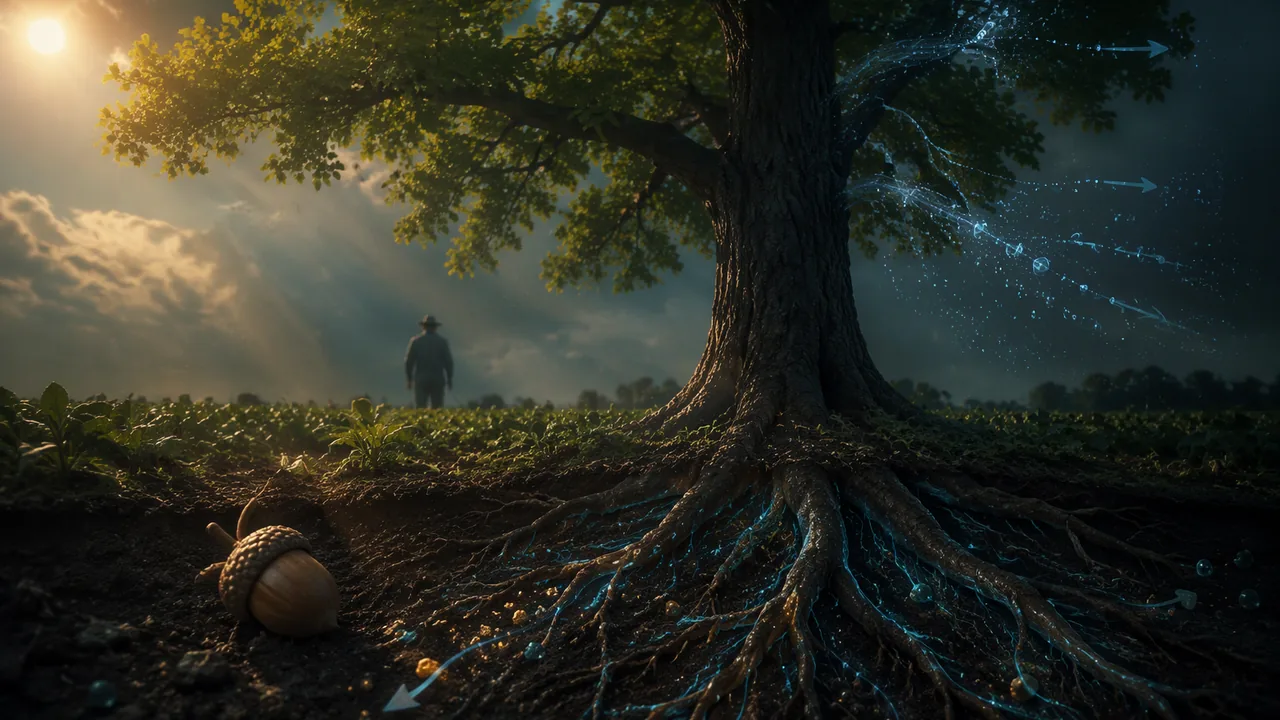
The phenomenon. In a bottomland crop field near McBaine, about half a mile from the Missouri River, stands Missouri’s champion bur oak. The Missouri Department of Conservation measured it at 74 feet tall and 295 inches around, with outermost branches reaching 129 feet across, and the National Park Service estimates that it is 350 to 400 years old. It grew from a single acorn; bur oak acorns average from about 0.9 to 7.5 grams, depending on where the tree grows. The soil beneath it is still there. So where did all that matter come from?
Most of a plant’s mass, including the carbon backbone of its molecules, originates from carbon dioxide in the atmosphere.
📖 Read for this lesson
The reading opens over the lesson; close it to come back to exactly where you were. The checks below draw on it.
What do you think is the biggest source of mass for a giant tree, and why?
Where does most of the dry mass of a giant bur oak like the McBaine oak come from?
Common ideas
Cellulose, made by plants from sugar, is the most abundant organic compound on Earth.
Most people guess the soil, or water, or sunlight. Each guess deserves testing. Sunlight is energy, not matter: it has no mass to add. Water is matter, and plants take in a great deal of it, but most of it passes through the plant and evaporates from the leaves. Soil supplies minerals such as nitrogen, phosphorus and potassium, but in small amounts.
In 6CO2 + 6H2O → C6H12O6 + 6O2, the reactants have a mass of 372.144 g per mole of glucose made, so the products have a mass of g.
A historical experiment
In the 1600s the Flemish scientist Jan Baptist van Helmont planted a willow shoot of about 5 pounds in a tub holding 200 pounds of dried soil, and watered it for five years. The willow grew to about 169 pounds, while the soil, dried and weighed again, had lost only about 2 ounces. He concluded that the mass came from water. His measurement was sound, but his conclusion missed an input he could not see: a gas in the air. (These figures are van Helmont’s own, as reported in histories of science.)
Most of a plant’s mass comes from the soil it grows in, or the water it absorbs, or the sunlight it uses.
While plants absorb water and small amounts of minerals from the soil, the vast majority of their dry mass comes from carbon dioxide gas from the air, which is converted into sugar through photosynthesis.
A plant makes proteins from the products of photosynthesis. Which element must it get from somewhere other than carbon dioxide and water?
The modern answer
Most of a plant’s dry mass comes from carbon dioxide in the air. In photosynthesis, chloroplasts use light energy to combine carbon dioxide and water into sugar, releasing oxygen:
6CO2 + 6H2O + light energy → C6H12O6 + 6O2
Check that matter is conserved. Using molar masses (CO2 44.009 g/mol, H2O 18.015, C6H12O6 180.156, O2 31.998), the left side is 6(44.009) + 6(18.015) = 372.144 g and the right side is 180.156 + 6(31.998) = 372.144 g. Every atom on the left appears on the right. Carbon makes up 72.066 ÷ 180.156, or 40.0%, of glucose by mass, and all of that carbon came from the air.
The process in which chloroplasts use light energy to make sugar from carbon dioxide and water, releasing oxygen.
The organelle in plant and algal cells where photosynthesis happens.
Van Helmont concluded that the willow’s mass came from water. Using the photosynthesis equation, explain what he got right and what he missed. Then write one testable question about photosynthesis you could investigate at home.
From sugar to tree
Glucose is only the start. Plants link glucose into cellulose (the main material of wood and cell walls) and starch (stored energy). They combine the carbon, hydrogen and oxygen of sugar with nitrogen from the soil to make amino acids and proteins, with phosphorus to make DNA and ATP, and rearrange sugar carbon into lipids. This is the key idea of 9-12.LS1.C.3: the carbon backbone of nearly every molecule in a plant, and in the animals that eat plants, was once carbon dioxide.
A long chain of glucose units that forms plant cell walls and most of the mass of wood.
Energy is a separate story
Matter cycles, but energy flows. Light energy is stored in the chemical bonds of sugar. When the tree, or anything that eats it, breaks those bonds in cellular respiration, the energy is used for work and eventually leaves as heat. You will track both across this unit.
Questions to test
Does a leaf make oxygen faster in brighter light? Does a plant release carbon dioxide in the dark? Can a living thing release energy from sugar without oxygen? Each is testable at home with kitchen materials.
Key terms
In chemical reactions, atoms are rearranged but not created or destroyed, so total mass stays the same.
A large biological molecule, such as a carbohydrate, protein, lipid or nucleic acid, built from smaller units.
Practice
Work these on paper or in your notebook, then open Check your answer. Aim for all of Fluency and Application; try at least one Challenge.
Printable version: this unit’s practice workbook (PDF)
Fluency
Build speed and accuracy with the core skill.
- Find the molar mass of Al2O3.
Check your answer
Answer: 101.96 g/molAdd the atomic masses of every atom in the formula (Al 26.982, O 15.999). - Find the molar mass of CaCO3.
Check your answer
Answer: 100.09 g/molAdd the atomic masses of every atom in the formula (Ca 40.078, C 12.011, O 15.999). - Count the carbon, hydrogen and oxygen atoms on each side of 6CO2 + 6H2O → C6H12O6 + 6O2.
Check your answer
Answer: Each side: 6 C, 12 H, 18 OLeft: 6 C, 12 O + 6 O = 18 O, 12 H. Right: 6 C, 12 H, 6 O + 12 O = 18 O. - Which reactant supplies the carbon in glucose: carbon dioxide, water or soil minerals?
Check your answer
Answer: Carbon dioxideWater supplies hydrogen (and the oxygen released as O2); soil supplies elements such as nitrogen, not carbon.
Application
Use the skill in context. Show your reasoning.
- Van Helmont’s willow gained about 164 pounds 3 ounces while the soil lost about 2 ounces. What percentage of the tree’s gain could have come from the soil? (1 pound = 16 ounces)
Check your answer
Answer: About 0.08%Gain = 164 × 16 + 3 = 2,627 oz. 2 ÷ 2,627 = 0.00076 = 0.076%. - Van Helmont concluded that the willow’s mass came from water. Which part of his conclusion was right, and what did he miss?
Check your answer
Answer: Water does contribute (its hydrogen, and it is taken up), but most of the dry mass is carbon and oxygen from carbon dioxide in the air, which he did not measure.Glucose is 40% carbon by mass, and all of that carbon comes from CO2. - The McBaine bur oak’s trunk is 295 inches around (Missouri Department of Conservation). Convert the circumference to meters (1 in = 0.0254 m) and find the trunk’s diameter.
Check your answer
Answer: About 7.49 m around and 2.39 m across295 × 0.0254 = 7.493 m; diameter = 7.493 ÷ π = 2.385 m.
Challenge
Stretch problems. Expect to think before you write.
- Model the lower trunk of the McBaine bur oak as a cylinder 7.493 m around and 4.5 m tall (an assumed height). Bur oak has a specific gravity of 0.58 on a green-volume basis (USDA Wood Handbook), so each cubic meter of living wood holds about 580 kg of dry wood. Assume dry wood is half carbon. Estimate the mass of carbon dioxide the tree removed from the air to build this part of its trunk.
Check your answer
Answer: About 21,400 kg (about 21 tonnes) of CO2Cross-section = 7.4932 ÷ (4π) ≈ 4.468 m2; volume ≈ 4.468 × 4.5 ≈ 20.1 m3; dry mass ≈ 20.1 × 580 ≈ 11,660 kg; carbon ≈ 5,830 kg; CO2 = 5,830 × 44.009/12.011 ≈ 21,400 kg.
Review
Keep earlier skills sharp.
- Name the level of organization of a leaf and explain your answer.
Check your answer
Answer: Organ: it is made of several tissues (epidermis, photosynthetic tissue, vascular tissue) working together.An organ is a structure of several tissue types with a shared function.
The carbon atoms that form Missouri’s champion bur oak near McBaine, 295 inches around and an estimated 350 to 400 years old, were once floating as carbon dioxide in the air.
Considering matter is conserved, how does the chemical equation for photosynthesis demonstrate where a tree gets its mass?
How confident are you that you can explain where a plant’s mass comes from and show that photosynthesis conserves matter?
The Shift
- Plants use carbon dioxide from the air.
- Photosynthesis converts CO2 and water into sugar.
- Matter is conserved as atoms are rearranged into plant structures.
Where a Tree’s Mass Comes From
SLS reading for RLP Biology A, drawing on the Missouri Department of Conservation and National Park Service accounts of the McBaine champion bur oak, the USDA Forest Service Fire Effects Information System (bur oak acorn mass), the USDA Forest Products Laboratory Wood Handbook (bur oak specific gravity) and NASA Earth Observatory; retrieved November 5, 2026 · SLS original
A very large tree
In a bottomland crop field near the village of McBaine, in Boone County, about half a mile from the Missouri River, stands Missouri’s champion bur oak. The Missouri Department of Conservation measured it at 74 feet tall and 295 inches around the trunk, with its outermost branches reaching 129 feet across. The National Park Service estimates that it is 350 to 400 years old, so it was already close to 200 years old when the Lewis and Clark Expedition traveled up the river. Converting the trunk’s circumference: 295 × 0.0254 = 7.493 m around, so its diameter is 7.493 ÷ π ≈ 2.39 m (about 94 inches). Every gram of that wood was built by the tree itself, starting from a single acorn; the U.S. Forest Service reports bur oak acorns averaging from about 0.9 g in Minnesota to 7.5 g in Texas. The phenomenon for this unit is a question of bookkeeping: where did the matter come from?
Testing the obvious answers
- Sunlight? Light carries energy, not matter. It can power the building process, but it cannot become the building material.
- Soil? Soil supplies mineral nutrients such as nitrogen, phosphorus and potassium. They are essential but small in amount. A tree growing in a pot does not leave a crater behind.
- Water? Plants absorb a great deal of water, but most of it travels up the stem and evaporates from the leaves. Some water is used as a raw material, contributing hydrogen atoms to sugar.
- Air? Air contains carbon dioxide, only a small fraction of it, but a tree bathes its leaves in an enormous volume of air over its lifetime.
Van Helmont’s willow
In the 1600s Jan Baptist van Helmont grew a willow shoot of about 5 pounds in a tub of 200 pounds of dried soil, adding only water, for five years. The tree reached about 169 pounds 3 ounces, a gain of about 164 pounds 3 ounces, while the soil lost only about 2 ounces. Convert the gain to ounces (1 pound = 16 ounces): 164 × 16 + 3 = 2,627 ounces. The share that could have come from the soil is 2 ÷ 2,627 = 0.00076, or about 0.08%. His measurements ruled out soil. His conclusion, that the mass came from water, was half right: water does contribute. What he missed was an input he could not weigh with the tools he had, a gas in the air.
The modern answer and a mass check
In photosynthesis, chloroplasts use light energy to combine carbon dioxide and water into the sugar glucose, releasing oxygen:
6CO2 + 6H2O + light energy → C6H12O6 + 6O2
Count atoms. Left: 6 C; 12 H; 12 O from CO2 plus 6 O from water = 18 O. Right: 6 C and 12 H in glucose; 6 O in glucose plus 12 O in six O2 = 18 O. Each side has 6 C, 12 H and 18 O. Atoms are rearranged, never created or destroyed; this is conservation of matter.
Molar mass is the mass of one mole of a substance. Find it by adding the atomic masses of every atom in the formula.
| Element | H | C | N | O | Na | Mg | Al | S | Cl | K | Ca | Fe |
|---|---|---|---|---|---|---|---|---|---|---|---|---|
| Atomic mass (g/mol) | 1.008 | 12.011 | 14.007 | 15.999 | 22.990 | 24.305 | 26.982 | 32.06 | 35.45 | 39.098 | 40.078 | 55.845 |
- CO2: 12.011 + 2(15.999) = 44.009 g/mol
- H2O: 2(1.008) + 15.999 = 18.015 g/mol
- C6H12O6: 6(12.011) + 12(1.008) + 6(15.999) = 72.066 + 12.096 + 95.994 = 180.156 g/mol
- O2: 2(15.999) = 31.998 g/mol
- The method works for any compound: NaCl = 22.990 + 35.45 = 58.44 g/mol; CaCO3 = 40.078 + 12.011 + 3(15.999) = 100.086 g/mol; NH3 = 14.007 + 3(1.008) = 17.03 g/mol; Fe2O3 = 2(55.845) + 3(15.999) = 159.69 g/mol.
Now the mass check for one mole of glucose made. Reactants: 6(44.009) + 6(18.015) = 264.054 + 108.090 = 372.144 g. Products: 180.156 + 6(31.998) = 180.156 + 191.988 = 372.144 g. The masses match exactly.
How much of glucose is carbon? 72.066 ÷ 180.156 = 0.400, or 40%. All of that carbon came from carbon dioxide; water supplies none. Experiments with labeled atoms show that the oxygen gas released comes from the water, while the oxygen atoms in the sugar come from carbon dioxide. (The summary equation hides a detail here: inside the chloroplast, 12 water molecules are split and 6 new ones are made, and the summary cancels them to 6.)
From sugar to a whole tree
Glucose is the starting material, not the end product. Plants join thousands of glucose units into cellulose, the main material of cell walls and wood, and into starch for storage. They rearrange sugar carbon into fats and oils. To make amino acids and proteins, they must add nitrogen, which is not in CO2 or water; roots take it from the soil as nitrate or ammonium. To make DNA and ATP they add phosphorus, also from the soil. So the carbon skeleton of nearly every molecule in a plant, and in every animal that eats plants, was once carbon dioxide in the air, while a few elements arrive through the roots.
The same levels of organization you met in Unit 1 apply to plants. A leaf is an organ: it contains several tissues, including an epidermis that covers it, photosynthetic tissue packed with chloroplasts, and vascular tissue (veins) that carries water in and sugar out.
Estimating the carbon in the McBaine oak’s trunk
No one has measured the volume of this trunk, so build an estimate and state every assumption. Treat the trunk as a cylinder 7.493 m around and 4.5 m tall (an assumed height, roughly to where the great limbs branch off). Its cross-section is 7.4932 ÷ (4π) ≈ 4.468 m2, so its volume is 4.468 × 4.5 ≈ 20.1 m3. The U.S. Forest Products Laboratory’s Wood Handbook gives bur oak a specific gravity of 0.58 on a green-volume basis, which means each cubic meter of living wood holds about 580 kg of dry wood. Dry mass ≈ 20.1 × 580 ≈ 11,660 kg, more than 1.5 million times the mass of even a heavy 7.5 g acorn. Taking dry wood as half carbon (a round, assumed value), carbon ≈ 5,830 kg. Each carbon atom came from one CO2 molecule, so multiply by 44.009 ÷ 12.011 = 3.664: about 21,400 kg (roughly 21 tonnes) of carbon dioxide pulled from the air to build the lower trunk alone. The huge limbs, the twigs, the bark and the roots hold more. Stating the assumptions matters as much as the arithmetic.
Matter cycles, energy flows
Keep two stories separate. Atoms of carbon, hydrogen and oxygen are recycled: they move from air to tree and, through respiration, decay or fire, back to the air. Energy does not cycle. Light energy is stored in the chemical bonds of sugar; when the tree or anything that eats it breaks those bonds, the energy powers work and ends up as heat that radiates away. The ecosystem needs a steady new supply of sunlight.
Questions worth testing
Good questions name a variable to change and one to measure: Does a leaf release oxygen faster in brighter light? Does a plant give off carbon dioxide in the dark? Do yeast release carbon dioxide without oxygen? You will test versions of all three in this unit.
Sources: Missouri Department of Conservation, Xplor (September 2021): Big Tree Hunters (McBaine champion bur oak: 74 ft tall, 295 in around, 129 ft crown spread) (mdc.mo.gov); National Park Service, Lewis and Clark National Historic Trail: McBaine Burr Oak (nps.gov); USDA Forest Service, Fire Effects Information System: Quercus macrocarpa (bur oak) (fs.usda.gov); USDA Forest Products Laboratory, Wood Handbook (FPL-GTR-190), Chapter 5, Table 5-3a: bur oak specific gravity 0.58 (green) (research.fs.usda.gov); NASA Earth Observatory: Photosynthesis (earthobservatory.nasa.gov); NASA Earth Observatory: The Carbon Cycle (earthobservatory.nasa.gov)