How does the body hold its temperature steady, and why does that system sometimes fail?
describe the levels of organization in a multicellular organism and ask testable questions about how body systems interact to keep core temperature stable in extreme heat.
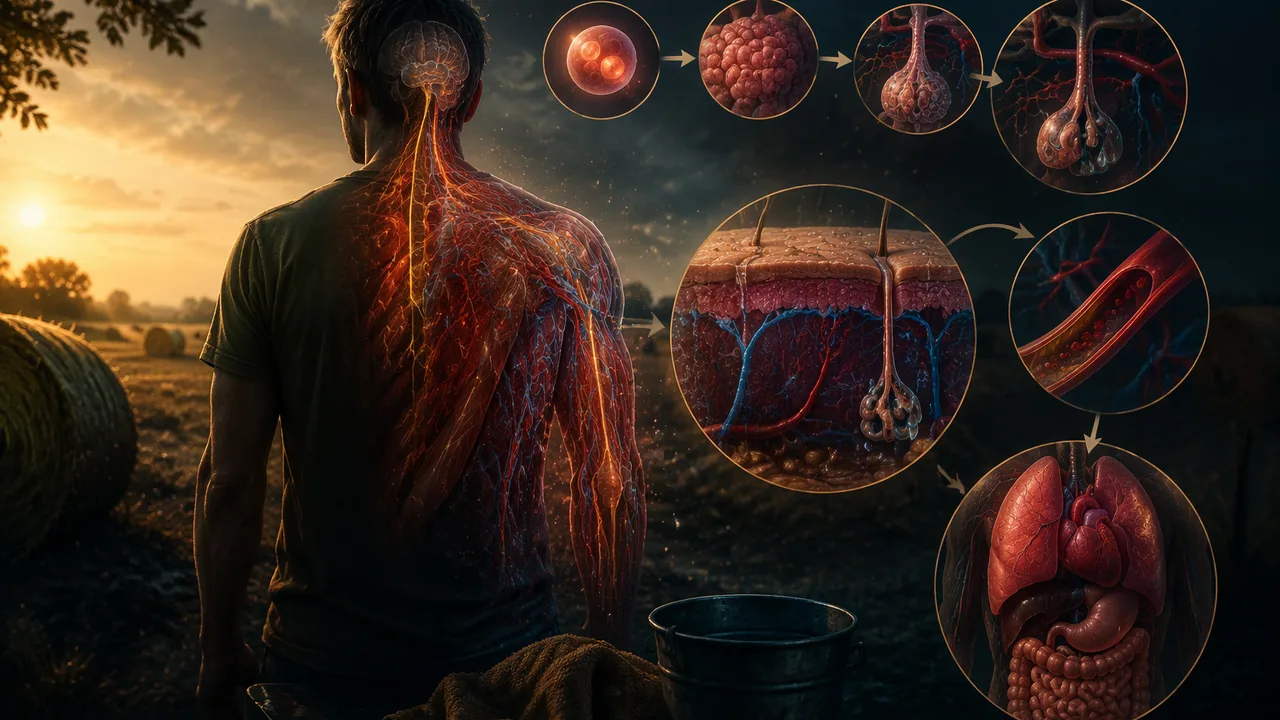
The phenomenon. From June 28 through July 7, 2012, the afternoon high at St. Louis Lambert International Airport was 100 °F or more on ten days in a row, peaking at 108 °F on June 28. On three of those afternoons it was 105 °F (about 40.6 °C), and even the overnight lows stayed between 76 and 83 °F, so bodies got little relief after dark. A farmworker baling hay, a football player at practice and a roofer laying shingles all produce heat inside their bodies with every muscle contraction, and on afternoons like these the air around them is hotter than their skin. Yet a healthy person’s core temperature stays near 37 °C (98.6 °F). Sometimes it does not: when core temperature climbs above about 40 °C (104 °F), a person can develop heat stroke, a medical emergency. The Missouri Department of Health and Senior Services reports that 23 Missouri residents, aged 9 months to 91 years, died of heat-related illness in 2024. Our question for the unit: how does the body hold its temperature steady, and why does that system sometimes fail?
The body maintains stable internal conditions, such as temperature, through the coordinated action of multiple organ systems.
📖 Read for this lesson
The reading opens over the lesson; close it to come back to exactly where you were. The checks below draw on it.
What are some ways you currently think your body manages to stay cool on a hot day?
On a 105 °F day, the air is hotter than your skin. Which way can your body still lose heat?
Levels of organization
The hypothalamus, the control center for body temperature, also plays a key role in regulating hunger, thirst, and sleep cycles.
Biologists explain an organism as a hierarchy of systems, each built from the level below. Cells are the smallest units that carry out life’s functions. Similar cells working together form a tissue: sweat glands are made of epithelial tissue, and the walls of blood vessels contain smooth muscle tissue. Several tissues form an organ, such as the skin, which contains epithelial, connective, muscle and nervous tissue. Organs that work together form an organ system, and the organ systems together make the organism. The key idea is that each level has properties the level below does not have on its own. A single sweat gland cell cannot cool you; the skin, supplied by blood and directed by nerves, can.
A group of similar cells that work together to carry out a function.
A group of organs that work together, such as the circulatory system (heart, blood vessels, blood).
I get cool just by sweating, no matter how humid it is.
Sweat only cools the body when it evaporates from the skin, a process that is much slower in humid conditions.
Which list is in order from smallest to largest level of organization?
Three systems, one job
Cooling takes at least three organ systems working together:
- The nervous system detects temperature. Sensors in the skin and in the brain report to the hypothalamus, which acts as the control center.
- The circulatory system moves heat. When you are hot, blood vessels near the skin widen (vasodilation), carrying warm blood from the core to the surface, which is why a hot face turns red.
- The integumentary system (skin and sweat glands) releases heat. Sweat evaporating from the skin carries energy away. Evaporation is the only way to lose heat when the air is hotter than the skin.
A region of the brain that acts as the control center for body temperature and other homeostatic variables.
Widening of blood vessels, which increases blood flow; near the skin it helps release heat.
Which question could you test at home with data you collect yourself?
Why humidity matters
Sweat only cools when it evaporates. In humid air, evaporation slows, so sweat drips off instead of cooling. This single physical fact explains why a humid 95 °F day, common in a Missouri summer, can be more dangerous than a dry 105 °F day. Losing sweat also costs water and salt, and if the water is not replaced, blood volume drops and the heart has to work harder to deliver blood to both muscles and skin.
Sketch an initial model of a person working in 105 °F heat. Show where heat comes from (inside and outside the body), where it goes, and which organ systems are involved. Then write two testable questions your model raises.
Asking good questions
A testable question names something you can measure or observe. Why do people get heat stroke? is a starting point. Does heart rate return to its resting value faster after exercise in a cool room than in a warm room? is testable: it names a variable you can change (room temperature) and one you can measure (heart rate over time). Over this unit you will investigate at three levels: cells and their membranes, proteins (enzymes) whose function depends on temperature, and the whole-body feedback loop that ties them together.
Key terms
The maintenance of relatively stable internal conditions, such as temperature and water balance, despite changes outside the body.
Practice
Work these on paper or in your notebook, then open Check your answer. Aim for all of Fluency and Application; try at least one Challenge.
Printable version: this unit’s practice workbook (PDF)
Fluency
Build speed and accuracy with the core skill.
- Convert 25 mL to L.
Check your answer
Answer: 0.0250 L - Convert 60 km to m.
Check your answer
Answer: 60,000.00 m - Convert 105 °F, the St. Louis afternoon high on July 4, 2012, to degrees Celsius. Use °C = (°F − 32) × 5/9.
Check your answer
Answer: ≈ 40.6 °C(105 − 32) × 5/9 = 73 × 5/9 = 40.56 °C. - Heat stroke becomes a danger when core temperature passes about 40 °C. Convert 40 °C to °F.
Check your answer
Answer: 104 °F°F = 40 × 9/5 + 32 = 72 + 32 = 104. - Put these in order from smallest to largest level of organization: organ system, cell, organ, tissue, organism.
Check your answer
Answer: cell, tissue, organ, organ system, organismEach level is built from the level before it.
Application
Use the skill in context. Show your reasoning.
- Classify each as a cell, tissue, organ or organ system: (a) a sweat gland cell; (b) the skin; (c) smooth muscle in a blood-vessel wall; (d) the heart, blood vessels and blood together.
Check your answer
Answer: (a) cell; (b) organ; (c) tissue; (d) organ system (circulatory)The skin contains several tissues working together, so it is an organ; the heart, vessels and blood together form the circulatory system. - A worker doing moderate labor produces about 400 W of body heat (illustrative value; 1 W = 1 J/s). On a 105 °F day nearly all of it must leave by sweat evaporation, and each gram of sweat that evaporates removes about 2.4 kJ. How much sweat must evaporate each hour?
Check your answer
Answer: About 600 g (roughly 0.6 L) per hourHeat per hour = 400 J/s × 3,600 s = 1,440,000 J = 1,440 kJ. Sweat = 1,440 ÷ 2.4 = 600 g. - Rewrite this question so that it is testable at home: “Is heat bad for athletes?” Name the variable you would change and the one you would measure.
Check your answer
Answer: Sample: “Does pulse return to resting faster after two minutes of stepping in a 20 °C room than in a 28 °C room?” Change: room temperature; measure: time for pulse to return to resting.A testable question names a variable to change and a variable to measure, and can be answered with data.
Challenge
Stretch problems. Expect to think before you write.
- In humid air only half of the sweat evaporates; the rest drips off. For the same 400 W worker, how much sweat must be produced each hour to remove the same heat, and why does this raise the risk of dehydration?
Check your answer
Answer: About 1,200 g (1.2 L) per hour; twice as much water is lost for the same cooling, so blood volume falls faster unless the worker drinks more.Only evaporated sweat cools: 600 g must evaporate, so 600 ÷ 0.5 = 1,200 g must be produced.
Review
Keep earlier skills sharp.
- A 70 kg worker loses 1.4 kg of body mass as sweat during a shift. What percentage of body mass is that?
Check your answer
Answer: 2%1.4 ÷ 70 = 0.02 = 2%. - NOAA records give the daily highs at St. Louis Lambert International Airport from June 28 to July 7, 2012 as 108, 106, 105, 102, 100, 101, 105, 105, 106 and 107 °F. Find the mean high, and count the days at or above 105 °F.
Check your answer
Answer: Mean 104.5 °F; 7 days at or above 105 °FSum = 1,045 °F over 10 days, so the mean is 1,045 ÷ 10 = 104.5 °F. Days at or above 105: 108, 106, 105, 105, 105, 106, 107 = 7.
Understanding how the body manages heat matters for Missouri workers such as farmworkers baling hay and roofers, who face extreme heat on the job; in 2024, 23 Missouri residents died of heat-related illness.
Why is it important to ask specific, testable questions when studying how the body works?
How confident are you that you can describe how cells, tissues, organs and organ systems work together to keep body temperature stable?
The Shift
- The body maintains stable internal conditions like temperature through homeostasis.
- Multiple organ systems, like the nervous, circulatory, and integumentary systems, work together to regulate body temperature.
- Cooling through sweat evaporation is less effective in humid conditions.
Heat, Sweat and the Levels of a Living Body
SLS reading for RLP Biology A, drawing on NOAA ACIS daily temperatures for St. Louis Lambert International Airport (June 28 to July 7, 2012), Missouri DHSS heat-illness releases (2023, 2025), CDC/NIOSH heat stress pages and recommendations, MedlinePlus and the National Weather Service heat index; retrieved November 5, 2026 · SLS original
A body is a heat engine
Every living cell releases heat as it works. When you rest, most of that heat comes from organs such as the liver, heart and brain. When you bale hay, run football drills or lay shingles on a roof, your skeletal muscles take over, and heat production can rise several times above resting. A working body therefore always has a heat problem to solve: it must get rid of heat as fast as it makes it, or its core temperature will climb. For a healthy person the core stays near 37 °C (98.6 °F). Keeping an internal condition steady like this is called homeostasis.
A Missouri heat wave in numbers
In the summer of 2012 a heat wave settled over Missouri. The table gives the daily high and overnight low recorded at St. Louis Lambert International Airport (NOAA station record).
| Date (2012) | High (°F) | Low (°F) |
|---|---|---|
| June 28 | 108 | 79 |
| June 29 | 106 | 77 |
| June 30 | 105 | 78 |
| July 1 | 102 | 79 |
| July 2 | 100 | 77 |
| July 3 | 101 | 76 |
| July 4 | 105 | 83 |
| July 5 | 105 | 83 |
| July 6 | 106 | 83 |
| July 7 | 107 | 83 |
Every one of these ten afternoons reached at least 100 °F, and seven reached 105 °F or more. The ten highs add to 1,045 °F, so the mean high was 1,045 ÷ 10 = 104.5 °F. The nights matter too: with lows of 76 to 83 °F, a body that stored heat during the day had little chance to shed it after dark. Heat is a real hazard in Missouri. The Missouri Department of Health and Senior Services (DHSS) reports that 23 Missouri residents, aged 9 months to 91 years, died of heat-related illness in 2024, and that 23 also died in 2022, four of them in vehicles.
Four ways heat moves
Heat always flows from a warmer object to a cooler one. Your skin can exchange heat with its surroundings in four ways:
- Radiation: every warm object gives off infrared energy. Skin warmer than its surroundings radiates heat away; in direct sun, or next to hot pavement, the body gains heat this way instead.
- Conduction: heat passes directly between things that touch, such as your back and a hot truck seat.
- Convection: moving air or water carries heat away from the skin, which is why a breeze feels good on a mild day.
- Evaporation: when sweat turns from liquid to vapor, it absorbs a large amount of energy from the skin.
The first three only cool you when the surroundings are cooler than your skin, and skin is normally a few degrees cooler than the core. On a 105 °F afternoon the air is about 40.6 °C, hotter than skin, so radiation, conduction and convection all push heat into the body. That leaves evaporation as the only way out. This is why sweating matters so much in a Missouri heat wave, and why Missouri’s humid summer air is dangerous: in humid air sweat evaporates slowly, and sweat that drips off removes water and salt but very little heat. The National Weather Service combines temperature and humidity into a heat index, the temperature it “feels like.” Its own example: at 96 °F and 65% relative humidity, the heat index is 121 °F.
Levels of organization in the cooling system
Cooling is not done by one part of the body. It is the work of a hierarchy, and each level is built from the one below it.
| Level | Example in the cooling system | Why it belongs at this level |
|---|---|---|
| Cell | One sweat-gland cell | The smallest unit that carries out life’s functions |
| Tissue | Epithelial tissue of a sweat gland; smooth muscle in a blood-vessel wall | Many similar cells doing one job together |
| Organ | The skin; the heart | Several different tissues working together (skin has epithelial, connective, muscle and nervous tissue) |
| Organ system | Circulatory system (heart, blood vessels, blood); integumentary system (skin, sweat glands); nervous system | Several organs cooperating on a larger task |
| Organism | The whole worker | All the systems together |
The order from smallest to largest is cell, tissue, organ, organ system, organism. A useful test: if the thing is made of one kind of cell, it is a tissue; if it is made of several tissues, it is an organ; if it is several organs, it is a system.
Three systems do most of the cooling. The nervous system senses temperature in the skin and the brain and sends the information to the hypothalamus, the control center. The circulatory system carries heat: blood vessels near the skin widen (vasodilation), so warm blood from the core flows to the surface where heat can leave. The integumentary system releases heat through sweat. Each system depends on the others: sweat glands need blood to supply water, and blood vessels need nerve signals to know when to widen.
How much sweat does it take?
Power is measured in watts, and 1 watt is 1 joule of energy per second. Suppose a worker doing moderate labor produces 400 W of heat (an illustrative value). In one hour that is 400 J/s × 3,600 s = 1,440,000 J, or 1,440 kJ. Each gram of sweat that evaporates removes about 2.4 kJ, so the worker must evaporate 1,440 ÷ 2.4 = 600 g of sweat each hour, about 0.6 L.
Now make the air humid so that only half the sweat evaporates. The same 600 g must still evaporate, so the body must produce 600 ÷ 0.5 = 1,200 g per hour. The cooling is the same but the water loss doubles, so blood volume falls faster and the heart must work harder to supply both muscles and skin. A simple way to track water loss is as a percentage of body mass: a 70 kg worker who loses 1.4 kg of sweat has lost 1.4 ÷ 70 = 0.02, or 2%, of body mass. NIOSH, the federal agency that researches workplace safety, recommends that a person doing moderate activity in the heat for less than two hours drink 1 cup (8 oz, about 237 mL) of water every 15–20 minutes, which is 3 to 4 cups (about 0.71 to 0.95 L) an hour, and that fluid intake generally not exceed 6 cups (about 1.42 L) an hour. Compare that ceiling with the humid-air case: replacing 1,200 g of sweat an hour would take about 1,200 ÷ 237 ≈ 5 cups, close to the limit, which is one reason rest and shade matter as much as water.
Useful conversions
| Convert | Rule | Example |
|---|---|---|
| °F to °C | °C = (°F − 32) × 5/9 | 105 °F: 73 × 5/9 = 40.6 °C |
| °C to °F | °F = °C × 9/5 + 32 | 40 °C: 72 + 32 = 104 °F |
| °C to kelvin | K = °C + 273.15 | 37 °C = 310.15 K |
| km/h to m/s | divide by 3.6 | 60 km/h = 16.67 m/s |
| Mass and volume | 1 kg = 1,000 g; 1 L = 1,000 mL; 1 cm3 = 1 mL | 600 g = 0.6 kg |
| Pressure | 1 atm = 101.325 kPa | 1,250 kPa = 12.34 atm |
Turning curiosity into testable questions
“Why is heat bad for people?” is a good starting point, but no single experiment can answer it. A testable question names one variable you will change (the independent variable) and one you will measure (the dependent variable), and it can be answered with data you could actually collect. Compare:
- “Is summer getting worse?” Too vague: what would you measure?
- “Does pulse return to its resting value faster after two minutes of stepping in a 20 °C room than in a 28 °C room?” Testable: change room temperature, measure recovery time.
- “Does a wet cloth on the skin lower skin temperature more in a room with a fan than without one?” Testable: change air movement, measure skin temperature.
When you sketch your first model of a worker in the heat, show the heat sources (muscles inside, sun and hot air outside), the one exit that still works (evaporation), and the three organ systems. Every arrow on that model is a question you can test later in the unit.
Sources: NOAA Regional Climate Centers, Applied Climate Information System (ACIS): daily maximum and minimum temperature, St. Louis Lambert International Airport (station USW00013994), June 25 to July 10, 2012 (data.rcc-acis.org); Missouri Department of Health and Senior Services: Staying healthy and safe in the ongoing summer heat (July 23, 2025) (health.mo.gov); Missouri Department of Health and Senior Services: Dangerous heat warnings ahead for Missouri (June 28, 2023) (health.mo.gov); NIOSH: Heat Stress Recommendations (cdc.gov); NIOSH: Heat-Related Illnesses (cdc.gov); NIOSH: Heat Stress (About) (cdc.gov); MedlinePlus: Heat emergencies (medlineplus.gov); National Weather Service: Heat Index (weather.gov)