4.08 Gallery Critique and Version 2: Testing the Pantry Cooler
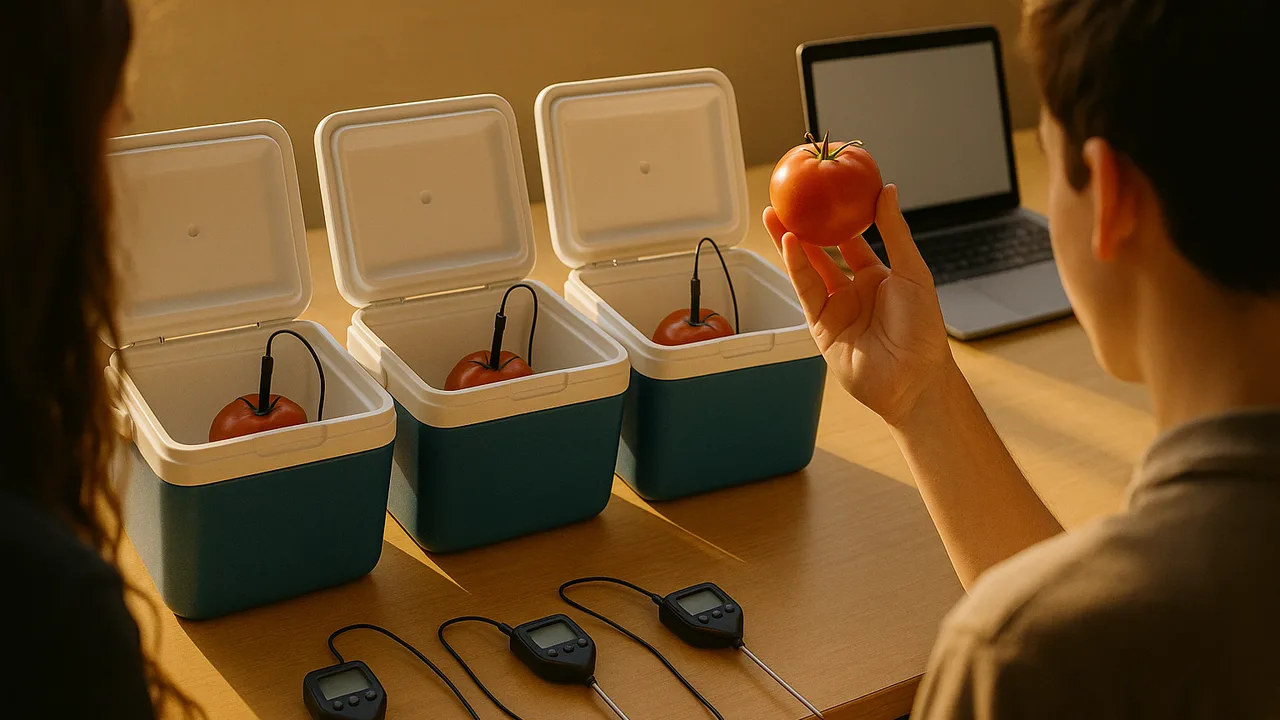
give and use evidence-based critique, test my team’s cooler against every criterion, and refine version 2 by making and justifying trade-offs.
- I can systematically evaluate different ways to refine a chemical system by comparing how well each option meets the criteria for increasing product and fits within the given constraints.
- I can refine a chemical system by making tradeoffs to optimize product formation and explain the reasoning behind my design choices.
Phase 4: Build
Warm-Up ~5 min
Do Now. Reread your version 1 table. Circle the criterion you came closest to missing. Write one change that might fix it without breaking another criterion.
A team's cooler reached 9 °C at 20 minutes but 13 °C at 40 minutes. They opened the lid at every reading. What is the most likely cause?
Instruction ~10 min
Gallery critique protocol. Each team posts its design sketch, decision matrix, temperature graph and antacid data. Visitors leave three sticky notes: I like… (a strength tied to a criterion), I wonder… (a question about evidence or the science), and What if… (one specific change). Notes must cite a number or a collision-theory reason; “looks good” does not count.
Class criteria and constraints (sample values set by the class). A pantry cooler must (1) bring the air inside to 10 °C or below within 20 minutes and hold it there for the rest of the test; (2) slow the antacid test reaction: a tablet in 150 mL of water stored inside for 20 minutes must take at least 1.5 times as long as one in room-temperature water; (3) use no electricity; (4) cost no more than 12 sample budget points; and (5) weigh no more than 10 kg when loaded, so one volunteer can carry it.
Worked example 1: turning critique into a change (sample data). Mei’s team (concept B, pot-in-pot) got the note: “I wonder if your pot cooled enough on a humid day. Your inside air only reached 16 °C.” Their antacid ratio was 1.3, below the 1.5 criterion. They kept the clay pots, which need no ice, but added two frozen bottles inside. Version 2 (sample data): 9 °C at 20 minutes, ratio 1.7, 11 budget points. The trade-off: the pantry now needs a freezer somewhere, which the team stated plainly.
Worked example 2: a trade-off made visible (sample data). Diego’s team (concept D, foam box) passed every criterion except weight: 11.5 kg loaded. They swapped three 1 L frozen bottles for six frozen 0.5 L bottles spread around the produce, same ice mass but more contact surface, and moved the thermometer to a probe through the lid so readings did not let warm air in. Then they cut the load per box and recommended two boxes. Version 2: 9.6 kg, air at 7 °C at 40 minutes. They traded one bigger box for two lighter ones.
| Criterion | Version 1 | Change made | Version 2 | Met? |
|---|---|---|---|---|
| Air temperature at 20 / 40 min | ||||
| Antacid time ratio | ||||
| No electricity | ||||
| Budget | ||||
| Loaded mass |
Refining is the same move everywhere. Whether the system is a cooler slowing spoilage reactions or an ammonia plant pushing an equilibrium toward product, refining means: name the criteria and constraints, change one condition, measure, and state what the change gained and cost. That is the core of both HS-PS1-6 and engineering design.
What our bench test cannot show. Real produce gives off its own heat as it respires, and a pantry opens the cooler dozens of times. Our 40-minute test is a screen, not a full day. Your recommendation must name at least one limit of the model.
Guided Exercises ~15 min
Use your version 1 data and the sticky notes you received.
Independent Practice ~10 min
Run version 2 and complete the comparison table.
Compare version 1 and version 2 on every criterion. Which criterion improved most, and what did you give up to get it? Then apply the same refining move to the ammonia plant: propose one change, the criterion it improves and the constraint it costs.
🔎 Mini case study: Haber and Bosch: refining a reaction into fertilizer ~8 min
In the early 1900s, the chemist Fritz Haber showed in the laboratory that nitrogen from the air and hydrogen could be combined into ammonia at high pressure with a catalyst. Turning that into a factory was a separate problem. The engineer Carl Bosch and his team at a German chemical company had to build steel reactors that could hold hot hydrogen at very high pressure; hydrogen weakened ordinary steel, so they designed a reactor with an inner liner inside a thick pressure shell. A colleague, Alwin Mittasch, tested thousands of catalyst mixtures before settling on an iron-based one. The first industrial plant opened in 1913.
Both men later received Nobel Prizes. Today the process makes most of the world’s nitrogen fertilizer, and it still runs on the same compromise you studied: moderate temperature with a catalyst, high pressure, and continuous removal and recycling. Its main drawback is energy use and the carbon dioxide released in making the hydrogen, which engineers are now trying to cut.
Think about it: Which criteria and constraints did Bosch’s team trade off, and which of them match the trade-offs your team made in its cooler?
Closure ~5 min
Version 2 is tested and justified. Next phase, you write the brief and present to the food bank’s board.
Exit ticket: name the biggest trade-off in your version 2 and explain why you accepted it.
Teacher notes
Materials: version 1 coolers, fresh frozen packs and bottles, sticky notes in three colors, thermometers (probe types through the lid if available), antacid tablets, timers, scale.
Timing: critique 15 minutes, version 2 build and test 25 minutes, comparison write-up 10 minutes.
Listen for: “more ice is always better” (weight); changes with no reason; critique aimed at people instead of designs.
Support / stretch: provide critique sentence starters. Stretch: use the rule of thumb to estimate how many extra hours of shelf life a pantry gains by holding produce at 8 °C instead of 21 °C for a 6-hour distribution.