1.02 Project Brief and Wonder Board: The Geothermal Co-op’s Question
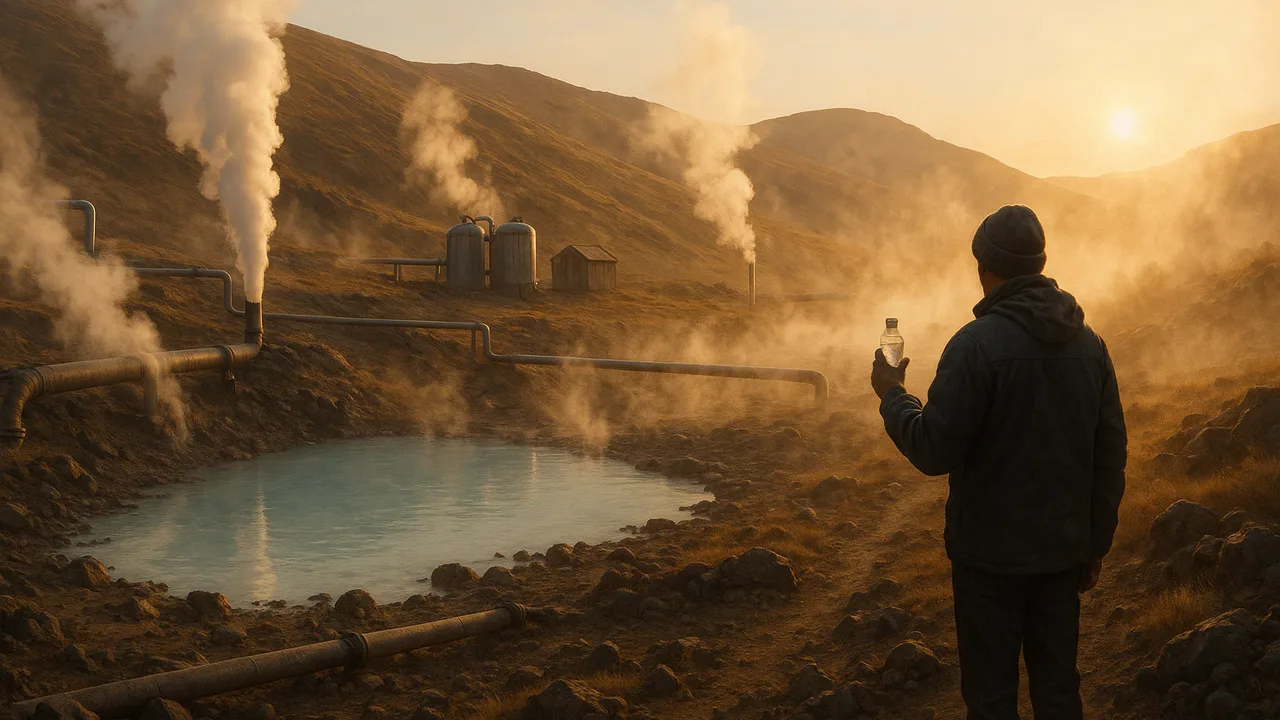
Lithium From Hot Brine: An Element Brief for a Geothermal Co-op
How can the periodic table explain why some elements rust, fizz or dissolve while others stay unchanged for centuries, and how can that help a geothermal co-op plan to recover lithium from its brine?
The mystery: Gold flakes recovered from an old mining camp still shine, while the iron picks and pans buried beside them have rusted away. Not far from many such camps, hot brine pumped up by geothermal power plants carries dissolved lithium, the metal in rechargeable batteries.
Questions we will figure out together in this unit:
- Why does gold stay shiny when iron rusts?
- What makes elements in the same column behave alike?
- Why is lithium dissolved in the brine instead of being a solid metal?
- Is lithium more or less reactive than sodium and potassium?
- How can you pull one kind of ion out of water full of others?
- Why does the periodic table list the mass of lithium as 6.94 and not 7?
- How much water and energy does lithium recovery use?
- What would the people living near the plant want to know?
explain the geothermal co-op’s request, use the periodic table to locate lithium and its neighbors, and turn our questions into need-to-knows for the project.
- I can explain how the arrangement of the main groups in the periodic table shows patterns in the outermost electrons of atoms.
- I can describe how elements are organized in the periodic table by the number of protons in their atoms.
- I can identify and describe how elements are arranged in the periodic table.
- I can explain that atoms have a positively charged nucleus made of protons and neutrons, surrounded by negatively charged electrons.
- I can describe how the number of protons and the arrangement of electrons, especially the outermost electrons, are important for understanding elements.
Phase 1: Spark
Warm-Up ~5 min
Do Now. Your phone battery is a lithium-ion battery. Write where you think the lithium in it came from before it was a battery: a mine, a lake, the ocean, a recycling plant? Give a reason.
Lithium is element 3. How many protons and electrons does a neutral lithium atom have?
Instruction ~10 min
Meet the client. A geothermal power co-op in a hot desert basin has written to our class. Its plants pump very hot, salty water (brine) up from deep underground, use the heat to make electricity, and send the cooled brine back down. Tests show the brine carries dissolved lithium, along with much more sodium, potassium, calcium and magnesium. Battery makers want lithium. The co-op’s board has two requests:
- An element brief that explains, from the periodic table, what lithium is, how it behaves and why it is dissolved in the brine as an ion instead of sitting underground as a shiny metal.
- A bench-scale plan for the first cleanup step of recovery: pulling the 2+ ions (calcium and magnesium) out of a model brine so lithium can be captured later. The co-op also wants community and water-use concerns named up front.
Driving question. How can the periodic table explain why some elements rust, fizz or dissolve while others stay unchanged for centuries, and how can that help the co-op plan to recover lithium?
A first look at the periodic table. The table lists elements in order of atomic number: each box has one more proton than the box before. Rows are periods; columns are groups. Lithium (Z = 3), sodium (11) and potassium (19) all sit in group 1; magnesium (12) and calcium (20) sit in group 2. Elements in a group behave alike, which is a pattern we will explain with electrons.
Worked example 1: reading the brine list. The brine report lists Na, K, Li, Ca and Mg. Mei located each: three in group 1, two in group 2. She noted, “Lithium’s closest chemical cousins in the brine are sodium and potassium. That might make it hard to separate.” That is a need-to-know.
Worked example 2: from wonder to need-to-know. “Why is lithium in the water?” becomes “What property of lithium atoms makes them exist as dissolved ions?” The second version tells us what science to learn.
Breaking the problem down. Engineers split big problems into sub-problems (HS-ETS1-2). Ours: (a) explain lithium’s behavior; (b) remove the 2+ ions; (c) capture Li+ away from Na+ and K+; (d) limit water and energy use; (e) protect the nearby community. This unit tackles (a) and (b) and frames the rest.
Team roles. Teams of four rotate weekly: Lead Chemist (keeps the team on the question), Data Analyst (tables, graphs, calculations), Lab Manager (materials and safety checks) and Communicator (shares findings and the team’s questions with the client).
Guided Exercises ~15 min
Use the periodic table and the co-op’s brine list.
Independent Practice ~10 min
Start your Element Notebook and the team charter.
In 3–4 sentences, restate the co-op's two requests and break the project into at least three sub-problems.
Add two questions to the Wonder Board: one about atoms or the periodic table, one about recovering lithium.
Closure ~5 min
We know the client, the driving question and our teams. Next phase, we test element samples in the lab.
Exit ticket: why might lithium be hard to separate from sodium and potassium? Use the word group.
Teacher notes
Materials: the client letter (generic, on co-op letterhead you design), a sample brine list naming Na, K, Li, Ca and Mg with no concentrations, periodic tables, role cards, chart paper for the Wonder Board.
Setup: keep the Wonder Board posted all unit; 1.06 and 1.09 return to it. The co-op is fictional; keep any real-world numbers out of the letter so students do not treat sample data as fact.
Listen for: “the table is in order of mass” (mostly true but not the rule); students assuming lithium sits underground as metal.
Support / stretch: give a sentence frame for need-to-knows (“We need to know ___ so that we can ___”). Stretch: rank the five sub-problems in the order they must be solved and justify the order.