2.03 Mystery White Solids
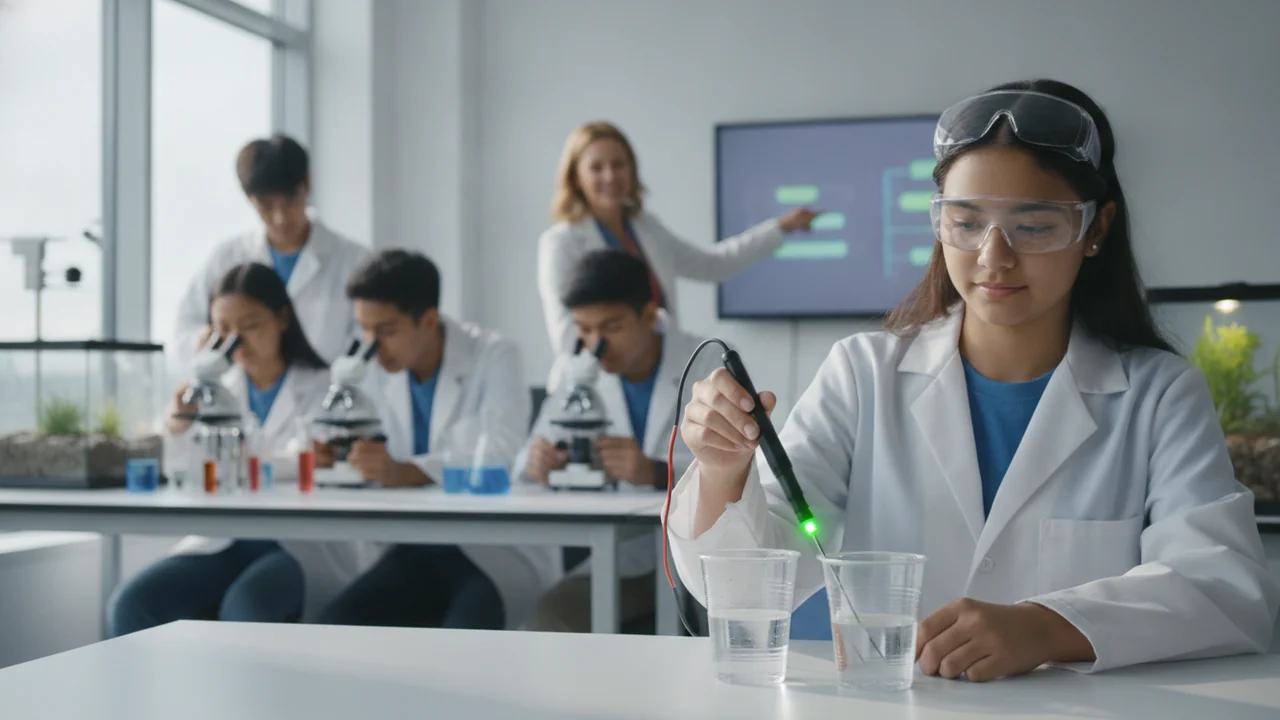
test four white solids for solubility, conductivity in solution and behavior when warmed, and use the results to infer the relative strength of the forces between their particles.
- I can justify my choice of substances to compare and describe their composition at the atomic and molecular scale.
- I can describe how I will collect data, including the number of trials, the experimental setup, and the equipment I will use.
- I can collect and record both quantitative and qualitative data about the bulk properties of substances.
- I can plan an investigation that uses bulk properties such as melting point, boiling point, volatility, and surface tension to gather evidence about the strength of electrical forces between particles.
- I can describe the data I will collect and explain how it can be used to infer the strength of electrical forces between particles.
Phase 2: Investigate
Warm-Up ~5 min
Do Now. Table salt, sugar, candle wax shavings and fine sand sit in four unlabeled dishes. Without touching them, list one test that might tell each apart.
Which solution will make the LED light up?
Instruction ~10 min
The investigation question. Table salt, sugar, candle wax and fine sand all look like white or pale solids. They are held together by very different forces. Today you measure bulk properties, the properties of a sample big enough to hold, and use them as evidence about particles you cannot see. This lab runs two 50-minute periods.
What each test tells you.
- Behavior when warmed. A substance melts when its particles gain enough energy to overcome the forces holding them in place. In a hot-water bath at about 70 °C, a substance with weak forces between its particles (wax, melting point roughly 50–65 °C depending on the blend) will melt. Substances with stronger forces will not. Published melting points complete the picture: sugar about 186 °C (it also begins to decompose), salt 801 °C, and quartz sand about 1,700 °C.
- Solubility in water. Water molecules are polar: the oxygen end is slightly negative and the hydrogen ends slightly positive. They can pull ions out of a lattice and surround them, and they can attract polar molecules such as sugar. Nonpolar substances like wax do not dissolve. Sand is a covalent network: every atom is bonded to its neighbors through the whole grain, so water cannot pull pieces away.
- Conductivity of the solution. Electric current is moving charge. A solution conducts only if it contains mobile ions. Dissolved salt separates into Na+ and Cl−, so the LED lights. Dissolved sugar stays as whole neutral molecules, so it does not, even though it dissolved. That single test separates ionic from molecular substances.
From evidence to inference. Dissolves, conducts in solution, very high melting point: an ionic lattice with strong forces. Dissolves, does not conduct, moderate melting point: polar molecules with moderate intermolecular forces. Does not dissolve, melts easily: nonpolar molecules with weak intermolecular forces. Does not dissolve and does not melt at any temperature we can reach: a covalent network with very strong bonds throughout. Note that melting wax spreads its molecules apart without changing them: the particles stay wax.
Worked reasoning. Suppose an unknown dissolves (1 g in 10 mL clears after 1 minute of stirring), the LED stays dark, and it does not melt in the bath. The data rule out ionic (no conduction) and weak nonpolar forces (did not melt). The best inference is a polar molecular substance, such as sugar. The reasoning uses more than one test; one test alone often cannot decide.
Fair testing. Use the same mass of solid (1.0 g on the balance), the same volume of water (10 mL), the same stirring time, and the same tester. Rinse and dry the tester probes between samples, because a trace of salt left on a probe will make the next sample appear to conduct. Test the water alone first as your control: tap water contains a few ions and may make the LED glow faintly, so record its brightness for comparison.
Procedure. (1) Examine each solid with the hand lens; record crystal shape, texture and hardness. (2) Test 10 mL of water alone and record LED brightness (0 dark, 1 faint, 2 bright). (3) Weigh 1.0 g of each solid into its own cup, add 10 mL of water, stir 1 minute, record all / part / none dissolved. (4) Test each mixture with the tester, rinsing and drying the probes between samples. (5) Stand a pea-sized amount of each dry solid in a test tube in the hot-water bath for 3 minutes; record the bath temperature and whether each melts. (6) Repeat for the unknown and identify it.
| Sample | Appearance | Dissolves? (all / part / none) | LED in solution (0–2) | Melts in bath at ___ °C? | Inferred force type and strength |
|---|---|---|---|---|---|
| Water only (control) | n/a | n/a | n/a | n/a | |
| Table salt | |||||
| Sugar | |||||
| Wax | |||||
| Sand | |||||
| Unknown |
Guided Exercises ~15 min
Answer while your samples stir and warm.
Independent Practice ~10 min
Lab analysis.
Identify the unknown and explain which single test was most decisive and why one test alone might not have been enough.
Name two sources of error (for example, salt left on the probes, or a bath that cooled during the test) and how each could mislead you. Then use your results to explain why salt is left behind in the ponds when the water evaporates.
Closure ~5 min
Properties revealed the forces. Next class: why does water itself boil so high?
Exit ticket: the superabsorbent crystals do not dissolve but do take in water. Which result from today does that remind you of, and what might it say about their structure?
Teacher notes
Materials (per team): about 5 g each of table salt, granulated sugar, paraffin wax shavings (unscented candle) and fine clean sand, plus a teacher-prepared unknown; balance (0.1 g), weighing paper, 10 mL graduated cylinder, five clear cups, stirring sticks; low-voltage tester (2 AA, LED, two leads); test tubes in a rack; a foam cup of hot tap water at about 70 °C as a bath, with a thermometer; hand lens; goggles.
Two periods: day 1 tests; day 2 unknown, analysis and CER. No-lab alternative: the teacher’s recorded demonstration with a class data table, plus the PhET States of Matter simulation.
Listen for: “sugar conducts because it dissolved”; “sand didn’t dissolve so it has weak forces.”
Support / stretch: give a decision tree (dissolves? conducts? melts?). Stretch: design a fourth test that would separate sugar from a second polar molecular solid.