2.02 Project Brief and Wonder Board: The Farm Co-op’s Dry Soil
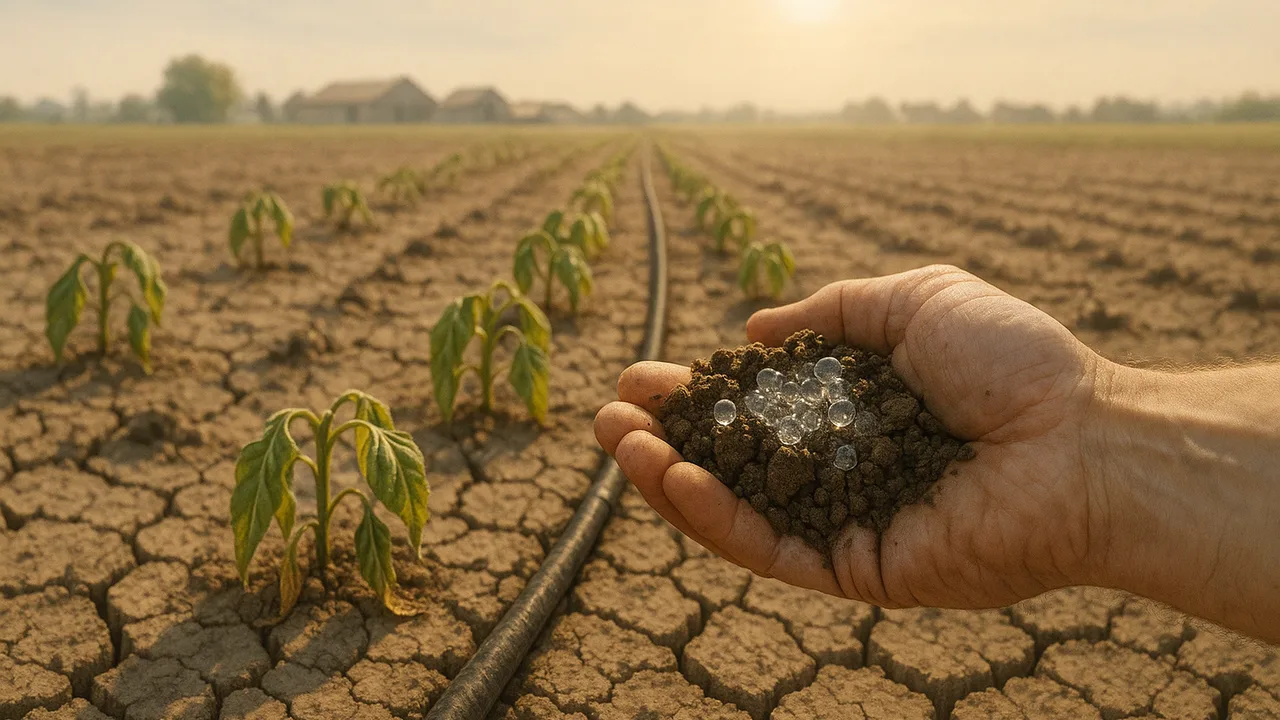
Holding Water in Dry Soil: A Materials Brief for a Farm Co-op
Why do some substances hold together, dissolve or hold water better than others, and which soil additive should a farm co-op in a hot, dry valley choose to keep water near its crops’ roots?
The mystery: At salt-evaporation ponds along a coastal bay, shallow ponds turn green, orange and red, and the last ponds dry to white crystals of salt, many of them nearly perfect cubes. The water leaves; the salt stays behind.
Questions we will figure out together in this unit:
- Why does salt stay behind when water evaporates?
- Why is water a liquid when bigger molecules are gases?
- How can a few crystals soak up a whole cup of water?
- Does salty water change how much the crystals absorb?
- Is compost or mulch better than a polymer, and why?
- Why does a nonstick pan not stick?
- How can we measure how strongly particles attract each other?
- What happens to the polymer in the soil after a year?
explain the farm co-op’s request, describe the intended function of a designed material that holds water in soil, and turn our questions into need-to-knows and a first investigation plan.
- I can describe the intended function of a chosen designed material.
- I can plan an investigation that uses bulk properties such as melting point, boiling point, volatility, and surface tension to gather evidence about the strength of electrical forces between particles.
- I can describe the data I will collect and explain how it can be used to infer the strength of electrical forces between particles.
Phase 1: Spark
Warm-Up ~5 min
Do Now. Your teacher pours 50 mL of water into a cup of plain potting soil and another 50 mL into a cup of soil mixed with a pinch of white crystals. Predict which cup drains more water out the bottom, and why.
Which cup lets more water drain out?
Instruction ~10 min
Meet the client. A farm co-op in a hot agricultural valley has written to our class. Its members grow vegetables and orchard crops. Summers are long and dry, and much of their irrigation water is slightly salty, because evaporation in the fields leaves salt behind, just like the bay’s salt ponds. The co-op’s question: which soil additive should we use to keep water near the roots longer? Sellers offer superabsorbent polymer crystals; neighbors swear by compost or wood-chip mulch.
The request. The co-op wants (1) a lab-tested recommendation for a soil mix, using criteria they care about, and (2) a materials brief that explains, from particle structure, why the chosen material works and when it might not.
Driving question. Why do some substances hold together, dissolve or hold water better than others, and which soil additive should the co-op choose?
Function first. A designed material is chosen or engineered for a job. Its intended function is that job, stated plainly. For a superabsorbent polymer in soil: “absorb irrigation water, hold it in the root zone, and release it to roots as the soil dries.” Stating the function first tells us which properties to test.
Worked example 1: function to properties. Jamal listed the function, then the measurable properties it needs: water held per gram of material; how much of that water drains away; how much is still held after a day; whether salty water changes the result. Each property becomes a test.
Worked example 2: planning what data to collect. Ava’s team will compare plain soil with soil plus 1% crystals by mass. They plan to add 100 mL of water to 100 g of each mix, collect and measure what drains in 10 minutes, and repeat three times. Water held = water added − water drained. They will also repeat with salty water. That plan names the data and how it shows the strength of the material’s attraction to water.
Team roles. Teams of four rotate weekly: Lead Scientist, Data Analyst, Lab Manager and Communicator, as in Unit 1.
Guided Exercises ~15 min
Use the client letter and the worked examples.
Independent Practice ~10 min
Start your Materials Notebook.
Write the intended function of each candidate additive (superabsorbent polymer, compost, mulch) in one sentence each, and list two measurable properties you would test.
Add two questions to the Wonder Board: one about particles and forces, one about the co-op's choice.
Closure ~5 min
We have a client, a function and a plan. Next phase: mystery solids in the lab.
Exit ticket: why should a team state a material's intended function before choosing tests?
Teacher notes
Materials: client letter (generic farm co-op), potting soil, a small amount of superabsorbent polymer crystals (garden “water crystals”), two cups with drain holes, collection cups, graduated cylinder, role cards, Wonder Board paper.
Safety for the demo: the teacher handles the dry crystals; avoid making dust; wipe up any gel because it is slippery.
Listen for: “the crystals make water”; confusing absorbing with dissolving.
Support / stretch: provide a function → property → test organizer. Stretch: write the co-op’s problem as sub-problems and order them.