1.10 Unit 1 Checkpoint: Atoms and the Periodic Table
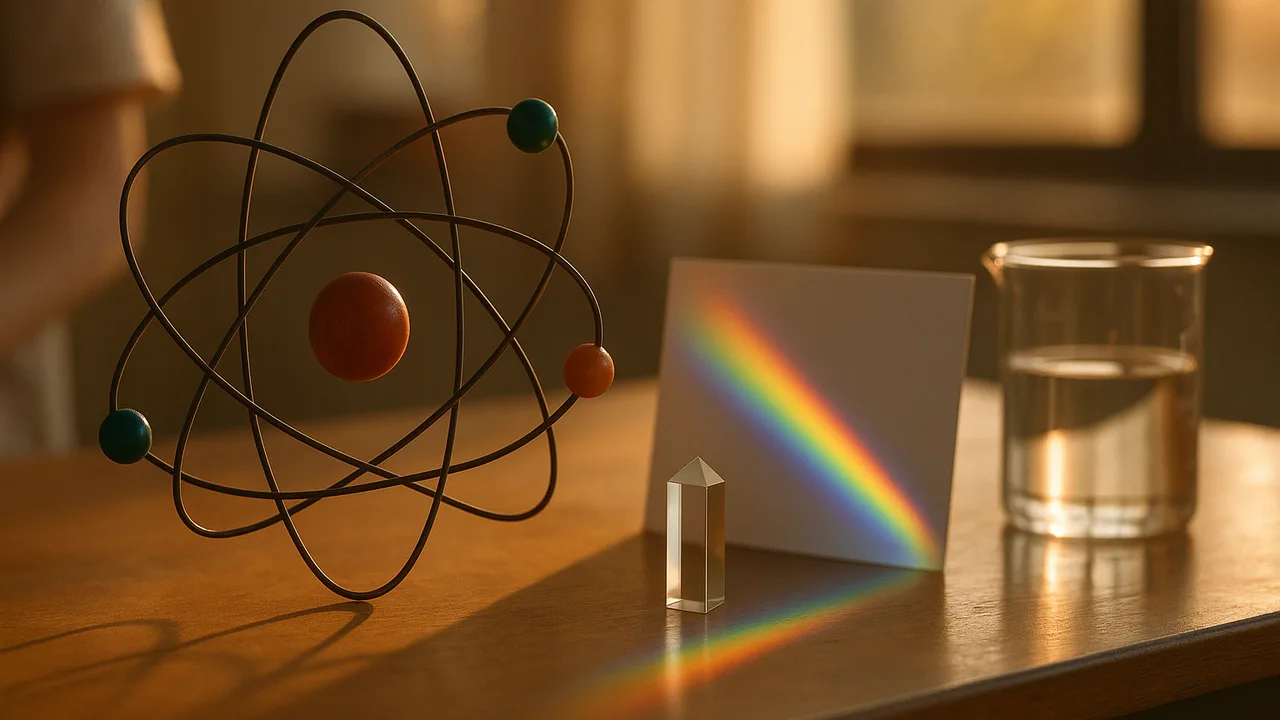
show what I learned about atomic structure, the periodic table and periodic trends by answering data questions, a scenario set and short constructed responses.
- I can identify and describe how elements are arranged in the periodic table.
- I can explain that atoms have a positively charged nucleus made of protons and neutrons, surrounded by negatively charged electrons.
- I can describe how the number of protons and the arrangement of electrons, especially the outermost electrons, are important for understanding elements.
- I can use the periodic table to predict how elements behave based on the attraction and repulsion between charged particles and the patterns of outermost electrons that affect an atom’s reactivity.
- I can predict the number and types of bonds an element can form, and the kinds of bonds formed between elements.
- I can predict the number and charges of stable ions that form from atoms in a group of the periodic table.
- I can analyze and compare trends in reactivity, electronegativity, and atomic size across rows and down groups in the periodic table, based on the attraction of valence electrons to the nucleus.
Phase 5: Prove It
Warm-Up ~5 min
Do Now. Back to the phenomenon: in three sentences, explain why the miners’ gold still shines, why their iron rusted, and why lithium is dissolved in the co-op’s brine.
All atoms of an element have the same number of protons.
Instruction ~10 min
Chemists, this is the unit checkpoint. Part A is multiple choice with data. Part B is a scenario set: several questions share one situation. Part C is short constructed responses, each scored 0–3. Read each question twice and show your reasoning.
How a 0–3 answer is scored. 3: a correct claim, accurate evidence (a value or observation) and reasoning that names the mechanism (outer electrons, distance, shielding, charge). 2: correct claim and evidence, with reasoning that is incomplete. 1: a correct claim with little or no support, or a partly correct answer. 0: incorrect or blank.
Worked example: from 1 point to 3. “Which is more reactive, Na or Mg?” “Sodium” earns 1. “Sodium, because its ionization energy is 5.14 eV against magnesium’s 7.65 eV” earns 2. Adding “sodium loses one outer electron, held more weakly because magnesium has one more proton pulling on the same shell” earns 3.
Scenario data (NIST first ionization energies, eV). Use for Part B.
| Element | Group | Period | First ionization energy (eV) |
|---|---|---|---|
| Be | 2 | 2 | 9.32 |
| Mg | 2 | 3 | 7.65 |
| Ca | 2 | 4 | 6.11 |
| Na | 1 | 3 | 5.14 |
| Cl | 17 | 3 | 12.97 |
| Ar | 18 | 3 | 15.76 |
Guided Exercises ~15 min
Parts A and B: answer on your own. Your teacher reviews answers after everyone finishes.
Independent Practice ~10 min
Part C: constructed responses, each scored 0–3.
13. Describe the structure of a magnesium-24 atom (particles, where they are, their charges) and explain which part of that structure places magnesium in group 2. (0–3)
14. Use the table: is magnesium or sodium more reactive? Give a claim, cite two values, and explain with nuclear charge and distance. (0–3)
15. Predict the ions formed by aluminum, sulfur and potassium, and the formulas of aluminum sulfide and potassium sulfide. Explain how the periodic table let you predict them. (0–3)
16. Rank Li, Na and K by atomic size and by reactivity with water, then explain why both trends come from the same cause. (0–3)
Closure ~5 min
Finished, chemists. Next unit, we go from single atoms to the forces that hold substances together.
Exit ticket: which item was hardest, and which idea do you want to practice before Unit 2?
How confident are you that you can I can use the periodic table to explain and predict how elements behave.
Teacher notes
Materials: printed checkpoint with the data table, periodic tables, calculators, scoring guide for items 13–16.
Setup: about 40 minutes, then a brief review. Item tags: 1, 2, 3, 12 and 13 → HS-PS1-1:1a; 2, 4 and 13 → 2a; 5–7, 10, 14 and 16 → 3a; 8, 9, 11 and 15 → 3b. Use the tags to regroup students for re-teaching.
Listen for: “higher ionization energy means more reactive” for metals; isotope averages computed without weights.
Support / stretch: read items aloud on request and allow a blank shell-diagram sheet. Stretch: explain why the Mg–Al dip in ionization energy does not overturn item 7’s trend.