3.04 Hand Warmers and Cold Reactions: Energy in Bonds
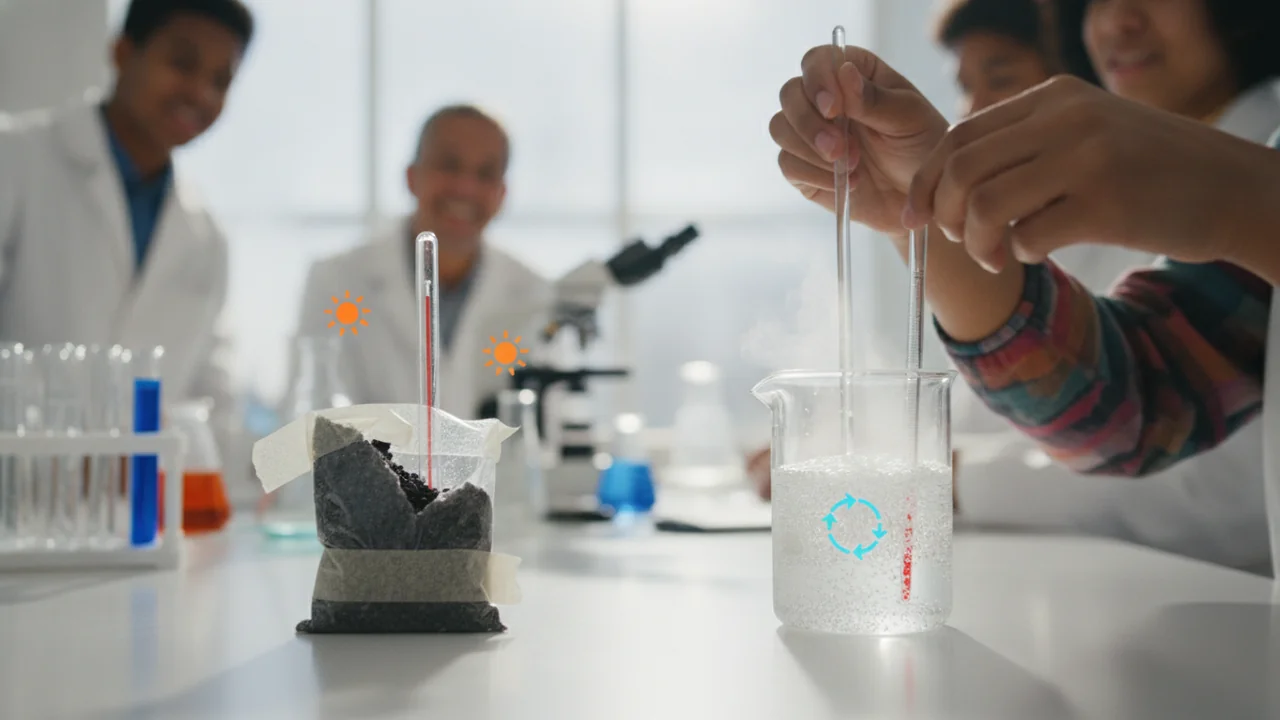
measure the temperature change of an exothermic and an endothermic reaction and use a bond-energy model to argue where the energy released or absorbed comes from.
- I can develop a model of a chemical reaction that identifies the system, the surroundings, and the bonds that are broken and formed.
- I can use my model to describe how energy is transferred between the system and surroundings, and how potential energy changes to kinetic energy (or vice versa) during molecular collisions.
- I can use my model to compare the relative potential energies of the reactants and products in a chemical reaction.
- I can use my model to illustrate that the energy change in a chemical reaction comes from the difference in bond energies between reactants and products.
- I can explain that breaking bonds requires energy input and forming bonds releases energy, and that energy transfer between the system and surroundings happens during molecular collisions.
- I can use my model to show that the total energy of the system and surroundings is conserved during a chemical reaction, and that changes in bond energy account for the relative potential energies of reactants and products.
Phase 2: Investigate
Warm-Up ~5 min
Do Now. A sealed hand warmer stays cold in its wrapper for months. Tear the wrapper and it heats up within minutes. Write what changes when the wrapper opens, and where you think the heat comes from.
You add baking soda to vinegar with a thermometer in the cup. What happens to the temperature?
Instruction ~10 min
Rust that you can feel. A disposable hand warmer, the kind people carry to winter games or on cold hikes, contains iron powder, salt, water held in a fiber and activated carbon. Open the packet and air gets in: the iron rusts, fast, and the packet heats up for hours. It is the same reaction eating at the bridge’s steel, sped up by fine powder and salt water. Meanwhile, baking soda and vinegar, from the last lab, get colder as they react. Today you measure both and argue where the energy goes.
Quick measurement. (1) Put a thermometer in 30 mL of vinegar in a foam cup and record the temperature. (2) Add 2.0 g of baking soda, stir gently, and record the lowest temperature reached. (3) Tape a thermometer to an opened hand warmer, wrap both loosely in a paper towel, and record the temperature every minute for 5 minutes. Typical classes see the vinegar cup drop a few degrees and the hand warmer rise well above body temperature.
| Time (min) | 0 | 1 | 2 | 3 | 4 | 5 |
|---|---|---|---|---|---|---|
| Hand warmer (°C) | ||||||
| Vinegar + baking soda (°C) |
System and surroundings. The system is the reacting substances; the surroundings are everything else, including the water, the cup, the thermometer and your hand. A reaction that releases energy to the surroundings is exothermic: the surroundings warm. One that absorbs energy from the surroundings is endothermic: the surroundings cool. The energy moves by molecular collisions: fast-moving particles bump slower ones and share kinetic energy.
The bond-energy model. Every reaction breaks some bonds and forms others. Breaking a bond always takes energy, because you are pulling apart attracted particles. Forming a bond always releases energy. The bond energy is the energy needed to break one mole of a given bond (kJ/mol). The energy change of the reaction is: energy change = (energy to break reactant bonds) − (energy released forming product bonds). A negative result means more energy is released than absorbed: exothermic. A positive result means endothermic.
Worked example 1: hydrogen burning. 2H2 + O2 → 2H2O. Approximate average bond energies from standard tables (values differ slightly between sources): H–H 436, O=O 498, O–H 464 kJ/mol. Broken: 2 H–H + 1 O=O = 2(436) + 498 = 1,370 kJ. Formed: each water has 2 O–H, so 4 O–H = 4(464) = 1,856 kJ. Change = 1,370 − 1,856 = −486 kJ. Exothermic, and close to the measured value of about −484 kJ for forming water vapor. The products sit lower in potential energy than the reactants because their O–H bonds are stronger, in total.
Worked example 2: methane (natural gas) burning. CH4 + 2O2 → CO2 + 2H2O, with C–H 413 and C=O 799. Broken: 4(413) + 2(498) = 2,648 kJ. Formed: 2(799) + 4(464) = 3,454 kJ. Change = −806 kJ, near the measured −802 kJ.
An energy diagram. Draw energy on the vertical axis. Reactants sit at one level. Breaking bonds climbs up to separated atoms (energy absorbed); forming product bonds drops down to the products (energy released). If the products end below the reactants, the difference leaves as heat: exothermic. If they end above, the difference was taken from the surroundings: endothermic.
The misconception to argue against. Many people say “energy is stored in bonds and released when bonds break.” The model says the opposite: breaking bonds absorbs energy. Fuels release energy because the bonds in the products (CO2 and H2O) are stronger than the bonds in the fuel and oxygen. The energy is a property of the whole system’s change, not of one bond snapping.
Your argument. Explain the hand warmer and the cold baking-soda reaction with the model, using your temperature data as evidence. The iron-oxygen reaction releases about 824 kJ per mole of Fe2O3 formed (a measured value), so the Fe–O attractions in rust are much stronger than the bonds broken in iron metal and O2. Then judge the “energy stored in bonds” statement against the model and the data.
Reading. OpenStax Chemistry 2e, chapter 5 (thermochemistry) and section 7.5 (bond strengths), CC BY 4.0.
Guided Exercises ~15 min
Use your data and the bond-energy table.
Independent Practice ~10 min
Model and calculate, in your Corrosion Notebook.
Draw labeled energy diagrams for the hand warmer and for the baking soda reaction. Mark the system, the surroundings, bonds broken, bonds formed and the direction of the net energy transfer.
Use bond energies (N≡N 946, H–H 436, N–H 391 kJ/mol) to calculate the energy change for N2 + 3H2 → 2NH3. Show the bonds broken and formed, and state whether the reaction is exothermic.
Closure ~5 min
Energy is conserved too: what the system releases, the surroundings gain. Next class, we learn to count atoms by weighing them.
Exit ticket: rust forms on the bridge too, but the steel never feels warm. Use the words rate and surroundings to explain why.
Teacher notes
Materials (per group): one air-activated iron hand warmer, two thermometers or temperature probes, a foam cup, 30 mL vinegar, 2.0 g baking soda, masking tape, paper towels, goggles, the bond-energy table.
Answer for the ammonia task: broken 946 + 3(436) = 2,254 kJ; formed 6(391) = 2,346 kJ; change −92 kJ, exothermic. Unit 4 reuses this value.
Listen for: “cold flows into the cup”; “the bonds were full of energy and it leaked out”; system and surroundings confused.
Support / stretch: give a bond-counting table (bond, number broken, number formed, energy). Stretch: explain why bond-energy estimates differ slightly from measured values (average bond energies, gas-phase values).