2.07 Polymer, Compost or Mulch? Designing the Soil Mix
plan a fair investigation of competing soil mixes, choose a design with a weighted decision matrix, and build and test version 1 against the co-op’s criteria.
- I can plan an investigation that uses bulk properties such as melting point, boiling point, volatility, and surface tension to gather evidence about the strength of electrical forces between particles.
- I can describe the data I will collect and explain how it can be used to infer the strength of electrical forces between particles.
- I can justify my choice of substances to compare and describe their composition at the atomic and molecular scale.
- I can describe how I will collect data, including the number of trials, the experimental setup, and the equipment I will use.
- I can explain how I will collect data, how many trials I will conduct, and what experimental setup and equipment I will use.
Phase 4: Build
Warm-Up ~5 min
Do Now. Look at the sample data table. Which mix holds the most tap water? Which loses the most when the water is salty? Write one particle-level guess for the drop.
| Mix (sample data, 3 trials) | Water held, tap (mL) | Water held, salty (mL) |
|---|---|---|
| Plain soil | 38, 36, 40 | 37, 35, 38 |
| Soil + 1% polymer | 71, 68, 74 | 52, 49, 55 |
| Soil + 20% compost | 55, 53, 58 | 54, 52, 55 |
Why does the polymer hold much less salty water than tap water?
Instruction ~10 min
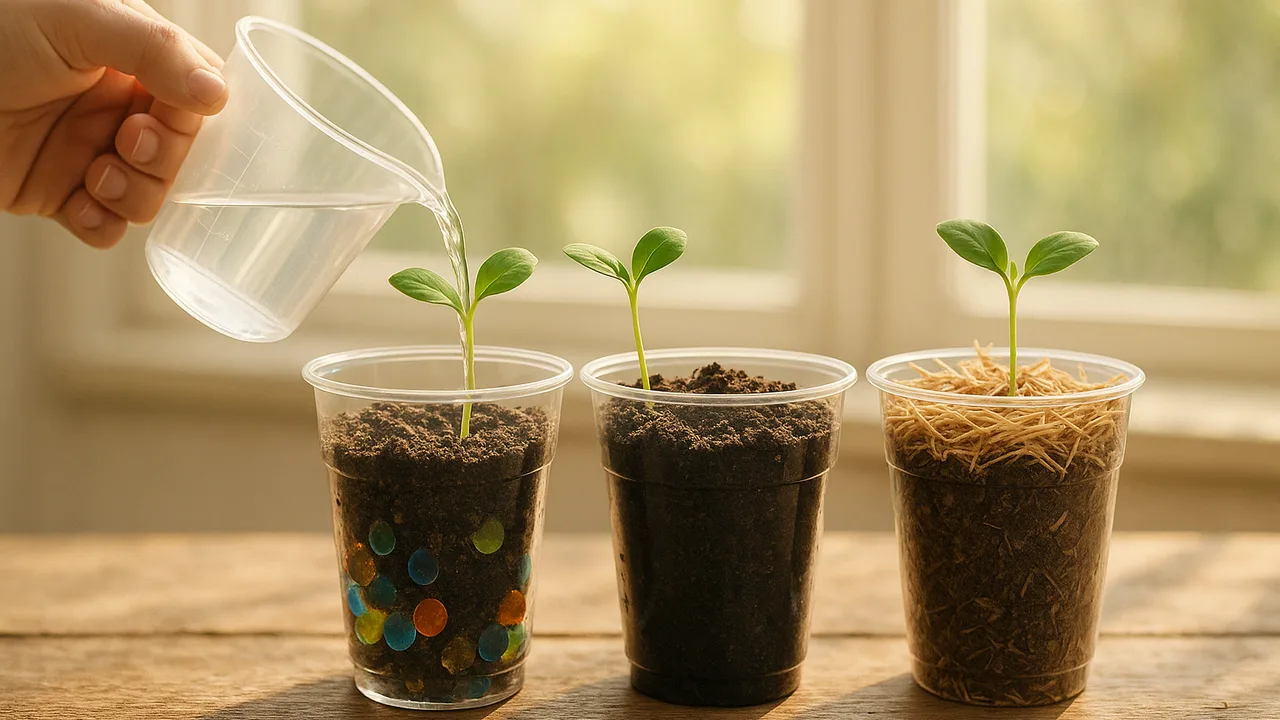
Competing designs. Teams choose among four concepts: A soil plus 1% polymer crystals by mass; B soil plus 20% compost by mass; C plain soil with a 2 cm wood-chip mulch layer on top; D a mix of your own design (for example 0.5% polymer plus 10% compost). Each is a designed material system: its particle structure is chosen for a function.
Class criteria and constraints (sample values set by the class). Each test pours 100 mL of water onto 100 g of soil mix in a cup with drain holes and collects what drains in 10 minutes. A mix must (1) hold at least 50 mL of tap water; (2) hold at least 45 mL of salty water (5 g of table salt per liter, a stand-in for the co-op’s slightly salty irrigation water); (3) lose no more than 30 g of water in the next 24 hours; (4) cost no more than 10 sample budget points per cup; and (5) be at least half biodegradable additive by mass, a concern the co-op raised.
Planning the investigation. Choose substances to compare and justify them at the particle scale: the polymer for its charged network, compost for its many polar groups and pores, mulch for slowing evaporation at the surface. Then fix the setup: same cup, same 100 g of mix, same 100 mL of water poured over the same 30 seconds, same 10-minute drain, three trials per mix, tap and salty water. Equipment: balance (0.1 g), 100 mL graduated cylinder, timer, collection cups.
Worked example 1: reading precision. The polymer’s tap-water trials (71, 68, 74 mL) have a mean of 71 mL and a range of 6 mL. The compost’s salty-water trials (54, 52, 55 mL) have a mean of 53.7 mL and a range of 3 mL. Both are fairly precise; a range larger than about 10 mL would be a signal to check the method.
Worked example 2: a weighted decision matrix (sample scores 1–3).
| Criterion (weight) | A Polymer | B Compost | C Mulch | D Mix |
|---|---|---|---|---|
| Holds tap water (×2) | 3 → 6 | 2 → 4 | 1 → 2 | 3 → 6 |
| Holds salty water (×3) | 2 → 6 | 3 → 9 | 1 → 3 | 3 → 9 |
| Slows 24-hour loss (×2) | 2 → 4 | 2 → 4 | 3 → 6 | 2 → 4 |
| Cost (×1) | 2 → 2 | 3 → 3 | 3 → 3 | 2 → 2 |
| Biodegradable (×1) | 1 → 1 | 3 → 3 | 3 → 3 | 2 → 2 |
| Total | 19 | 23 | 17 | 23 |
The salty-water weight decides it: the co-op’s water is slightly salty, so the class weighted that criterion highest. B and D tie; testing will break the tie. Mulch scores low on holding water but highest on slowing loss, a hint that it could be added on top of any mix.
Build version 1. Mix your design, run three trials with tap water and three with salty water, weigh the cups, and set them aside for the 24-hour reading.
| Trial | Water added (mL) | Drained (mL) | Held (mL) | Cup mass now (g) | Cup mass at 24 h (g) |
|---|---|---|---|---|---|
| Tap 1 | 100 | ||||
| Tap 2 | 100 | ||||
| Tap 3 | 100 | ||||
| Salty 1 | 100 | ||||
| Salty 2 | 100 | ||||
| Salty 3 | 100 |
Guided Exercises ~15 min
Plan before you pour.
Independent Practice ~10 min
Score and build.
Fill your own decision matrix with your team's weights and explain your choice of concept in four sentences, citing two rows.
Record version 1 in the data table and compute the mean and range for tap and salty water.
Closure ~5 min
Version 1 is built and has data. Next class, the 24-hour reading, gallery critique and version 2.
Exit ticket: explain, at the particle level, why your chosen mix should hold salty water well.
Teacher notes
Materials (per team): potting soil, garden water crystals (superabsorbent polymer), compost, wood-chip mulch, six plastic cups with four small drain holes each and six collection cups, balance, 100 mL graduated cylinder, timer, salty water (5 g table salt per liter), goggles. Sample budget prices: 1 g polymer 4 points, 20 g compost 2 points, mulch layer 2 points, cup 1 point.
Setup: pre-measure the polymer in 1 g portions. Soak or pre-moisten soil the same way for every team so the starting moisture matches. The sample data are illustrative; real results vary with soil type.
Listen for: “salt makes the polymer dissolve”; teams changing two things at once between trials.
Support / stretch: provide a planning template with the controlled variables listed. Stretch: design a test that measures how much held water a plant can actually take up.