3.06 Why Salt Fog Eats Steel: Revising Our Rust Model
combine atoms, electrons, energy and moles into one revised model of rusting, revise my explanation when given new evidence, and brainstorm protection ideas for the bridge authority.
- I can revise or expand my explanation about the outcome of a chemical reaction when given new evidence or context, and justify my changes.
- I can describe how the net energy change in a chemical reaction system results from the bonds broken and formed, and how energy is transferred between the system and surroundings by molecular collisions.
- I can explain how the total energy change in the chemical reaction system is balanced by an equal but opposite energy change in the surroundings.
- I can use my model to show that whether energy is released or absorbed depends on the change in potential energy from reactants to products.
- I can explain how my mathematical work (like stoichiometric calculations) supports the idea that atoms and mass are conserved in a chemical reaction.
Phase 3: Make Sense
Warm-Up ~5 min
Do Now. Look back at your first model of rust from 3.01. Write one thing it got right and one thing it left out that you now know (mass, energy, salt, or something else).
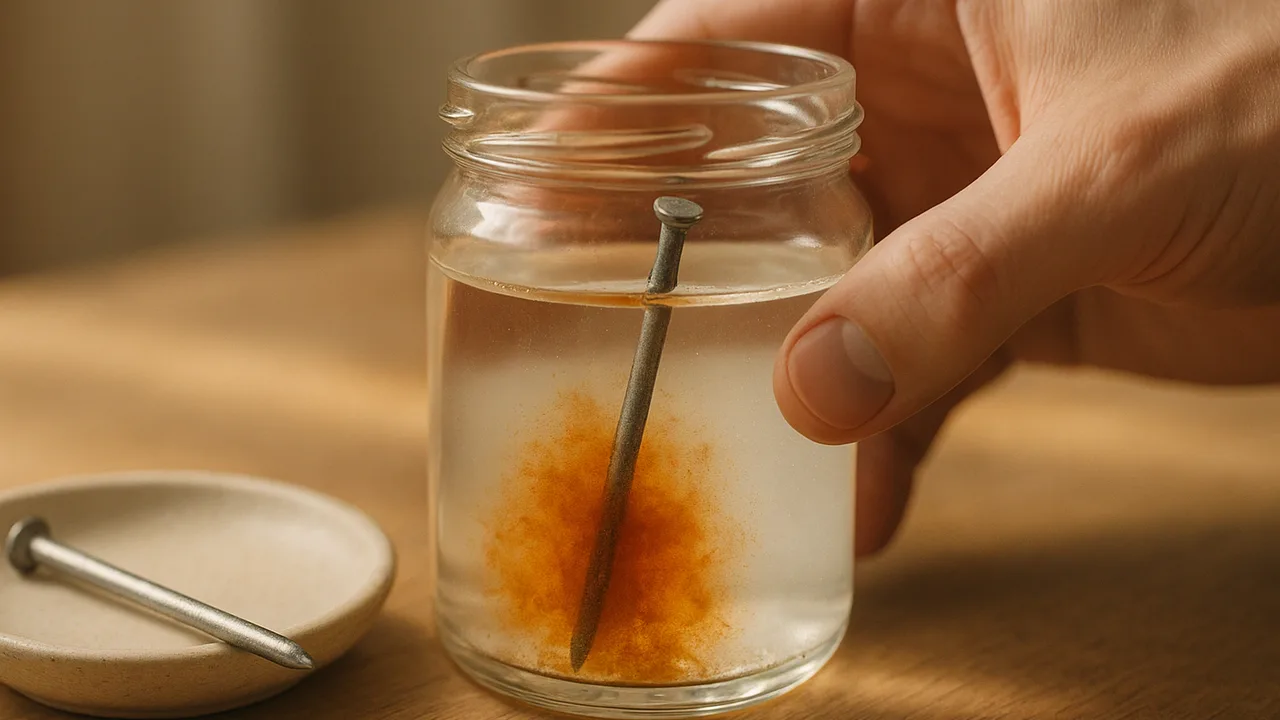
New evidence: nails sealed in jars of boiled (oxygen-poor) salt water rust far less than nails in open cups of salt water. How should our model change?
Instruction ~10 min
Where we are. We have four pieces: a balanced equation with electrons explaining the product (3.01, 3.02), conservation of mass (3.03), energy from bonds (3.04) and moles (3.05). Today we assemble them into one model of what happens on the bridge, test it against new evidence, and revise it. Then we brainstorm solutions for the client.
Piece 1, particles and electrons. 4Fe + 3O2 → 2Fe2O3. Iron (electronegativity 1.83) loses three electrons per atom; oxygen (3.44) gains two per atom. Metallic bonds in iron and covalent O=O bonds break; ionic Fe–O attractions form. Atoms are conserved.
Piece 2, energy. Forming 1 mol of Fe2O3 releases about 824 kJ. The energy released by the system equals the energy gained by the surroundings: energy is conserved, not created. Worked example 1: a hand warmer. Suppose a warmer held 20 g of iron (an illustrative figure). 20 ÷ 55.845 = 0.358 mol Fe → 0.179 mol Fe2O3; 0.179 × 824 = about 148 kJ released to the surroundings over several hours. On the bridge, the same reaction releases the same energy per mole, but so slowly, over years, that the air and steel carry it away with no warming you could feel.
Piece 3, energy in the cold cup (sample data). In 3.04 one group’s 32 g of vinegar solution dropped 3.0 °C. The energy the surroundings lost is q = m × c × ΔT = 32 g × 4.18 J/(g·°C) × 3.0 °C = 401 J, about 0.40 kJ. The system absorbed the same 0.40 kJ: the energy change in the system is balanced by an equal and opposite change in the surroundings.
Piece 4, mass. 1,000 g of iron becomes 1,430 g of rust by taking 430 g of oxygen from the air. The calculation conserves mass because each step conserves atoms.
New evidence to explain (sample class data). Four nails sat for three days: (A) in tap water, open cup: light rust; (B) in salt water, open cup: heavy rust; (C) in boiled salt water under a layer of oil: almost none; (D) a galvanized nail in salt water, open cup: white crust, no red rust. Our model explains A and C (oxygen is a reactant). B needs more: dissolved salt makes water a better conductor of ions, so electrons can leave iron at one spot while oxygen gains them at another, with ions carrying charge between them. D needs more too: zinc, which gives up electrons more easily than iron, is oxidized first and feeds electrons to the steel.
Worked example 2: revising a CER. Malik’s first claim was “Salt makes rust because salt has oxygen in it.” Evidence B and C refute it: salt water without oxygen barely rusted. His revised claim: “Salt speeds rusting by letting ions carry charge between the places where iron loses electrons and oxygen gains them; oxygen is still a reactant.” He cited nails B and C and reasoned with electrons. That is what revising an explanation with new evidence looks like.
Ideate. With the model in hand, brainstorm at least five ways to protect the bridge’s new bolts and brackets. Each idea must name which part of the model it attacks: keep out oxygen, keep out water and salt, supply electrons from a more reactive metal, or change the metal itself. Defer judgment; quantity first.
Guided Exercises ~15 min
Work in your project teams.
Independent Practice ~10 min
Draw your revised model.
Draw one labeled diagram of a rusting spot on a bolt in salt fog. Show where iron loses electrons, where oxygen gains them, how ions move in the water film, the balanced equation, and an arrow for energy leaving to the surroundings. Add a caption that says how mass is conserved.
Closure ~5 min
Our model now covers atoms, electrons, energy and mass. Next phase, we design and test protection for the bridge’s new parts.
Exit ticket: which of your protection ideas do you expect to work best, and which part of the model supports that prediction?
How confident are you that you can revise an explanation of rusting using new evidence and explain how both mass and energy are conserved?
Teacher notes
Materials: each student’s 3.01 model, the sample nail-evidence card (or photos of your own four-nail jars, started a week earlier), chart paper, sticky notes for the Ideate round.
Setup: if you can, run the four-nail setup yourself 3–5 days before this lesson so students see real nails; boil the water, cool it, and seal it under a thin layer of cooking oil for nail C.
Listen for: “salt contains oxygen”; “the hand warmer makes energy”; zinc “is just a stronger paint.”
Support / stretch: give a model checklist (equation, electrons, energy arrow, mass statement). Stretch: estimate how much energy 1.00 kg of iron releases as it rusts completely (8.95 mol Fe2O3 × 824 ≈ 7,380 kJ).