4.04 Where Does New Variation Come From? The Meiosis and Mutation Argument
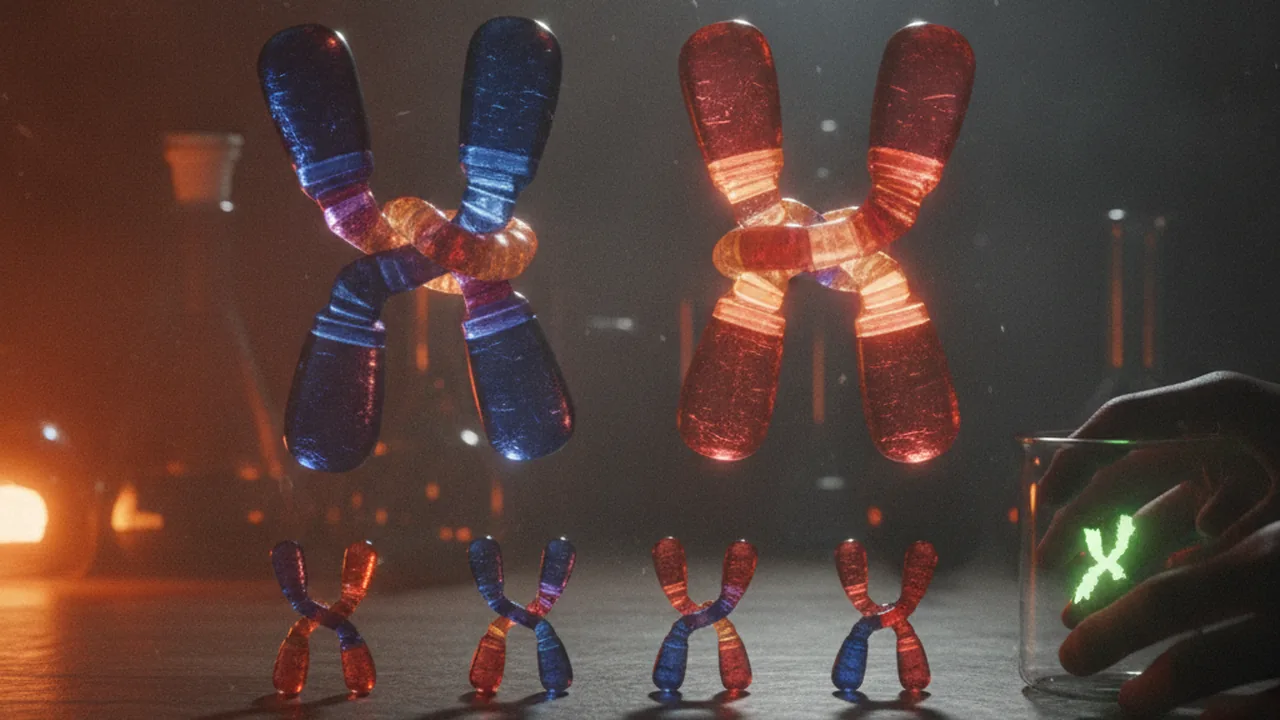
model meiosis with crossing over, calculate the number of chromosome combinations in gametes, and defend a claim about how meiosis, replication errors and environmental mutagens produce heritable variation.
- I can make a claim that inheritable genetic variations may result from new genetic combinations through meiosis, viable errors during DNA replication, and mutations caused by environmental factors.
- I can describe evidence that inheritable genetic variations can result from chromosome sections exchanging places during meiosis.
- I can explain how genetic mutations can occur due to errors during DNA replication or from environmental factors.
- I can describe how genetic material is passed from one generation to the next.
- I can defend my claim about genetic variation by evaluating counter-claims and explaining how the evidence best supports my claim.
Phase 2: Investigate
Warm-Up ~5 min
Do Now. Two bean plants grew from seeds of the same pod. One has speckled seeds and one has plain seeds. List every reason you can think of for the difference.
A person with 23 pairs of chromosomes makes eggs or sperm. About how many different chromosome combinations are possible from independent assortment alone?
Instruction ~10 min
Three sources of new variation. Siblings with the same parents are not identical (except identical twins), and neither are seeds from one plant. Heritable variation arises in three ways: new combinations of alleles during meiosis, errors made when DNA is copied, and mutations caused by the environment. Each is backed by different evidence.
1. New combinations in meiosis. Meiosis has two divisions. In meiosis I, homologous chromosomes pair up and then separate, one to each cell. Which way each pair faces at the cell’s equator is random, and each pair lines up independently of the others. In meiosis II the sister chromatids separate, as in mitosis, giving four haploid cells.
Worked example 1: counting combinations. With 2 pairs of chromosomes there are 22 = 4 possible combinations in the gametes; with n pairs there are 2n. Onion, with 8 pairs, can make 28 = 256. Humans have 23 pairs, so one person can make 223 = 8,388,608 chromosome combinations. Two parents together can produce 8,388,608 × 8,388,608 ≈ 7.0 × 10¹³ combinations in a child, before counting the next process.
Early in meiosis I, homologous chromosomes also exchange segments, a process called crossing over. A chromosome that carried alleles A and B on one homolog and a and b on the other can produce Ab and aB chromosomes that neither parent carried. Crossing over multiplies the combinations far beyond 223.
2. Errors in replication. DNA polymerase copies billions of bases each time a cell divides. It proofreads its work and other enzymes repair mismatches, so after repair errors are very rare: estimates are on the order of one uncorrected error per billion bases copied (OpenStax Biology 2e, section 14.6, describes proofreading and repair). But a human cell copies about 6 billion bases each time, so a few new changes can appear in each division. A change in a cell that becomes an egg or sperm can be passed on.
3. Mutations caused by the environment. Some agents damage DNA directly. Ultraviolet light from the sun can join two neighboring thymine bases into a thymine dimer, which distorts the helix; if it is not repaired, a wrong base can be copied in. The National Cancer Institute identifies UV radiation and chemicals in tobacco smoke as causes of DNA damage that can lead to cancer. Note the important difference: a mutation in a skin cell affects that person but is not inherited; only mutations in cells that form gametes are passed to offspring.
Not every mutation matters. Many changes fall outside genes or are silent; some are harmful, and a few are helpful in a particular environment. Mutation is random with respect to need: an organism does not produce the mutation it needs.
Worked example 2: building the argument. Case: two corn plants from the same cross give ears with different kernel combinations. Claim: new combinations in meiosis best explain it. Evidence: each parent can make 2n gamete types plus crossover types; our pipe-cleaner runs produced different gametes from the same cell. Reasoning: each kernel comes from a different pair of gametes, so siblings inherit different allele combinations. Rebuttal: a new mutation could explain one odd kernel, but mutations are rare (about one per billion bases copied), so they cannot explain differences seen in nearly every pair of siblings.
Lab procedure: pipe-cleaner meiosis with crossing over. Question: how do independent assortment and crossing over produce gametes with new combinations of alleles?
- Build two homologous pairs from pipe cleaners in two colors (one color per parent): a long pair carrying A and a, and a short pair carrying B/b and D/d near opposite ends. Twist a copy onto each chromosome to show replicated sister chromatids.
- Model meiosis I: pair the homologs, then twist a segment of one short chromatid onto its partner to model crossing over between the B and D positions. Photograph or draw the result.
- Line the pairs up at the equator in one orientation, separate them into two cells, then model meiosis II to make four gametes. Record the alleles in each gamete.
- Repeat with the other orientation of the long pair and with no crossing over. Record the gametes again.
- Pool results: list every distinct allele combination the class produced, and mark which combinations required crossing over.
| Run | Orientation | Crossing over? (Y/N) | Gamete 1 | Gamete 2 | Gamete 3 | Gamete 4 |
|---|---|---|---|---|---|---|
| 1 | ||||||
| 2 | ||||||
| 3 |
No pipe cleaners? Use printed chromosome cut-outs to model the same steps on paper; the analysis is the same.
Reading: OpenStax Biology 2e, chapter 11 and section 14.6, DNA Repair (CC BY 4.0); NHGRI Talking Glossary entries for crossing over and mutation, and National Cancer Institute pages on ultraviolet radiation and DNA damage (public domain).
Guided Exercises ~15 min
Use your gamete records and the reading.
Independent Practice ~10 min
Finish your analysis.
How many different gamete combinations did the class produce with and without crossing over? Compare with 2n for your number of pairs, and explain how these variations could be passed to the next generation.
Identify one way the pipe-cleaner model misrepresents real meiosis and explain why it matters, or does not, for your argument.
Closure ~5 min
We know where heritable variation comes from. Next: traits that vary smoothly, and the part the environment plays.
Exit ticket: name the three sources of heritable variation and give one piece of evidence for each.
How confident are you that you can explain and defend how meiosis, replication errors and environmental mutagens produce heritable variation.
Teacher notes
Materials: pipe cleaners in two colors and two lengths (four of each color per group), beads or sticky labels for alleles, paper plates or large paper as cells, phone cameras or drawing paper; printed chromosome cut-outs.
Timing: this lab spans two 50-minute periods: modeling on day 1, argument writing on day 2.
Listen for: “mutations happen because the organism needs them”; “a sunburn mutation is inherited”; confusing meiosis II with crossing over.
Support / stretch: give an argument frame and a case-evidence matching card. Stretch: estimate how many new single-base changes appear per human cell division if about 6 billion bases are copied at about one error per billion, and explain what that means for each generation.