2.03 Floating Leaf Disks: Measuring Photosynthesis
measure the rate of photosynthesis with floating leaf disks, control variables, and explain how light intensity affects the rate.
- I can identify and describe the parts of a model that show how light energy is used in photosynthesis, including light, carbon dioxide, water, sugar, and oxygen.
- I can explain how chemical bonds are broken to absorb energy and formed to release energy during photosynthesis.
- I can use valid and reliable sources, such as theories, simulations, peer-reviewed research, or my own investigations, to gather evidence for my explanation.
Phase 2: Investigate
Warm-Up ~5 min
Do Now. A leaf floats in water. Why? Write one idea about what is inside a leaf.
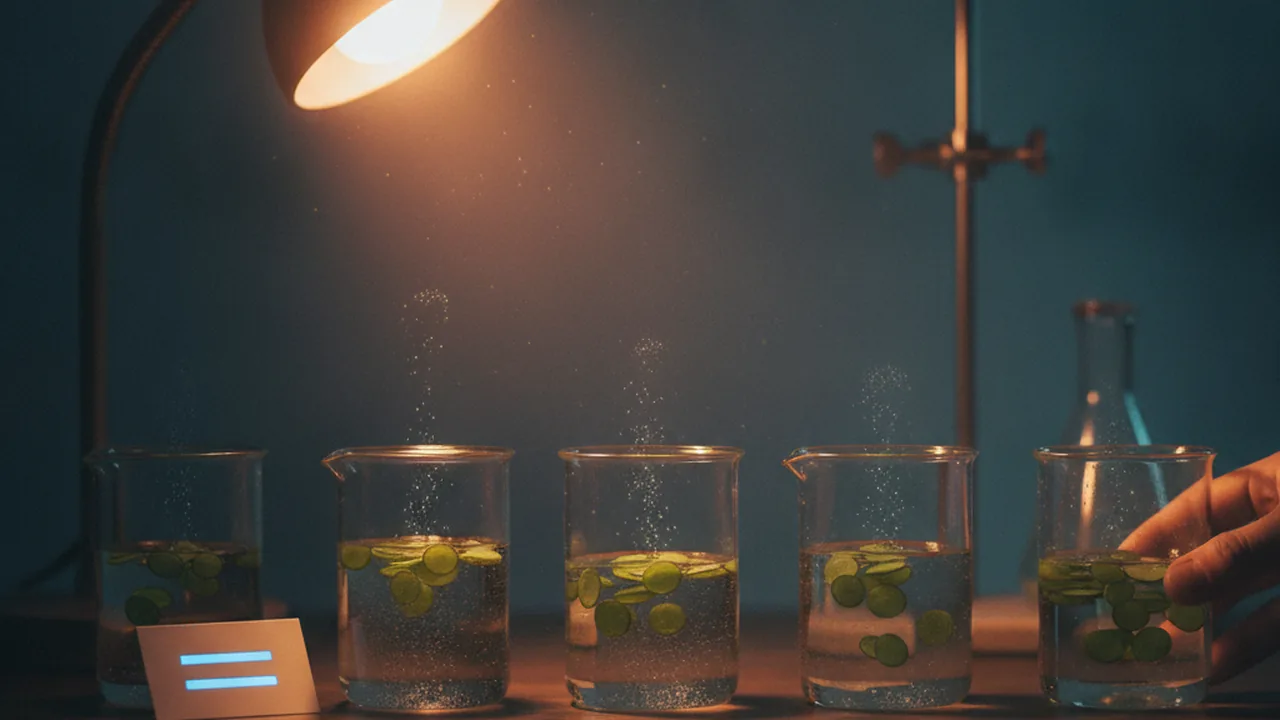
Sunken spinach disks sit in a weak baking-soda solution under a lamp. What will happen over 20 minutes?
Instruction ~10 min
Inside the chloroplast. Photosynthesis happens in two linked stages. In the light-dependent reactions, on the thylakoid membranes, chlorophyll absorbs light energy. That energy splits water molecules, releasing oxygen gas, and is stored temporarily in two energy carriers, ATP and NADPH. In the Calvin cycle, in the fluid around the thylakoids (the stroma), the enzyme rubisco attaches carbon dioxide to an existing five-carbon sugar, and ATP and NADPH power the steps that turn the product into three-carbon sugars, which the plant uses to build glucose. Chemical bonds in water and carbon dioxide are broken (absorbing energy) and new bonds in sugar and oxygen are formed (releasing energy); overall the products store more chemical energy than the reactants, and light supplies the difference. The oxygen released comes from water, not carbon dioxide; experiments in the 1940s using heavy oxygen isotopes showed this.
How the disks work. A leaf is full of air spaces, which is why a leaf floats. If you pull the air out with a syringe and replace it with a weak solution of baking soda (sodium bicarbonate, a source of dissolved carbon dioxide), the disks sink. In light, they photosynthesize: oxygen collects in the air spaces and the disks float back up. A convenient measure is ET50, the elapsed time until half the disks float. A shorter ET50 means a faster rate, so we use 1/ET50 as a rate.
Worked example 1: rates from timings (sample data). A group placed cups of ten disks at four distances from a lamp: at 10 cm ET50 was 6.5 min, at 20 cm 9.0 min, at 30 cm 13.5 min and at 40 cm 21.0 min. The rates 1/ET50 are 0.154, 0.111, 0.074 and 0.048 per minute. Moving the lamp from 10 cm to 40 cm cut the rate to less than a third. Light intensity falls with distance, so less energy reaches the chlorophyll and the light-dependent reactions slow.
Worked example 2: controlling variables. The independent variable is light intensity (lamp distance). The dependent variable is ET50. Hold constant: the plant (fresh spinach from one bag), disk size (one hole punch), bicarbonate concentration, solution volume, number of disks and, often forgotten, temperature. A lamp close to the cup also warms it, so a heat shield (a clear container of water between lamp and cup) or an LED bulb keeps temperature from changing along with light.
Controls. One cup of disks in plain water (no bicarbonate) under the brightest light shows what happens without a carbon dioxide source: the disks should rise slowly or not at all, because the Calvin cycle cannot run and the light reactions soon stall. Another cup in the dark shows what happens with no light.
Limits. Doubling light does not double the rate forever. At high intensity, something else becomes limiting: carbon dioxide supply or enzyme speed. Your graph may begin to level off near the lamp.
Lab procedure: floating leaf disks and light intensity.
- Punch 10 disks per cup from spinach leaves, avoiding large veins.
- Put the disks in a 10 mL needle-free syringe with 5 mL of bicarbonate solution (about 1/8 teaspoon baking soda and a drop of dish soap in 300 mL water), push out the air, cover the tip and pull back the plunger for 10 seconds. Release and repeat until the disks sink.
- Pour the sunken disks into a cup with 3 cm of bicarbonate solution. Prepare one cup for each lamp distance (10, 20, 30 and 40 cm), a cup in plain water, and a cup kept in the dark.
- Place the heat shield between lamp and cup. Record the number of floating disks every minute for 20 minutes, and the water temperature at the start and end.
- Find ET50 for each cup (the time when 5 of 10 disks float) and calculate the rate as 1/ET50.
| Cup | Floating disks at minute 1, 2, 3 … 20 | ET50 (min) | Rate 1/ET50 (per min) | Start/end temp (°C) |
|---|---|---|---|---|
| 10 cm | ||||
| 20 cm | ||||
| 30 cm | ||||
| 40 cm | ||||
| No bicarbonate | ||||
| Dark |
Reading: OpenStax Biology 2e, chapter 8, Photosynthesis (CC BY 4.0).
Guided Exercises ~15 min
Use your data or the sample data.
Independent Practice ~10 min
Finish the lab analysis.
Graph rate (1/ET50) against lamp distance and describe the pattern with numbers. Explain what the no-bicarbonate and dark cups showed about the inputs to photosynthesis, and name two sources of error and how you controlled them.
Closure ~5 min
Light builds sugar. Next: how living things release that sugar’s energy, with or without oxygen.
Exit ticket: name the inputs and outputs of photosynthesis, and say which stage releases the oxygen.
How confident are you that you can measure a photosynthesis rate with leaf disks and explain how light intensity changes it.
Teacher notes
Materials: fresh spinach, baking soda, dish soap, 10 mL needle-free syringes, single-hole punches, clear cups, LED desk lamps, meter sticks, stopwatches, water-filled clear containers as heat shields, thermometers, goggles.
Timing: this lab spans two 50-minute periods: practice sinking disks and run trials on day 1, graph and analyze on day 2. Groups whose disks will not sink use the sample data.
Listen for: “oxygen comes from CO2”; “longer time means faster.”
Support / stretch: give a pre-scaled graph and a rate calculation frame. Stretch: test colored filters and explain the result with chlorophyll’s absorption of red and blue light.