1.07 Design and Prototype: Cooling Sleeves and a Decision Matrix
set measurable criteria and constraints, compare competing cooling designs with a weighted decision matrix, and plan a fair test of my prototype on a model arm.
- I can explain why the data I collect will help answer the question about how feedback mechanisms maintain homeostasis.
- I can describe how I will measure or identify changes in the external environment during my investigation.
- I can describe how I will measure or identify the living system’s response and determine if its internal conditions are stabilized or destabilized.
- I can outline my experimental procedure, including how many systems I will test, what factors I will consider, what evidence I will gather, any limitations in my data, and whether I will work alone or with others.
Phase 4: Build
Warm-Up ~5 min
Do Now. Wrap one finger in a damp tissue and blow on it. Then blow on a dry finger. Which feels cooler, and which step of the body’s loop does this copy?
A warm bottle wrapped in a wet cotton sleeve sits in front of a fan. Compared with a bare bottle, it will…
Instruction ~10 min
Engineers, the brief. The co-op wants a cheap, light cooling aid that works with the body’s own loop, plus a simple work-rest routine. Our prototype is a wearable cooling sleeve. We test it on a model arm: a 500 mL plastic bottle filled with warm tap water at about 37 °C, standing in front of a desk fan.
Class criteria (set in 1.07). A cooling sleeve on a 500 mL “model arm” bottle of water that starts at about 37 °C must (1) cool it at least 2 °C more than a bare control bottle in 10 minutes in front of a fan, (2) use no more than 50 mL of water per test, (3) cost no more than 8 sample budget points, and (4) stay on a moving arm for a full work hour without slipping.
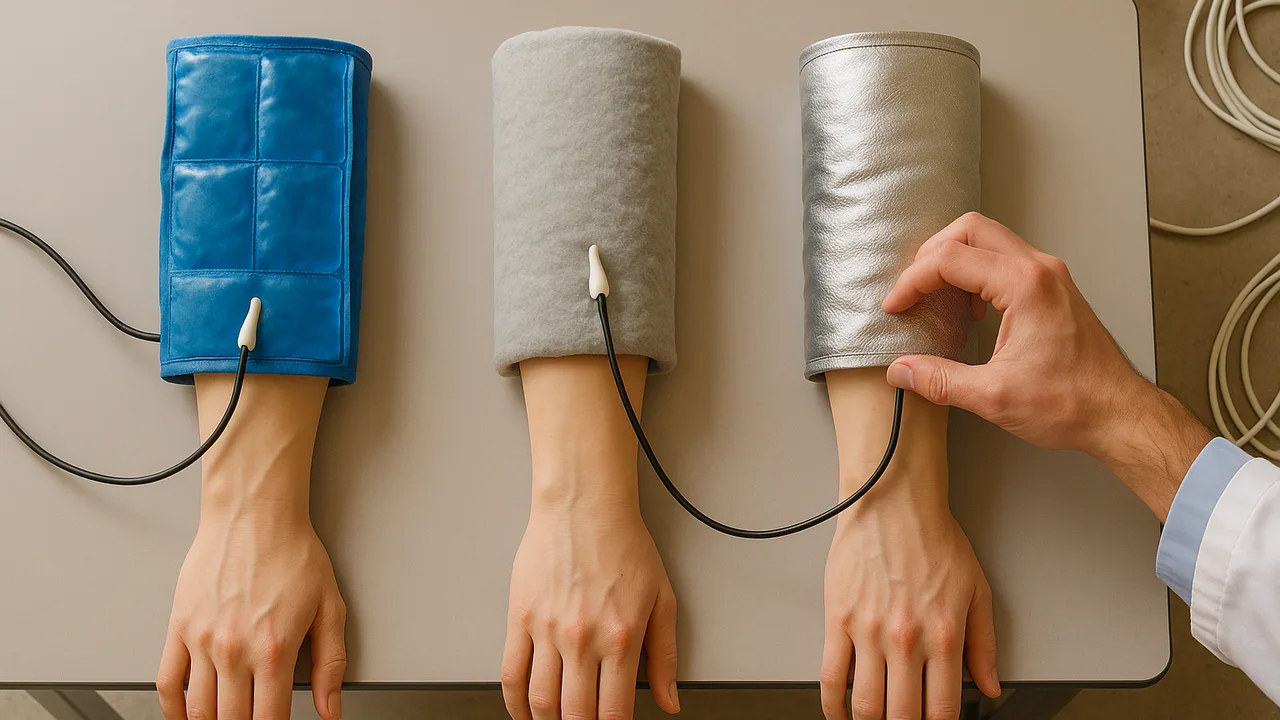
Three competing concepts. Concept A, the wet cotton sleeve: cheap and soaks up water, but heavy when wet. Concept B, the mesh-and-sponge sleeve: a thin sponge strip under open mesh; holds water and lets air through. Concept C, the shade sleeve: dry, light-colored fabric that blocks sun but does not evaporate water. Each tackles a different step: A and B boost evaporation; C cuts heat gain.
Worked example 1: a weighted decision matrix. Score each concept 1–3 on each criterion, multiply by the weight, and add.
| Criterion (weight) | A: wet cotton | B: mesh and sponge | C: shade |
|---|---|---|---|
| Cooling beyond control (3) | 2 × 3 = 6 | 3 × 3 = 9 | 1 × 3 = 3 |
| Water use (2) | 1 × 2 = 2 | 2 × 2 = 4 | 3 × 2 = 6 |
| Cost (1) | 3 × 1 = 3 | 2 × 1 = 2 | 3 × 1 = 3 |
| Stays on for an hour (2) | 2 × 2 = 4 | 2 × 2 = 4 | 3 × 2 = 6 |
| Total | 15 | 19 | 18 |
Sample scores for teaching; your team scores its own concepts. B wins narrowly, but C is close and needs no water. A matrix guides a choice; it does not end the discussion. Teams may also combine ideas, such as B with a light-colored outer layer.
Worked example 2: planning a fair test. Change one thing: sleeve or no sleeve. Measure the response: water temperature every 2 minutes for 10 minutes. Keep the same: starting temperature (37 ± 1 °C), fan speed and distance (50 cm), bottle size, room. Measure the environment too: room temperature at the start and end. Run the control bottle at the same time beside the test bottle. Decide in advance what counts as success (criterion 1) and how many repeats (at least two).
Why a model arm? We never heat people. The bottle stands in for skin with blood flowing beneath it; its water carries heat to the surface the way blood does. Name this limitation in your report: a bottle does not sweat, move or shiver.
Build procedure.
- Sketch your chosen concept with dimensions and a materials list; check its cost against the sample price list (cotton strip 2 points, sponge strip 2, mesh 2, light fabric 1, elastic band 1, tape free).
- Build version 1 to fit the bottle snugly from shoulder to base.
- Wet it with a measured amount of water (no more than 50 mL), recording the volume.
- Run the test beside a bare control bottle and fill in the data table.
| Time (min) | 0 | 2 | 4 | 6 | 8 | 10 |
|---|---|---|---|---|---|---|
| Control bottle (°C) | ||||||
| Sleeve bottle (°C) | ||||||
| Difference (°C) |
Guided Exercises ~15 min
Score your team’s concepts and plan the test before you build.
Independent Practice ~10 min
Build and run version 1.
Record your version 1 results. Calculate the extra cooling compared with the control at 10 minutes, and state which criteria version 1 met and which it missed.
Closure ~5 min
Version 1 is built and tested. Next lesson: gallery critique, a second test and version 2.
Exit ticket: name the change in the environment and the response you measured, and say whether your data show the system stabilizing or not.
Teacher notes
Materials: 500 mL plastic bottles (two per team), thermometers or digital probes, warm tap water, desk fans with guards, cotton and light fabric strips, sponge strips, plastic mesh, elastic bands, tape, graduated cylinders, goggles.
Setup: start bottles at 37 ± 1 °C by mixing hot and cold tap water; set fans 50 cm away on the same speed. A thermometer through a hole in the cap keeps readings steady.
Listen for: teams that change two things at once, or skip the control.
Support / stretch: give a pre-drawn matrix and data table. Stretch: add a humid condition by testing inside a loosely covered clear box and predict the result first.