2.01 Where Does a Giant Tree’s Mass Come From?
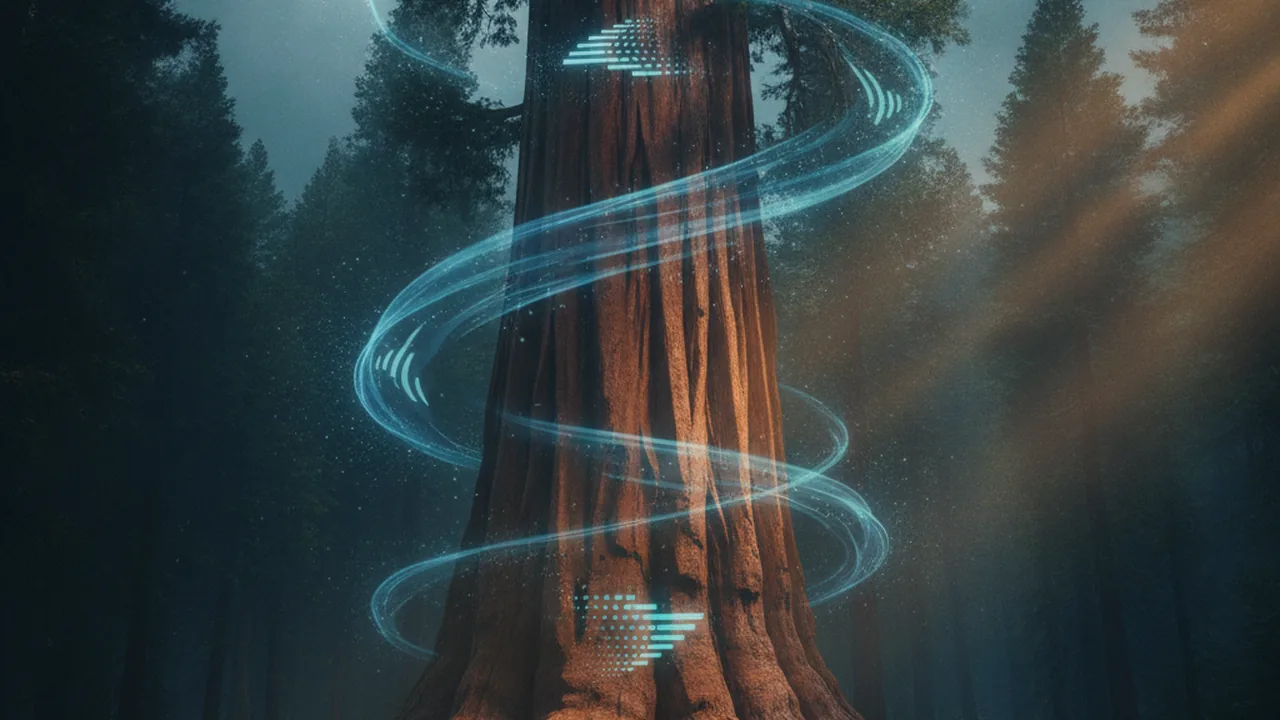
The Park Carbon Ledger
Where does a tree’s mass come from, where does its carbon go, and how can a city park plan its trees and green waste to keep more carbon out of the air?
The mystery: A forest giant holds tonnes of wood, yet it grew from a seed lighter than a grain of rice, and the soil beneath it was never used up.
evaluate evidence about where a plant’s mass comes from and ask testable questions about how carbon dioxide, water and light become plant matter.
- I can identify and explain that photosynthesis uses carbon dioxide and water to produce sugar and oxygen.
- I can explain how the carbon, hydrogen, and oxygen atoms in sugar molecules are related to the same atoms found in amino acids and other large carbon-based molecules.
- I can explain that chemical reactions between sugar molecules (or their atoms) and other atoms can produce amino acids and other large carbon-based molecules.
Phase 1: Spark
Warm-Up ~5 min
Do Now. The tallest trees on Earth stand taller than a 20-story building, and every one of them grew from a seed you could hold on a fingertip. The soil around an old giant is still there. Write your best guess: where did all that wood come from?
Where does most of the dry mass of a giant tree come from?
Instruction ~10 min
The phenomenon. A forest giant can hold more wood than a house holds air, yet it grew from a seed lighter than a grain of rice, and the soil beneath it is still there. So where did all that matter come from?
Common ideas. Most people guess the soil, or water, or sunlight. Each guess deserves testing. Sunlight is energy, not matter: it has no mass to add. Water is matter, and plants take in a great deal of it, but most of it passes through the plant and evaporates from the leaves. Soil supplies minerals such as nitrogen, phosphorus and potassium, but in small amounts.
A historical experiment. In the 1600s the Flemish scientist Jan Baptist van Helmont planted a willow shoot of about 5 pounds in a tub holding 200 pounds of dried soil, and watered it for five years. The willow grew to about 169 pounds, while the soil, dried and weighed again, had lost only about 2 ounces. He concluded that the mass came from water. His measurement was sound, but his conclusion missed an input he could not see: a gas in the air. (These figures are van Helmont’s own, as reported in histories of science.)
The modern answer. Most of a plant’s dry mass comes from carbon dioxide in the air. In photosynthesis, chloroplasts use light energy to combine carbon dioxide and water into sugar, releasing oxygen:
6CO2 + 6H2O + light energy → C6H12O6 + 6O2
Worked example 1: matter is conserved. Using molar masses (CO2 44.009 g/mol, H2O 18.015, C6H12O6 180.156, O2 31.998), the left side is 6(44.009) + 6(18.015) = 372.144 g and the right side is 180.156 + 6(31.998) = 372.144 g. Every atom on the left appears on the right.
Worked example 2: how much of sugar is carbon? Glucose has 6 carbon atoms: 6 × 12.011 = 72.066 g per mole. 72.066 ÷ 180.156 = 0.400, so carbon is 40.0% of glucose by mass, and all of that carbon came from the air.
From sugar to tree. Glucose is only the start. Plants link glucose into cellulose (the main material of wood and cell walls) and starch (stored energy). They combine the carbon, hydrogen and oxygen of sugar with nitrogen from the soil to make amino acids and proteins, with phosphorus to make DNA and ATP, and rearrange sugar carbon into lipids. The carbon backbone of nearly every molecule in a plant, and in the animals that eat plants, was once carbon dioxide.
Energy is a separate story. Matter cycles, but energy flows. Light energy is stored in the chemical bonds of sugar. When the tree, or anything that eats it, breaks those bonds in cellular respiration, the energy is used for work and eventually leaves as heat. You will track both across this unit.
Questions to test. Does a leaf make oxygen faster in brighter light? Does a plant release carbon dioxide in the dark? Can a living thing release energy from sugar without oxygen? Each is testable in a school lab.
Reading: OpenStax Biology 2e, chapters 3, Biological Macromolecules, and 8, Photosynthesis (CC BY 4.0).
Guided Exercises ~15 min
Work with a partner; show every calculation.
Independent Practice ~10 min
Start your Carbon Notebook.
Draw an initial model of a tree with arrows for everything that goes in and out. Label each arrow as matter, energy or both.
Closure ~5 min
Next lesson we meet a client who needs to know exactly where its trees’ carbon comes from and goes.
Exit ticket: in one sentence, where does most of a tree's mass come from, and what is your best evidence?
How confident are you that you can explain where a plant's mass comes from and show that photosynthesis conserves matter.
Teacher notes
Materials: a photo of a generic old-growth forest, a willow or any potted plant as a prop, calculators, Carbon Notebooks.
Listen for: “plants eat soil”; “sunlight is food”; “oxygen comes from carbon dioxide” (it comes from water; 2.03 returns to this).
Support / stretch: give a molar-mass table and a fill-in-the-steps calculation frame. Stretch: calculate the percentage of glucose mass that is hydrogen and oxygen, and explain where each came from.