2.04 Respiration With and Without Oxygen: The Yeast Balloon Argument
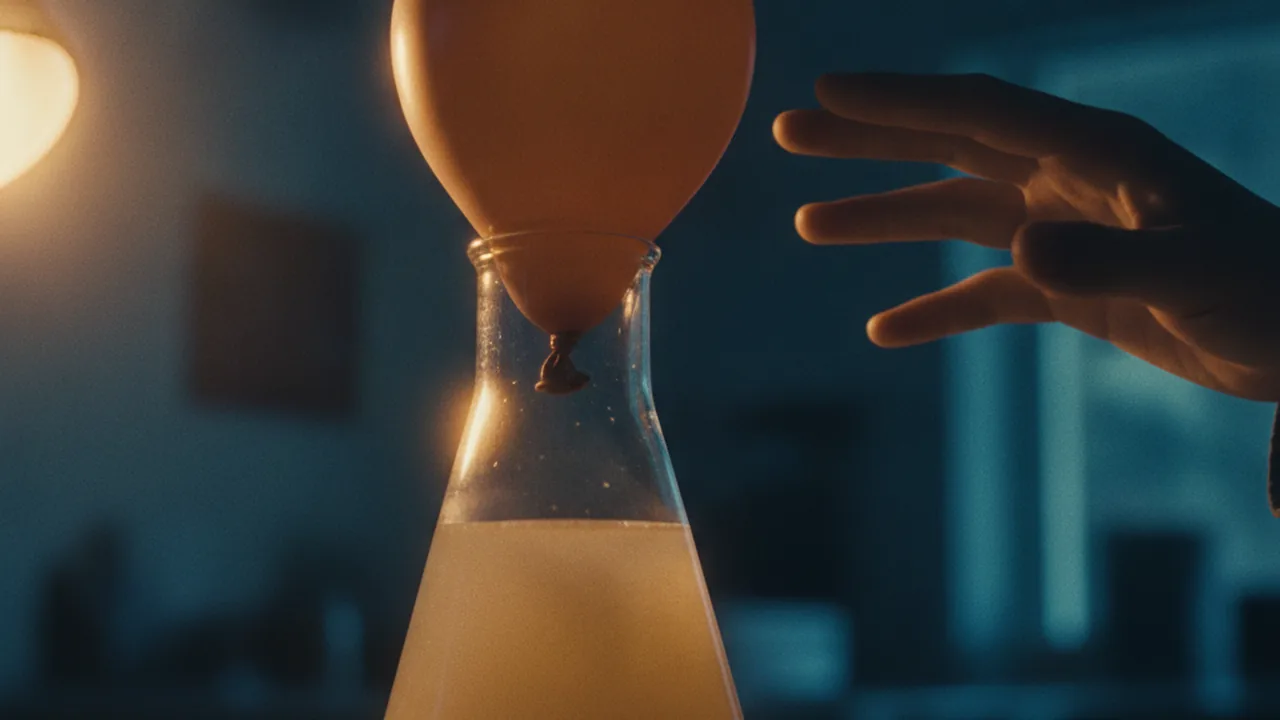
compare aerobic respiration and fermentation, measure carbon dioxide release by yeast, and evaluate claims about how organisms release energy from food.
- I can explain how energy from photosynthesis and respiration drives the cycling of matter and flow of energy in ecosystems under both aerobic and anaerobic conditions.
- I can describe that anaerobic respiration mainly happens when oxygen is not available.
- I can describe how all organisms take in matter and rearrange atoms in chemical reactions.
- I can explain how photosynthesis captures sunlight energy to make chemical products that can be used as food in cellular respiration.
- I can explain how cellular respiration uses matter from food and rearranges it to release energy for life processes.
Phase 2: Investigate
Warm-Up ~5 min
Do Now. Bread dough rises in a warm kitchen. What gas makes the bubbles, and what living thing makes it?
Four sealed bottles hold warm water and yeast with 0, 1, 2 and 3 teaspoons of sugar, each capped with a balloon. After 20 minutes, which balloon is biggest?
Instruction ~10 min
Why every cell respires. Sugar stores energy in its chemical bonds, but cells cannot use that energy directly. Cellular respiration transfers it to ATP, the molecule cells spend to do work: contracting muscles, pumping ions, building proteins. Every living cell, plant or animal, respires all the time.
Aerobic respiration. With oxygen, cells break glucose all the way down:
C6H12O6 + 6O2 → 6CO2 + 6H2O + energy (ATP and heat)
It happens in three stages. Glycolysis, in the cytoplasm, splits glucose into two three-carbon molecules and makes a net 2 ATP. The citric acid (Krebs) cycle, in the mitochondria, releases the remaining carbon as CO2. The electron transport chain, on the inner mitochondrial membrane, passes electrons to oxygen, forming water, and makes most of the ATP. The total is roughly 30 ATP per glucose; textbooks give figures from about 30 to 38, because the exact yield depends on the cell. This is the photosynthesis equation run in reverse.
Worked example 1: the mass check. 180.156 g of glucose and 191.988 g of oxygen (6 × 31.998) yield 264.054 g of carbon dioxide (6 × 44.009) and 108.090 g of water (6 × 18.015). Both sides total 372.144 g: atoms are rearranged, not created or destroyed.
Without oxygen: fermentation. When oxygen is scarce, many cells run glycolysis alone. To keep glycolysis going they must recycle a carrier molecule, and they do it by fermentation. Yeast turn the products into ethanol and carbon dioxide, which is how bread rises. Your muscle cells, in a hard sprint, make lactate instead. Fermentation yields only the 2 ATP from glycolysis, about one-fifteenth of the aerobic yield, which is why no large active animal can live on fermentation alone.
Anaerobic conditions in ecosystems. The same chemistry scales up. In waterlogged peat soils, oxygen cannot reach buried plant material, so decomposers break it down slowly and anaerobically, and carbon builds up over thousands of years. When peatlands are drained for farming, oxygen reaches the peat, aerobic decomposition speeds up, and carbon stored for millennia returns to the air as CO2. Drained peat land surfaces sink as the peat is used up, a process documented in low-lying farm regions such as parts of the Netherlands and many river deltas.
The investigation and the claims. Seal yeast and warm water in bottles with 0, 1, 2 and 3 teaspoons of sugar and cap each with a balloon. In a sample run after 20 minutes the balloon circumferences were: no sugar, no inflation; 1 tsp, 14 cm; 2 tsp, 22 cm; 3 tsp, 27 cm (sample data). Judge three claims with evidence:
- Yeast need sugar to release carbon dioxide.
- More sugar always means proportionally more carbon dioxide.
- Plants photosynthesize instead of respiring, so they never release carbon dioxide.
Worked example 2: evaluating claim 2. Look at the increases: 14 cm, then 8 more, then 5 more. Doubling the sugar did not double the balloon, so something else limited the rate. For claim 3, reason from the equation: plant cells have mitochondria and need ATP at night, when there is no light. A strong evaluation says which claims are supported, which are contradicted and which need more evidence.
Lab procedure: yeast balloons.
- Label four clean 500 mL bottles 0, 1, 2 and 3. Add 0, 1, 2 and 3 level teaspoons of sugar.
- Add 200 mL of warm tap water (35–40 °C) to each bottle and swirl to dissolve.
- Add one packet of yeast to each bottle, swirl, and immediately stretch a balloon over each opening.
- Every 5 minutes for 20 minutes, measure each balloon’s widest circumference with string and a ruler.
- Record the water temperature at the end, and pool results with other groups.
| Sugar (tsp) | 5 min (cm) | 10 min (cm) | 15 min (cm) | 20 min (cm) |
|---|---|---|---|---|
| 0 | ||||
| 1 | ||||
| 2 | ||||
| 3 |
Reading: OpenStax Biology 2e, chapter 7, Cellular Respiration (CC BY 4.0).
Guided Exercises ~15 min
Use your class data or the sample data.
Independent Practice ~10 min
Finish the argument.
Evaluate claim 3 (plants never release carbon dioxide) using the respiration equation and what plant cells need at night. Then design an experiment that could test it, naming the variable you change and what you measure.
Closure ~5 min
Cells release sugar’s energy, with or without oxygen. Next we follow the carbon atoms themselves.
Exit ticket: compare aerobic respiration and fermentation in two sentences: oxygen, products and ATP yield.
How confident are you that you can compare aerobic respiration and fermentation and evaluate claims about them with evidence.
Teacher notes
Materials: four clean 500 mL bottles and four identical balloons per group, dry baker’s yeast (4 packets per group), table sugar, warm tap water, thermometers, funnels, measuring spoons, string and rulers, goggles.
Timing: this lab spans two 50-minute periods: setup and data on day 1, graph and three-claim evaluation on day 2.
Listen for: “respiration means breathing” (it is a cell process); “plants respire only at night.”
Support / stretch: give a claim-evaluation table (claim, evidence, supported or not). Stretch: add a bottle with sugar and yeast in cold water and explain the result with enzymes from Unit 1.