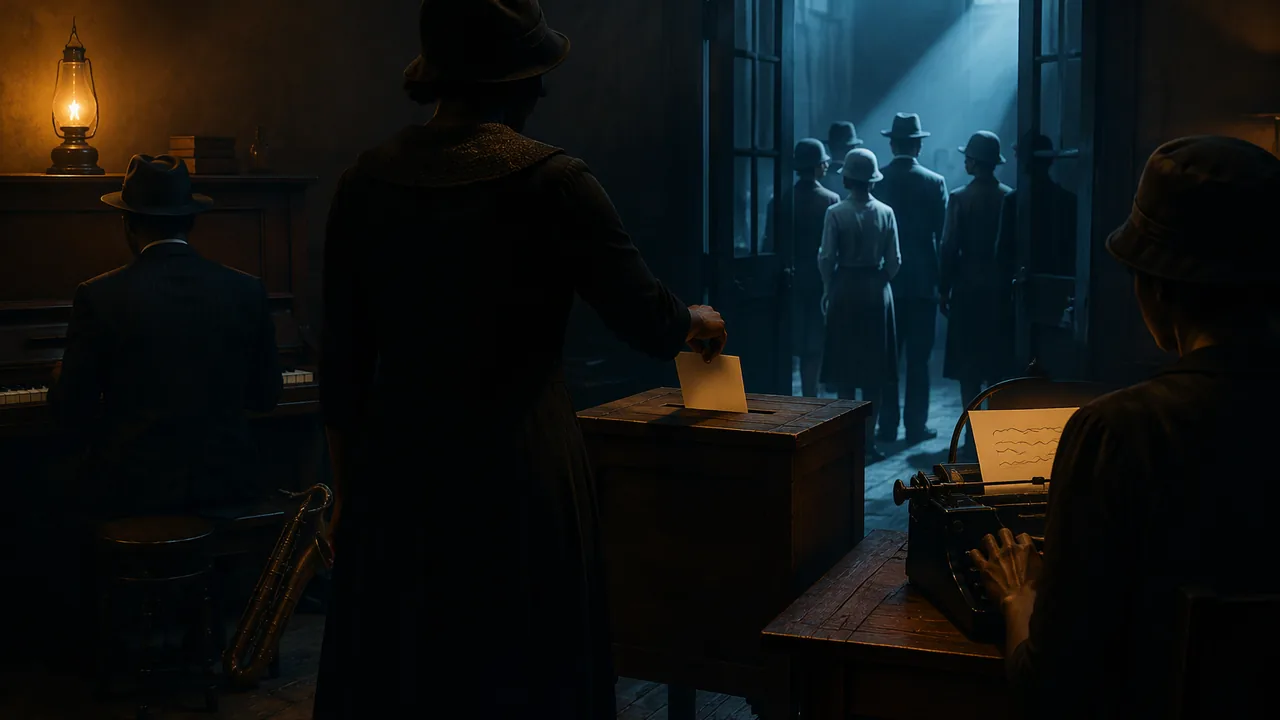
analyze the passage of the Nineteenth Amendment and the changing roles of women, and explain the Harlem Renaissance through the work of its writers and musicians.
Instruction
In 1920 women won the vote nationally, and Black writers and musicians in Harlem announced a “New Negro.” Both movements claimed a fuller place in American life, and both met limits.
The long road to the Nineteenth Amendment. The women’s movement you met at Seneca Falls split in 1869 over the Fifteenth Amendment, which enfranchised Black men but not women. Elizabeth Cady Stanton and Susan B. Anthony opposed ratifying it without women; others supported it. The two wings reunited in 1890 as the National American Woman Suffrage Association. Western states led: Wyoming Territory granted women the vote in 1869. Elsewhere the road was longer. In Missouri, Virginia Minor was turned away when she tried to register to vote in 1872; her case reached the Supreme Court, which ruled unanimously against her in 1874. Missouri lawmakers voted no every time a suffrage amendment reached them between 1867 and 1901, and the legislature let women vote only for president, in March 1919. Carrie Chapman Catt’s “Winning Plan” pressed state campaigns and a federal amendment together. Alice Paul’s National Woman’s Party took more confrontational tactics: from 1917 its “Silent Sentinels” picketed the White House, and jailed hunger strikers were force-fed. Wilson endorsed the amendment in 1918, calling it a war measure. Congress passed it in 1919, Missouri ratified it on 3 July 1919 as the eleventh state, and Tennessee’s ratification in August 1920 made it law.
Who still could not vote. The amendment barred discrimination by sex, not by race. Jim Crow laws kept most Black women in the South from voting, as they did Black men. Native American women were not all citizens until the Indian Citizenship Act of 1924, and Asian immigrant women could not naturalize.
Changing roles, differing views. Women entered clerical, sales and professional work in growing numbers, and more attended college. The “flapper” with bobbed hair and short skirts symbolised a new freedom, though most women’s lives changed less than the image suggests. In 1923 Alice Paul introduced an Equal Rights Amendment. Many women reformers opposed it, because it would have struck down the protective labor laws they had fought for, which limited women’s hours and set minimum wages. That disagreement — equal treatment or special protection — ran through the women’s movement for fifty years, and you will return to it in the second semester.
The Harlem Renaissance. The Great Migration made Harlem, in New York, the largest Black community in the country, and in the 1920s it became a center of literature, music and art. Alain Locke’s anthology The New Negro (1925) announced a generation that would define itself. Claude McKay’s sonnet “If We Must Die” answered the white mob violence of 1919 with defiance. Langston Hughes, whose “The Negro Speaks of Rivers” links Black experience to the Euphrates, the Congo, the Nile and the Mississippi, wrote in the rhythms of jazz and the blues. Zora Neale Hurston, an anthropologist as well as a writer, collected Black Southern folklore and wrote with humor and pride; her essay of 1928 rejects the idea that being Black is a tragedy. Her best-known novel, Their Eyes Were Watching God (1937), and Hughes’s later poems are still under copyright; read them through your library or the Poetry Foundation rather than in this course. Jazz, born in New Orleans, traveled with migrants up the Mississippi through St. Louis to Chicago and New York and west to Kansas City, where, under the political boss Tom Pendergast, who let alcohol flow during Prohibition, more than a hundred clubs, dance halls and theaters at their height featured jazz, and radio and records carried it worldwide. Musicians such as Louis Armstrong, Duke Ellington and Bessie Smith became stars, though Harlem’s famous Cotton Club admitted white customers only.
Reading in context. HI.3 asks you to interpret the past in its own context. McKay’s poem does not name race; readers in 1919 knew exactly what violence it answered. RH.11-12.4 asks you to interpret words as used: in Hughes’s poem, “rivers” carry the meaning of ancestry and endurance across thousands of years.
Writing the explanation. WHST.11-12.2 asks you to explain with well-chosen evidence; WHST.11-12.4 asks for writing whose organization and style suit the purpose and audience. Pair two sources (for example, the Nineteenth Amendment and Hurston, or McKay and Hughes) and explain what each shows about the decade’s promises and limits.
📖 Read for this lesson
The reading opens over the lesson; close it to come back to exactly where you were. The checks below draw on it.
Reading: A vote and a voice
U.S. Constitution, Amendment XIX (ratified 1920); Claude McKay, ‘If We Must Die’, The Liberator (July 1919); Langston Hughes, ‘The Negro Speaks of Rivers’, The Crisis (June 1921); Zora Neale Hurston, ‘How It Feels to Be Colored Me’, The World Tomorrow (May 1928) · Public domain
All four were published before 1930 and are in the public domain in the United States. Read each twice: once for meaning, once for the author’s choices of word and image.
Nineteenth Amendment: The right of citizens of the United States to vote shall not be denied or abridged by the United States or by any State on account of sex.
McKay (1919): If we must die, let it not be like hogs
Hunted and penned in an inglorious spot
Hughes (1921): I’ve known rivers:
I’ve known rivers ancient as the world and older than the flow of human blood in human veins.
My soul has grown deep like the rivers.
Hurston (1928): I am not tragically colored.
Formative check
Work through these before moving on. They are not graded — they tell you whether the standard below has landed yet.
Why did many women reformers oppose the Equal Rights Amendment in 1923?
After 1920, all adult women citizens in every state could vote freely.
Write an explanatory essay (600-750 words) pairing two of the readings. Explain what each reveals about the promises and limits of the 1920s for women or for Black Americans, analyze at least two specific word or image choices in context, and connect both to events you studied in this unit.
How confident are you that you can explain the Nineteenth Amendment, the changing roles of women and the Harlem Renaissance using primary sources?
Practice
Work these on paper or in your notebook, then open Check your answer. Aim for all of Fluency and Application; try at least one Challenge.
Printable version: this unit’s practice workbook (PDF)
Fluency
Build speed and accuracy with the core skill.
- Order: Nineteenth Amendment ratified; Wyoming Territory grants women the vote; Missouri women win the vote for president; NAWSA formed; Indian Citizenship Act.
Check your answer
Answer: Wyoming Territory (1869); NAWSA (1890); Missouri women vote for president (1919); Nineteenth Amendment (1920); Indian Citizenship Act (1924). - Who edited The New Negro (1925), and what did the phrase mean?
Check your answer
Answer: Alain Locke; a generation of Black Americans asserting pride and self-definition.
Application
Use the skill in context. Show your reasoning.
- McKay’s ‘If We Must Die’ (The Liberator, July 1919) begins ‘If we must die, let it not be like hogs / Hunted and penned in an inglorious spot’. The poem never names race. Using its date, explain what readers in 1919 would have understood.
Check your answer
Answer: It appeared during the Red Summer of 1919, when white mobs attacked Black communities; readers understood it as a call to resist that violence with dignity.Context is evidence: a strong answer uses the date and publication to interpret the words. - The Nineteenth Amendment says the vote ‘shall not be denied or abridged by the United States or by any State on account of sex.’ Corroborate: what evidence shows the text did not secure the vote for all women in 1920?
Check your answer
Answer: Jim Crow laws kept most Black women in the South from voting; many Native women were not citizens until 1924; Asian immigrant women could not naturalize. - Wilson endorsed suffrage in 1918, and Congress passed the amendment in 1919. Did Wilson’s endorsement cause passage?
Check your answer
Answer: Model answer: it helped, but decades of state campaigns, Catt’s Winning Plan, the National Woman’s Party’s pickets and women’s war work all built the pressure that moved Wilson and Congress. Strong answers show how the causes interacted rather than crediting the last step.
Review
Keep earlier skills sharp.
- From Unit 1: which 1848 convention first demanded women’s suffrage in a declaration modeled on 1776?
Check your answer
Answer: The Seneca Falls Convention.
A Vote and Three Voices: McKay, Hughes and Hurston in Full
Claude McKay, ‘If We Must Die’, The Liberator (July 1919), text from Harlem Shadows (1922); Langston Hughes, ‘The Negro Speaks of Rivers’, The Crisis (June 1921), text from The Weary Blues (1926); Zora Neale Hurston, ‘How It Feels to Be Colored Me’, The World Tomorrow 11, no. 5 (May 1928), 215-216 · Public domain
Why this reading. Lesson 4.4 asks you to pair two of its four readings and analyze at least two specific word or image choices in context. The lesson gives you the Nineteenth Amendment complete, but only two lines of McKay’s fourteen, part of Hughes’s poem, and a single sentence of Hurston’s essay. You cannot analyze an image choice in a poem you have not read to the end. All three literary texts were published before 1930 and are in the public domain in the United States; here they are. What to look for: all three writers are answering something. McKay is answering the mob violence of 1919. Hughes is answering the idea that Black American history begins with slavery. Hurston is answering other Black writers. Decide what each is answering before you decide what it means.
1. Claude McKay, “If We Must Die” (1919)
Published in The Liberator in July 1919, during the summer in which white mobs attacked Black communities in Chicago, Washington, Elaine in Arkansas and more than twenty other places. The text below is from McKay’s collection Harlem Shadows (1922).
If we must die, let it not be like hogs
Hunted and penned in an inglorious spot,
While round us bark the mad and hungry dogs,
Making their mock at our accursèd lot.
If we must die, O let us nobly die,
So that our precious blood may not be shed
In vain; then even the monsters we defy
Shall be constrained to honor us though dead!
O kinsmen! we must meet the common foe!
Though far outnumbered let us show us brave,
And for their thousand blows deal one death-blow!
What though before us lies the open grave?
Like men we’ll face the murderous, cowardly pack,
Pressed to the wall, dying, but fighting back!
It is a sonnet: fourteen lines, three quatrains and a closing couplet, in the strictest English form there is. Nothing in it names a race, a city or a year. That is a choice, and it is the first thing to write about. A second: the poem never promises survival. Read the last two lines again and say exactly what is being claimed.
2. Langston Hughes, “The Negro Speaks of Rivers” (1921)
Hughes was seventeen, on a train crossing the Mississippi outside St. Louis, when he wrote it. It was published in The Crisis, the NAACP’s magazine, in June 1921, and collected in The Weary Blues (1926), from which this text is taken. The dedication is Hughes’s own.
(To W. E. B. DuBois)
I’ve known rivers:
I’ve known rivers ancient as the world and older than the flow of human blood in human veins.
My soul has grown deep like the rivers.
I bathed in the Euphrates when dawns were young.
I built my hut near the Congo and it lulled me to sleep.
I looked upon the Nile and raised the pyramids above it.
I heard the singing of the Mississippi when Abe Lincoln went down to New Orleans, and I’ve seen its muddy bosom turn all golden in the sunset.I’ve known rivers:
Ancient, dusky rivers.My soul has grown deep like the rivers.
Four rivers, in order: Mesopotamia, central Africa, Egypt, and the American river down which enslaved people were sold south. The speaker says “I” of all four, across five thousand years. Notice that the Mississippi line is the only one with a date and a name in it, and the only one that turns from mud to gold. Notice also who the poem is dedicated to, and read it next to the Du Bois you met in Unit 1.
3. Zora Neale Hurston, “How It Feels to Be Colored Me” (1928)
Published in The World Tomorrow in May 1928, pages 215–216. Hurston was a student at Barnard College, the only Black student there, and already an anthropologist collecting folklore in the South. The text below is transcribed from that printing.
But changes came in the family when I was thirteen, and I was sent to school in Jacksonville. I left Eatonville, the town of the oleanders, as Zora. When I disembarked from the river-boat at Jacksonville, she was no more. It seemed that I had suffered a sea change. I was not Zora of Orange County any more, I was now a little colored girl. I found it out in certain ways. In my heart as well as in the mirror, I became a fast brown—warranted not to rub nor run.
But I am not tragically colored. There is no great sorrow dammed up in my soul, nor lurking behind my eyes. I do not mind at all. I do not belong to the sobbing school of Negrohood who hold that nature somehow has given them a lowdown dirty deal and whose feelings are all hurt about it. Even in the helter-skelter skirmish that is my life, I have seen that the world is to the strong regardless of a little pigmentation more or less. No, I do not weep at the world—I am too busy sharpening my oyster knife.
Someone is always at my elbow reminding me that I am the grand-daughter of slaves. It fails to register depression with me. Slavery is sixty years in the past. The operation was successful and the patient is doing well, thank you. The terrible struggle that made me an American out of a potential slave said “On the line!” The Reconstruction said “Get set!”; and the generation before said “Go!” I am off to a flying start and I must not halt in the stretch to look behind and weep. Slavery is the price I paid for civilization, and the choice was not with me.
I do not always feel colored. Even now I often achieve the unconscious Zora of Eatonville before the Hegira. I feel most colored when I am thrown against a sharp white background.
For instance at Barnard. “Beside the waters of the Hudson” I feel my race. Among the thousand white persons, I am a dark rock surged upon, overswept by a creamy sea. I am surged upon and overswept, but through it all, I remain myself. When covered by the waters, I am; and the ebb but reveals me again.
Sometimes it is the other way around. A white person is set down in our midst, but the contrast is just as sharp for me. For instance, when I sit in the drafty basement that is The New World Cabaret with a white person, my color comes. … This orchestra grows rambunctious, rears on its hind legs and attacks the tonal veil with primitive fury, rending it, clawing it until it breaks through to the jungle beyond. I follow those heathen—follow them exultingly. I dance wildly inside myself… But the piece ends. The men of the orchestra wipe their lips and rest their fingers. I creep back…
At certain times I have no race, I am me. … The cosmic Zora emerges. I belong to no race nor time. I am the eternal feminine with its string of beads.
I have no separate feeling about being an American citizen and colored. I am merely a fragment of the Great Soul that surges within the boundaries. My country, right or wrong.
Sometimes, I feel discriminated against, but it does not make me angry. It merely astonishes me. How can any deny themselves the pleasure of my company! It’s beyond me.
But in the main, I feel like a brown bag of miscellany propped against a wall. Against a wall in company with other bags, white, red and yellow. Pour out the contents, and there is discovered a jumble of small things priceless and worthless. A first-water diamond, an empty spool, bits of broken glass, lengths of string, a key to a door long since crumbled away, a rusty knife-blade, old shoes saved for a road that never was and never will be, a nail bent under the weight of things too heavy for any nail, a dried flower or two, still a little fragrant. In your hand is the brown bag. On the ground before you is the jumble it held—so much like the jumble in the bags, could they be emptied, that all might be dumped in a single heap and the bags refilled without altering the content of any greatly. A bit of colored glass more or less would not matter. Perhaps that is how the Great Stuffer of Bags filled them in the first place—who knows?
Hurston was writing in the same years and the same magazines as McKay and Hughes and she does not agree with them. “The sobbing school of Negrohood” is a shot at other Black writers. “Slavery is sixty years in the past” is a claim about time that Hughes’s poem denies outright. And the cabaret passage is written in the vocabulary white readers of 1928 used for Black music — primitive, jungle, heathen — which is either Hurston turning that language on its owners or Hurston writing for a largely white magazine, and historians have argued both. Whichever you decide, say which and why. That disagreement between the three writers is the essay you are being asked to write.
A note on the texts. Hurston is transcribed from the original printing in The World Tomorrow, May 1928. Several widely circulated transcriptions of this essay online are corrupt — they print “whose feelings are all but about it” for “all hurt about it,” “pigmentation more of less” for “more or less,” and “I left Eatonville … a Zora” for “as Zora.” If you quote her, quote from this text or from the magazine itself. Omissions are marked …
Sources: Claude McKay, Harlem Shadows (1922), Project Gutenberg (gutenberg.org); Langston Hughes, The Weary Blues (1926), Project Gutenberg (gutenberg.org); The World Tomorrow, May 1928 (vol. 11, no. 5), scanned issue (archive.org)