explain the grievances and program of the Populists, the monetary debates of the late nineteenth century, and the movement’s effects, and evaluate competing historians’ interpretations of Populism.
Instruction
In the 1880s and 1890s millions of farmers in the South and West concluded that the new industrial economy was rigged against them. Their revolt produced the most successful third party since the Civil War and a set of ideas that outlived it.
The grievances. Crop prices fell for most of the late nineteenth century. Farmers had borrowed to buy land and machinery, and they depended on railroads, which often charged more for short hauls in areas without competition than for long hauls between big cities. Grain-elevator companies, merchants and banks took their share. In the South, sharecroppers and tenant farmers, Black and white, were trapped by crop-lien debts.
Why falling prices hurt debtors. Deflation, a general fall in prices, makes debts heavier. Worked example: a farmer borrows $1,000 when wheat sells for $1.00 a bushel, so the debt equals 1,000 bushels. If wheat falls to $0.50, the same $1,000 debt now takes 2,000 bushels to repay. The farmer grows twice as much wheat to pay back the same number of dollars.
The money question. That is why money supply became a political crusade. During the Civil War the government issued paper “greenbacks” not backed by gold. Afterward it moved back toward the gold standard, and the Coinage Act of 1873 stopped coining silver dollars — the “Crime of ’73” to its critics. Debtors wanted more money in circulation: first greenbacks, then the unlimited coinage of silver at a ratio of 16 ounces of silver to 1 of gold. Creditors, bankers and many economists answered that sound money protected savings and investment. Compromise laws in 1878 and 1890 bought limited silver. After the Panic of 1893, the worst depression the country had yet seen, the fight reached its peak.
Organization. The Grange (1867) created cooperatives and pushed states to regulate railroads, which the Supreme Court allowed in Munn v. Illinois (1877). The Farmers’ Alliances, including a separate Colored Farmers’ Alliance, grew into the People’s Party. Its 1892 Omaha Platform demanded free silver, a graduated income tax, government ownership of railroads and telegraphs, direct election of senators, the secret ballot and an eight-hour day for government workers. Its candidate, James Weaver, won over a million votes and 22 electoral votes.
1896 and after. In 1896 the Democrats nominated William Jennings Bryan on a free-silver platform, and the Populists endorsed him too. The Republican William McKinley, backed by business and by industrial workers who feared higher food prices, won decisively. The People’s Party faded, and new gold discoveries eased deflation. Yet many of its demands became law within two decades: the secret ballot, the income tax (1913), the direct election of senators (1913) and, in a different form, a flexible currency through the Federal Reserve (1913), which Congress created after the Panic of 1907 exposed the banking system’s weakness.
Race and Populism. Some Populists, such as Georgia’s Tom Watson in the early 1890s, appealed to Black and white farmers to vote together on shared economic interest. Democrats answered with fraud and violence. By the 1900s Watson himself had turned to vicious racial and anti-Semitic attacks.
Historians disagree. Richard Hofstadter’s The Age of Reform (1955) portrayed Populists as nostalgic and anxious, with streaks of conspiracy thinking and anti-Semitism. Lawrence Goodwyn’s Democratic Promise (1976) portrayed a genuine democratic movement built on cooperatives. Charles Postel’s The Populist Vision (2007) argued that Populists were modernizers who wanted to use government and science, not return to the past. HR.3 asks you to weigh such debates by examining each historian’s evidence: which sources would support each portrait?
📖 Read for this lesson
The reading opens over the lesson; close it to come back to exactly where you were. The checks below draw on it.
Reading: Two voices of the revolt
People’s Party Platform, adopted at Omaha, Nebraska (4 July 1892), preamble; William Jennings Bryan, speech to the Democratic National Convention, Chicago (9 July 1896) · Public domain
Both texts are written to be heard by a crowd. Mark the images each uses, and what each asks the listener to do.
Omaha Platform (1892): We meet in the midst of a nation brought to the verge of moral, political, and material ruin. Corruption dominates the ballot-box, the Legislatures, the Congress, and touches even the ermine of the bench.
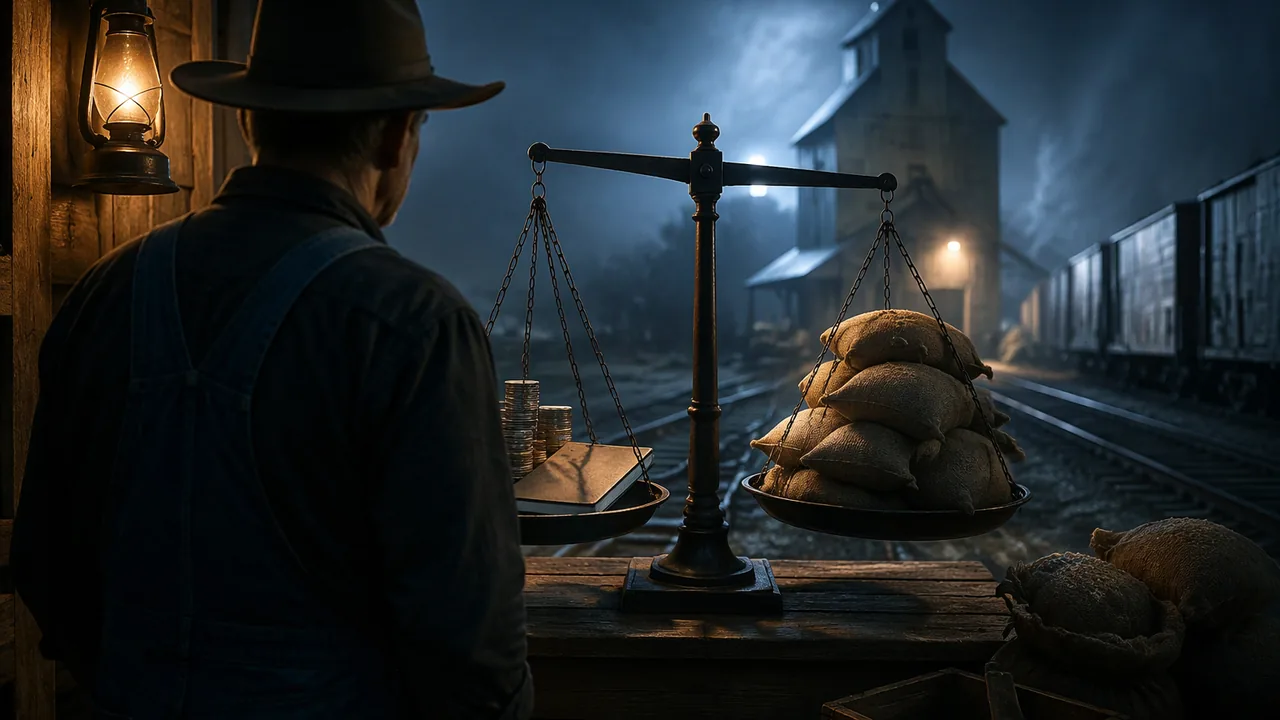
Bryan (1896): Having behind us the producing masses of this nation and the world, supported by the commercial interests, the laboring interests, and the toilers everywhere, we will answer their demand for a gold standard by saying to them: You shall not press down upon the brow of labor this crown of thorns, you shall not crucify mankind upon a cross of gold.
Formative check
Work through these before moving on. They are not graded — they tell you whether the standard below has landed yet.
A farmer owes $600. Cotton falls from 12 cents to 6 cents a pound. How many pounds of cotton does the debt now equal, compared with before?
Which Omaha Platform demand was NOT eventually enacted by constitutional amendment?
Historians broadly agree that the Populists were backward-looking opponents of modern economic change.
Complete the platform chart: for six Omaha Platform demands, state the grievance behind it, what happened to it, and when. Then write a paragraph (150-200 words) connecting the Populist revolt to one larger economic or political trend of the period, citing the platform or Bryan’s speech.
How confident are you that you can explain the Populists’ grievances, the money question and their legacy, and weigh historians’ interpretations?
Practice
Work these on paper or in your notebook, then open Check your answer. Aim for all of Fluency and Application; try at least one Challenge.
Printable version: this unit’s practice workbook (PDF)
Fluency
Build speed and accuracy with the core skill.
- Order: Bryan’s ‘Cross of Gold’ speech; the Coinage Act ending silver dollars; the Omaha Platform; the Federal Reserve Act; the Panic of 1893.
Check your answer
Answer: Coinage Act (1873); Omaha Platform (1892); Panic of 1893; Cross of Gold (1896); Federal Reserve Act (1913). - A farmer owes $900. Wheat falls from $0.90 to $0.60 a bushel. How many bushels did the debt equal before and after, and what term names this effect?
Check your answer
Answer: 1,000 bushels before; 1,500 after. Deflation.900 ÷ 0.90 = 1,000; 900 ÷ 0.60 = 1,500. Falling prices make a fixed debt heavier.
Application
Use the skill in context. Show your reasoning.
- Source the Omaha Platform’s opening: ‘We meet in the midst of a nation brought to the verge of moral, political, and material ruin.’ Who adopted it, when, and for what purpose? How should its tone affect how you use it?
Check your answer
Answer: The People’s Party convention at Omaha, 4 July 1892, launching a national campaign. It is persuasive rhetoric meant to rally voters, so it is strong evidence of Populist grievances and weak evidence, on its own, of how bad conditions actually were; corroborate with price and debt data. - Bryan’s ‘Cross of Gold’ speech and the Omaha Platform both attack the gold standard. Corroborate: in what ways do they agree, and how do their authors and audiences differ?
Check your answer
Answer: Both argue that the gold standard hurt producers and debtors. The Platform was a third party’s program in 1892; Bryan spoke to the Democratic convention in 1896, winning its nomination — showing that the Populists’ money demand had moved into a major party.Strong answers use the difference in audience to explain what changed between 1892 and 1896. - The People’s Party faded after 1896, and the income tax and direct election of senators arrived in 1913. Did Populism cause those amendments?
Check your answer
Answer: Model answer: Populism helped put the demands on the national agenda, but the amendments passed during the Progressive era through a broader coalition. A strong answer credits Populist influence while showing other causes and actors, rather than inferring cause from the platform coming first.
Review
Keep earlier skills sharp.
- From Unit 2: which 1890 federal law banned combinations ‘in restraint of trade’?
Check your answer
Answer: The Sherman Antitrust Act.
The Farmers’ Program and the Cross of Gold: What the Populists Asked For, and How Bryan Asked
William Jennings Bryan, speech to the Democratic National Convention, Chicago, 9 July 1896, as printed in Bryan, The First Battle: A Story of the Campaign of 1896 (1896); the People’s Party (Omaha) Platform of 4 July 1892, summarized rather than quoted · Public domain (Bryan); the platform summary is SLS original
Why this reading. Lesson 3.1 asks you to chart six Omaha Platform demands with the grievance behind each and what became of it, and then to write a paragraph citing the platform or Bryan’s speech. The lesson gives you two sentences of the platform’s preamble and the last sentence of Bryan’s speech — a peroration with no argument attached to it. Below is Bryan’s argument, from the book he published himself in 1896, and the platform’s demands laid out so the chart can be filled. What to look for: Bryan never once explains bimetallism. Notice what he does instead, and ask why that worked on a convention hall and lost the election.
1. The Omaha Platform’s demands, and what happened to each
The People’s Party adopted its platform at Omaha on 4 July 1892. The preamble, whose opening two sentences the lesson quotes, was written by the Minnesota novelist and congressman Ignatius Donnelly. The demands that follow it fall under three headings — Finance, Transportation and Land — with a set of supplementary resolutions. The table below summarizes them in our own words, with what became of each. The wording is ours, not the platform’s; quote the preamble from the lesson, or the platform itself from a library copy, and do not quote this table as if it were the document.
| Demand | The grievance behind it | What became of it |
|---|---|---|
| A national currency, issued by the government alone, without banks | Too little money in circulation, controlled by Eastern banks; deflation making every debt heavier | Never adopted in this form. Congress created the Federal Reserve in 1913 after the Panic of 1907 — a flexible currency, but issued through a banking system, which is not what the platform asked for. |
| Free and unlimited coinage of silver and gold at 16 to 1 | The Coinage Act of 1873 had ended the silver dollar; debtors wanted more money in circulation | Defeated with Bryan in 1896. New gold discoveries in South Africa, Alaska and the Yukon expanded the money supply instead, and the Gold Standard Act of 1900 closed the question. |
| A graduated income tax | Federal revenue came from tariffs and excise, which fall hardest on people who spend most of what they earn | Enacted. The Sixteenth Amendment was ratified in 1913 — overturning the Supreme Court’s Pollock decision of 1895, as Lesson 3.2 explains. |
| Government ownership of the railroads and the telegraph | Discriminatory freight rates; higher charges for short hauls where there was no competition | Never enacted. Regulation was the answer instead: the Interstate Commerce Act of 1887 and the Hepburn Act of 1906. The railroads were nationalized temporarily during the First World War and returned in 1920. |
| Direct election of United States senators | Legislatures chose senators, and corporations could buy a legislature more cheaply than an electorate | Enacted. The Seventeenth Amendment, also 1913. |
| The secret (Australian) ballot | Party-printed ballots let employers and bosses see how a man voted | Enacted, by the states, mostly during the 1890s — the fastest of all the demands. |
| An eight-hour day for government workers | Industrial hours with no legal limit | Extended and enforced in stages; a federal eight-hour law covering government contract work came in 1892 and was strengthened in 1912. |
| A postal savings system | Rural banks failed, taking farmers’ deposits with them | Enacted in 1910; the Postal Savings System ran until 1966. |
That is the fact the chart is designed to make you notice: a third party that never won the presidency and dissolved within a decade got most of its program enacted within twenty-five years, by the two parties that had beaten it. When you write the quiz answer about which demand was not enacted by constitutional amendment, look at rows one and four.
2. William Jennings Bryan, Democratic National Convention, Chicago, 9 July 1896
Bryan was thirty-six, a former two-term congressman from Nebraska with no national office. He spoke last in the debate on the platform, and the convention nominated him for president the next day. He printed the speech in his own account of the campaign, The First Battle, in 1896.
First, his answer to the claim that the gold standard is what businessmen want:
… their prosperity will leak through on those below. The Democratic idea, however, has been that if you legislate to make the masses prosperous, their prosperity will find its way up through every class which rests upon them.
Then the sentence that made the speech famous long before the last line did:
You come to us and tell us that the great cities are in favor of the gold standard; we reply that the great cities rest upon our broad and fertile prairies. Burn down your cities and leave our farms, and your cities will spring up again as if by magic; but destroy our farms and the grass will grow in the streets of every city in the country.
Then the argument against waiting for international agreement on bimetallism — the practical objection his opponents actually made:
My friends, we declare that this nation is able to legislate for its own people on every question, without waiting for the aid or consent of any other nation on earth; and upon that issue we expect to carry every State in the Union. … It is the issue of 1776 over again. Our ancestors, when but three millions in number, had the courage to declare their political independence of every other nation; shall we, their descendants, when we have grown to seventy millions, declare that we are less independent than our forefathers?
Therefore, we care not upon what lines the battle is fought. If they say bimetallism is good, but that we cannot have it until other nations help us, we reply that, instead of having a gold standard because England has, we will restore bimetallism, and then let England have bimetallism because the United States has it.
And the close, which the lesson quotes:
If they dare to come out in the open field and defend the gold standard as a good thing, we will fight them to the uttermost. Having behind us the producing masses of this nation and the world, supported by the commercial interests, the laboring interests, and the toilers everywhere, we will answer their demand for a gold standard by saying to them: You shall not press down upon the brow of labor this crown of thorns, you shall not crucify mankind upon a cross of gold.
3. What to do with this for the paragraph
Read the four passages again and notice what is not in them: no ratio, no calculation, no account of how coining silver at sixteen to one would raise the price of wheat. The argument is about who counts. The cities rest on the farms; the producing masses are behind us; this is 1776 again. Bryan converted a monetary question into a question about whose work the country is built on, and that is why a speech about coinage is still read.
It is also why it lost. McKinley’s campaign told industrial workers that free silver meant cheap money and dearer bread, and in November McKinley carried every industrial state in the North and East. The producing masses did not vote as one interest, because they were not one interest. When you connect the Populist revolt to a larger trend, that split — between farmers who sold what they grew and wage earners who bought it — is the most defensible connection the sources support.
A note on the texts. Bryan is transcribed from his own The First Battle: A Story of the Campaign of 1896 (Chicago: W. B. Conkey, 1896); obvious scanning errors have been corrected to the printed reading, and omissions are marked … The Omaha Platform table is written for this course and is not a quotation: we could not verify a clean scan of the platform’s own wording against a second copy in time for this reading, and a half-legible transcription of a founding document is worse than an honest summary. If you want the platform’s own words beyond the preamble your lesson quotes, ask a librarian for Edward McPherson, A Handbook of Politics for 1892, pages 269–271, which prints it in full.
Sources: William Jennings Bryan, The First Battle: A Story of the Campaign of 1896, Internet Archive (archive.org)