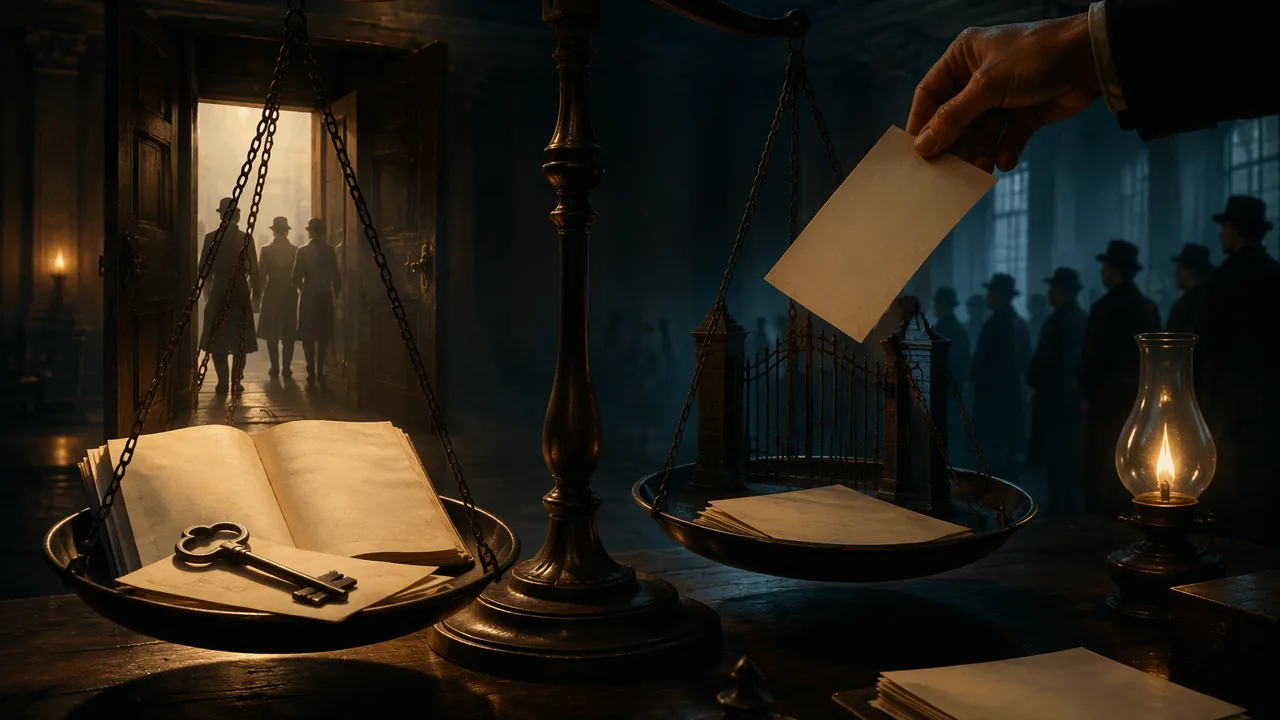
argue to what extent the United States had realized the promise of the Declaration of Independence by 1900, using documents and outside evidence, and present the argument orally.
Instruction
The question. To what extent had the United States realized the promise of the Declaration of Independence by 1900?
The documents. (1) The Declaration of Independence, 1776. (2) The Constitution’s three-fifths and fugitive slave clauses, 1787. (3) The Seneca Falls Declaration of Sentiments, 1848. (4) Frederick Douglass, Fourth of July address, 1852. (5) The Gettysburg Address, 1863. (6) The Thirteenth, Fourteenth and Fifteenth Amendments, 1865-1870. (7) The Chinese Exclusion Act, 1882, preamble (you will study it in Unit 2). (8) W. E. B. Du Bois, The Souls of Black Folk, 1903. All are in the unit’s readings or linked from the National Archives.
What “to what extent” asks. The question asks for a judgment of degree, not yes or no. A thesis such as “The United States partly realized the promise” is too vague to argue. A qualified thesis names the degree, the dimension and the reason: “By 1900 the United States had written the Declaration’s promise of equality into its Constitution through the Reconstruction amendments, but it had largely failed to honor it in practice, because federal commitment collapsed after 1877 and new exclusions — of Chinese immigrants and of Black voters in the South — were built on the same arguments about who belonged.”
Group, don’t list. A document-based essay that discusses Document 1, then 2, then 3 is a summary. Group documents by what they show: for example, promises written into law (1, 5, 6), exclusions written into law (2, 7), and excluded Americans claiming the promise (3, 4, 8). Each body paragraph makes one analytical point and uses two or three documents as evidence for it.
Source at least four documents. Sourcing means explaining how the author’s purpose, audience, point of view or historical situation affects the document’s meaning — not just naming the author. Example: “Lincoln spoke at a military cemetery in the middle of a war whose purpose he was redefining; by dating the nation from 1776 rather than 1787, he placed the Declaration’s equality, not the Constitution’s compromises, at its foundation.”
Outside evidence. Use at least two facts not in the documents: for example, Plessy v. Ferguson, Mississippi’s 1890 constitution, the Compromise of 1877, or the dropping of property qualifications for white men.
Two groups at least. Your essay must address at least two groups whose experience differed, such as formerly enslaved people, women, Chinese immigrants, Native nations, or white working men.
Counterclaim and conclusion. WHST.11-12.1.b asks you to develop the strongest counterclaim fairly. If you argue that the promise was largely unrealized, the counterclaim is that the constitutional changes of 1865-1870 were revolutionary and later generations used them to win real rights. The conclusion (WHST.11-12.1.e) should follow from your argument and say why it matters.
The talk. Three minutes, recorded or live: your thesis in one sentence, your strongest piece of evidence, the counterclaim and your answer. Then pose yourself the hardest question a skeptical listener would ask, and answer it.
📖 Read for this lesson
The reading opens over the lesson; close it to come back to exactly where you were. The checks below draw on it.
Formative check
Work through these before moving on. They are not graded — they tell you whether the standard below has landed yet.
Which thesis best answers a ‘to what extent’ question?
Which sentence actually sources a document?
How confident are you that you can write a document-based argument that groups and sources documents and answers the strongest counterclaim?
Unit 1 checkpoint
Do this before you start the task. It covers the whole unit and tells you what to review first.
Which compromise of 1787 counted enslaved people for representation?
The Bill of Rights was part of the original Constitution signed in 1787.
In v. Maryland (1819) the Court upheld implied powers; in 1832 South Carolina attempted of a federal tariff.
Which amendment made everyone born in the United States a citizen?
New Jersey ended voting by some property-holding women in 1807.
What ended in 1877?
The phrase ‘wall of separation’ comes from ‘s 1802 letter; Massachusetts kept a tax-supported church until .
Which revival leader is associated with the Second Great Awakening?
In Plessy v. Ferguson, Justice Harlan wrote the majority opinion.
Which pair best describes Washington’s and Du Bois’s strategies?
Which statement shows causation rather than sequence?
Submit: Document-Based Argument Essay (1,000-1,200 words) + 3-minute talk
Task: Argue to what extent the United States had realized the promise of the Declaration of Independence by 1900, using at least six of the eight documents, at least two pieces of outside evidence, and sourcing for at least four documents.
Submission workflow
- Stage 1 — Plan. Qualified thesis, document grouping chart (three groups), sourcing notes for four documents, two outside facts and the counterclaim.
- Stage 2 — Self-reviewed draft. Check your own draft (or ask a parent, guardian or other reader to) for one analytical point per body paragraph and sourcing that explains how context shapes meaning; save a revision note recording what you changed.
- Stage 3 — Revised final. 1,000-1,200 words with Chicago-style footnotes or MLA citations.
- Stage 4 — Talk. A three-minute recorded or live talk and your answer to one hard follow-up question.
How it is scored
| Criterion | What proficient looks like |
|---|---|
| Thesis (WHST.11-12.1) | Qualified, defensible thesis that states a degree and a line of reasoning. |
| Use of documents (WHST.11-12.9) | At least six documents grouped analytically, not summarized in turn. |
| Sourcing (9-12.AH.1.CC.C / 9-12.AH.1.CC.D) | At least four documents sourced by explaining how purpose, audience or context shapes meaning. |
| Historical knowledge (US.11.1.3) | Accurate outside evidence on constitutional change and its limits; at least two groups addressed. |
| Counterclaim and conclusion (WHST.11-12.1.b, WHST.11-12.1.e) | Strongest counterclaim stated fairly and answered; conclusion follows and states significance. |
| Talk (SL.11-12.4) | Clear line of reasoning; thesis early; evidence and counterclaim presented; question answered. |
The Eight Documents: The Promise of the Declaration by 1900
Declaration of Independence (1776) and Constitution of the United States (1787), National Archives transcriptions; Declaration of Sentiments (1848); Frederick Douglass, Corinthian Hall oration (1852); Lincoln, Address at Gettysburg (1863), Basler text via the National Park Service; Amendments XIII-XV; Chinese Exclusion Act, 22 Stat. 58 (1882), National Archives transcript; W. E. B. Du Bois, The Souls of Black Folk (1903) · Public domain
Why this reading. Lesson 1.5 names eight documents and says they are “in the unit’s readings or linked from the National Archives.” Three of them are nowhere in the course — the Constitution’s slavery clauses, the Gettysburg Address in full, and the Chinese Exclusion Act, which belongs to a unit you have not reached — and no essay can be written from a link. This is the document set, complete, with a sourcing note for each. Documents 1, 3, 4 and 8 appear here in the short form you need for quotation; their longer texts are in the readings for Lessons 1.1 and 1.4, and you should go back to those before you write. What to look for: the grouping. Read all eight, then sort them, and only then write a thesis. A thesis written before the sorting is a thesis the documents will not support.
Document 1. The Declaration of Independence, 4 July 1776
We hold these truths to be self-evident, that all men are created equal, that they are endowed by their Creator with certain unalienable Rights, that among these are Life, Liberty and the pursuit of Happiness.—That to secure these rights, Governments are instituted among Men, deriving their just powers from the consent of the governed…
Sourcing: adopted by the Continental Congress to justify a rebellion to a foreign audience. The men who adopted it included large slaveholders. Its principles are stated universally; its author owned people.
Document 2. The Constitution of the United States, 1787: three clauses
The word “slavery” appears nowhere in the 1787 text. These are the places where it is legislated anyway.
Article I, section 2: Representatives and direct Taxes shall be apportioned among the several States which may be included within this Union, according to their respective Numbers, which shall be determined by adding to the whole Number of free Persons, including those bound to Service for a Term of Years, and excluding Indians not taxed, three fifths of all other Persons.
Article I, section 9: The Migration or Importation of such Persons as any of the States now existing shall think proper to admit, shall not be prohibited by the Congress prior to the Year one thousand eight hundred and eight, but a Tax or duty may be imposed on such Importation, not exceeding ten dollars for each Person.
Article IV, section 2: No Person held to Service or Labour in one State, under the Laws thereof, escaping into another, shall, in Consequence of any Law or Regulation therein, be discharged from such Service or Labour, but shall be delivered up on Claim of the Party to whom such Service or Labour may be due.
Sourcing: a compromise document drafted in secret, needing ratification by states that would not have ratified without these clauses. Read the euphemisms: “other Persons,” “such Persons,” “Person held to Service or Labour.” The framers would not write the word. Ask in your essay what that tells you — and note that “excluding Indians not taxed” writes a second group out of the count in the same sentence.
Document 3. Declaration of Sentiments, Seneca Falls, 19–20 July 1848
We hold these truths to be self-evident: that all men and women are created equal…
He has never permitted her to exercise her inalienable right to the elective franchise.
He has compelled her to submit to laws, in the formation of which she had no voice.
He has made her, if married, in the eye of the law, civilly dead.
He has taken from her all right in property, even to the wages she earns.
Sourcing: drafted chiefly by Elizabeth Cady Stanton for a convention of reformers, and deliberately cast in the Declaration’s exact form. The form is the argument. The full grievance list is in the reading for Lesson 1.1.
Document 4. Frederick Douglass, Rochester, New York, 5 July 1852
What, to the American slave, is your 4th of July? I answer: a day that reveals to him, more than all other days in the year, the gross injustice and cruelty to which he is the constant victim. To him, your celebration is a sham; your boasted liberty, an unholy license… a thin veil to cover up crimes which would disgrace a nation of savages.
Fellow-citizens! I will not enlarge further on your national inconsistencies. The existence of slavery in this country brands your republicanism as a sham, your humanity as a base pretence, and your Christianity as a lie.
… notwithstanding the dark picture I have this day presented, of the state of the nation, I do not despair of this country.
Sourcing: spoken by a man who had escaped slavery, on the day after the Fourth, to a Northern antislavery audience, and then printed as a pamphlet for a much wider one. He attacks people who agree with him, which is a choice about what he thinks agreement is worth. The fuller text is in the reading for Lesson 1.1.
Document 5. Abraham Lincoln, Address at Gettysburg, 19 November 1863
Four score and seven years ago our fathers brought forth upon this continent, a new nation, conceived in liberty, and dedicated to the proposition that all men are created equal.
Now we are engaged in a great civil war, testing whether that nation, or any nation so conceived and so dedicated, can long endure. We are met on a great battlefield of that war. We have come to dedicate a portion of that field, as a final resting place for those who here gave their lives that that nation might live. It is altogether fitting and proper that we should do this.
But, in a larger sense, we can not dedicate—we can not consecrate—we can not hallow—this ground. The brave men, living and dead, who struggled here have consecrated it, far above our poor power to add or detract. The world will little note, nor long remember what we say here, but it can never forget what they did here. It is for us the living, rather, to be dedicated here to the unfinished work which they who fought here have thus far so nobly advanced. It is rather for us to be here dedicated to the great task remaining before us—that from these honored dead we take increased devotion to that cause for which they gave the last full measure of devotion—that we here highly resolve that these dead shall not have died in vain—that this nation, under God, shall have a new birth of freedom—and that government of the people, by the people, and for the people, shall not perish from the earth.
Sourcing: two minutes at the dedication of a military cemetery, in the middle of a war whose purpose was contested in the North. Count the arithmetic: “four score and seven” dates the nation from 1776, not 1787. Lincoln is choosing Document 1 over Document 2 as the nation’s founding, in a speech, without argument. That is one of the strongest sourcing observations available to you in this essay.
Document 6. The Reconstruction Amendments, 1865–1870
Thirteenth, §1 (1865): Neither slavery nor involuntary servitude, except as a punishment for crime whereof the party shall have been duly convicted, shall exist within the United States, or any place subject to their jurisdiction.
Fourteenth, §1 (1868): All persons born or naturalized in the United States, and subject to the jurisdiction thereof, are citizens of the United States and of the State wherein they reside. No State shall make or enforce any law which shall abridge the privileges or immunities of citizens of the United States; nor shall any State deprive any person of life, liberty, or property, without due process of law; nor deny to any person within its jurisdiction the equal protection of the laws.
Fifteenth, §1 (1870): The right of citizens of the United States to vote shall not be denied or abridged by the United States or by any State on account of race, color, or previous condition of servitude.
Sourcing: constitutional text, passed by a Congress from which the defeated South was largely absent and ratified in part as a condition of readmission. Each ends with a clause giving Congress power to enforce it by appropriate legislation — a power Congress largely stopped using after 1877. Note the exception clause in the Thirteenth, and what Southern states built on it.
Document 7. An Act to Execute Certain Treaty Stipulations Relating to Chinese (the Chinese Exclusion Act), 6 May 1882
Whereas in the opinion of the Government of the United States the coming of Chinese laborers to this country endangers the good order of certain localities within the territory thereof: Therefore,
Be it enacted … That from and after the expiration of ninety days next after the passage of this act, and until the expiration of ten years next after the passage of this act, the coming of Chinese laborers to the United States be, and the same is hereby, suspended; and during such suspension it shall not be lawful for any Chinese laborer to come, or having so come after the expiration of said ninety days to remain within the United States.
SEC. 14. That hereafter no State court or court of the United States shall admit Chinese to citizenship; and all laws in conflict with this act are hereby repealed.
SEC. 15. That the words “Chinese laborers”, wherever used in this act shall be construed to mean both skilled and unskilled laborers and Chinese employed in mining.
Sourcing: a federal statute, passed by large majorities twelve years after the Fifteenth Amendment and signed by President Arthur. The preamble gives a reason — “in the opinion of the Government” — and offers no evidence for it. Section 14 is the clause to think hardest about in an essay on the Declaration’s promise: it bars a whole nationality from ever becoming citizens, by name, in the same decade as the Fourteenth Amendment.
Document 8. W. E. B. Du Bois, The Souls of Black Folk, 1903
… the problem of the Twentieth Century is the problem of the color line.
… we must unceasingly and firmly oppose them. By every civilized and peaceful method we must strive for the rights which the world accords to men, clinging unwaveringly to those great words which the sons of the Fathers would fain forget: “We hold these truths to be self-evident: That all men are created equal…”
Sourcing: written for a national reading public by the first Black American to earn a Harvard doctorate, three years after the period your question ends in, looking back at it. The last document in the set quotes the first. The fuller text is in the reading for Lesson 1.4.
Three ways to group these documents
You must group, not list. Here are three groupings that the documents actually support. Do not simply take one: test each against the set, and expect to modify whichever you choose.
| Grouping | The groups | What the thesis would then have to argue |
|---|---|---|
| By what the law did | Promises written into law (1, 5, 6); exclusions written into law (2, 7); Americans claiming the promise from outside the law (3, 4, 8) | That the same constitutional machinery was used in both directions, so the law by itself cannot be the measure of progress. |
| By chronology | Founding (1, 2); the crisis that made a second founding (4, 5, 6); the retreat after 1877 (7, 8), with 3 running across all three | That 1865–1870 was a genuine turning point and that the turn was then reversed — which requires you to explain what reversed it. |
| By who is excluded | Enslaved and formerly enslaved people (2, 4, 6, 8); women (3); Chinese immigrants (7); Native nations (2, in the phrase “excluding Indians not taxed”) | That “to what extent” has a different answer for each group, and your degree word has to account for that. |
The rubric requires at least two groups of Americans whose experience differed. The third grouping above makes that easy, but it makes analytical grouping hard, because it tempts you back into summarizing one document per paragraph. The first grouping is the hardest to write and produces the strongest essays.
Outside evidence: four facts not in these documents
- Plessy v. Ferguson (1896) upheld state-mandated segregation under “separate but equal”; Justice Harlan dissented alone.
- Mississippi’s constitution of 1890 imposed a poll tax and a literacy test with an “understanding” clause; other Southern states copied it. The text is in the reading for Lesson 1.2.
- The withdrawal of federal troops from the last Southern statehouses in 1877 followed the disputed election of 1876.
- Between about 1800 and 1850 most states dropped property qualifications for white men while several states took the vote from free Black men — Pennsylvania by the addition of the single word “white” in 1838. That text is also in the reading for Lesson 1.2.
The counterclaim, in its strongest form
If your thesis is that the promise was largely unrealized by 1900, the counterclaim is not “but some things got better.” It is this: that between 1865 and 1870 the United States abolished slavery, made citizenship a birthright, and for the first time turned the Constitution into a restraint on the states rather than only on Congress — and that every subsequent advance in American rights, including the ones that came in the twentieth century, was won using that text. A promise written into enforceable law is a different kind of thing from a promise merely stated, even when it goes unenforced for eighty years. State it that way and then answer it.
A note on the texts. The Declaration, the Constitution and the amendments are from the National Archives transcriptions; the Gettysburg Address is the standard text as printed by the National Park Service from Basler’s Collected Works; the Exclusion Act is the National Archives transcript of 22 Stat. 58. Seneca Falls, Douglass and Du Bois are as cited in the readings for Lessons 1.1 and 1.4. Omissions are marked …
Sources: Declaration of Independence: transcription, National Archives (archives.gov); Constitution of the United States: transcription, National Archives (archives.gov); Declaration of Sentiments, National Park Service (nps.gov); Frederick Douglass, Oration Delivered in Corinthian Hall, Rochester (1852), scanned pamphlet (archive.org); The Gettysburg Address, Lincoln Home National Historic Site, National Park Service (nps.gov); Chinese Exclusion Act (1882): transcript, National Archives (archives.gov); W. E. B. Du Bois, The Souls of Black Folk (1903), Project Gutenberg (gutenberg.org)