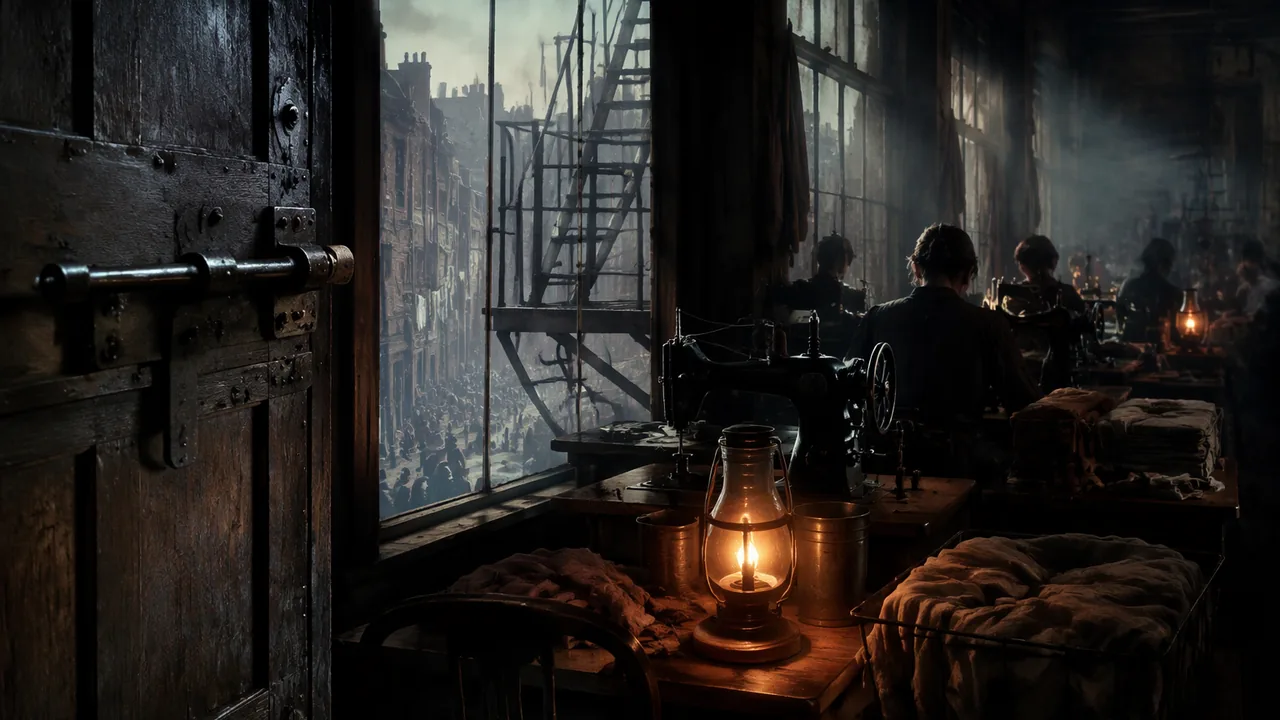
describe how industrialization changed living and working conditions, analyze how Upton Sinclair and Jacob Riis portrayed them, and explain how American cities grew and became divided by race, ethnicity and class.
Instruction
Industrial growth was measured in tons of steel. People experienced it as hours, wages, rent, danger and neighborhoods. This lab reads the evidence reformers gathered and asks how to use it well.
Work. Factory workers in 1900 commonly worked ten or more hours a day, six days a week. There was no federal minimum wage, no workers’ compensation in most states, and no unemployment insurance. Machines set the pace, and injuries were common in mills, mines and on the railroads. Children worked in textile mills, mines and street trades; the photographer Lewis Hine documented them for the National Child Labor Committee, and his photographs are in the Library of Congress. On 25 March 1911 a fire at the Triangle Shirtwaist Factory in New York killed 146 workers, most of them young Jewish and Italian immigrant women, many trapped because exit doors were locked. The disaster led New York to pass dozens of new safety laws.
Workers respond. Workers organized and struck. The Haymarket bombing in Chicago (1886), the Homestead strike at Carnegie’s steelworks (1892) and the Pullman strike (1894), broken by federal troops, showed how violent these conflicts could become and how often government sided with employers. You will follow organized labor further in the second semester.
The Jungle. Upton Sinclair spent seven weeks in Chicago’s meatpacking district and published The Jungle in 1906. He meant it as a novel about the exploitation of Lithuanian immigrant workers. Readers were most shocked by what went into their food. Within months Congress passed the Meat Inspection Act and the Pure Food and Drug Act (both June 1906). Sinclair’s own verdict is in the reading: he aimed at the public’s heart and hit its stomach. The lesson for historians: a source’s effect can differ from its author’s purpose.
Cities grow. Chicago had about 30,000 people in 1850 and about 1.7 million in 1900. Cities were linked by rail and trade into a national system: Chicago processed the grain and cattle of the West, Pittsburgh made steel, and St. Louis, where the Eads Bridge had opened in 1874, tied the river trade of the Mississippi to the railroads of the West. Growth changed the land itself. In 1900 Chicago reversed the flow of the Chicago River to carry sewage away from Lake Michigan, its drinking-water source — a human modification of the landscape with consequences downstream (HI.5).
Cities divided. Industrial cities sorted people by class, ethnicity and race. The wealthy moved to new streetcar suburbs; immigrants crowded into tenements near work, often in neighborhoods defined by language and religion. Discrimination confined Chinese residents of many cities to a few blocks — in St. Louis, the downtown neighborhood known as Hop Alley, which began in 1869 — and Black migrants to Northern cities faced exclusion from most neighborhoods and jobs. These divisions were not accidents; landlords, employers, laws and violence produced them.
Skill: bias in reform sources. HR.2 asks you to identify bias and prejudice. Riis’s book pushed New York to reform tenement housing, and his photographs are powerful evidence. The same book describes immigrant groups through ethnic stereotypes. A source can be both valuable and prejudiced. Worked example: use Riis for what he observed directly — overcrowded rooms, lack of light and air — and treat his generalizations about national “character” as evidence of his own era’s attitudes, not of the people he described.
Skill: words in context. RH.11-12.4 asks you to interpret words as used in the text. In the Sinclair passage, consumption means tuberculosis, a contagious disease that thrived in crowded, poorly ventilated housing.
📖 Read for this lesson
The reading opens over the lesson; close it to come back to exactly where you were. The checks below draw on it.
Reading: Two reformers look at the industrial city
Jacob Riis, How the Other Half Lives (1890), Introduction; Upton Sinclair, The Jungle (1906), chapter 14; Upton Sinclair, ‘What Life Means to Me’, Cosmopolitan (October 1906) · Public domain
Sinclair was a socialist who wanted readers to sympathize with workers. Notice what his readers reacted to instead.
Riis (1890): Long ago it was said that “one half of the world does not know how the other half lives.”
Sinclair, The Jungle (1906): There would be meat that had tumbled out on the floor, in the dirt and sawdust, where the workers had tramped and spit uncounted billions of consumption germs.
Sinclair on the novel’s reception (1906): I aimed at the public’s heart, and by accident I hit it in the stomach.
Formative check
Work through these before moving on. They are not graded — they tell you whether the standard below has landed yet.
In the passage from The Jungle, what does ‘consumption germs’ refer to?
Upton Sinclair wrote The Jungle mainly to win a federal meat-inspection law.
The 1911 Shirtwaist fire killed 146 workers; Jacob photographed New York tenements; in 1900 Chicago reversed the flow of its to protect Lake Michigan.
Choose one Lewis Hine photograph from the Library of Congress and one written source from this lesson. For each: source it, describe exactly what it shows, and name one thing it cannot show. Then identify one example of bias or prejudice in either source and explain how a historian can still use that source responsibly.
How confident are you that you can describe industrial working and living conditions and use reform sources while accounting for their bias?
Practice
Work these on paper or in your notebook, then open Check your answer. Aim for all of Fluency and Application; try at least one Challenge.
Printable version: this unit’s practice workbook (PDF)
Fluency
Build speed and accuracy with the core skill.
- Order: Triangle Shirtwaist fire; Haymarket bombing; Pure Food and Drug Act; Pullman strike; How the Other Half Lives.
Check your answer
Answer: Haymarket (1886); How the Other Half Lives (1890); Pullman (1894); Pure Food and Drug Act (1906); Triangle fire (1911). - In The Jungle’s phrase ‘uncounted billions of consumption germs,’ what is ‘consumption’?
Check your answer
Answer: Tuberculosis.
Application
Use the skill in context. Show your reasoning.
- Sinclair wrote in 1906: ‘I aimed at the public’s heart, and by accident I hit it in the stomach.’ What does this tell a historian about the difference between a source’s purpose and its effect?
Check your answer
Answer: Sinclair meant to win sympathy for exploited immigrant workers, but readers reacted to food safety, and Congress passed the Meat Inspection and Pure Food and Drug Acts. A source’s effect can differ from its author’s purpose. - A Lewis Hine photograph shows a small girl beside a spinning frame. Describe who made it, why, and one thing it cannot show.
Check your answer
Answer: Hine made it for the National Child Labor Committee to campaign for child-labor laws, so he framed her size against the machine. It cannot show her wages, her family’s needs, or whether she chose to work.Sourcing plus limitation: strong answers name the purpose and a specific gap, and suggest a corroborating source such as census records. - The Triangle fire (1911) was followed by dozens of New York safety laws. Cause or sequence?
Check your answer
Answer: Cause, with evidence: the deaths of 146 workers trapped behind locked doors produced public outrage and an investigation that led directly to the new laws. Reformers’ earlier campaigns were also a cause.Here the documented link supports causation; still name contributing causes.
Review
Keep earlier skills sharp.
- From Unit 1: what did Mississippi’s 1890 constitution introduce, and what was its effect?
Check your answer
Answer: A poll tax and a literacy test, which removed most Black men from the voter rolls.
Two Pages of Riis and Four Captions by Hine: Using a Reform Source Without Being Used by It
Jacob A. Riis, How the Other Half Lives (New York: Charles Scribner’s Sons, 1890); Lewis W. Hine, caption cards, National Child Labor Committee collection, Library of Congress Prints and Photographs Division; Lewis W. Hine, ‘Small newsie down-town. Saturday afternoon. St. Louis, Mo.’, 7 May 1910, 102-LH-1377, National Archives Identifier 523291, Records of the Children’s Bureau, Record Group 102 (DocsTeach record retrieved Nov. 9, 2026) · Public domain
Why this reading. Lesson 2.2 asks you to pair a Lewis Hine photograph with a written source, source both, say what each cannot show, and then find an example of bias or prejudice and explain how a historian can still use that source. The lesson gives you one sentence of Riis, in which there is no prejudice to find, and no Hine material at all. This reading supplies both halves. What to look for: in Riis, the difference between the paragraph where he reports what he walked through and the paragraph where he generalizes about a nationality. That difference is the whole skill.
1. Jacob Riis reporting what he saw: How the Other Half Lives (1890)
Riis takes the reader up a tenement staircase in the second person, in the present tense. He is describing a specific building on Cherry Street:
Be a little careful, please! The hall is dark and you might stumble over the children pitching pennies back there. Not that it would hurt them; kicks and cuffs are their daily diet. They have little else. Here where the hall turns and dives into utter darkness is a step, and another, another. A flight of stairs. You can feel your way, if you cannot see it. Close? Yes! What would you have? All the fresh air that ever enters these stairs comes from the hall-door that is forever slamming, and from the windows of dark bedrooms that in turn receive from the stairs their sole supply of the elements God meant to be free, but man deals out with such niggardly hand. That was a woman filling her pail by the hydrant you just bumped against. The sinks are in the hallway, that all the tenants may have access—and all be poisoned alike by their summer stenches. Hear the pump squeak! It is the lullaby of tenement-house babes. … Here is a door. Listen! That short hacking cough, that tiny, helpless wail—what do they mean? They mean that the soiled bow of white you saw on the door downstairs will have another story to tell—Oh! a sadly familiar story—before the day is at an end. The child is dying with measles. With half a chance it might have lived; but it had none. That dark bedroom killed it.
Everything checkable in that paragraph — one hydrant for a building, sinks in the hallway, interior bedrooms with no outside window, the death of a child from measles in a room with no light or air — is corroborated by tenement-house inspections and by the mortality statistics of the period. This is Riis at his most useful.
2. The same book, a few pages later
Content note: the passage below is prejudiced, and it is here because the task asks you to find prejudice and reason about it.
… he soon reduces what he does find to his own level, if allowed to follow his natural bent. The Italian comes in at the bottom, and in the generation that came over the sea he stays there. In the slums he is welcomed as a tenant who “makes less trouble” than the contentious Irishman or the order-loving German, that is to say: is content to live in a pig-sty and submits to robbery at the hands of the rent-collector without murmur. Yet this very tractability makes of him in good hands, when firmly and intelligently managed, a really desirable tenant.
Read the two passages as evidence of different things. The first is evidence about a building. The second is evidence about Riis, and about what a reforming, humane, widely admired New Yorker in 1890 could publish about a nationality without embarrassment. Both are usable. Neither is usable for the other’s purpose. A historian who cites the second as evidence of what Italian immigrants were like has made an error; a historian who throws the book away because of it has lost the first.
3. Lewis Hine’s own captions, from the National Child Labor Committee collection
Hine was hired by the National Child Labor Committee, an organization campaigning for child-labor laws. He traveled with a camera and a notebook and wrote a caption card for each negative. The Library of Congress holds the collection and states “No known restrictions on publication” for these items; the National Archives holds its own set of Hine’s prints, made for the Children’s Bureau, and describes them as public domain. Here are four, quoted exactly as Hine’s caption cards read, with the catalog information you need to cite them.
| Hine’s caption | Date and place | Catalog data |
|---|---|---|
| “Sadie Pfeifer, 48 inches high, has worked half a year. One of the many small children at work in Lancaster Cotton Mills. Nov. 30, 1908.” | 30 November 1908; Lancaster, South Carolina | LOT 7479, v. 1, no. 0362 [P&P]; digital file LC-DIG-nclc-01455; Hine no. 362; LCCN 2018674894 |
| “The girl berry carriers on Newton’s Farm at Cannon, Del. Ann Parion, 13 years of age, working her 5th season carries 60 lbs. of berries from the fields to the sheds. Andenito Carro, 14 years of age working her 2d season is seen carrying a 25 lb. load of berries. Besides the great physical strain in the carrying such weight, these girls also pick berries. When Andenito was asked her age she responded 12, at which her mother interrupted to say she was past 14. Edward F. Brown, Investigator.” | 28 May 1910; Cannon, Delaware | LOT 7475, v. 1, no. 1588 [P&P]; digital file LC-DIG-nclc-00103; Hine no. 1588; LCCN 2018674516 |
| “Small newsie down-town. Saturday afternoon. St. Louis, Mo.” | 7 May 1910; St. Louis, Missouri | National Archives Identifier 523291; 102-LH-1377; Records of the Children’s Bureau, Record Group 102, National Archives at College Park |
| “14 year old Spinner – Berkshire Cotton Mills.” | 1916; Adams, Massachusetts | National Child Labor Committee collection, P&P; LCCN 2018677462 |
Three things to notice before you write about any of them.
- A caption is a claim. “48 inches high” is a measurement Hine took, and he took it because a number is harder to argue with than an impression. “Has worked half a year” is something somebody told him.
- The Delaware caption records the moment the evidence became doubtful and prints it anyway: the girl said twelve, her mother said past fourteen. Hine did not resolve the contradiction; he wrote it down. Ask why a campaigner would leave that in.
- “Small” is Hine’s impression, not a measurement. Set the St. Louis caption beside the Lancaster one. Sadie gets a height in inches and a length of service; the St. Louis newsboy gets an adjective, a day of the week and a part of town. The caption does tell you something checkable — a child selling papers downtown on a Saturday afternoon in May 1910 — and something that is only Hine’s judgment. Ask what a reformer gained by writing “small” instead of an age.
What a Hine photograph cannot tell you: what the child earned, what the family needed, whether an adult was standing outside the frame, what the child would have said if asked. Those answers are in census schedules, payrolls, state factory-inspection reports and the NCLC’s own investigators’ notes — which is exactly the point of the paired analysis you are being asked to do.
Sources: Jacob A. Riis, How the Other Half Lives (1890), Project Gutenberg (gutenberg.org); National Child Labor Committee collection (Lewis Hine photographs), Library of Congress (loc.gov); Sadie Pfeifer, Lancaster Cotton Mills, 1908 (LCCN 2018674894) (loc.gov); The girl berry carriers, Cannon, Delaware, 1910 (LCCN 2018674516) (loc.gov); Lewis W. Hine, ‘Small newsie down-town. Saturday afternoon. St. Louis, Mo.’ (1910), National Archives Identifier 523291, DocsTeach (docsteach.org)