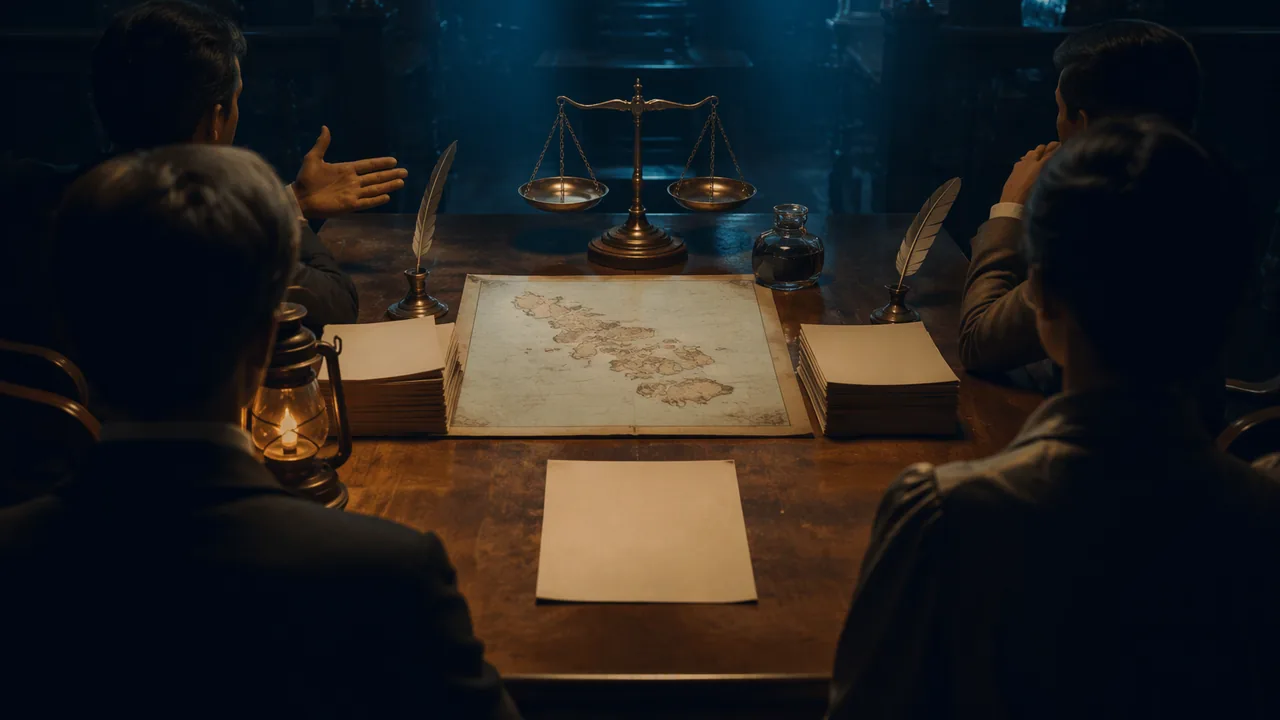
argue both sides of the 1899 annexation debate from primary sources, seek a reasoned shared conclusion, and write a position paper defending my own conclusion.
Instruction
The question. Should the Senate have ratified the Treaty of Paris and annexed the Philippines in 1899? The Senate did, on 6 February 1899, by 57 votes to 27 — one vote more than the two-thirds required. Two days earlier, fighting had broken out between American and Filipino forces outside Manila.
What a structured academic controversy is. A debate rewards winning. A structured academic controversy (SAC) rewards understanding. Teams of four split into two pairs; working alone, you play both pairs in turn and write each restatement before you answer it. Round 1: Pair A presents the case for annexation from the sources; Pair B listens, takes notes and restates Pair A’s case until Pair A agrees it is accurate. Round 2: Pair B presents the case against; Pair A restates it. Round 3: Pairs switch sides and add one argument the other pair missed. Round 4: Everyone drops their assigned side and works toward the strongest conclusion the group can share, noting where members still disagree and why.
The source packet. You will receive excerpts from: McKinley’s messages to Congress; senators’ speeches for and against the treaty from the Congressional Record, such as Albert Beveridge (for) and George Hoar (against); the Anti-Imperialist League platform; Emilio Aguinaldo’s statements to the American people; reports of the Philippine Commission; and the 1902 Senate testimony on the conduct of the war.
The arguments in 1899. For annexation, senators argued that the islands were a gateway to Asian trade, that leaving them would invite Germany or Japan to seize them, that Filipinos were not ready for self-government, and that the United States had a duty to govern them. The last two claims rested on racial assumptions of the time. Against annexation, senators and the Anti-Imperialist League argued that ruling people without their consent violated the Declaration of Independence and the Constitution, that colonies would require a standing army, and that Filipinos had already declared independence. Some opponents added racist arguments of their own, fearing that annexation would make Filipinos Americans. Filipino voices argued for independence.
Evaluating arguments, not only positions. HR.1 asks you to distinguish valid from fallacious arguments. A claim can be valid in form and rest on a false premise. Example: “If a people cannot govern themselves, another nation must govern them; Filipinos cannot govern themselves; therefore the United States must.” The form is valid; the second premise was asserted, not shown, and the evidence of the Malolos Republic of 1899 challenged it. Look for the premise under every argument.
Judging in context. Remember HI.3 from Lesson 3.3. You are judging a decision made in 1899 with the information and values available then, which included both strong arguments for self-government and widespread racial hierarchy. Your paper can, and should, also say what later evidence shows.
The position paper. After the controversy, write your own conclusion. It may differ from your group’s. Use at least five sources, state the strongest opposing argument in terms its holders in 1899 would accept (SL.11-12.1.d and WHST.11-12.1), and answer it.
📖 Read for this lesson
The reading opens over the lesson; close it to come back to exactly where you were. The checks below draw on it.
Formative check
Work through these before moving on. They are not graded — they tell you whether the standard below has landed yet.
‘If a people cannot govern themselves, another nation must govern them. Filipinos cannot govern themselves. Therefore the United States must.’ What is the main weakness of this argument?
The Senate ratified the Treaty of Paris by a wide margin with little debate.
How confident are you that you can argue both sides of a historical decision fairly and defend my own conclusion in writing?
Unit 3 checkpoint
Do this before you start the task. It covers the whole unit and tells you what to review first.
Why did indebted farmers support free silver?
The Populist candidate James Weaver won over a million votes in 1892.
The Amendment allowed a federal income tax; the Amendment provided for direct election of senators.
Who headed the federal Children’s Bureau when it was created in 1912?
Missouri’s Progressive reforms under Governor Joseph Folk included adding the initiative and referendum to the state constitution.
What was the main purpose of the Open Door notes?
What did Spain cede in the Treaty of Paris (1898)?
The Senate ratified the Treaty of Paris by a large margin.
The -Bunau-Varilla Treaty gave the United States a Canal Zone; the canal opened in .
What did the Roosevelt Corollary claim?
Which statement confuses sequence with cause?
Submit: Recorded SAC + Position Paper (900-1,100 words)
Task: Take part in a structured academic controversy on annexing the Philippines, then write a position paper defending your own conclusion from at least five primary sources.
Submission workflow
- Stage 1 — Plan. Evidence chart for both sides from the source packet (at least four sources per side), with the premise under each argument identified.
- Stage 2 — Self-reviewed draft. Draft position paper; check (or ask a parent, guardian or other reader to check) that the opposing argument is stated in terms its 1899 holders would accept. Save a revision note.
- Stage 3 — Revised final. 900-1,100 words, at least five cited sources, one paragraph testing a premise from each side.
- Stage 4 — Controversy. The recorded or live SAC (all four rounds), scored as the presentation stage; students unable to join live complete the rounds asynchronously in a recorded thread.
How it is scored
| Criterion | What proficient looks like |
|---|---|
| Collaborative discussion (SL.11-12.1) | Prepared, evidence-based participation in all four rounds; builds on others’ ideas. |
| Representing other views (SL.11-12.1.d) | Restates the other side accurately enough that its holders agree; seeks common ground. |
| Evaluating reasoning (SL.11-12.3, 9-12.AH.1.CC.B / 9-12.AH.1.CC.D) | Identifies premises and distinguishes valid from fallacious arguments on both sides. |
| Position paper (WHST.11-12.1) | Precise claim, at least five sources, strongest counterclaim answered. |
| Historical accuracy (US.11.4.2) | Accurate account of the war, the treaty and the annexation debate. |
| Revision (WHST.11-12.5) | Revision note shows substantive changes in response to feedback. |
The Source Packet: Should the Senate Have Annexed the Philippines?
McKinley to the Secretary of War, 21 December 1898, in Richardson, ed., Messages and Papers of the Presidents, vol. X; Beveridge, Senate speech of 9 January 1900 (Congressional Record, 56th Cong., 1st Sess., 704-712, and The Meaning of the Times, 1908, 58-88); Platform of the American Anti-Imperialist League, 17 October 1899, in Bancroft, ed., Speeches, Correspondence and Political Papers of Carl Schurz, vol. VI (1913), 77-79n; Hoar, Senate speech of 9 January 1899 (Congressional Record, 55th Cong., 3d Sess.); Emilio Aguinaldo, True Version of the Philippine Revolution (Tarlak, 1899); Affairs in the Philippine Islands, S. Doc. 331, 57th Cong., 1st Sess., pt. 3 · Public domain
Why this reading. Lesson 3.5 says “You will receive excerpts” from six kinds of document and then does not supply any of them. This is that packet. It holds six sources — three for annexation, three against or from the Filipino side — with enough of each that both pairs can build the evidence chart, argue the assigned side, and then argue the other side accurately enough that its holders would agree. What to look for: under every argument here there is a premise, usually unstated, about what Filipinos were and what the United States was. The structured academic controversy is won by finding those premises, not by finding better adjectives.
The decision you are judging
On 6 February 1899 the Senate voted 57 to 27 to ratify the Treaty of Paris, one vote more than the two-thirds required. Fighting between American and Filipino forces had broken out outside Manila two days earlier. A year later Senator Albert Beveridge introduced a resolution declaring the islands American territory, and made the speech below.
FOR ANNEXATION
Document 1. President McKinley to the Secretary of War, 21 December 1898 (the “benevolent assimilation” order)
This is not a speech; it is an instruction to the army that became a proclamation in Manila on 4 January 1899. Note the order of its sentences: sovereignty first, then reassurance, then the condition.
In fulfillment of the rights of sovereignty thus acquired and the responsible obligations of government thus assumed, the actual occupation and administration of the entire group of the Philippine Islands become immediately necessary…
It will be the duty of the commander of the forces of occupation to announce and proclaim in the most public manner that we come, not as invaders or conquerors, but as friends, to protect the natives in their homes, in their employments, and in their personal and religious rights. All persons who, either by active aid or by honest submission, co-operate with the Government of the United States to give effect to these beneficent purposes will receive the reward of its support and protection. All others will be brought within the lawful rule we have assumed, with firmness if need be, but without severity so far as may be possible.
Finally, it should be the earnest and paramount aim of the military administration to win the confidence, respect, and affection of the inhabitants of the Philippines by assuring to them in every possible way that full measure of individual rights and liberties which is the heritage of free peoples, and by proving to them that the mission of the United States is one of benevolent assimilation, substituting the mild sway of justice and right for arbitrary rule. In the fulfillment of this high mission … there must be sedulously maintained the strong arm of authority to repress disturbance and to overcome all obstacles to the bestowal of the blessings of good and stable government upon the people of the Philippine Islands under the free flag of the United States.
Two things to test. “Rights of sovereignty thus acquired” — acquired from whom, and did that party have them to give? And “the blessings … of good and stable government” are to be bestowed, which is a word about a gift and about a giver who decides.
Document 2. Senator Albert J. Beveridge of Indiana, Senate, 9 January 1900
Beveridge had just returned from four months in the islands, which he presented as the qualification nobody else in the chamber had. The opening, from his own 1908 printing of the speech:
Mr. President, the times call for candor. The Philippines are ours, “territory belonging to the United States,” as the Constitution calls them. And just beyond the Philippines are China’s illimitable markets. We will not retreat from either. We will not repudiate our duty in the archipelago. We will not abandon our opportunity in the Orient. We will not renounce our part in the mission of our race. And we will move forward to our work, not howling out regrets, like slaves whipped to their burdens, but with gratitude for a task worthy of our strength, and thanksgiving to Almighty God that He has deemed us worthy of His work.
Use this next fact in your paper; it is a sourcing point most students miss. The words above are Beveridge’s revision. As the Congressional Record printed the speech in 1900, the same passage read “The Philippines are ours forever”; “our part in the mission of our race, trustee, under God, of the civilization of the world”; and “thanksgiving to Almighty God that He has marked us as His chosen people, henceforth to lead in the regeneration of the world.” Eight years later Beveridge cut all three. A politician editing his own imperial theology out of the record is evidence about what had happened in between.
The commercial argument, stated plainly:
But to hold it will be no mistake. Our increasing trade henceforth must be with Asia. … Where shall we turn for consumers of our surplus? Geography answers the question. China is our natural customer. She is nearer to us than to England, Germany or Russia… The Philippines give us a base at the door of all the East.
… These islands are a self-supporting, dividend-paying fleet, permanently anchored at a spot selected by the strategy of Providence, commanding the Pacific. And the Pacific is the ocean of the commerce of the future. Most future wars will be conflicts for commerce. The power that rules the Pacific, therefore, is the power that rules the world. And, with the Philippines, that power will be the American Republic.
And the racial premise, under a heading the Congressional Record printed in capitals — “THE FILIPINOS ARE CHILDREN, UTTERLY INCAPABLE OF SELF-GOVERNMENT”:
But, Senators, it would be better to abandon this combined garden and Gibraltar of the Pacific, and count our blood and treasure already spent a profitable loss, than to apply any academic arrangement of self-government to these children. They are not capable of self-government. How could they be? … They are Orientals, Malays, instructed by Spaniards in the latter’s worst estate. … What alchemy will change the oriental quality of their blood and set the self-governing currents of the American pouring through their Malay veins? … Let men beware how they employ the term “self-government.” It is a sacred term.
This is the premise the lesson’s quiz is about. Beveridge does not argue that Filipinos cannot govern themselves; he asserts it, twice, and then asks rhetorical questions in place of evidence. Mark that in your chart. It is the load-bearing claim of the entire pro-annexation case, and it is the one claim Beveridge never supports.
AGAINST ANNEXATION
Document 3. Platform of the American Anti-Imperialist League, Chicago, 17 October 1899
The lesson quotes the first sentence. Here is most of the rest:
We hold that the policy known as imperialism is hostile to liberty and tends toward militarism, an evil from which it has been our glory to be free. We regret that it has become necessary in the land of Washington and Lincoln to reaffirm that all men, of whatever race or color, are entitled to life, liberty and the pursuit of happiness. We maintain that governments derive their just powers from the consent of the governed. We insist that the subjugation of any people is “criminal aggression” and open disloyalty to the distinctive principles of our Government.
We earnestly condemn the policy of the present National Administration in the Philippines. It seeks to extinguish the spirit of 1776 in those islands. We deplore the sacrifice of our soldiers and sailors, whose bravery deserves admiration even in an unjust war. We denounce the slaughter of the Filipinos as a needless horror. We protest against the extension of American sovereignty by Spanish methods.
We demand the immediate cessation of the war against liberty, begun by Spain and continued by us. We urge that Congress be promptly convened to announce to the Filipinos our purpose to concede to them the independence for which they have so long fought and which of right is theirs.
The United States have always protested against the doctrine of international law which permits the subjugation of the weak by the strong. A self-governing state cannot accept sovereignty over an unwilling people. The United States cannot act upon the ancient heresy that might makes right.
… Much as we abhor the war of “criminal aggression” in the Philippines, greatly as we regret that the blood of the Filipinos is on American hands, we more deeply resent the betrayal of American institutions at home. The real firing line is not in the suburbs of Manila. The foe is of our own household. The attempt of 1861 was to divide the country. That of 1899 is to destroy its fundamental principles and noblest ideals.
We deny that the obligation of all citizens to support their Government in times of grave National peril applies to the present situation. If an Administration may with impunity ignore the issues upon which it was chosen, deliberately create a condition of war anywhere on the face of the globe, debauch the civil service for spoils to promote the adventure, organize a truth-suppressing censorship and demand of all citizens a suspension of judgment and their unanimous support while it chooses to continue the fighting, representative government itself is imperiled.
We hold, with Abraham Lincoln, that “no man is good enough to govern another man without that other’s consent. When the white man governs himself, that is self-government, but when he governs himself and also governs another man, that is more than self-government—that is despotism.” … We cordially invite the cooperation of all men and women who remain loyal to the Declaration of Independence and the Constitution of the United States.
Notice the strategy, which you first met in Unit 1: the League does not offer a new principle. It quotes the Declaration and Lincoln and says the government has abandoned them.
Document 4. Senator George Frisbie Hoar of Massachusetts, Senate, 9 January 1899
Hoar was a Republican breaking with a Republican president, and he spends his first minutes saying so. The constitutional argument, on Senator Vest’s resolution that the Constitution gives no power to hold colonies:
I am to speak for my country, for its whole past and for its whole future. I am to speak to a people whose fate is bound up in the preservation of our great doctrine of constitutional liberty. … the strongest frame may get mortal sickness from one exposure; the most vigorous health or life may be destroyed by a single drop of poison, and what poison is to the human frame the abandonment of our great doctrine of liberty will be to the Republic.
And then a passage you must not skip, because it shows that opposing annexation did not require believing in Filipino equality. Hoar imagines the policy being carried out on
… a distant [people], dwelling in the Tropics, aliens in blood, most of them Moslem in faith, incapable to speak or comprehend our language, or to read or to write any language, to whom the traditions and the doctrines of civil liberty are unknown…
Hoar shares several of Beveridge’s assumptions about Filipinos and draws the opposite conclusion from them: not that such a people must be governed, but that governing them would destroy the governor. That is a real argument and it is not the same argument as the League’s. Your chart should separate them, because they have different premises and a student arguing “the anti-imperialist case” as one thing will be arguing something nobody actually held.
Document 5. Emilio Aguinaldo, True Version of the Philippine Revolution, Tarlak, 23 September 1899
Aguinaldo had declared Philippine independence in June 1898 and was president of the Philippine Republic. He wrote this book in English, during the war, to be read in the United States. The translator’s British spellings and long sentences are as printed.
On the proclamation in Document 1, as it reached Manila:
The second impolitic act of General Otis was the issue of a proclamation on the 4th of January, 1899, asserting in the name of President McKinley the sovereignty of America in these islands, with threats of ruin, death and desolation to all who declined to recognize it.
I, Emilio Aguinaldo—though the humble servant of all, am, as President of the Philippine Republic, charged with the safeguarding of the rights and independence of the people who appointed me to such an exalted position of trust and responsibility—mistrusted for the first time the honour of the Americans, perceiving of course that this proclamation of General Otis completely exceeded the limits of prudence…
On the outbreak of fighting and the Senate vote two days later:
… there came the fatal day of the 4th February, during the night of which day the American forces suddenly attacked all our lines, which were in fact at the time almost deserted, because being Saturday, the day before a regular feast day, our Generals and some of the most prominent officers had obtained leave to pass the Sabbath with their respective families.
And the address to American readers that closes the book:
Oh, sensible American people! Deep is the admiration of all the Philippine people and of their untrained Army of the courage displayed by your Commanders and soldiers. … Limited are our warlike resources, but we will continue this unjust, bloody, and unequal struggle, not for the love of war—which we abhor—but to defend our incontrovertible rights of Liberty and Independence (so dearly won in war with Spain) and our territory which is threatened by the ambitions of a party that is trying to subjugate us.
Go back, therefore, North American people, to your old-time liberty. Put your hand on your heart and tell me: Would it be pleasant for you if, in the course of time, North America should find herself in the pitiful plight of a weak and oppressed people and the Philippines, a free and powerful nation, then at war with your oppressors, asked for your aid promising to deliver you from such a weighty yoke, and after defeating her enemy with your aid she set about subjugating you, refusing the promised liberation?
The veracity of these facts rests upon my word as President of this Republic and on the honour of the whole population of eight million souls, who, for more than three hundred years have been sacrificing the lives and wealth of their brave sons to obtain due recognition of the natural rights of mankind—liberty and independence.
Source him as carefully as you source Beveridge. This is a wartime appeal by a head of state losing a war, written to change American opinion, and his account of who fired first on 4 February is contested. It is also the only document in this packet written by a Filipino, and it is the direct answer to Beveridge’s assertion: a functioning government, a congress, a constitution and an army are evidence about capacity for self-government, and Beveridge offered none against them.
Document 6. Testimony before the Senate Committee on the Philippines, 1902
Content note: this document describes torture. It is here because the Senate took it under oath, printed it, and then had to decide what it meant. Daniel J. Evans, late of the Twelfth Infantry, of Concordia, Kansas, describing what he saw done to a Filipino prisoner who would not say where the insurgents were:
… they commenced this so-called “water cure.” The first thing one of the Americans—I think one of the scouts for the Americans—grabbed one of the men by the head and jerked his head back, and then they took a tomato can and poured water down his throat until he could hold no more, and during this time one of the natives had a rattan whip, about as large as my finger, and he struck him on the face and on the bare back, and every time they would strike him it would raise a large welt, and some blood would come. And when this native could hold no more water, then they forced a gag into his mouth; they stood him up and tied his hands behind him; they stood him up against a post and fastened him so he could not move. Then one man, an American soldier, who was over six feet tall, and who was very strong, too, struck this native in the pit of the stomach as hard as he could strike him, just as rapidly as he could. It seemed as if he didn’t get tired of striking him.
Q. With his hand?—A. With his clenched fist. He struck him right in the pit of the stomach and it made the native very sick. They kept that operation up for quite a time, and finally I thought the fellow was about to die…
Q. Where was the commander? How far distant from where this business was performed?—A. The captain in charge? Q. Yes.—A. He was not over 200 yards away.
Captain Fred McDonald, on the presidente of Igbaras:
I saw the presidente of Igbaras. I saw him first in the second story of the convent in the town of Igbaras. He was at that time under a water tank. The water was running from the tank onto his face or, I think, into his mouth… He was afterwards thrown on his back in front of the convent and a syringe inserted into his mouth and water pumped into his stomach.
The committee was chaired by Senator Henry Cabot Lodge, who supported annexation. Senator Beveridge, whose speech you read above, sat on it and questioned these witnesses. Use this document carefully: evidence of atrocities in 1902 does not by itself answer the question the Senate faced in 1899, which is what the lesson means by judging a decision in its context. But it is exactly what the strongest form of the anti-imperialist counterclaim predicted, and a paper that argues for annexation has to say what it makes of it.
How to build the evidence chart
| Argument | Documents | The premise under it |
|---|---|---|
| Markets and strategy require the islands | 2 | That American prosperity depends on Asian markets, and that a naval base secures them. Testable against trade figures. |
| If we leave, Germany or Japan take them | 2, and the diplomacy in Lesson 3.3 | That the only alternatives are American rule or another power’s. It excludes independence by assumption. |
| Filipinos cannot govern themselves | 2 | Asserted, never shown. Document 5 is the counter-evidence. |
| We have a duty to govern them well | 1 | That benefit can be conferred on people without their consent, and that the conferrer judges whether it worked. |
| Ruling without consent violates our own founding | 3 | That the Declaration states a universal principle and not only a domestic one. |
| Colonies would corrupt the Republic | 3, 4, 6 | That a government’s conduct abroad changes its character at home. Document 6 is the test case. |
| Filipinos had already declared independence and were fighting for it | 5 | That prior possession of self-government defeats a claim to bestow it. |
Both sides in 1899 contained people making racial arguments. Beveridge wanted to rule Filipinos because he thought them incapable; some anti-imperialists opposed annexation because they did not want Filipinos as fellow citizens. Hoar’s language above is milder than that and still not innocent. Round 4 of the controversy asks for the strongest conclusion your group can share; noticing that the racial premise runs through both sides is usually where a group finds it.
A note on these texts
Document 1 is from Richardson’s official compilation of presidential messages. Document 2 is quoted from Beveridge’s own 1908 printing, whose type is clean, with the 1900 Congressional Record readings given separately where they differ; both were checked against each other. Document 3 is the platform as printed in full in Bancroft’s 1913 edition of Carl Schurz’s papers. Document 4 is from the Congressional Record for 9 January 1899, whose microfilm scan has dropped words; the one word restored here is marked in square brackets. Document 5 is a transcription of Aguinaldo’s 1899 English printing. Document 6 is from Senate Document 331, 57th Congress, whose scan is badly damaged; the passages above are given in the printed reading, and the damaged scan is linked below so that anyone can check them. Omissions are marked … The Malolos Constitution of January 1899, which the lesson mentions, is not reproduced here: no pre-1930 English printing of it could be found in a source we could verify, so its text is described rather than quoted.
Sources: Richardson, ed., A Compilation of the Messages and Papers of the Presidents, vol. X, Internet Archive (archive.org); Albert J. Beveridge, The Meaning of the Times and Other Speeches (1908), Internet Archive (archive.org); Congressional Record, 56th Congress, 1st Session, vol. 33 (Dec. 1899 – Jan. 1900), Internet Archive (archive.org); Bancroft, ed., Speeches, Correspondence and Political Papers of Carl Schurz, vol. VI (1913), Internet Archive (archive.org); Congressional Record, 55th Congress, 3d Session, vol. 32 (Dec. 1898 – Jan. 1899), Internet Archive (archive.org); Emilio Aguinaldo, True Version of the Philippine Revolution (1899), Project Gutenberg (gutenberg.org); Affairs in the Philippine Islands, S. Doc. 331, 57th Cong., 1st Sess., part 3 (1902), Internet Archive (archive.org)