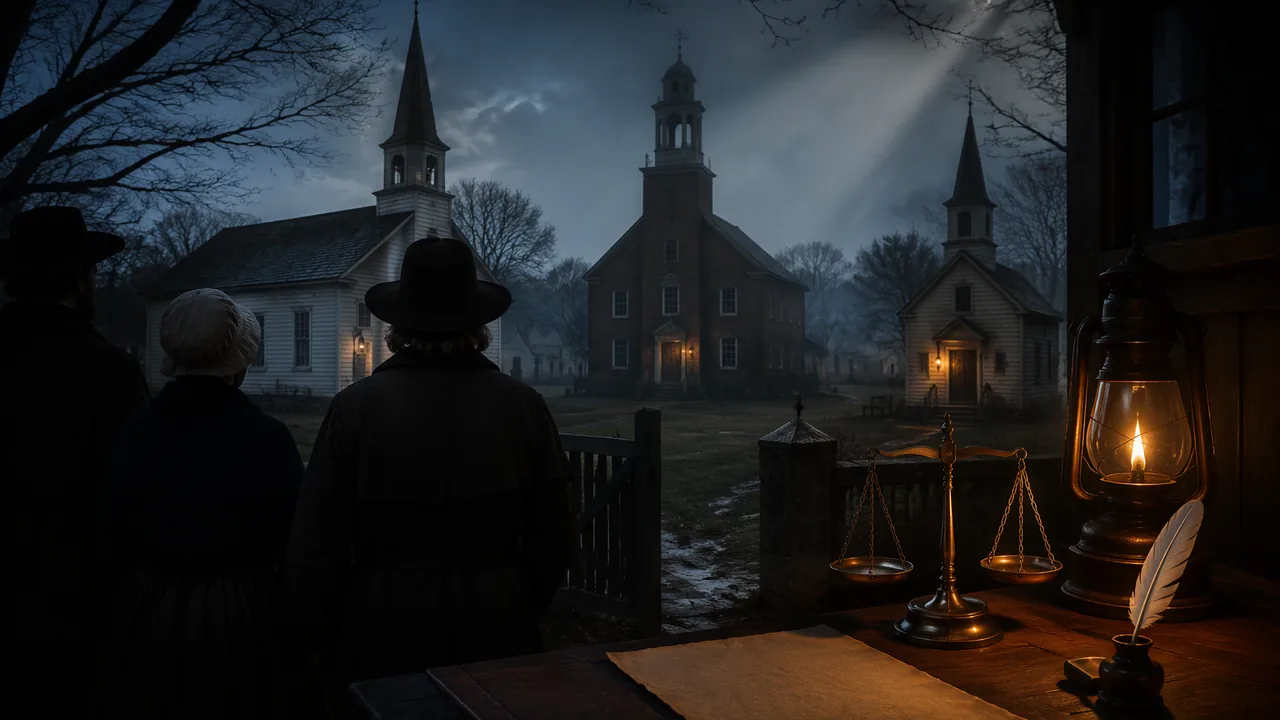
describe how religious groups and revivals shaped American civic principles and reform, explain the Establishment and Free Exercise clauses, and discuss competing interpretations of the separation of church and state.
Instruction
Religion runs through American history as a source of civic ideals, reform energy and conflict. This seminar asks what role it played and what the First Amendment says government may and may not do about it.
Colonial roots. Many colonies were founded by religious dissenters: Puritans in Massachusetts, Quakers in Pennsylvania, Catholics in Maryland. Their congregations governed themselves, which accustomed many colonists to electing their leaders and resisting distant authority. But toleration was limited. Massachusetts banished Roger Williams and Anne Hutchinson, and most colonies had an established, tax-supported church.
The Great Awakenings. The First Great Awakening (1730s-1740s) was a wave of revivals led by preachers such as Jonathan Edwards and George Whitefield. It stressed personal conversion over church hierarchy, and some historians argue it taught colonists to challenge established authority a generation before the Revolution; others think that link is overstated. The Second Great Awakening (about 1790s-1840s) brought camp meetings and preachers such as Charles Finney, who taught that people could choose salvation and perfect society. That conviction fed reform: temperance, prison and asylum reform, and above all abolition. Black Americans built independent churches, such as Richard Allen’s African Methodist Episcopal Church (1816), which became centers of community life and later of the civil rights movement. Both armies of the Civil War saw revivals among soldiers.
Later currents. In the late nineteenth century, liberal Protestant theologians reinterpreted the Bible in light of science and history, and the Social Gospel (Unit 2) urged churches to reform industrial society. Catholic teaching on workers, set out by Pope Leo XIII in 1891, supported unions and a living wage. In reaction to liberal theology, fundamentalists defended the literal truth of Scripture; you will meet them at the Scopes trial of 1925 (Unit 4), and their heirs became a political force from the late 1970s. The Second Vatican Council (1962-1965) transformed Catholic worship, allowing Mass in local languages, and changed the Church’s relations with other faiths.
Contributions to civic principles. Religious groups supplied arguments for self-rule and against monarchy, for the dignity of work and for worker protection, for individual responsibility, and for civil and human rights. They also supplied arguments for slavery, for exclusion and for intolerance. Both belong in the record.
The First Amendment. It contains two religion clauses. The Establishment Clause bars Congress from establishing a religion; the Free Exercise Clause bars it from prohibiting religious practice. At first they bound only the federal government; Massachusetts kept a tax-supported church until 1833. After the Fourteenth Amendment, the Supreme Court applied both clauses to the states in the 1940s.
The interpretive debate. Jefferson’s phrase “a wall of separation” is not in the Constitution; it comes from the 1802 letter in the reading. Strict separationists read the clause as barring nearly all government support for religion, as the Court did when it struck down official school prayer in Engel v. Vitale (1962). Accommodationists argue that the founders meant only to forbid a national church and favoring one faith, and that government may support religion even-handedly. Scholars and justices cite the same founders on both sides — a case study for HR.3, evaluating debates among interpreters and their use of evidence.
Seminar question: Does the First Amendment require a “wall of separation” or only even-handed treatment of all faiths? Prepare two pieces of evidence for each side. In the seminar, SL.11-12.1.c asks you to pose questions that probe reasoning — for example, “Which of Jefferson’s actions as president supports your reading?” Your own beliefs are not the subject of the seminar and you are never asked to share them.
📖 Read for this lesson
The reading opens over the lesson; close it to come back to exactly where you were. The checks below draw on it.
Reading: The First Amendment and two presidents’ letters
U.S. Constitution, Amendment I (1791); George Washington to the Hebrew Congregation in Newport, Rhode Island (18 August 1790); Thomas Jefferson to the Danbury Baptist Association (1 January 1802) · Public domain
Washington and Jefferson were each answering a letter from a religious minority. What did each group want to hear?
First Amendment: Congress shall make no law respecting an establishment of religion, or prohibiting the free exercise thereof; or abridging the freedom of speech, or of the press; or the right of the people peaceably to assemble, and to petition the Government for a redress of grievances.
Washington to the Newport congregation: For happily the Government of the United States, which gives to bigotry no sanction, to persecution no assistance, requires only that they who live under its protection should demean themselves as good citizens.
Jefferson to the Danbury Baptists: I contemplate with sovereign reverence that act of the whole American people which declared that their legislature should “make no law respecting an establishment of religion, or prohibiting the free exercise thereof,” thus building a wall of separation between Church & State.
Formative check
Work through these before moving on. They are not graded — they tell you whether the standard below has landed yet.
Which reform movement drew most heavily on the Second Great Awakening’s belief that people could perfect society?
The phrase ‘separation of church and state’ appears in the text of the First Amendment.
First Great Awakening
Tap to reveal1730s-1740s revivals; Edwards and Whitefield; personal conversion over church hierarchy.
Second Great Awakening
Tap to revealAbout 1790s-1840s; Finney, camp meetings; fed abolition and temperance.
AME Church
Tap to revealIndependent Black denomination founded by Richard Allen in 1816.
Second Vatican Council
Tap to reveal1962-1965; transformed Catholic worship and relations with other faiths.
Engel v. Vitale (1962)
Tap to revealStruck down official prayer in public schools under the Establishment Clause.
Record a 90-second seminar contribution answering the seminar question, citing at least one reading and one later event. Then write two replies to published views on the question (for example a reading’s author or a historian): in each, restate the claim fairly, then ask a question that probes the evidence or add evidence that qualifies it.
How confident are you that you can explain religion’s role in American reform and civic life and discuss both readings of the religion clauses?
Practice
Work these on paper or in your notebook, then open Check your answer. Aim for all of Fluency and Application; try at least one Challenge.
Printable version: this unit’s practice workbook (PDF)
Fluency
Build speed and accuracy with the core skill.
- Order: the Second Vatican Council; the First Great Awakening; Jefferson’s letter to the Danbury Baptists; Engel v. Vitale; the founding of the AME Church.
Check your answer
Answer: First Great Awakening (1730s-1740s); Danbury letter (1802); AME Church (1816); Engel v. Vitale (June 1962); Second Vatican Council (opened October 1962, closed 1965). - Distinguish the Establishment Clause from the Free Exercise Clause in one sentence each.
Check your answer
Answer: The Establishment Clause bars government from establishing a religion; the Free Exercise Clause bars government from prohibiting religious practice.
Application
Use the skill in context. Show your reasoning.
- Source Washington’s words: ‘the Government of the United States, which gives to bigotry no sanction, to persecution no assistance.’ Who was he writing to, when, and why does the audience matter?
Check your answer
Answer: The Hebrew Congregation in Newport, Rhode Island, in August 1790. He was answering a religious minority’s letter, so the reassurance is aimed at people who had reason to fear persecution; it is evidence of the new government’s stated principle.Strong answers use the audience to explain why the letter stresses protection, and note that a promise is not proof of practice. - Jefferson’s phrase ‘a wall of separation between Church & State’ comes from a private letter to Baptists in 1802. How reliable is it as evidence of what the First Amendment means?
Check your answer
Answer: Model answer: it is strong evidence of Jefferson’s own reading, but he did not write the amendment, and a private letter written years later is weaker evidence of what Congress and the ratifying states intended. Separationists and accommodationists weigh it differently.A strong answer distinguishes one founder’s view from the text’s meaning and acknowledges both interpretive camps. - The Second Great Awakening came before the rise of abolitionism in the 1830s. Did the revival cause abolitionism, or only precede it?
Check your answer
Answer: Historians see a real causal link, not only sequence: revival preaching that sin could be overcome and society perfected moved many converts into reform, including abolition. But abolition had other causes too, including Black activism and Enlightenment ideas.A strong answer names the mechanism (belief in perfecting society) and at least one other cause.
Review
Keep earlier skills sharp.
- From Lesson 1.2: which amendment led, through the Supreme Court in the 1940s, to the religion clauses binding the states?
Check your answer
Answer: The Fourteenth Amendment.
The Other Half of the Seminar: Evidence for Both Readings of the Religion Clauses
Northwest Ordinance (1787), Article 3, Avalon Project; George Washington, Thanksgiving Proclamation, 3 October 1789, in Richardson, ed., Messages and Papers of the Presidents, vol. I; Everson v. Board of Education, 330 U.S. 1 (1947); Zorach v. Clauson, 343 U.S. 306 (1952); Engel v. Vitale, 370 U.S. 421 (1962), official U.S. Reports · Public domain
Why this reading. Lesson 1.3 asks you to prepare two pieces of evidence for each side of the seminar question and then to cite at least one reading and one later event in your contribution. The lesson supplies the separationist side — Jefferson’s wall — and names Engel v. Vitale without quoting it. It supplies nothing at all for the accommodationist side, so half the seminar cannot be prepared from it. These are the texts the accommodationists actually use, and the two Supreme Court passages that decided the question each way. What to look for: every one of these documents was written by someone who could have written the other. The same Congress that sent the First Amendment to the states also passed the Northwest Ordinance and asked Washington for a day of prayer.
The separationist evidence
Jefferson to the Danbury Baptist Association, 1 January 1802. You have the sentence in the lesson. Two facts about it belong in your notes. It is a letter, not a law; and it was written to a religious minority in Connecticut, a state that still had an established church, to reassure them that the federal government would never do to them what their own state was doing.
Everson v. Board of Education, 330 U.S. 1 (1947). This is the case in which the Supreme Court applied the Establishment Clause to the states. Justice Black, for the Court:
The “establishment of religion” clause of the First Amendment means at least this: Neither a state nor the Federal Government can set up a church. Neither can pass laws which aid one religion, aid all religions, or prefer one religion over another. Neither can force nor influence a person to go to or to remain away from church against his will or force him to profess a belief or disbelief in any religion. No person can be punished for entertaining or professing religious beliefs or disbeliefs, for church attendance or non-attendance. No tax in any amount, large or small, can be levied to support any religious activities or institutions, whatever they may be called, or whatever form they may adopt to teach or practice religion. Neither a state nor the Federal Government can, openly or secretly, participate in the affairs of any religious organizations or groups and vice versa. In the words of Jefferson, the clause against establishment of religion by law was intended to erect “a wall of separation between church and State.”
Note the sting in the case: having said all that, the Court upheld the New Jersey program at issue, which reimbursed parents for bus fares to Catholic schools. The strictest statement of separation in American law appears in an opinion that allowed the aid. Ask why.
Engel v. Vitale, 370 U.S. 421 (1962). Justice Black again, on a prayer written by the New York Board of Regents for use in public schools:
… the constitutional prohibition against laws respecting an establishment of religion must at least mean that in this country it is no part of the business of government to compose official prayers for any group of the American people to recite as a part of a religious program carried on by government.
We think that by using its public school system to encourage recitation of the Regents’ prayer, the State of New York has adopted a practice wholly inconsistent with the Establishment Clause.
The accommodationist evidence
The Northwest Ordinance, 13 July 1787, Article 3. Passed by the Confederation Congress in the same summer the Constitutional Convention sat, and re-enacted by the First Congress:
Religion, morality, and knowledge, being necessary to good government and the happiness of mankind, schools and the means of education shall forever be encouraged.
Read it carefully before you use it. It ties religion to good government and to schools in one sentence. It does not establish a church, and it does not spend a dollar on one.
George Washington, Thanksgiving Proclamation, 3 October 1789. Both houses of Congress asked him for it, by joint committee, in the same session in which they sent the Bill of Rights to the states:
Whereas it is the duty of all nations to acknowledge the providence of Almighty God, to obey His will, to be grateful for His benefits, and humbly to implore His protection and favor; and
Whereas both Houses of Congress have, by their joint committee, requested me “to recommend to the people of the United States a day of public thanksgiving and prayer…”
This is the accommodationist case in a single document: the men who wrote the Establishment Clause did not think it forbade a president to proclaim a national day of prayer. A separationist reply is available and you should know it — Jefferson and Madison both refused to issue such proclamations as president, and Madison later wrote that he had come to think them a mistake.
Zorach v. Clauson, 343 U.S. 306 (1952). Five years after Everson, the Court upheld a New York program releasing pupils from school to attend religious instruction elsewhere. Justice Douglas, for the Court:
We are a religious people whose institutions presuppose a Supreme Being. We guarantee the freedom to worship as one chooses. We make room for as wide a variety of beliefs and creeds as the spiritual needs of man deem necessary. We sponsor an attitude on the part of government that shows no partiality to any one group and that lets each flourish according to the zeal of its adherents and the appeal of its dogma.
That sentence is the single most quoted accommodationist line in American law, and it is from a majority opinion written ten years before Engel, by a justice generally counted a civil libertarian.
Two facts that cut against easy versions of either side
- Massachusetts kept a tax-supported church until 1833 — forty-two years after the First Amendment was ratified — and nobody thought this unconstitutional, because until the Fourteenth Amendment the religion clauses bound only Congress. Any argument about what the founders “meant” has to account for that.
- The reform energy the lesson traces to the Second Great Awakening — abolition, temperance, prison and asylum reform — was religious energy applied to public policy. A rule that kept religion entirely out of government would have suppressed the abolitionists along with everyone else. Whichever side you argue, that is the cost your position has to acknowledge.
A note on the texts. The three court opinions are quoted from the official United States Reports as digitized by the Library of Congress. Two obvious scanning errors have been corrected to the printed reading: Everson’s “force him. to profess” and Zorach’s “whose,,histitutions,” the latter checked against the same sentence quoted correctly in Justice Jackson’s dissent in the same volume. Washington’s proclamation is from Richardson’s official Messages and Papers of the Presidents, which modernizes the manuscript’s capitalization; the wording is identical.
Sources: Northwest Ordinance (1787), Avalon Project, Yale Law School (avalon.law.yale.edu); Richardson, ed., A Compilation of the Messages and Papers of the Presidents, vol. I (1896), Project Gutenberg (gutenberg.org); Everson v. Board of Education, 330 U.S. 1 (1947), official U.S. Reports (tile.loc.gov); Zorach v. Clauson, 343 U.S. 306 (1952), official U.S. Reports (tile.loc.gov); Engel v. Vitale, 370 U.S. 421 (1962), official U.S. Reports (tile.loc.gov)