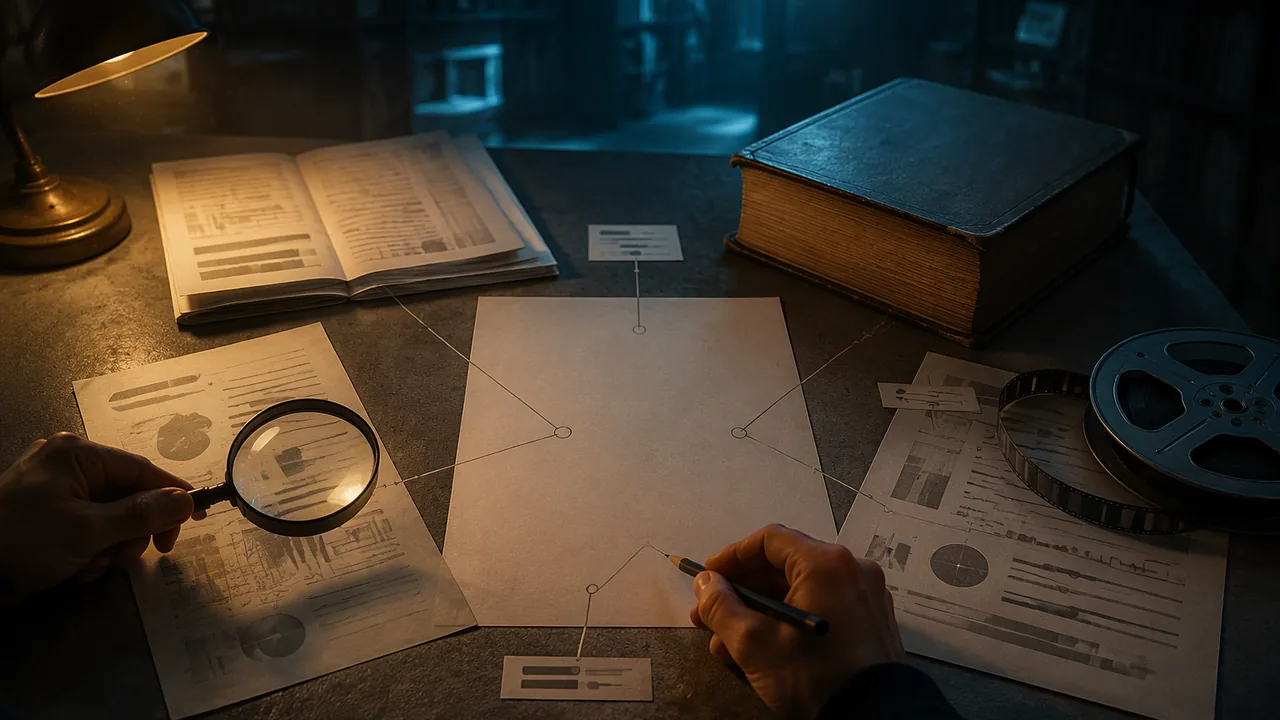
research a focused question about the war years or the 1920s, evaluate primary and secondary sources, and write and present a sourced historical argument.
Instruction
A research paper is the historian’s basic form: a question, an argument, and evidence someone else can check. This task asks you to do all of it yourself.
1. Ask a researchable question. A good question is focused, debatable and answerable from available sources. “What was the 1920s like?” is a topic. “Why did St. Louis voters approve a residential segregation ordinance in 1916, and what ended it?” is a question. Other possibilities: How did United States v. Thind affect Indian Americans? How did Black newspapers cover the Great Migration? How did the influenza pandemic change public health in one city? How did American films spread American culture abroad? Test your question against the sources: if you cannot find at least four primary sources for it, narrow or change it, and ask a parent, guardian or other reader whether it is clear.
2. Find sources. Primary: Chronicling America (Library of Congress) has digitized newspapers through 1963; HathiTrust and Project Gutenberg have books published before 1930; the U.S. Reports have court opinions; the National Archives has federal records. Secondary: OpenStax U.S. History for orientation, then scholarly books and articles through your library; JSTOR’s early journal content is free. You need at least eight sources, including four primary and two scholarly secondary.
3. Evaluate as you go. WHST.11-12.8 asks you to assess each source’s strengths and limitations for your question. A 1924 newspaper is excellent evidence of what its editors wanted readers to believe and weaker evidence of what actually happened. Write a two-to-three sentence annotation for each source as you read it; that becomes your annotated bibliography.
4. Find the conversation. Historians have already written about most subjects. Engage at least one historian’s interpretation: summarize it fairly, then say whether your evidence supports, qualifies or challenges it. That is what makes a paper an argument rather than a report.
5. Build the argument. Your thesis answers the question. Each section advances one part of it with evidence. Worked example of a thesis: “St. Louis voters approved the 1916 ordinance by about three to one because its backers presented it as a way to keep the peace rather than as an attack on Black residents; a ruling about a Louisville law, not any St. Louis decision, ended it, and the private covenants that followed show that its aim outlived the law.” That thesis is specific, arguable and testable against newspaper, court and city records.
6. Cite and integrate. Use Chicago-style footnotes. Quote only when the exact words matter; otherwise paraphrase and cite. Every quotation must be exact. WHST.11-12.6 asks you to use technology to produce and update your work; keep dated drafts so that you, or a parent, guardian or other reader, can see how the work changed. Follow your school’s policy on AI tools, and never let a tool invent a source or a quotation: check every citation against the source itself.
7. Present. In five minutes: your question, your thesis, your best piece of evidence, the historian you engaged, and what remains uncertain. Then take questions.
📖 Read for this lesson
The reading opens over the lesson; close it to come back to exactly where you were. The checks below draw on it.
Formative check
Work through these before moving on. They are not graded — they tell you whether the standard below has landed yet.
Which is a researchable historical question rather than a topic?
A 1924 newspaper editorial is strong evidence of what its editors wanted readers to believe, and weaker evidence of what actually happened.
How confident are you that you can research, write and present a sourced historical argument that engages a historian’s interpretation?
Unit 4 checkpoint
Do this before you start the task. It covers the whole unit and tells you what to review first.
What did the Zimmermann Telegram propose?
The Senate ratified the Treaty of Versailles and joined the League of Nations.
The Committee on Public ran wartime propaganda; the Espionage and Acts punished anti-war speech.
Which scandal involved leasing federal oil reserves for bribes?
Which film introduced synchronised dialogue to feature films?
Farm prices stayed depressed throughout the 1920s.
On which census did the 1924 Immigration Act base its quotas?
Marcus led the Universal Negro Improvement Association; the was founded in 1920 to defend civil liberties.
Which amendment repealed Prohibition?
Alice Paul’s National Woman’s Party picketed the White House from 1917.
Which writer published ‘How It Feels to Be Colored Me’ in 1928?
Which claim confuses sequence with cause?
Submit: Research proposal + annotated bibliography + paper (1,800-2,200 words) + 5-minute talk
Task: Answer a research question that your sources can support about the years 1914-1929 in a sourced historical argument that engages at least one historian’s interpretation.
Submission workflow
- Stage 1 — Proposal. Research question, why it matters, working thesis, and a working bibliography of at least eight sources (four primary, two scholarly secondary) with two-sentence annotations.
- Stage 2 — Self-reviewed draft. Full draft with footnotes; check (or ask a parent, guardian or other reader to check) that every claim is supported and every citation matches its source. Save a revision note.
- Stage 3 — Revised final. 1,800-2,200 words, Chicago-style footnotes and an annotated bibliography assessing each source’s strengths and limitations.
- Stage 4 — Talk. A five-minute recorded or live presentation followed by questions.
How it is scored
| Criterion | What proficient looks like |
|---|---|
| Research question and process (WHST.11-12.7) | Focused, debatable question answered through sustained research; inquiry narrowed or broadened as needed. |
| Source evaluation (WHST.11-12.8) | At least eight sources; strengths and limitations assessed; information integrated and cited without plagiarism. |
| Use of evidence (WHST.11-12.9, 9-12.AH.1.CC.C / 9-12.AH.1.CC.D) | Primary and secondary evidence analyzed to support the thesis; a historian’s interpretation engaged. |
| Historical accuracy (US.11.5) | Accurate and contextualised account of the period. |
| Writing process (WHST.11-12.6, WHST.11-12.10) | Drafts developed and revised over time using shared digital tools. |
| Presentation (SL.11-12.4) | Clear line of reasoning; thesis, evidence and uncertainty presented; questions answered. |
Three Research Dossiers: Sources and a Historian for Each
Research guidance written for this course, built on the official United States Reports, U.S. Census Bureau Working Paper No. 76, the Library of Congress Chronicling America collection, and public-domain studies published before 1930; Missouri sources: St. Louis Public Radio, ‘Living apart despite decades of court cases’ (2009) · SLS original
Why this reading. Lesson 4.5 asks for eight sources, four of them primary, on a question you choose, and then lists six possible questions without pointing at a single document for any of them. A research paper cannot start from a list of databases. This reading turns three of the lesson’s own suggested questions into working dossiers, each with named, checked, public-domain primary sources and a named historian to argue with. Choose one of the three, or use them as models and build a fourth. What to look for: in each dossier, the source that will disagree with your first hypothesis. Find it early. A paper that never met resistance is a report.
How to judge a source before you use it
WHST.11-12.8 asks for strengths and limitations for your question — not in general. The same document changes value depending on what you ask of it. A 1924 newspaper editorial is first-rate evidence of what an editor wanted readers to think that week, decent evidence of what was being argued about in that town, and weak evidence of what happened. Write every annotation in that form: strong evidence of X, weak evidence of Y.
Dossier A. Why did St. Louis voters approve a residential segregation ordinance in 1916, and what ended it?
Primary sources you can reach:
- Buchanan v. Warley, 245 U.S. 60 (1917), in the official United States Reports (govinfo.gov). The case was argued in 1916, reargued on 27 April 1917 and decided on 5 November 1917, and it concerned an ordinance of the City of Louisville, Kentucky. Read the whole opinion, then work out for yourself why a ruling about Louisville also took the force out of the St. Louis ordinance.
- Newspapers, 1915–1917. The St. Louis Argus, a Black weekly founded in 1912, is held on microfilm at the University of Missouri–St. Louis, and the St. Louis Genealogical Society reports scans of issues from 1915 through 1926 on the Internet Archive; check that the issues you need are there before you build the paper on them. Chronicling America may also hold Missouri papers of these years: search
loc.gov/collections/chronicling-america/for segregation ordinance and St. Louis, restricted to 1916. Two or three papers on opposite sides of the question is a complete primary base. - The reasons its supporters gave. St. Louis Public Radio reports that supporters justified the ordinance as “preserving peace, preventing conflict and ill feeling” between the races; find that language, or language like it, in the 1916 newspapers and decide whether it explains the vote or hides it.
- Census figures for St. Louis in 1910, 1920 and 1930 from Campbell Gibson and Kay Jung, Census Bureau Working Paper No. 76 (2005), Table 26: the Black population was 43,960 (6.4 per cent) in 1910, 69,854 (9.0 per cent) in 1920 and 93,580 (11.4 per cent) in 1930. These establish who was moving in while the ordinance was being argued.
- What came after. Shelley v. Kraemer, 334 U.S. 1 (1948), a St. Louis case that ended judicial enforcement of the racial covenants which spread after the ordinance lost its force.
- A historian to argue with. Colin Gordon, Mapping Decline: St. Louis and the Fate of the American City (University of Pennsylvania Press, 2008), traces the complicity of private real estate restrictions, local planning and zoning, and federal housing policy in the “white flight” of people and wealth from the central city (the publisher’s description). The book is in copyright, so read it through a library. Your 1916 evidence can support that, qualify it, or complicate it: was the ordinance an early case of the same pattern, or a different kind of event?
Dossier B. How did United States v. Thind change the lives of Indian Americans?
This question has an unusually clean documentary spine, because the law did the damage in public.
- United States v. Bhagat Singh Thind, 261 U.S. 204 (1923), in the official United States Reports. Read the whole opinion: the Court concedes that Thind is Caucasian by the anthropology of the day and holds that “white person” in the naturalization statute means what the common man understands by it. That move — abandoning the science it had just cited — is the heart of the case.
- Ozawa v. United States, 260 U.S. 178 (1922), decided three months earlier, which reached the same result by the opposite reasoning. The pair is the argument.
- State alien land laws of these years, which barred aliens ineligible to citizenship from owning agricultural land — so Thind did not only cancel naturalizations, it could take farms. Choose one state, find its session laws (state statutes of these years are public domain) and find out whether and how the law was enforced against Indian farmers.
- The Immigration Act of 1924, sections 13(c) and 28(c), in the reading for Lesson 4.3 — the clause that turned “ineligible to citizenship” into a bar at the border.
A historian to argue with. Ian Haney López, White by Law: The Legal Construction of Race (1996), argues that the prerequisite cases show courts inventing racial categories to fit the results they wanted. Test that against the two opinions themselves: does the Court look like it is reasoning, or like it is reaching?
Dossier C. How did Black newspapers cover the Great Migration?
This is the lesson’s own suggested question and the best supplied of the three.
- Chronicling America holds digitized Black newspapers of the period, including the Chicago Defender’s contemporaries. Search the collection by date range 1916–1920. Each page is a citable primary source with a full catalog record.
- The census table in the reading for Lesson 4.1, which gives you the size of the movement the papers were describing, from the Census Bureau’s own compilation.
- Emmett J. Scott, Negro Migration during the War (New York: Oxford University Press, 1920), a study written for the Carnegie Endowment that reprints migrants’ letters. Published before 1930 and in the public domain.
- The Chicago Commission on Race Relations, The Negro in Chicago: A Study of Race Relations and a Race Riot (1922) — the official report on the 1919 riot, with several hundred pages of interviews, housing data and press analysis. Public domain.
A historian to argue with. James R. Grossman, Land of Hope (1989), argues that migrants were not pushed passively but chose, and that the Black press was an active recruiter rather than a mirror. Scott’s 1920 letters and the Commission’s 1922 interviews let you test that against what migrants said at the time.
Where the public-domain rule bites, and what to do about it
Your four primary sources can and should be public-domain documents you can read in full. Your two scholarly secondary sources almost certainly cannot: modern historical scholarship is in copyright and sits behind a library. That is not a problem for the paper, because you are citing and arguing with a secondary source, not reproducing it. Three routes that work:
- JSTOR’s Early Journal Content — everything published before 1923 — is free to anyone. For all three dossiers above there is contemporary scholarship in it.
- Many university presses and journals post author manuscripts; a search for the author’s name plus the article title often finds one.
- A public library card usually carries remote access to at least one scholarly database. If it does not, a published book review of the historian’s work, which is short and often free, will let you state their argument fairly enough to engage it — as long as you say in the annotation that you read the review and not the book. Never cite a book you have not opened.
And the rule that matters most. Check every citation against the source itself. Two examples from this course of what happens when nobody does. The sentence “There can be no fifty-fifty Americanism in this country” is attributed to a Roosevelt letter of 3 January 1919 across hundreds of pages on the web; the letter, which you read in Lesson 2.3, does not contain it. The most widely circulated online transcription of Hurston’s 1928 essay, which you read in Lesson 4.4, prints “whose feelings are all but about it” where the magazine reads “all hurt about it.” Both errors are copied from site to site because nobody went back to the document. A single unchecked quotation can sink an otherwise good paper, and it is the one mistake a reader can always catch.
Sources: Chronicling America: historic American newspapers, Library of Congress (loc.gov); United States v. Bhagat Singh Thind, 261 U.S. 204 (1923), official U.S. Reports (tile.loc.gov); Ozawa v. United States, 260 U.S. 178 (1922), official U.S. Reports (tile.loc.gov); North American Review, March-May 1926 (vol. 223, no. 830), containing Hiram Wesley Evans, ‘The Klan’s Fight for Americanism’, Internet Archive (archive.org); Emmett J. Scott, Negro Migration during the War (1920), Internet Archive (archive.org); Chicago Commission on Race Relations, The Negro in Chicago (1922), Internet Archive (archive.org); JSTOR Early Journal Content (free, published before 1923) (jstor.org); Buchanan v. Warley, 245 U.S. 60 (1917), official U.S. Reports, govinfo.gov (govinfo.gov); Gibson and Jung, Working Paper No. 76 (2005), Table 26, Missouri, U.S. Census Bureau (census.gov); Living apart despite decades of court cases, St. Louis remains one of the most segregated cities, St. Louis Public Radio (2009) (stlpr.org); Colin Gordon, Mapping Decline (University of Pennsylvania Press, 2008), description, State Historical Society of Missouri shop (shop.shsmo.org)