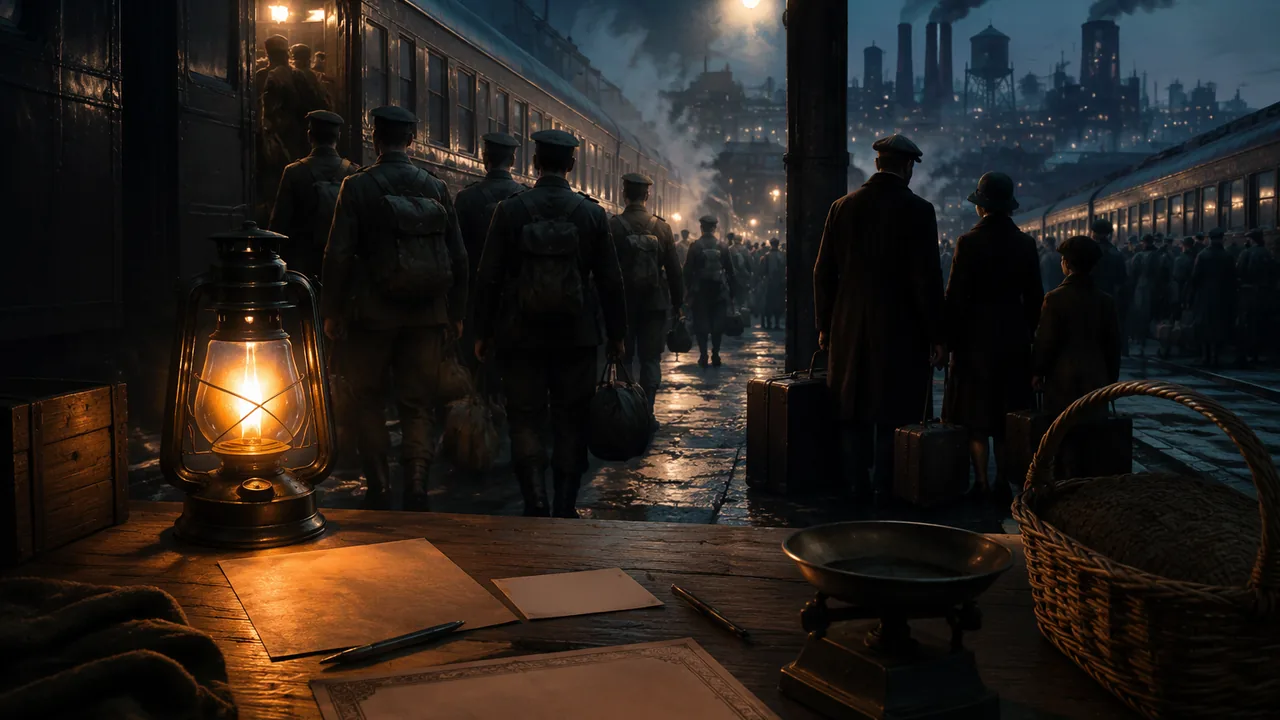
explain why the United States entered the First World War and analyze the war’s political, economic and social effects on the home front, including mobilization, civil liberties, the Great Migration and the peace settlement.
Instruction
The United States fought in the First World War for only nineteen months, but the war changed American government, the economy and the population in ways that lasted for decades.
From neutrality to war. When war broke out in Europe in 1914, Wilson declared neutrality, and many Americans — including millions of German and Irish Americans — wanted no part of it. Neutrality was hard to keep. American trade and loans flowed overwhelmingly to Britain and France, whose navy controlled the Atlantic. Germany answered with submarines. In May 1915 a U-boat sank the British liner Lusitania, killing nearly 1,200 people, 128 of them Americans. Germany pledged to restrict submarine attacks, then in early 1917 resumed unrestricted warfare against all ships in the war zone. The same winter, British intelligence intercepted the Zimmermann Telegram, in which Germany proposed that Mexico join the war and recover Texas, New Mexico and Arizona. Wilson asked for war on 2 April 1917, framing it as a fight for democracy. HI.2 asks you to weigh several causes — trade, submarines, the telegram, ideals — without pretending one explains everything.
Mobilizing a nation. The Selective Service Act (1917) drafted nearly three million men. Federal power grew rapidly: the War Industries Board directed production, the Food Administration under Herbert Hoover urged “meatless” and “wheatless” days, and Liberty Bond drives and new taxes paid the bill. The Committee on Public Information, led by George Creel, produced posters, films and speeches to build support — a modern propaganda campaign. About 116,000 Americans died in the war, roughly half of them from disease.
Liberty under strain. The Espionage Act (1917) and the Sedition Act (1918) punished interference with the draft and, under the second, “disloyal” language about the government. The socialist leader Eugene Debs was sentenced to ten years in prison for a speech against the war; he ran for president from his cell in 1920 and won nearly a million votes. In Schenck v. United States (1919) the Supreme Court upheld the conviction of a man who mailed anti-draft leaflets, announcing the “clear and present danger” test in the reading. German Americans faced suspicion and violence; schools dropped German classes, and in 1918 a German-born man, Robert Prager, was lynched by a mob in Illinois.
New workers, new places. The war cut off European immigration just as factories needed workers. Hundreds of thousands of Black Southerners moved north to Chicago, Detroit, New York and other cities in the first wave of the Great Migration, escaping Jim Crow and seeking industrial jobs. They met hostility as well as opportunity: a white mob killed dozens of Black residents of East St. Louis, Illinois, in July 1917. Women took jobs in factories, offices and transport, and served as nurses and in the Navy. Federal officials waived immigration restrictions to admit Mexican farm and railroad workers. Many Native Americans served, although many were not yet citizens.
Pandemic. In 1918 an influenza pandemic swept through camps, ships and cities. The Centers for Disease Control and Prevention estimates that about 675,000 Americans died.
The peace. Wilson’s Fourteen Points (January 1918) called for “open covenants of peace, openly arrived at,” freedom of the seas, national self-determination and a League of Nations. At Versailles he won the League but compromised on much else. The Senate, led by Henry Cabot Lodge, objected that Article X of the League Covenant could commit American troops without Congress’s consent, and it rejected the treaty. In 1919 strikes, race riots and bombings followed the armistice — the subject of Lesson 4.3.
Skill: point of view. RH.11-12.6 asks you to compare authors’ points of view. Wilson and Holmes both served democracy as they understood it. Ask of each: whose liberty is being protected, and from whom?
📖 Read for this lesson
The reading opens over the lesson; close it to come back to exactly where you were. The checks below draw on it.
Reading: Democracy abroad, dissent at home
Woodrow Wilson, Address to a Joint Session of Congress Requesting a Declaration of War (2 April 1917); Schenck v. United States, 249 U.S. 47 (1919), opinion of Justice Holmes · Public domain
Wilson asks Congress for war in the name of democracy. Two years later the Supreme Court decides how much dissent that war could tolerate. Read them as a pair.
Wilson (1917): The world must be made safe for democracy. Its peace must be planted upon the tested foundations of political liberty.
Schenck (1919): The most stringent protection of free speech would not protect a man in falsely shouting fire in a theatre and causing a panic… The question in every case is whether the words used are used in such circumstances and are of such a nature as to create a clear and present danger that they will bring about the substantive evils that Congress has a right to prevent.
Formative check
Work through these before moving on. They are not graded — they tell you whether the standard below has landed yet.
Which wartime law did Eugene Debs’s conviction for an anti-war speech fall under?
The sinking of the Lusitania in 1915 led the United States to declare war immediately.
Simulation & tools
Map the first Great Migration, 1910-1930
Build a five-slide StoryMapJS map of the first Great Migration. Slide 1: a Southern starting region (for example the Mississippi Delta). Slides 2-4: three destination cities (for example Chicago, Detroit and St. Louis). For each destination, record from the census tables in OpenStax U.S. History or the Census Bureau’s historical population reports the city’s Black population in 1910 and in 1930 (write the source beside each number), and add one public-domain image or newspaper page from the Library of Congress with its credit. Slide 5: the question — what pulled migrants to each city, and what did they meet when they arrived? No-tool route: mark the same places and numbers on a printed outline map of the United States and answer the question in a paragraph.
Open Knight Lab ↗ · Knight Lab, Northwestern University (TimelineJS, StoryMapJS) · MPL-2.0 open source
Complete the home-front chart with two political, two economic and two social effects of the war, each tied to a source. Then write 150-200 words comparing Wilson’s and Holmes’s points of view: whose liberty did each protect, and from whom?
How confident are you that you can explain why the United States entered the war and how the war changed the home front?
Practice
Work these on paper or in your notebook, then open Check your answer. Aim for all of Fluency and Application; try at least one Challenge.
Printable version: this unit’s practice workbook (PDF)
Fluency
Build speed and accuracy with the core skill.
- Order: Zimmermann Telegram published; sinking of the Lusitania; U.S. declaration of war; Schenck v. United States; Fourteen Points.
Check your answer
Answer: Lusitania (May 1915); Zimmermann Telegram (early 1917); declaration of war (April 1917); Fourteen Points (January 1918); Schenck (1919). - Use ‘Great Migration’ in a sentence that explains why it accelerated during the war.
Check your answer
Answer: Example: The war cut off European immigration just as factories needed workers, so the Great Migration of Black Southerners to Northern cities accelerated.
Application
Use the skill in context. Show your reasoning.
- Source Wilson’s line ‘The world must be made safe for democracy.’ When and to whom did he say it, and what was he asking for?
Check your answer
Answer: To a joint session of Congress on 2 April 1917, asking for a declaration of war against Germany. The phrase framed the war in universal democratic terms to win congressional and public support. - Holmes wrote in Schenck (1919) that speech may be punished if it creates ‘a clear and present danger.’ Compare his point of view with Wilson’s 1917 message. Whose liberty is each protecting, and from whom?
Check your answer
Answer: Model answer: Wilson presents the war as protecting democracy abroad from autocracy; Holmes protects the war effort at home from speech judged dangerous, limiting dissenters’ liberty. A strong answer quotes both, notes their shared wartime context, and recognizes that Holmes later narrowed his view in Abrams. - Germany resumed unrestricted submarine warfare in early 1917 and the United States declared war in April. Was the submarine campaign the only cause?
Check your answer
Answer: No. It was a major cause, but the Zimmermann Telegram, trade and loans tied to Britain and France, and Wilson’s ideals also mattered. A strong answer ranks causes and does not treat the last event before the declaration as the whole explanation.
Review
Keep earlier skills sharp.
- From Unit 3: which president’s diplomacy was called ‘Moral Diplomacy’, and which Mexican intervention tested it before the war?
Check your answer
Answer: Wilson’s; the occupation of Veracruz (1914) or the Pershing expedition (1916).
Two Statutes and a Census Table: Sources for the Home-Front Chart
Selective Service Act, 18 May 1917, 40 Stat. 76; Espionage Act section 3 as amended by the Act of 16 May 1918 (the Sedition Act), 40 Stat. 553; Campbell Gibson and Kay Jung, Historical Census Statistics on Population Totals By Race, 1790 to 1990 … For Large Cities And Other Urban Places In The United States, U.S. Census Bureau Population Division Working Paper No. 76 (February 2005), tables 14, 23, 26 and 33 · Public domain (U.S. government works)
Why this reading. Lesson 4.1 prints both texts you need for the Wilson-and-Holmes comparison, so that half is complete. Two other things it asks for are not in it. The home-front chart wants six effects of the war “each tied to a source,” and the only sources in the lesson are a war message and a court opinion. And the mapping activity sends you outside the lesson for the Black population of three cities in 1910 and 1930. This reading supplies both: the two statutes that produced most of the political and economic effects the mini-lecture describes, and the census table. What to look for: in the statutes, the exact words a prosecutor would have to prove. In the table, the difference between what a percentage tells you and what a number tells you.
Part 1. Two statutes for the home-front chart
The Selective Service Act, 18 May 1917 (40 Stat. 76)
Eleven days after Wilson’s war message, Congress gave him an army. The authorization is in the opening section:
That in view of the existing emergency, which demands the raising of troops in addition to those now available, the President be, and he is hereby, authorized—
… Third. To raise by draft as herein provided, organize and equip an additional force of five hundred thousand enlisted men, or such part or parts thereof as he may at any time deem necessary…
Five hundred thousand, and then as many more as the President thought necessary; nearly three million men were drafted before the armistice. This is a political effect with a source attached: for the first time since the Civil War, and this time without the substitutes and commutation that made the 1863 draft so hated, the federal government conscripted citizens directly.
The Espionage Act of 1917 as amended by the Sedition Act, 16 May 1918 (40 Stat. 553)
This is the law under which Debs was sentenced to ten years, and the one the quiz asks about. The amended section 3 reads, in part:
Whoever, when the United States is at war, shall willfully make or convey false reports or false statements with intent to interfere with the operation or success of the military or naval forces of the United States, or to promote the success of its enemies, or shall willfully make or convey false reports or false statements, or say or do anything except by way of bona fide and not disloyal advice to an investor or investors, with intent to obstruct the sale by the United States of bonds or other securities of the United States or the making of loans by or to the United States, and whoever, when the United States is at war, shall willfully cause or attempt to cause, or incite or attempt to incite, insubordination, disloyalty, mutiny, or refusal of duty, in the military or naval forces of the United States, or shall willfully obstruct or attempt to obstruct the recruiting or enlistment service of the United States, and whoever, when the United States is at war, shall willfully utter, print, write, or publish any disloyal, profane, scurrilous, or abusive language about the form of government of the United States, or the Constitution of the United States, or the military or naval forces of the United States, or the flag of the United States, or the uniform of the Army or Navy of the United States, or any language intended to bring [them] … into contempt, scorn, contumely, or disrepute…
(The emphasis is ours; the bracketed phrase replaces a repetition of the same five-item list.)
Three things to take from this for the chart.
- A political effect. The clause in bold at the end punishes language about the form of government and about a uniform. It does not require that anyone act on the words, or that the words be false, or that any harm follow. Compare that with the test Holmes announces in Schenck, printed in your lesson, and you have the whole civil-liberties question of 1917–1919 in two documents.
- An economic effect, in the same sentence. The clause in bold in the middle makes it a federal crime to discourage the purchase of war bonds. Congress financed the war largely by borrowing from the public through Liberty Loan drives, and it wrote that financing method into the criminal law. A statute is evidence of an economic policy as well as a political one; cite this clause and say what it tells you about how the war was paid for.
- Read what the exception protects. “Except by way of bona fide and not disloyal advice to an investor” — a stockbroker advising a client against war bonds is safe, provided he is loyal. Who decides that? The same problem as Mississippi’s understanding clause and the 1924 Act’s “ineligible to citizenship”: the statute delegates the judgment and says nothing about how it is to be made.
Part 2. Black and total population of four cities, 1910 and 1930
| City | Total 1910 | Black 1910 | Total 1930 | Black 1930 |
|---|---|---|---|---|
| New York | 4,766,883 | 91,709 (1.9%) | 6,930,446 | 327,706 (4.7%) |
| Chicago | 2,185,283 | 44,103 (2.0%) | 3,376,438 | 233,903 (6.9%) |
| Detroit | 465,766 | 5,741 (1.2%) | 1,568,662 | 120,066 (7.7%) |
| St. Louis | 687,029 | 43,960 (6.4%) | 821,960 | 93,580 (11.4%) |
All four rows are from Campbell Gibson and Kay Jung, Historical Census Statistics on Population Totals By Race, 1790 to 1990 … For Large Cities and Other Urban Places in the United States, U.S. Census Bureau Population Division Working Paper No. 76 (February 2005), state tables 14, 23, 26 and 33. The 2005 compilation heads the column “Black”; the 1910 and 1930 census volumes it draws on headed the same count “Negro.” Cite the working paper and the table number, not “the census.”
- Detroit is the extreme case. Its Black population rose from 5,741 to 120,066 — more than twenty times over — while the city itself grew from under half a million to over a million and a half. The car industry is in both numbers at once.
- Chicago and New York look alike in percentage and not in number. Chicago’s share rose from 2.0 to 6.9 per cent and New York’s from 1.9 to 4.7; but New York added about 236,000 Black residents and Chicago about 190,000. Argue from percentages alone and you will make Chicago look like the larger destination. It was not.
- St. Louis shows a different kind of destination. The city grew by only about a fifth — from 687,029 to 821,960 — while its Black population more than doubled, from 43,960 to 93,580. It began with a Black share (6.4 per cent) more than three times Chicago’s or New York’s, so its rise to 11.4 per cent is a smaller story in numbers than the percentages suggest: it added about 49,620 Black residents, roughly a quarter of Chicago’s gain. It is also the city where, in 1916, voters approved a residential segregation ordinance (Lesson 3.2), and where the East St. Louis violence of 1917 happened across the river.
- A percentage can rise because the numerator grows or the denominator shrinks. Here every denominator is growing fast, so every one of these rises is real growth and then some. Check that before you make the same claim about any other table.
For the map or the paper route, three of these cities plus one Southern starting region is enough. Put both numbers and the citation beside each city, then answer the second half of the question: what did migrants meet when they arrived? The mini-lecture gives you East St. Louis in 1917; Lesson 4.3 gives you Tulsa in 1921 and the 1919 summer that Claude McKay’s sonnet answers.
A note on the texts. Both statutes are quoted from the official United States Statutes at Large, volume 40, as digitized by the Government Publishing Office. Omissions are marked … and one bracketed phrase replaces a repeated list, as noted above.
Sources: Selective Service Act, 40 Stat. 76 (1917), United States Statutes at Large, govinfo.gov (govinfo.gov); Act of 16 May 1918 amending section 3 of the Espionage Act, 40 Stat. 553, govinfo.gov (govinfo.gov); Gibson and Jung, Working Paper No. 76 (2005), U.S. Census Bureau (census.gov); Working Paper No. 76: landing page and abstract (census.gov)