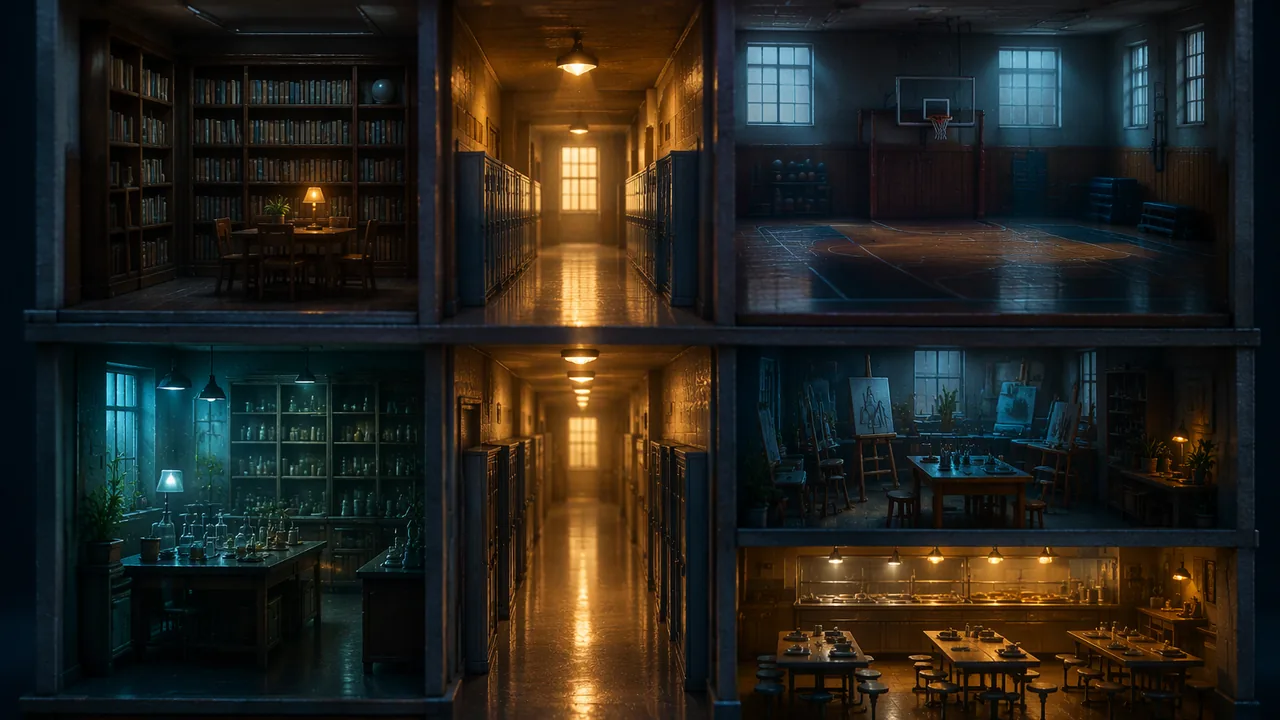
understand a short text about a student’s school day, name school subjects and places, and compare how school is organized in the United States and in Mexico.
Instruction
Reading at the Novice level is detective work. You will not know every word, and you do not need to. You need three habits: use what you already know, use cognates, and use the context.
Cognates are words that look alike and mean the same in two languages, because they share a Latin or Greek root: la biología, la historia, el arte, la música, la clase, el estudiante, la computadora. School vocabulary is full of them, which is why this unit is a good place to practice reading. Watch for false cognates, too: el colegio is usually a school (often a private one), not a college, and la librería is a bookshop, while a library is la biblioteca.
School subjects (las materias or las clases): las matemáticas, el inglés, el español, las ciencias, la biología, la química, la historia, el arte, la música, la educación física (P.E.). Places at school: el salón de clase (classroom; el aula in some countries), la biblioteca, la cafetería, el gimnasio, la oficina, el patio. People: el maestro / la maestra and el profesor / la profesora (teacher), el director / la directora (principal), el compañero / la compañera de clase (classmate).
A reading strategy you can use today. Before you read, look at the title and any picture, and predict five words you expect to see. Read once for the general idea, without stopping. Read a second time with a question in mind (When does she arrive? What is her favorite class?). Circle every word you understood and underline the cognates. You will be surprised how much you understand.
Culture: school in Mexico and Central America. The levels have different names: la primaria (grades 1-6), la secundaria (roughly grades 7-9 in Mexico), and la preparatoria (la prepa) or el bachillerato (roughly grades 10-12). Three differences students notice:
- Shifts. Many public schools in Mexico run two shifts in the same building: el turno matutino (morning) and el turno vespertino (afternoon). A student may go to school from 7:00 to 13:00, or from 14:00 to 20:00.
- The group stays together. In many schools a grupo of students stays in one classroom and the teachers move from room to room. In most U.S. high schools, it is the other way round.
- Uniforms are common in public and private schools.
These are general patterns, not rules for every school; schools differ between cities, states and countries, just as they do across Missouri and the United States. When you compare, say what you notice and what you would like to know, and avoid turning one school into a picture of a whole country.
Culture: Spanish in Missouri. Missouri recognizes students who master two languages. The Missouri Seal of Biliteracy, adopted by the Department of Elementary and Secondary Education (DESE) in October 2017, is awarded to graduating high school students in districts with a DESE-approved program who show achievement in English and another language. In 2018-19, 1,084 Missouri students earned it, in languages from Spanish and German to Swahili and Vietnamese (Missouri DESE). Spanish also has deep community roots in the state: in Kansas City, the Guadalupe Centers began on the Westside in 1919 as a volunteer school and clinic for Mexican immigrant families, and the organization still serves Latino families today (Guadalupe Centers). The Spanish you start now is the first step toward that level of skill.
📖 Read for this lesson
The reading opens over the lesson; close it to come back to exactly where you were. The checks below draw on it.
Formative check
Work through these before moving on. They are not graded — they tell you whether the standard below has landed yet.
Read Mariana’s description of her school day, then answer.
Me llamo Mariana y soy estudiante en una escuela secundaria de Kansas City. Llego a la escuela a las siete y media. Mi primera clase es matemáticas. Es difícil, pero la maestra es muy buena. A las diez tengo biología en el laboratorio. Mi clase favorita es arte, a la una. Después de las clases, estudio en la biblioteca con mis amigos. En la escuela hablo inglés y español.
Show transcript
Me llamo Mariana y soy estudiante en una escuela secundaria de Kansas City. Llego a la escuela a las siete y media. Mi primera clase es matemáticas. Es difícil, pero la maestra es muy buena. A las diez tengo biología en el laboratorio. Mi clase favorita es arte, a la una. Después de las clases, estudio en la biblioteca con mis amigos. En la escuela hablo inglés y español.
What time does Mariana arrive at school?
Where does she have biology?
What is her favorite class?
What does she do after school?
Match each school word to its meaning.
Listen. Which class is the speaker talking about?
Show transcript
Mi clase favorita es química. Es a las nueve, en el laboratorio.
In many public schools in Mexico, one group of students uses the building in the morning and a different group uses it in the afternoon.
How confident are you that you can understand a short text about a school day and compare school in the United States and Mexico?
Practice
Work these on paper or in your notebook, then open Check your answer. Aim for all of Fluency and Application; try at least one Challenge.
Printable version: this unit’s practice workbook (PDF)
Fluency
Build speed and accuracy with the core skill.
- Write the English meaning of each school subject: (a) las matemáticas; (b) las ciencias; (c) la química; (d) la educación física; (e) la historia.
Check your answer
Answer: (a) math; (b) science; (c) chemistry; (d) P.E.; (e) history.Most are cognates; educación física is P.E. - Write the Spanish word, with its article, for: (a) library; (b) classroom; (c) gym; (d) principal (a woman); (e) classmate (a boy).
Check your answer
Answer: (a) la biblioteca; (b) el salón de clase (or el aula in some countries); (c) el gimnasio; (d) la directora; (e) el compañero de clase.Watch the false cognate: la librería is a bookshop, not a library. - True or false? Explain each. (a) La librería is where you borrow library books. (b) El colegio is usually a school, not a college.
Check your answer
Answer: (a) False: la librería is a bookshop; a library is la biblioteca. (b) True: el colegio is usually a school, often a private one.These are false cognates: they look like English words but mean something else.
Application
Use the skill in context. Show your reasoning.
- Read: Me llamo Diego. Soy estudiante en una preparatoria de México. Tengo clases en el turno vespertino, de las dos a las ocho. Mi clase favorita es historia. El maestro de música es muy bueno. Answer in English: (a) What level of school is Diego in? (b) Which shift does he attend? (c) What is his favorite class?
Check your answer
Answer: (a) Preparatoria (prepa), roughly grades 10-12. (b) The afternoon shift (turno vespertino), from 2:00 to 8:00. (c) History.Use cognates (estudiante, historia, música) and the culture vocabulary from the lesson (preparatoria, turno vespertino). - List every cognate in this sentence and give its English meaning: Mi clase favorita es biología, en el laboratorio, y después estudio en la biblioteca con la computadora.
Check your answer
Answer: clase (class), favorita (favorite), biología (biology), laboratorio (laboratory), computadora (computer).Cognates share a Latin or Greek root. Underlining them is the reading habit the lesson teaches. - Name the three school differences the lesson says students often notice between many Mexican schools and most U.S. high schools.
Check your answer
Answer: 1) Many public schools run two shifts in one building (turno matutino and turno vespertino). 2) The grupo of students stays in one classroom and the teachers move. 3) Uniforms are common in public and private schools.The lesson adds that these are general patterns, not rules for every school. - A classmate says, “In Mexico every school has two shifts and everyone wears a uniform.” Rewrite the statement so it is accurate, using the lesson’s caution about comparisons.
Check your answer
Answer: Model: “Many public schools in Mexico run two shifts, and uniforms are common, but schools differ between cities, states and countries, just as they do across Missouri.”A strong answer replaces “every” and “everyone” with “many” or “common” and avoids turning one school into a picture of a whole country.
Challenge
Stretch problems. Expect to think before you write.
- Explain in two or three English sentences what the Missouri Seal of Biliteracy is, when DESE adopted it, and how many students earned it in 2018-19.
Check your answer
Answer: It is an award for graduating high school students in districts with a DESE-approved program who show achievement in English and another language. DESE adopted it in October 2017. In 2018-19, 1,084 Missouri students earned it, in languages from Spanish and German to Swahili and Vietnamese.A strong answer gives who awards it, who can earn it, the 2017 date and the 1,084 figure.
Review
Keep earlier skills sharp.
- Review (Lesson 1.3): write in Spanish how Mariana, a student in Kansas City, would say she is from Kansas City and is fifteen.
Check your answer
Answer: Soy de Kansas City y tengo quince años.Soy de for origin; tengo … años for age.
Un día en la escuela: César, en St. Louis
SLS original reading, written for Spanish 1A Lesson 2.1; RLP edition · SLS original
Un segundo estudiante describe su día, con cognados de las materias y los lugares de la escuela subrayados en tu lectura.
Un día en la escuela: César, en St. Louis
Me llamo César. Soy estudiante en una escuela secundaria de St. Louis. Llego a la escuela a las siete y media. Mi primera clase es inglés, en el salón doce. A las nueve tengo educación física, en el gimnasio. Mi clase favorita es música, a las once.
A la una, tengo el almuerzo en la cafetería con mis amigos. Después tengo ciencias, en el laboratorio, y arte, en el salón de arte. Estudio en la biblioteca los lunes y los miércoles.
En mi escuela hay un solo horario, de las siete y media a las tres. En muchas escuelas de México hay un turno matutino y un turno vespertino, así que no todos los estudiantes están en la escuela a la misma hora del día.