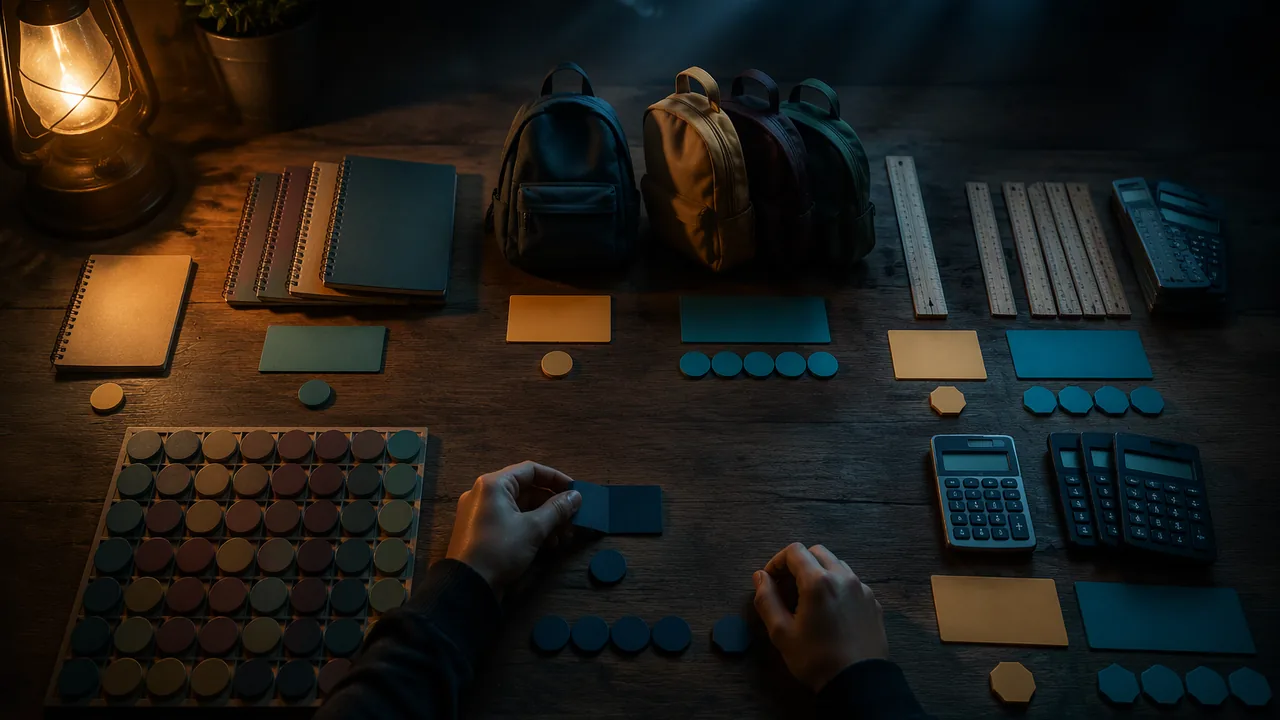
use the correct article with school nouns, make nouns plural, say what there is with hay, and count to one hundred.
Instruction
Every Spanish noun is either masculine or feminine. This is a grammar category, not a statement about the object: a notebook is not “male.” It matters because the words around the noun (articles and adjectives) change to match it.
Articles. Spanish has four words for the and four for a / some:
| masculine | feminine | |
|---|---|---|
| the (singular) | el cuaderno | la mochila |
| the (plural) | los cuadernos | las mochilas |
| a / an | un cuaderno | una mochila |
| some | unos cuadernos | unas mochilas |
Predicting gender. Most nouns ending in -o are masculine (el libro, el cuaderno) and most ending in -a are feminine (la regla, la calculadora). Nouns ending in -ción and -dad are feminine (la lección, la universidad). For other endings, learn the article with the word: el lápiz, el papel, la clase. There are famous exceptions: el día, el mapa, el problema, el programa are masculine; la mano is feminine. This is why you should always learn a noun with its article, never alone.
Plurals. Add -s after a vowel (libro → libros) and -es after a consonant (papel → papeles, profesor → profesores). A final z becomes c: lápiz → lápices. Some accents drop or appear because the stress rules from Unit 1 still apply: lección → lecciones.
Hay. Hay (said like English eye) means both there is and there are: Hay un mapa en la pared. Hay treinta libros en la biblioteca. Ask with ¿Cuántos … hay? for masculine nouns and ¿Cuántas … hay? for feminine ones: ¿Cuántas calculadoras hay? To say there are none: No hay libros.
Supplies, with regional words. The word for pen changes across the Spanish-speaking world: la pluma in Mexico, el bolígrafo in Spain and in many textbooks, el lapicero in Peru and parts of Central America, el esfero in Colombia. All of them are correct. The same happens with computer: la computadora in Mexico and most of Latin America, el computador in Chile and Colombia, el ordenador in Spain. When you meet a new word, ask where it is used.
Numbers to 100. treinta, cuarenta, cincuenta, sesenta, setenta, ochenta, noventa, cien. From 31 on, join with y as separate words: treinta y dos, cuarenta y cinco, noventa y nueve. Cien is exactly 100; for 101 and up it becomes ciento (ciento uno).
Comparing languages: borrowed words. English has taken many words from Spanish, often through the U.S. Southwest: patio, plaza, rodeo, canyon (from cañón), lasso (from lazo), mesa, ranch (from rancho). Spanish borrows from English too: many speakers say el email or el correo electrónico, el wifi and el fútbol. Borrowing shows two communities living side by side.
📖 Read for this lesson
The reading opens over the lesson; close it to come back to exactly where you were. The checks below draw on it.
Formative check
Work through these before moving on. They are not graded — they tell you whether the standard below has landed yet.
Match each school supply to its English meaning.
Say it in Spanish.
There are two pens and three notebooks in the backpack.
Listen and write the number in Spanish words.
Show transcript
cuarenta y cinco
How do I type á é í ó ú ñ ¿ ¡ ?
Long-press the vowel on a phone keyboard. On Windows use the US-International layout (apostrophe then the vowel); on a Mac hold Option+E then the vowel. You can also use the buttons below.
From 31 on, the tens and the units are separate words joined by y.
Build it: “There are thirty books and one calculator in the library.”
Type it instead
How confident are you that you can use the right article with school nouns, make plurals, use hay and count to 100?
Practice
Work these on paper or in your notebook, then open Check your answer. Aim for all of Fluency and Application; try at least one Challenge.
Printable version: this unit’s practice workbook (PDF)
Fluency
Build speed and accuracy with the core skill.
- Write the definite article (el, la, los, las) for each noun: (a) ____ cuaderno; (b) ____ calculadora; (c) ____ lección; (d) ____ lápices; (e) ____ mochilas.
Check your answer
Answer: (a) el; (b) la; (c) la; (d) los; (e) las.-o nouns are usually masculine, -a and -ción nouns feminine; plurals take los or las. - Write the plural of each noun with its article: (a) el libro; (b) el papel; (c) el lápiz; (d) la lección; (e) el profesor.
Check your answer
Answer: (a) los libros; (b) los papeles; (c) los lápices; (d) las lecciones; (e) los profesores.Add -s after a vowel and -es after a consonant; z becomes c (lápices); lección loses its accent in lecciones because the stress rule now predicts it. - Write each number in Spanish words: (a) 45; (b) 60; (c) 72; (d) 99; (e) 100.
Check your answer
Answer: (a) cuarenta y cinco; (b) sesenta; (c) setenta y dos; (d) noventa y nueve; (e) cien.From 31 on, the tens and units are separate words joined by y. Cien is exactly 100.
Application
Use the skill in context. Show your reasoning.
- Each noun is an exception to the -o / -a pattern. Write the correct article: (a) ____ día; (b) ____ mapa; (c) ____ problema; (d) ____ mano.
Check your answer
Answer: (a) el día; (b) el mapa; (c) el problema; (d) la mano.Día, mapa, problema and programa are masculine; mano is feminine. Learn each noun with its article. - Translate into Spanish: (a) There is a map on the wall. (b) There are forty-five students in the gym. (c) There are no calculators.
Check your answer
Answer: (a) Hay un mapa en la pared. (b) Hay cuarenta y cinco estudiantes en el gimnasio. (c) No hay calculadoras.Hay means both there is and there are; no hay says there are none. - Write the question with ¿Cuántos…? or ¿Cuántas…?: (a) How many rulers are there? (b) How many notebooks are there?
Check your answer
Answer: (a) ¿Cuántas reglas hay? (b) ¿Cuántos cuadernos hay?Cuántas matches feminine nouns (la regla), cuántos masculine ones (el cuaderno). - A student in Mexico, one in Spain and one in Colombia each ask for a pen. Write the word each would most likely use, with its article.
Check your answer
Answer: Mexico: la pluma. Spain: el bolígrafo. Colombia: el esfero.All are correct. The lesson also lists el lapicero (Peru and parts of Central America). - Count the supplies in this list and write one Spanish sentence with hay for each item: 3 notebooks, 1 backpack, 2 pencils, 50 sheets of paper. Then add: how many items are there in all? Write the total in Spanish.
Check your answer
Answer: Hay tres cuadernos. Hay una mochila. Hay dos lápices. Hay cincuenta papeles. Total: 3 + 1 + 2 + 50 = 56, cincuenta y seis.Use una with the feminine mochila; lápiz becomes lápices; 56 is cincuenta y seis.
Challenge
Stretch problems. Expect to think before you write.
- English borrowed many words from Spanish. Give the Spanish source word for canyon, lasso and ranch, and name one word Spanish speakers have borrowed from English.
Check your answer
Answer: cañón, lazo, rancho. Spanish borrowings from English include el email, el wifi and el fútbol.The lesson says borrowing shows two communities living side by side.
Review
Keep earlier skills sharp.
- Review (Lesson 1.2): write in Spanish words: (a) the number 31; (b) the date 23/10.
Check your answer
Answer: (a) treinta y uno; (b) el veintitrés de octubre.Treinta y uno is three words. Dates put the day first; veintitrés carries an accent because the stress falls on the last syllable of a word ending in s.
¿Qué hay en la mochila?
SLS original reading, written for Spanish 1A Lesson 2.2 · SLS original
Un inventario de dos mochilas, con artículos, género y hay, más los números hasta cien.
¿Qué hay en la mochila?
Hay una mochila azul en el salón de clase. Dentro de la mochila hay tres cuadernos, dos lápices, una calculadora y una regla. También hay una pluma y veinte hojas de papel. No hay libros en la mochila hoy.
En la otra mochila hay cuarenta y cinco lápices de colores, porque es la mochila de la clase de arte. Hay quince estudiantes en la clase de arte, y cada estudiante necesita tres lápices de colores.
—¿Cuántos cuadernos hay en tu mochila?
— Hay dos cuadernos y una calculadora.
—¿Cuántas plumas hay?
— No hay plumas. Solo hay un lápiz.
En total, hay cinco mochilas en el salón de clase hoy, y cada mochila tiene cosas diferentes dentro.