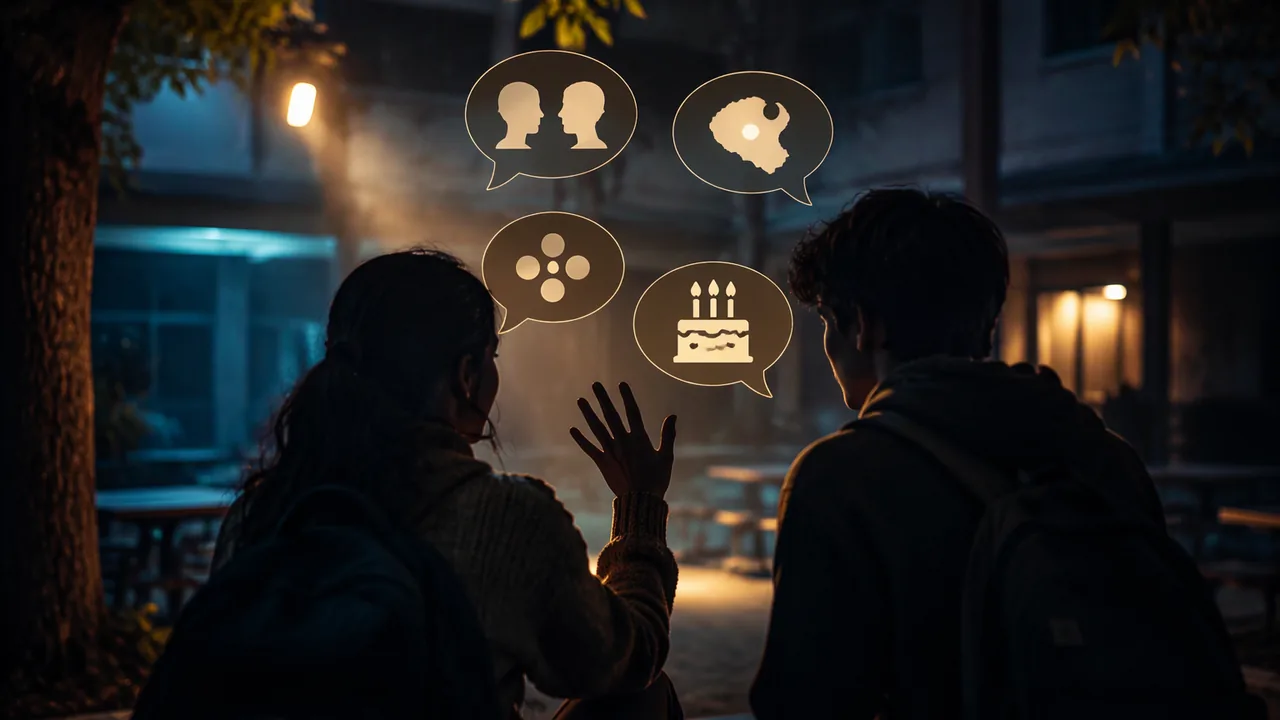
ask and answer questions about name, origin, age and birthday, and use a strategy to keep the conversation going when I do not understand.
Instruction
An introduction in Spanish is a short, predictable script. Once you have its four moves, you can hold a real conversation today, and in the interpersonal mode that is the goal: two people exchanging information they did not know before, without a written script in hand.
Move 1: names.
- ¿Cómo te llamas? (tú) / ¿Cómo se llama usted? (usted): What is your name?
- Me llamo Daniela. or Soy Daniela. Both mean “I’m Daniela.” Mi nombre es Daniela is also correct but sounds a little more formal.
- Mucho gusto. (Nice to meet you.) A man may also say encantado, a woman encantada. The answer is Igualmente (likewise) or El gusto es mío (the pleasure is mine).
Move 2: origin. ¿De dónde eres? / ¿De dónde es usted? Answer with soy de and a place: Soy de Kansas City. Soy de Oaxaca, pero vivo en St. Louis. (I’m from Oaxaca, but I live in St. Louis.) You may answer with your city, your family’s hometown, or both. Many people do.
Move 3: age. Spanish uses tener (to have) for age: you have years. ¿Cuántos años tienes? (How old are you?) Tengo quince años. (I’m fifteen.) Saying soy quince is a common beginner mistake; it sounds like “I am the number fifteen.” With usted: ¿Cuántos años tiene usted? Many people consider asking an adult’s age impolite, so keep this question for people your own age.
Move 4: birthday. ¿Cuándo es tu cumpleaños? Es el ocho de junio.
The small words that hold it together. Question words carry accents and open with ¿: ¿Cómo? (how), ¿De dónde? (from where), ¿Cuántos? (how many), ¿Cuándo? (when). Answer, then ask back: Tengo catorce años. ¿Y tú? Asking back is what turns a quiz into a conversation.
When you do not understand. Every speaker, including native speakers, needs these. Use them in Spanish instead of switching to English:
- ¿Cómo? or ¿Perdón?: Sorry? What?
- Más despacio, por favor.: More slowly, please.
- ¿Puedes repetir, por favor? / ¿Puede repetir? (usted): Can you repeat?
- ¿Cómo se dice “locker” en español?: How do you say “locker” in Spanish?
- No entiendo.: I don’t understand.
A model exchange. Read it aloud, playing both parts, then close the text and do it with your own information.
— Hola, ¿cómo te llamas?
— Me llamo Tomás. ¿Y tú?
— Soy Lucía. Mucho gusto.
— Igualmente. ¿De dónde eres?
— Soy de Columbia. ¿Y tú?
— Soy de Sedalia, pero mi familia es de Michoacán.
— ¿Cuántos años tienes?
— ¿Perdón? Más despacio, por favor.
— ¿Cuán-tos a-ños tie-nes?
— ¡Ah! Tengo quince años.
Your choice about personal information. You never have to share your real birthday, age or family origin. You may use one of these invented identities for any part of this lab: Sofía Torres, de Springfield, quince años, cumpleaños el tres de marzo, or Mateo Ruiz, de Joplin, catorce años, cumpleaños el veinte de octubre. The grade is for the Spanish, not for the facts.
Doing this lab on your own. The course itself plays the other speaker. Use this prompt card: 1. Hola, ¿cómo te llamas? 2. ¿De dónde eres? 3. ¿Cuántos años tienes? 4. ¿Cuándo es tu cumpleaños? Write each question on a slip of paper, shuffle the slips, and turn them over one at a time. Read the question aloud, answer it aloud without notes, and ask it back (¿Y tú?). Record yourself; a phone voice memo is fine. For a second take, play both roles: answer as yourself, then as Itzel or Andrés from the conversation in this lesson’s checks. If a family member or another adult you know is willing, they can read you the English card (What’s your name? Where are you from? How old are you? When is your birthday?) in any order while you ask and answer in Spanish. Finish by filling in an information grid (name, origin, age, birthday) for Tomás, Lucía, Itzel and Andrés from this lesson’s conversations.
📖 Read for this lesson
The reading opens over the lesson; close it to come back to exactly where you were. The checks below draw on it.
Formative check
Work through these before moving on. They are not graded — they tell you whether the standard below has landed yet.
Listen to the question. Which answer fits?
Show transcript
¿Cuántos años tienes?
Build the question you would ask someone your age you have just met: “Where are you from?”
Type it instead
Say it in Spanish.
I’m from St. Louis and I’m fifteen years old.
Read the conversation, then answer.
— Buenas tardes. ¿Cómo te llamas?
— Me llamo Itzel. ¿Y tú?
— Soy Andrés. Mucho gusto.
— Igualmente. ¿De dónde eres, Andrés?
— Soy de Springfield. ¿Y tú?
— Soy de Kansas City, pero mi familia es de Guatemala.
— ¿Cuándo es tu cumpleaños?
— Es el treinta de enero.
Show transcript
— Buenas tardes. ¿Cómo te llamas? — Me llamo Itzel. ¿Y tú? — Soy Andrés. Mucho gusto. — Igualmente. ¿De dónde eres, Andrés? — Soy de Springfield. ¿Y tú? — Soy de Kansas City, pero mi familia es de Guatemala. — ¿Cuándo es tu cumpleaños? — Es el treinta de enero.
Where is Itzel’s family from?
Whose birthday is January 30?
What time of day is it?
How confident are you that you can ask and answer questions about name, origin, age and birthday, and keep going when I don’t understand?
Practice
Work these on paper or in your notebook, then open Check your answer. Aim for all of Fluency and Application; try at least one Challenge.
Printable version: this unit’s practice workbook (PDF)
Fluency
Build speed and accuracy with the core skill.
- Match each question to its answer: (1) ¿Cómo te llamas? (2) ¿De dónde eres? (3) ¿Cuántos años tienes? (4) ¿Cuándo es tu cumpleaños? — (a) Tengo catorce años. (b) Es el ocho de junio. (c) Me llamo Daniela. (d) Soy de Columbia.
Check your answer
Answer: 1-c, 2-d, 3-a, 4-b.Cómo te llamas asks the name, de dónde the origin, cuántos años the age (answered with tener), cuándo the date. - Write the usted form of each question: (a) ¿Cómo te llamas? (b) ¿De dónde eres?
Check your answer
Answer: (a) ¿Cómo se llama usted? (b) ¿De dónde es usted?The verb changes with the register: te llamas becomes se llama usted, eres becomes es usted. - Write the Spanish for each repair phrase: (a) More slowly, please. (b) I don’t understand. (c) How do you say “locker” in Spanish?
Check your answer
Answer: (a) Más despacio, por favor. (b) No entiendo. (c) ¿Cómo se dice “locker” en español?These keep a conversation going in Spanish instead of switching to English.
Application
Use the skill in context. Show your reasoning.
- A student writes Soy quince años. Correct the sentence and explain the mistake.
Check your answer
Answer: Tengo quince años. Spanish uses tener (to have) for age; soy quince sounds like “I am the number fifteen.”Age is something you “have” in Spanish: tengo … años. - Translate into Spanish: “I’m from Oaxaca, but I live in St. Louis.”
Check your answer
Answer: Soy de Oaxaca, pero vivo en St. Louis (or San Luis).Soy de + place gives origin; pero joins the contrast. Vivo en (I live in) is the phrase the lesson models. - Use the invented identity from the lesson, Mateo Ruiz, de Joplin, catorce años, cumpleaños el veinte de octubre, to write Mateo’s four answers to the prompt-card questions.
Check your answer
Answer: Me llamo Mateo Ruiz (or Soy Mateo Ruiz). Soy de Joplin. Tengo catorce años. Mi cumpleaños es el veinte de octubre (or Es el veinte de octubre).One sentence per move: name, origin (soy de), age (tengo … años), birthday (es el + day + de + month). - Write a six-line conversation in Spanish between two invented teenagers, Ana and Luis, who meet for the first time. Include names, mucho gusto with its reply, origin, one repair phrase, and age.
Check your answer
Answer: Model: — Hola, ¿cómo te llamas? — Me llamo Luis. ¿Y tú? — Soy Ana. Mucho gusto. — Igualmente. ¿De dónde eres? — Soy de Springfield. ¿Cuántos años tienes? — ¿Perdón? Más despacio, por favor. — ¿Cuántos años tienes? — Tengo quince años. ¿Y tú?A strong answer uses tú forms throughout (same age), answers and asks back (¿Y tú?), answers mucho gusto with igualmente or el gusto es mío, and uses tengo for age.
Challenge
Stretch problems. Expect to think before you write.
- You are introduced to your friend’s aunt. Explain in English why you would not ask her ¿Cuántos años tiene usted?, and write two questions you could ask her instead.
Check your answer
Answer: Many people consider asking an adult’s age impolite, so the lesson says to keep that question for people your own age. Instead: ¿Cómo se llama usted? and ¿De dónde es usted?A strong answer gives the politeness reason and uses usted forms for both questions.
Review
Keep earlier skills sharp.
- Review (Lesson 1.2): write in Spanish words the birthday of Itzel from this lesson’s conversation, January 30, and of the invented student Sofía Torres, March 3.
Check your answer
Answer: el treinta de enero; el tres de marzo.Day first, then de, then the month in lower case.
Dos conversaciones nuevas
SLS original dialogue, written for Spanish 1A Lesson 1.3; RLP edition · SLS original
Dos primeras conversaciones: una entre estudiantes nuevos en la feria de clubes, y una con una maestra que Rubén no conoce.
Dos conversaciones nuevas
En la feria de clubes.
— Hola, ¿cómo te llamas?
— Me llamo Brenda. ¿Y tú?
— Soy Iván. Mucho gusto.
— Igualmente. ¿De dónde eres?
— Soy de Columbia, pero mi familia es de Jalisco. ¿Y tú?
— Soy de Joplin. ¿Cuántos años tienes?
— Tengo catorce años. ¿Y tú?
— Tengo quince años.
En el pasillo.
— Buenas tardes, ¿cómo se llama usted?
— Me llamo la señora Ibarra. Soy maestra de español. ¿Y tú, cómo te llamas?
— Me llamo Rubén.
— Mucho gusto, Rubén. ¿De dónde eres?
— Soy de Sedalia.
— ¿Cuándo es tu cumpleaños?
— ¿Perdón? Más despacio, por favor.
— ¿Cuán-do es tu cum-plea-ños?
— ¡Ah! Es el nueve de mayo.
Brenda e Iván son estudiantes nuevos, así que usan tú entre ellos. La señora Ibarra es maestra, así que Rubén usa usted con ella.