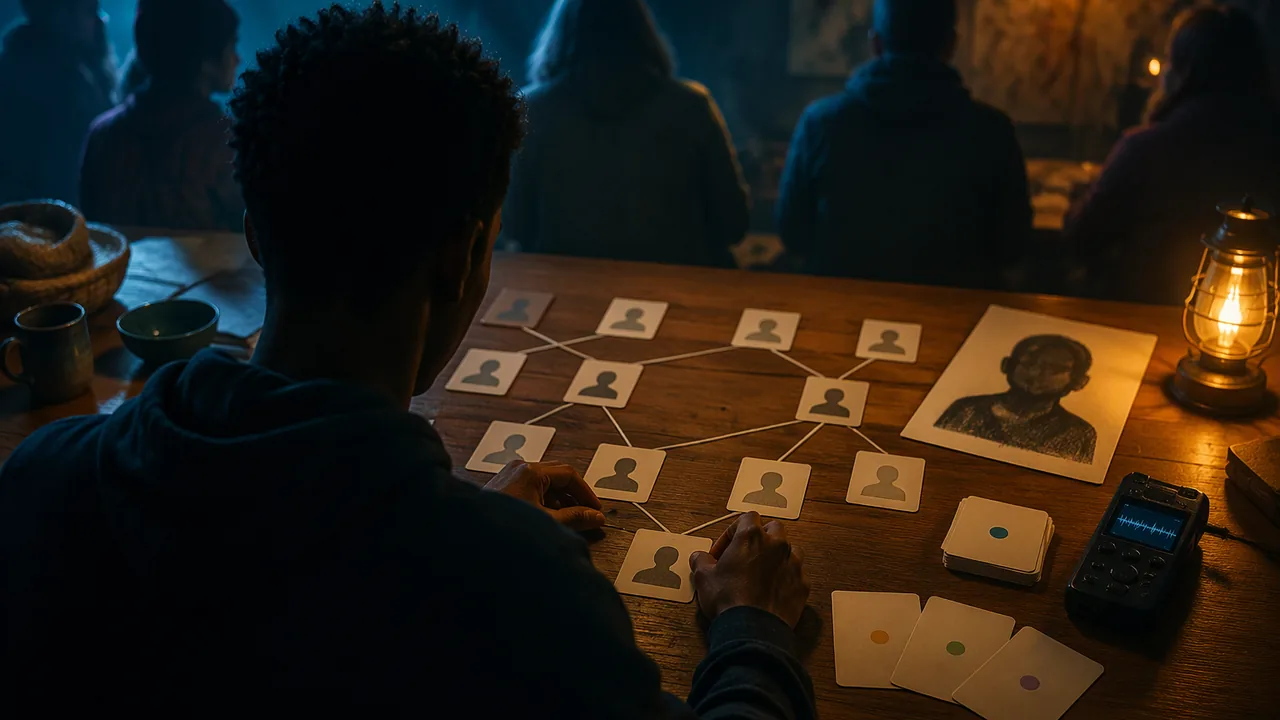
understand an unseen description of a family and friends, hold a recorded conversation about the people in our lives, and present a portrait of a person who matters.
Instruction
The theme of this IPA is mi gente, my people: the family, friends and community members who shape who we are. The three tasks connect: you read about someone else’s people, you talk about yours, and you present one person.
Task 1: Interpretive. You will read a blog post in which a student in St. Louis describes her family and her best friend, and listen to a short description. Draw a quick tree as you read, as you did in Lesson 3.1. Watch possessives (mi, su, nuestro) to see whose relative is whose, and use adjective endings as clues: simpática describes a woman or girl, simpáticos a group. Questions ask about relationships, ages and traits, and one asks you to infer something the text does not say directly.
Task 2: Interpersonal. Record a conversation about your family or friend group, or about a family from a TV series or one you invent. Use this prompt card, in any order: ¿Cuántas personas hay en tu familia? ¿Tienes hermanos? ¿Cómo se llama tu…? ¿Cómo es? ¿Cuántos años tiene? ¿Tienen mascotas? ¿Dónde viven tus abuelos? Shuffle the questions so you do not know which comes next, read each one aloud, pause, and answer it. React with ¡Qué bien! or ¿De verdad? and ask and answer at least one follow-up question of your own. You may play both roles. If a family member or another adult you know is willing, they can ask the questions from an English version of the card while you answer in Spanish, and then you ask them the questions in Spanish; they may answer in English, and you sum up their answers in Spanish.
Task 3: Presentational. Create a portrait of a person who matters to you, or of a public figure from a Spanish-speaking community: a poster, a slide or a short video with an image or a sketch. Write at least eight sentences using the four layers from Lesson 3.4: identity, appearance, personality and actions. Include at least one sentence explaining why the person matters, with porque.
Scoring focus. Agreement is the grammar focus of this unit, so the language-control row looks closely at adjective and possessive endings. A Novice Mid portrait is a list of accurate simple sentences; a Novice High portrait connects them, adds detail and reads as a description of a real person rather than a form.
Heritage and home speakers. Extend the portrait to twelve sentences, including a short anecdote in the present tense (Los sábados, mi abuelo y yo…), and a paragraph comparing how your family uses tú, usted or vos with different relatives. Use your family’s own words for relatives and endearments.
Privacy. You never have to share real family details. A public figure, an invented person or a fictional character is always an equal-credit choice.
📖 Read for this lesson
The reading opens over the lesson; close it to come back to exactly where you were. The checks below draw on it.
Formative check
Work through these before moving on. They are not graded — they tell you whether the standard below has landed yet.
Interpretive task, part A. Read Daniela’s blog post, then answer.
Mi gente
¡Hola! Soy Daniela y vivo en St. Louis con mi mamá, mi padrastro y mis dos hermanos menores. Mi mamá se llama Gloria; es enfermera y trabaja mucho. Mi padrastro, Rubén, es muy cómico y cocina los domingos. Mis hermanos son gemelos: tienen diez años y son muy activos. Mi mejor amiga se llama Kimberly. Su familia es de El Salvador. Kimberly es alta, tiene el pelo largo y rizado y es muy inteligente. Nosotras estudiamos juntas todos los días. Mis abuelos viven en Michoacán, pero hablamos por video los sábados.
Show transcript
Mi gente ¡Hola! Soy Daniela y vivo en St. Louis con mi mamá, mi padrastro y mis dos hermanos menores. Mi mamá se llama Gloria; es enfermera y trabaja mucho. Mi padrastro, Rubén, es muy cómico y cocina los domingos. Mis hermanos son gemelos: tienen diez años y son muy activos. Mi mejor amiga se llama Kimberly. Su familia es de El Salvador. Kimberly es alta, tiene el pelo largo y rizado y es muy inteligente. Nosotras estudiamos juntas todos los días. Mis abuelos viven en Michoacán, pero hablamos por video los sábados.
Who cooks on Sundays?
How old are Daniela’s brothers?
Where is Kimberly’s family from?
What can you infer about Daniela’s grandparents?
Interpretive task, part B. Listen. How does Martín describe his sister?
Show transcript
Mi hermana Paola es baja, tiene el pelo corto y es muy extrovertida y generosa.
Presentational planning. Fill in your four layers in Spanish (identity, appearance, personality, actions) for your chosen person, and write your porque sentence.
How confident are you that you can understand a family description, talk about the people in my life and present a portrait in Spanish?
Unit 3 checkpoint
Do this before you start the task. It covers the whole unit and tells you what to review first.
What does los parientes mean?
In the name Rosa López García, García is usually the surname from Rosa’s mother.
In many Mexican and Central American families, godparents are called los .
Which language does the lesson describe as an Indigenous language of Oaxaca, Puebla and Guerrero?
Complete: Mis primas son ____.
In Spanish, descriptive adjectives usually come before the noun: un simpático amigo.
Spanish uses tener for hair and eyes: Mi tía los ojos verdes.
Which is correct?
In 1993, who became the first Hispanic woman to go to space?
Join with “because”: Es mi persona favorita es muy generosa.
Chicano Park in San Diego’s Barrio Logan was founded in 1970 and became a National Historic Landmark in 2016.
Submit: IPA Mi gente (interpretive answers, conversation, illustrated portrait)
Theme: the people in our lives.
Interpretive. Read Daniela’s blog post (in the lesson checks) and listen to the description; answer the questions, including one inference.
Interpersonal. Two to three minutes, recorded: answer at least five questions from the prompt card, use two reactions, and ask and answer one follow-up of your own. Play both roles, or a willing family member reads the English prompt card. Real, TV or invented family: your choice.
Presentational. An illustrated portrait (poster, slide or short video) with at least eight sentences: identity, appearance, personality, actions and why the person matters.
Heritage-speaker extension: twelve sentences with a present-tense anecdote, and a paragraph on tú, usted or vos in your family.
Submission workflow
- Stage 1: Plan. A four-layer planning grid (identity, appearance, personality, actions) with the Spanish for each, plus the image or sketch you will use.
- Stage 2: Self-checked draft. Write the portrait. Circle each adjective and check its agreement, underline each verb and check its subject, and add one connector (y, pero, también, porque). A family member may help by circling every adjective for you to check. Submit the draft with your checking marks.
- Stage 3: Revised final. Revise and add one sentence that connects two ideas.
- Stage 4: Presentation. Record the portrait (audio or video), or submit it as an illustrated poster or slide with the text; a family member may watch or read it. End with one question in Spanish for your audience. Both routes earn equal credit.
How it is scored
| Criterion | What proficient looks like |
|---|---|
| Interpretive (WL.1.2a.I / WL.1.2b.I) | Novice Mid: identifies relationships, ages and traits in an unseen text. Novice High: also makes a supported inference and uses agreement as a clue. |
| Interpersonal (WL.1.1a.I / WL.1.1b.I / WL.1.1c.I / WL.1.1d.I / WL.1.1e.I) | Novice Mid: asks and answers questions about a family with memorized patterns. Novice High: reacts naturally, asks follow-ups and sustains the exchange. |
| Presentational (WL.1.3a.I / WL.1.3b.I) | Novice Mid: eight understandable sentences across the four layers. Novice High: connected sentences with detail and a reason with porque. |
| Language control (WL.1.3a.I) | Adjective and possessive agreement, forms of ser and tener; errors do not block meaning. |
| Culture (WL.2.1b.I / WL.2.2b.I / WL.4.2a.I) | Uses family terms, names and, where chosen, cultural references (padrinos, surnames, murals) accurately and without stereotype. |
Mi gente: el blog de Yaretzi
SLS original reading, written for the RLP Spanish 1A Unit 3 Integrated Performance Assessment · SLS original
Un segundo blog de práctica sobre la familia y los amigos, antes de la evaluación integrada.
Mi gente: el blog de Yaretzi
¡Hola! Soy Yaretzi y vivo en Springfield, Missouri, con mi mamá, mi abuelo y mi hermano mayor. Mi mamá se llama Rosario; es enfermera y trabaja mucho. Mi abuelo se llama Efraín; es mayor, pero es muy activo y trabajador. Mi hermano Diego tiene diecinueve años y es muy paciente y amable.
Mi mejor amiga se llama Fátima. Su familia es de Guatemala. Fátima es alta, tiene el pelo largo y rizado, y es muy inteligente y generosa. Nosotras estudiamos juntas todos los días después de las clases.
Mis padrinos, mi tío Ismael y mi tía Yolanda, viven en Sedalia. Mis primos favoritos, Kevin y Emily, son cómicos y muy simpáticos.
Los fines de semana, Yaretzi y Fátima estudian en la biblioteca y a veces cocinan juntas en la casa de la abuela de Yaretzi.