derive conservation of momentum from Newton’s third law, distinguish elastic from inelastic collisions by kinetic energy, apply component conservation to a two-dimensional collision, and argue from my lab data whether momentum was conserved.
Instruction
Why momentum is conserved: Newton’s third law
During a collision, cart A pushes on cart B with force FA on B, and B pushes back on A with FB on A. Newton’s third law says these are equal in size and opposite in direction at every instant: FB on A = −FA on B. The two forces also act for exactly the same time Δt, because they exist only while the carts touch. Multiply each by Δt and use impulse = Δp:
ΔpA = FB on AΔt = −FA on BΔt = −ΔpB, so ΔpA + ΔpB = 0.
Whatever momentum A loses, B gains. The total cannot change unless something outside the two carts exerts a net force. This is the argument you will defend: conservation of momentum is not a separate rule, it follows from the third law (and second law) applied to a system.
Where did the “lost” momentum go?
Your lab totals were rarely identical. External forces explain part of it. Suppose rolling friction on a cart is about 0.05 N (illustrative) and you measured its velocity 0.5 s before the collision instead of just before. Friction delivered an impulse of 0.05 × 0.5 = 0.025 N·s, which is 7.6% of the 0.328 kg·m/s in the sticking trial. The collision itself lasts only milliseconds, so friction does little during contact; it matters in the time between your measurements and the collision. A tilted track (gravity has a component along it) and a cart scraping a wall are other external forces.
Elastic and inelastic collisions
Momentum is conserved in every collision of an isolated system. Kinetic energy, KE = ½mv2, is not. An elastic collision keeps total kinetic energy; an inelastic one converts some into thermal energy, sound and permanent deformation; a perfectly inelastic collision is one where the objects stick.
- Illustrative sticking trial: KE before = ½ × 0.512 × 0.642 = 0.1049 J; after = ½ × 1.010 × 0.322 = 0.0517 J. About 51% of the kinetic energy is gone, while momentum changed by only 1.4%. When the target starts at rest and they stick, theory predicts the fraction kept is mA/(mA + mB) = 51%.
- Illustrative bouncing trial: KE before 0.0922 J, after 0.0839 J, so 91% was kept: nearly elastic.
For two equal masses in a perfectly elastic head-on collision with one at rest, the moving object stops and the target leaves with its full velocity (think of a Newton’s cradle).
Collisions in two dimensions
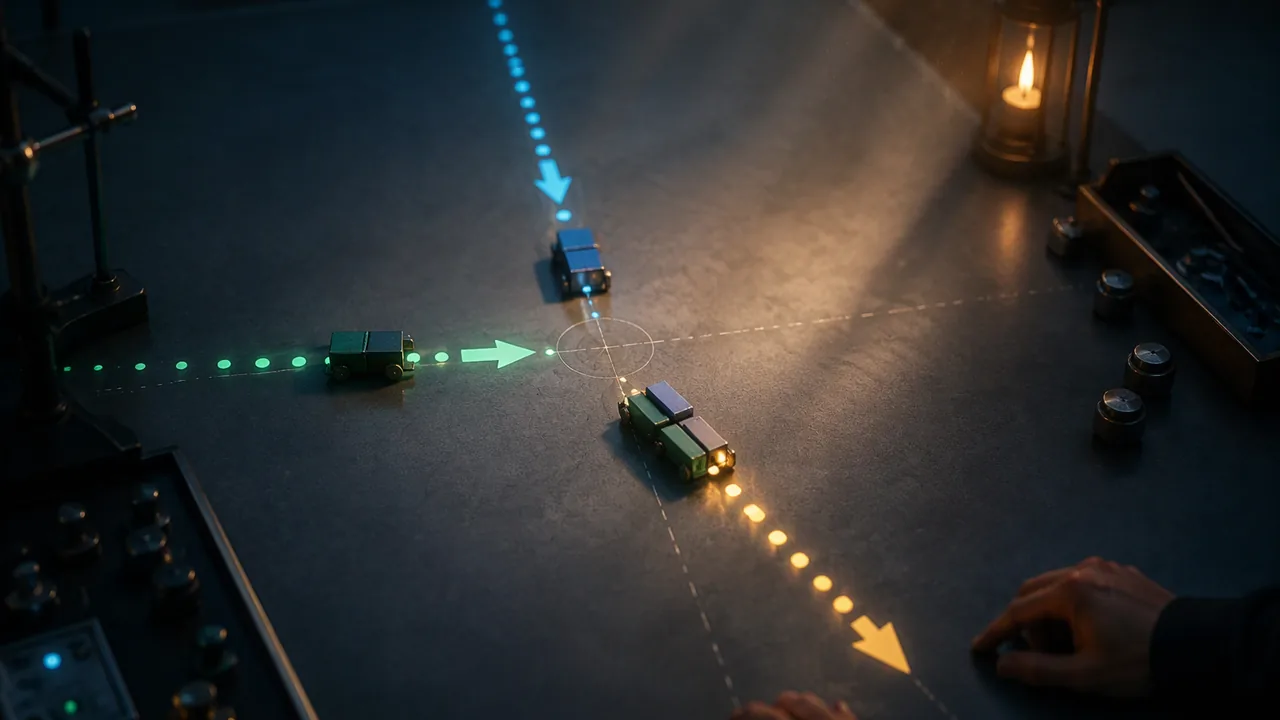
Momentum is a vector, so it is conserved in each direction separately. Split every momentum into east (x) and north (y) components with cosine and sine, and write two conservation equations.
Worked example: a 0.20 kg puck A moving east at 3.0 m/s strikes an identical puck B at rest. Afterward A moves at 1.5 m/s, 60° north of east. Find B’s velocity.
- A after: vx = 1.5 cos 60° = 0.750 m/s; vy = 1.5 sin 60° = 1.299 m/s.
- The masses are equal, so velocity components add like momenta. x: 3.0 = 0.750 + vBx, so vBx = 2.250 m/s. y: 0 = 1.299 + vBy, so vBy = −1.299 m/s.
- Speed: √(2.2502 + 1.2992) = 2.60 m/s at tan−1(1.299/2.250) = 30° south of east.
Check the energy: before, ½(0.20)(3.0)2 = 0.90 J; after, ½(0.20)(1.52 + 2.602) = 0.90 J. This collision is elastic, and the pucks leave 90° apart, the signature of an elastic glancing collision between equal masses.
Misconceptions to argue against
- “In an inelastic collision momentum is lost.” Kinetic energy is lost; momentum is conserved unless an external force acts.
- “The heavier cart pushes harder.” The forces are equal and opposite; the lighter cart simply has the larger change in velocity.
📖 Read for this lesson
The reading opens over the lesson; close it to come back to exactly where you were. The checks below draw on it.
Formative check
Work through these before moving on. They are not graded — they tell you whether the standard below has landed yet.
Two carts stick together after colliding on a level track. Which statement is correct?
When a loaded truck hits a small car, the truck exerts a larger force on the car than the car exerts on the truck.
Simulation & tools
Glancing collisions in two dimensions
Open the Explore 2D screen. Set ball 1 to 0.50 kg with velocity 1.00 m/s in x and 0 in y; set ball 2 to 0.50 kg at rest, placed slightly above ball 1’s path so the hit is off-center. Turn on Momentum vectors and set elasticity to 100%. Run and record each ball’s x and y momentum after the collision. Then check: do the x-momenta add to 0.50 kg·m/s and the y-momenta add to zero? Repeat at elasticity 0%. Which total changes, momentum or kinetic energy? No device? Use the worked puck example in the lecture: draw the three velocity arrows to scale on graph paper and show head-to-tail that the after-arrows add to the before-arrow.
Open in a new tab ↗ · PhET Interactive Simulations, University of Colorado Boulder · CC BY 4.0
A student’s lab report says: ‘Our bouncing trials lost 9% of their momentum, so momentum is not conserved in real collisions.’ Using your own data (or the frame record) and the provided collision data set, write a rebuttal of 150-200 words. Say what evidence would convince you they are right, identify at least one external force or measurement error that could explain the 9%, and propose a change to the procedure that would test your explanation. (Record it as an oral argument if you prefer.)
How confident are you that you can explain conservation of momentum with Newton’s third law and decide from data whether a collision was elastic or inelastic?
Practice
Work these on paper or in your notebook, then open Check your answer. Aim for all of Fluency and Application; try at least one Challenge.
Printable version: this unit’s practice workbook (PDF)
Fluency
Build speed and accuracy with the core skill.
- Find the kinetic energy of a 0.5 kg object moving at 20 m/s.
Check your answer
Answer: 100.0 JKE = ½mv2. - Find the kinetic energy of a 2 kg object moving at 20 m/s.
Check your answer
Answer: 400.0 JKE = ½mv2. - In a right triangle, an acute angle is 62° and the hypotenuse is 37. Find the side adjacent to the angle. Round to the nearest tenth.
Check your answer
Answer: 17.4cos 62° = adj/37 - In a right triangle, an acute angle is 18° and the hypotenuse is 20. Find the side opposite the angle. Round to the nearest tenth.
Check your answer
Answer: 6.2sin 18° = opp/20 - A 0.40 kg cart at 1.5 m/s sticks to a 0.60 kg cart at rest. Find the final velocity and the fraction of kinetic energy kept.
Check your answer
Answer: 0.60 m/s; 40%v = 0.60/1.00 = 0.60 m/s. KE before 0.450 J, after 0.180 J: 40% (= m1/(m1 + m2)). - Momentum components: a 2.0 m/s velocity at 60° north of east. Find the east and north components.
Check your answer
Answer: 1.00 m/s east, 1.73 m/s northv cos 60° and v sin 60°.
Application
Use the skill in context. Show your reasoning.
- If the same two carts (0.40 kg at 1.5 m/s, 0.60 kg at rest) collide perfectly elastically, the velocities after are v1 = (m1 − m2)u/(m1 + m2) and v2 = 2m1u/(m1 + m2). Find them and check that momentum and kinetic energy are both conserved.
Check your answer
Answer: v1 = −0.30 m/s, v2 = 1.20 m/sMomentum after: 0.40(−0.30) + 0.60(1.20) = 0.60 = 0.60 ✓. KE after: 0.450 J = 0.450 J ✓. - A 0.17 kg puck moving east at 4.0 m/s strikes an identical puck at rest. Afterward the first puck moves at 2.0 m/s, 60° north of east. Find the second puck’s velocity.
Check your answer
Answer: 3.46 m/s at 30° south of eastEast: 4.0 = 1.00 + vBx, so vBx = 3.00. North: 0 = 1.73 + vBy, so vBy = −1.73. Speed 3.46 m/s, angle tan−1(1.73/3.00) = 30°. - A student’s report says, “In an inelastic collision momentum is lost.” Write a two-sentence rebuttal using the 0.40 kg / 0.60 kg example.
Check your answer
Answer: Momentum is conserved (0.60 kg·m/s before and after); kinetic energy is what decreases.The pair leaves with 1.00 × 0.60 = 0.60 kg·m/s, the same as before, while 60% of the kinetic energy became thermal energy and deformation.
Challenge
Stretch problems. Expect to think before you write.
- At an intersection, a 1,500 kg car moving east at 15 m/s collides with a 2,000 kg SUV moving north at 10 m/s, and they lock together. Find the speed and direction of the wreckage just after impact.
Check your answer
Answer: 8.60 m/s at 42° north of eastpx = 22,500, py = 20,000 kg·m/s. v = √(px2 + py2)/3,500 = 8.60 m/s; angle tan−1(20,000/22,500) = 42°.
Review
Keep earlier skills sharp.
- An object starts at 12 m/s and accelerates at 1 m/s2 for 10 s. How far does it travel?
Check your answer
Answer: 170.0 md = v0t + ½at2. - A 12 kg box on a 25° frictionless ramp: find its acceleration down the ramp.
Check your answer
Answer: 4.14 m/s2a = g sin 25°.
The Collision Data Set: Eight Runs, One 9% Loss, and Where the Momentum Went
SLS original summary of eight home cart-collision runs, with each run’s measurement notes, plus kinetic-energy accounting for the lesson’s two trials; constructed teaching data, not measurements · SLS original (CC BY 4.0); constructed teaching data, labeled illustrative
Why this reading. The argument you write rebuts a student’s lab report that says “our bouncing trials lost 9% of their momentum, so momentum is not conserved,” and you are told to use your own data and the provided collision data set. If you did the lab, you have your own; the provided data are here. Eight runs, each filmed and analyzed by a different student at home, the momentum totals each reported, and, because it decides the argument, each run’s note on where in the video the velocities were read and whether the track was level. Run 5 belongs to the student whose report you are rebutting. All of it is constructed and illustrative; runs 1 and 2 are the lesson’s worked trials.
The data set
| Run | Type | p before (kg·m/s) | p after (kg·m/s) | Change (%) | Frames used for velocities | Track |
|---|---|---|---|---|---|---|
| 1 | stick | 0.3277 | 0.3232 | -1.4 | frames 0-9 and 15-24 (just before and just after) | level |
| 2 | bounce | 0.3072 | 0.2991 | -2.6 | frames 0-9 and 15-24 | level |
| 3 | stick | 0.2816 | 0.2761 | -2.0 | frames 0-9 and 15-24 | level |
| 4 | stick | 0.3635 | 0.3602 | -0.9 | frames 0-9 and 15-24 | level |
| 5 | bounce | 0.3072 | 0.2795 | -9.0 | frames 0-9 before; frames 24-33 after (0.4-0.7 s after contact) | one end raised on a folder, about 1 cm over 1.2 m |
| 6 | bounce | 0.2765 | 0.2740 | -0.9 | frames 0-9 and 15-24 | level |
| 7 | stick | 0.3174 | 0.3117 | -1.8 | frames 0-9 and 15-24; doubled-mass B | level |
| 8 | bounce | 0.2970 | 0.2899 | -2.4 | frames 0-9 and 15-24; doubled-mass B; A bounced back | level |
Seven runs are within 2.6% of conservation, and every one of the seven lost a little rather than gained; the losses are 1 to 3% and they are all in the same direction. Run 5 lost 9.0%. Two things in run 5’s notes are different from everyone else’s: its after-velocities were read late, 0.4 to 0.7 s after contact instead of 0.1 to 0.4 s, and its track was tilted so that the carts rolled slightly uphill after the collision.
Accounting for run 5’s 9%
Momentum changes only under an external force, and the impulse is force × time. Estimate the two external forces run 5’s notes admit to.
- Friction. Rolling friction on a cart is about 0.05 N (illustrative; you can measure it by timing a cart coasting to rest). Reading the after-velocities 0.3 s later than the other runs adds 0.3 s of friction on both carts: impulse ≈ 2 × 0.05 × 0.3 = 0.030 N·s. On a total of 0.307 kg·m/s that is 9.8%. The lesson’s version of the same estimate, one cart read 0.5 s early, gives 0.025 N·s or 7.6%. Friction alone can account for the whole 9%.
- Tilt. A 1 cm rise over 1.2 m is an angle whose sine is 0.0083. Gravity’s component along the track on the two carts (1.010 kg) is 1.010 × 9.8 × 0.0083 = 0.082 N, uphill after the collision. Over 0.3 s that is another 0.025 N·s, 8%.
Either force alone explains run 5; together they over-explain it, which means one of the two estimates is generous. That is fine. The point of the rebuttal is not to find the exact number but to show that external forces of the size actually present in the apparatus, acting for the time actually elapsed, produce a loss of the size actually observed. The collision itself lasts about 0.03 s (one frame at 30 fps), during which those forces deliver an impulse of a few thousandths of a newton-second, under 1%. Momentum is conserved in the collision; it leaks in the seconds around it.
What would convince you the report is right
A loss that did not shrink when the velocities were read closer to contact. A loss that appeared equally on a level track and a tilted one. A loss that stayed the same size when the carts’ friction was halved (better bearings, a smoother track). Any of those would mean the missing momentum was not going into the track, and Newton’s third law would be in trouble. The procedure change that tests this: re-read run 5’s video at frames 15 to 24, then level the track and repeat one trial.
Kinetic energy: the quantity that really is lost
| Trial | KE before (J) | KE after (J) | Fraction kept | Prediction |
|---|---|---|---|---|
| Sticking (trial 1) | ½(0.512)(0.64)2 = 0.1049 | ½(1.010)(0.32)2 = 0.0517 | 49% | mA/(mA+mB) = 0.512/1.010 = 51% |
| Bouncing (trial 2) | ½(0.512)(0.60)2 = 0.0922 | ½(0.512)(0.02)2 + ½(0.498)(0.58)2 = 0.0839 | 91% | 100% if perfectly elastic |
The sticking collision kept 49% of its kinetic energy while conserving momentum to 1.4%; the theory for a target at rest that sticks says the fraction kept is mA/(mA + mB) = 51%. The bouncing collision kept 91%: nearly, not perfectly, elastic, because rubber-band bumpers warm up a little. A report that says “momentum was lost” has usually confused these two quantities.
Your turn
- Compute the mean percent change for the four sticking runs and for the four bouncing runs, with and without run 5. Which single number best represents the data set?
- Redo the friction estimate with a friction force of 0.03 N instead of 0.05 N. Does friction still account for run 5’s loss on its own? What does that tell you about how sensitive the argument is to that one illustrative number?
- Run 2 (bouncing, 2.6%) and run 8 (doubled-mass target, bouncing, 2.4%) lost the most of the seven level-track runs, and both are bouncing trials. Propose a reason that is about the apparatus, not about the law.
- Write the 150-200 word rebuttal: what evidence would convince you, which external force explains the 9%, and the procedure change that would test it.