draw free-body diagrams, apply Newton’s three laws to find net force and acceleration, and explain why a truck without brakes speeds up on a downgrade.
Instruction
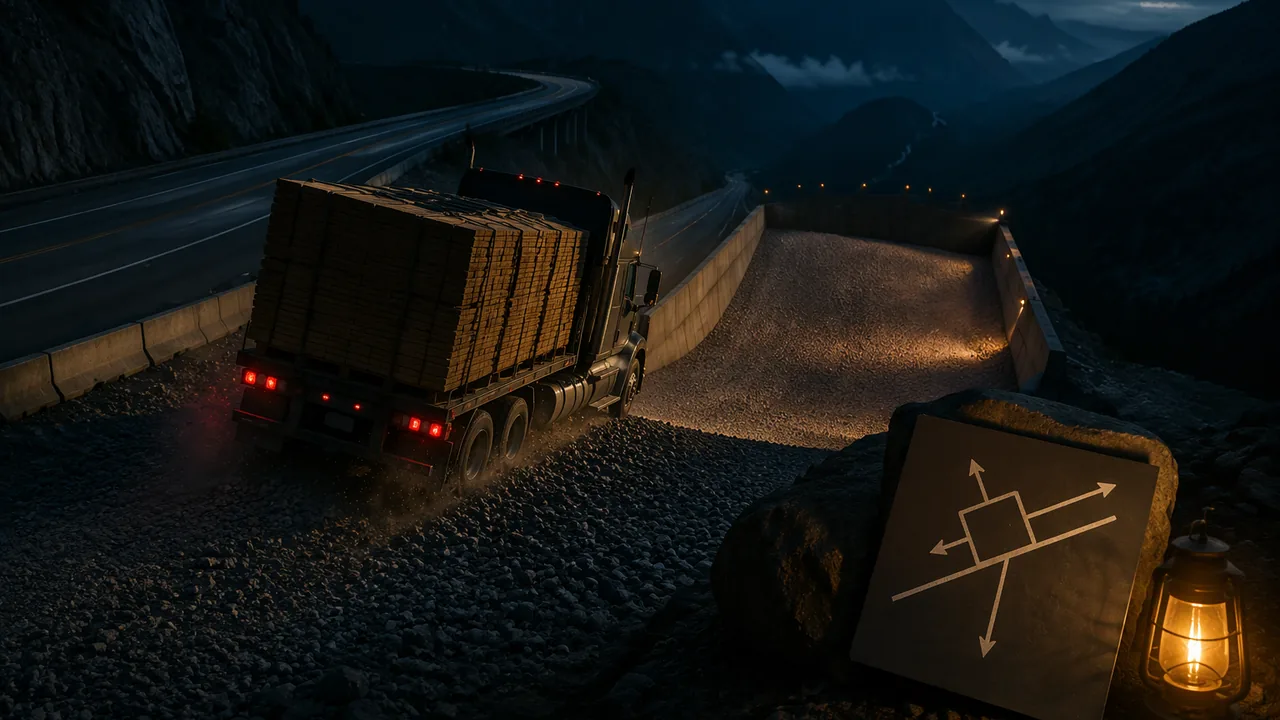
The phenomenon. Interstate 70 crosses Missouri between Kansas City and St. Louis, and trucks loaded here follow it west into Colorado. West of the Eisenhower Tunnel, westbound I-70 drops toward Silverthorne on 5.5 miles of 7% downhill grade, and the Colorado Department of Transportation (CDOT) has built runaway-truck escape ramps beside it: lanes of deep loose gravel that leave the road. CDOT calls the Lower Straight Creek ramp there the most heavily used runaway-truck ramp in the United States, and a CDOT spokesperson has said about 90% of the trucks that use Colorado’s escape ramps are from out of state. A loaded tractor-trailer can weigh up to 80,000 lb, the gross-weight limit in both federal law for Interstates (23 U.S.C. 127) and Missouri law (RSMo 304.180), which is about 36,287 kg. If its brakes overheat on the way down, nothing the driver does with the pedal will slow it. Why does a truck speed up on a hill, and how can a bed of gravel stop it? This unit answers with forces and Newton’s laws, and ends with you designing an escape ramp.
A force is an interaction. Every force is a push or pull that one object exerts on another, so name both: “Earth on the truck”, “road on the truck”. Forces are vectors, measured in newtons (1 N = 1 kg·m/s2). The forces you will use most are weight (Earth’s gravitational pull, W = mg), the normal force (a surface pushing perpendicular to itself), friction (a surface resisting sliding, parallel to itself), tension (a rope pulling along its length) and applied pushes.
Free-body diagrams. Draw the object as a dot or box and draw only the forces acting on it, each as an arrow starting at the object, with its length proportional to its size. Worked example: you push a 20 kg box across a floor at constant velocity with 60 N. Its weight is (20)(9.8) = 196 N, so the floor pushes up 196 N. The velocity is constant, so the net force is zero, and kinetic friction must be exactly 60 N backward.
Newton’s first law. If the net force on an object is zero, its velocity does not change: at rest it stays at rest, and moving it keeps moving in a straight line at constant speed. Motion does not need a force; changes in motion do. The box above keeps moving at a steady speed with zero net force.
Newton’s second law. The net force causes acceleration in its own direction: a = Fnet/m, or Fnet = ma. Worked example: on the 7% downgrade below the Eisenhower Tunnel (the road falls 7 m for every 100 m across, an angle of 4.00°), the component of the truck’s weight along the road is mg sin θ. With no braking and ignoring rolling resistance and drag, a = g sin θ = 9.8 × sin 4.00° = 0.684 m/s2. In 30 s the truck gains 20.5 m/s, about 46 mph. To hold a steady speed, the brakes and engine must supply a backward force equal to mg sin θ = (36,300)(9.8)(sin 4.00°) = 24,841 N for the whole descent, and that work becomes thermal energy in the brakes.
Mass and weight. Mass (kg) measures inertia and is the same everywhere. Weight (N) depends on the local gravitational field. A 6 kg backpack weighs 58.8 N on Earth but only 9.72 N on the Moon (g = 1.62 m/s2, NASA Moon fact sheet), and it is exactly as hard to shake back and forth in both places.
The normal force is not always mg. Push down on the 20 kg box with an extra 50 N and the floor must push up 246 N; lift up on it with 50 N and the floor pushes only 146 N. The normal force is whatever the surface needs to supply to stop the object sinking into it.
Newton’s third law. Forces come in pairs: if A pushes B, B pushes A with a force of the same size in the opposite direction, at the same instant. The pair acts on different objects, so the two forces never cancel each other on one free-body diagram. The truck pushes back on the road just as hard as the road pushes on the truck.
Misconceptions. (1) “A moving object needs a force to keep moving.” It needs a net force only to speed up, slow down or turn. (2) “Weight and normal force are a third-law pair.” They act on the same object and are different kinds of force; the pair to Earth-on-truck is truck-on-Earth. (3) “Heavier objects fall faster.” Both force and inertia double, so a = g for any mass when air resistance is small.
📖 Read for this lesson
The reading opens over the lesson; close it to come back to exactly where you were. The checks below draw on it.
Formative check
Work through these before moving on. They are not graded — they tell you whether the standard below has landed yet.
A truck rolls down a 7% grade with its engine off and brakes released. Ignoring air drag and rolling resistance, what happens to its speed?
A 20 kg box is pushed with 120 N against 58.8 N of kinetic friction. What is its acceleration?
For a book resting on a table, the table’s upward push on the book and Earth’s downward pull on the book are a Newton’s third-law pair.
Simulation & tools
Net force and acceleration
Open the Acceleration screen. Turn on Forces, Sum of Forces, Values, Masses and Acceleration, and set friction to none. Put the 50 kg crate on the skateboard. (1) Apply 100 N and record the acceleration; predict it first with a = F/m. (2) Add a 50 kg mystery object on top and apply 100 N again: record a and compare. (3) Now set friction to a middle value, push with 100 N from rest and record whether it moves, then raise the push until it does. Which law explains each result? No device: answer the same three questions with a = Fnet/m for a 50 kg and a 100 kg load, and explain in words what static friction does before the crate starts moving.
Open in a new tab ↗ · PhET Interactive Simulations, University of Colorado Boulder · CC BY 4.0
How confident are you that you can draw free-body diagrams and use Newton’s laws to find net force and acceleration?
Practice
Work these on paper or in your notebook, then open Check your answer. Aim for all of Fluency and Application; try at least one Challenge.
Printable version: this unit’s practice workbook (PDF)
Fluency
Build speed and accuracy with the core skill.
- A net force of 6 N acts on a 2 kg object. What is its acceleration?
Check your answer
Answer: 3.00 m/s2a = Fnet/m. - A net force of 1.0 N gives an object an acceleration of 2 m/s2. What is its mass?
Check your answer
Answer: 0.50 kgm = Fnet/a. - A net force of 15 N gives an object an acceleration of 3 m/s2. What is its mass?
Check your answer
Answer: 5.00 kgm = Fnet/a. - A 20 kg box is pushed with 107 N to the right against 17 N of friction. Find the net force and the acceleration.
Check your answer
Answer: net force 90 N to the right; a = 4.50 m/s2Add forces as vectors: the net force is the applied force minus friction. - A 12 kg box rests on the floor while you push straight down on it with 30 N. What is the normal force on the box?
Check your answer
Answer: 147.6 NNet force is zero: FN = mg + 30 = 117.6 + 30 = 147.6 N. - A 70 kg astronaut weighs how much on Earth and on Mars (g = 3.71 m/s2, NASA Mars fact sheet)? What is the astronaut’s mass on Mars?
Check your answer
Answer: 686 N; 260 N; still 70 kgW = mg: 70 × 9.8 = 686 N; 70 × 3.71 = 260 N. Mass does not change.
Application
Use the skill in context. Show your reasoning.
- A 40 kg crate is pulled right with 150 N while friction pushes left with 90 N. Draw the free-body diagram in words and find the acceleration.
Check your answer
Answer: 1.5 m/s2 to the rightForces: weight 392 N down, normal 392 N up, 150 N right, 90 N left. Fnet = 60 N right; a = 60/40 = 1.5 m/s2. - A 30,000 kg truck coasts down a 7% grade with no braking. Ignoring drag, find its acceleration and the braking force needed to hold a steady speed.
Check your answer
Answer: 0.684 m/s2; 20,530 Nθ = tan−1(0.07) = 4.00°. a = g sin θ = 0.684 m/s2. Needed force mg sin θ = 20,530 N. - Two skaters (50 kg and 70 kg) stand still on ice and push apart with a 140 N force. Find each skater’s acceleration and explain why they differ.
Check your answer
Answer: 2.8 m/s2 and 2.0 m/s2Third law: each feels 140 N. a = F/m: 140/50 = 2.8, 140/70 = 2.0 m/s2. Equal forces, different inertia.
Challenge
Stretch problems. Expect to think before you write.
- A 25 kg sled is pulled with 80 N along a rope at 30° above horizontal against 40 N of kinetic friction. Find the acceleration and the normal force.
Check your answer
Answer: a = 1.17 m/s2; FN = 205.0 NHorizontal: 80 cos 30° − 40 = 29.28 N, so a = 1.17 m/s2. Vertical: FN = mg − 80 sin 30° = 245 − 40 = 205.0 N.
Review
Keep earlier skills sharp.
- A car moving at 2 m/s speeds up at 3 m/s2 for 9 s. What is its final speed?
Check your answer
Answer: 29.0 m/sv = v0 + at. - A car moving at 13 m/s speeds up at 2 m/s2 for 4 s. What is its final speed?
Check your answer
Answer: 21.0 m/sv = v0 + at. - Resolve a 50 N force at 25° above horizontal into components.
Check your answer
Answer: 45.3 N horizontal, 21.1 N verticalF cos θ and F sin θ.
The I-70 Downgrade: The Weight Limit, the Escape Ramps, and a Coasting Truck’s Speed Record
23 U.S.C. 127 (Cornell LII) and RSMo 304.180 (revisor.mo.gov); CDOT, Mount Vernon emergency escape ramp news release and project page (codot.gov, 2024); K. Simpson, The Colorado Sun, Dec. 3, 2023; KOAA News5, Aug. 2024; NASA NSSDC Moon Fact Sheet (updated Jan. 11, 2024); all retrieved Nov. 5, 2026. The coasting record is SLS illustrative data. · SLS original (tables and explanation); cites public government records, statutes and published design values, with brief quotations only. Original: Statutes and U.S./state government documents are public domain or quoted as published; news reporting quoted briefly with attribution; SLS additions CC BY 4.0
Why this reading. The lesson opens on a real place and asks you to explain a real danger with Newton’s laws. It states a truck’s legal weight, a grade, an acceleration and a braking force. Here are the sources behind the first two, a speed record (illustrative) that produces the third, and the free-body cases the lesson’s worked example depends on, so that the question board you write at the end starts from evidence rather than from a paragraph.
1. How heavy a truck may be
Federal law caps the weight of trucks on the Interstate System. Title 23 of the United States Code, section 127, sets an axle limit of 20,000 lb, a tandem-axle limit of 34,000 lb and an overall gross-weight limit of 80,000 lb, including enforcement tolerances. Missouri law matches it: the weight table in section 304.180 of the Revised Statutes of Missouri tops out at 80,000 lb, and the section adds that on Missouri highways “total gross weight shall not exceed eighty thousand pounds” except under the special permits it lists. One pound is 0.45359237 kg exactly, so 80,000 lb is 36,287 kg. That is the mass the lesson rounds to 36,300 kg.
2. The ramps are real, they are used, and they need maintenance
Interstate 70 runs west from St. Louis across Missouri to Kansas City, through Kansas, and into the Colorado Rockies, where it climbs to the Eisenhower Tunnel under the Continental Divide. The Colorado Sun reported in December 2023 that drivers heading west toward Silverthorne pass two escape ramps, the second being the Lower Straight Creek ramp, which it called “the most used in the country” because of “5.5 miles of 7% downhill grade.” The same article reported that Colorado has 13 runaway-truck ramps, that runaway trucks entered them 44 times in 2022, and that the Lower Straight Creek ramp stopped 75 trucks in five years; the second-busiest, near the bottom of Vail Pass at mile marker 182, had 27 uses in the same period. A CDOT spokesperson told KOAA News5 in 2024 that the Lower Straight Creek ramp is the most heavily used in the U.S. and that “90% of the trucks that use escape ramps, they’re out of state”: drivers who, as a Colorado safety official told The Colorado Sun, may come through only once or twice. A truck heading west on I-70 from Missouri is exactly that kind of trip.
Why the ramps matter: in 2019 a truck whose brakes failed descending Mount Vernon Canyon on eastbound I-70 caused a 28-vehicle pileup that killed four people, and the driver testified that he did not see the last signs for the Mount Vernon ramp (The Colorado Sun). CDOT rebuilt that ramp, at mile post 257 just east of Genesee, as a $15 million project; it reopened June 2, 2024, with three feet of gravel in its arrester bed, a larger concrete barrier and detection that triggers flashing signs. During the rebuild, CDOT’s project page lowered the heavy-truck speed limit between exits 253 and 258 from 45 to 40 mph. Two facts for your model follow: the bed is loose aggregate, and it works only while the aggregate stays deep and loose. The Colorado Sun notes that a truck stopped near the top of an uphill ramp can roll back or jackknife depending on its brakes and on whether the aggregate is soft or frozen hard. That is why the lesson calls the bed’s friction coefficient effective, and why the Unit 2 design task includes maintenance among its constraints.
Note on the grade: the 7% figure comes from The Colorado Sun’s reporting, not from a CDOT design document, so cite it as reported. Real grades vary along a descent; 7% is a fair single number for a model.
3. A coasting record (illustrative)
Suppose a loaded truck on the 7 percent grade loses its brakes at 8.0 m/s and its speed is read from GPS every 5 s. The values below were constructed from a = g sin θ with about ±0.07 m/s of reading noise; they are not a measurement of any real truck.
| t (s) | Speed (m/s) | (mph) |
|---|---|---|
| 0 | 8.00 | 17.9 |
| 5 | 11.48 | 25.7 |
| 10 | 14.79 | 33.1 |
| 15 | 18.33 | 41.0 |
| 20 | 21.65 | 48.4 |
| 25 | 25.14 | 56.2 |
| 30 | 28.47 | 63.7 |
A straight line fitted to speed against time has slope 0.683 m/s2. The model: a 7 percent grade falls 7 m for every 100 m across, so tan θ = 0.07 and θ = 4.00°; sin θ = 0.06983; a = 9.8 × 0.06983 = 0.684 m/s2. In 30 s the truck gains 20.5 m/s (46 mph), from 8.0 to about 28.5 m/s (64 mph), and it is still gaining. The lesson’s 24,841 N is the braking force that would hold the speed constant: mg sin θ = 36,300 × 9.8 × 0.06983 = 24,841 N. If you use sin 4.00° rounded to 0.0698 you get about 24,831 N; the lesson used the unrounded angle. Say which you did.
Over the full 5.5 miles (8,851 m along the road) the road drops 8,851 × 0.06983 = 618 m. With no brakes and no drag, a truck starting from rest would reach v = √(2ad) = √(2 × 0.684 × 8,851) ≈ 110 m/s at the bottom, which is why the brakes, the engine and, when they fail, a ramp must take that speed away. Two things the record shows that the formula does not. First, the acceleration does not depend on the truck’s mass: a pickup on the same grade gains speed at the same rate. Second, air drag grows with speed and would eventually bend this line over, but at 25 m/s the drag on a truck is a few thousand newtons against about 24,800 N of downhill pull; the line stays nearly straight through the speeds that matter.
4. The free-body cases the lesson uses
Forces on a 20 kg box on a level floor (weight 20 × 9.8 = 196 N). Each row is one free-body diagram; draw it before you read the last two columns.
| Situation | Gravity (Earth on box) | Normal force (floor on box) | Applied push | Friction | Net force | Acceleration |
|---|---|---|---|---|---|---|
| Pushed at constant velocity, 60 N forward | 196 N down (Earth) | 196 N up (floor) | 60 N forward (you) | 60 N backward (kinetic friction) | 0 | 0 |
| Same push, plus you press down with 50 N | 196 N down + 50 N down | 246 N up | 60 N forward | 60 N backward | 0 | 0 |
| Same push, plus you lift up with 50 N | 196 N down; 50 N up | 146 N up | 60 N forward | 60 N backward | 0 | 0 |
| Pushed with 120 N against 58.8 N friction | 196 N down | 196 N up | 120 N forward | 58.8 N backward | 61.2 N forward | 3.06 m/s2 forward |
The normal force changes from row to row because it is whatever the floor must supply to keep the box from sinking in; it equals mg only when nothing else acts vertically. In no row are weight and normal force a third-law pair: both act on the box. The partners are box-on-Earth (196 N up, on Earth) and box-on-floor (pressing down on the floor).
5. Mass is not weight: the Moon check
NASA’s Moon fact sheet gives the Moon’s surface gravity as 1.62 m/s2, against 9.80 m/s2 for Earth (9.78 at Earth’s equator). A 6 kg backpack has weight 6 × 9.8 = 58.8 N here and 6 × 1.62 = 9.72 N on the Moon, and the same 6 kg of inertia in both places: the force to shake it back and forth at a given rate is identical.
Your turn
- Fit the coasting record yourself (two points or a full regression) and compare your slope with g sin θ. Which sign of error would a GPS that reads slightly low at high speed introduce?
- Draw the free-body diagram of the coasting truck on the grade with tilted axes. Show that the component of gravity along the road is mg sin θ and the normal force is mg cos θ, and compute both for 36,300 kg.
- Using the 80,000 lb limit in 23 U.S.C. 127 and RSMo 304.180, compute the weight in newtons of a truck at the limit and the downhill force on it on the 7 percent grade. Then write one sentence on why the escape-ramp length in Unit 2 will not depend on that mass.
- Write three questions for the question board that could be answered with the coasting record, the Colorado ramp-use figures, or a free-body diagram, and say which one answers each.
Sources: 23 U.S.C. 127, Vehicle weight limitations, Interstate System (Legal Information Institute, Cornell Law School) (law.cornell.edu); Revised Statutes of Missouri, section 304.180, Regulations as to weight (Missouri Revisor of Statutes, effective Aug. 28, 2023) (revisor.mo.gov); Kevin Simpson, “Colorado’s runaway truck ramps, fixtures for decades, see renewed focus in campaign for highway safety,” The Colorado Sun, Dec. 3, 2023 (coloradosun.com); KOAA News5, “This runaway truck ramp on I-70 in Colorado is the most heavily used in the US. Here’s how they work” (Aug. 2024) (koaa.com); CDOT news release, “CDOT opens the eastbound I-70 Mount Vernon emergency escape ramp” (June 2024) (codot.gov); CDOT project page, Eastbound I-70 Mount Vernon Emergency Escape Ramp Reconstruction (codot.gov); NASA NSSDC, Moon Fact Sheet (last updated Jan. 11, 2024) (nssdc.gsfc.nasa.gov)