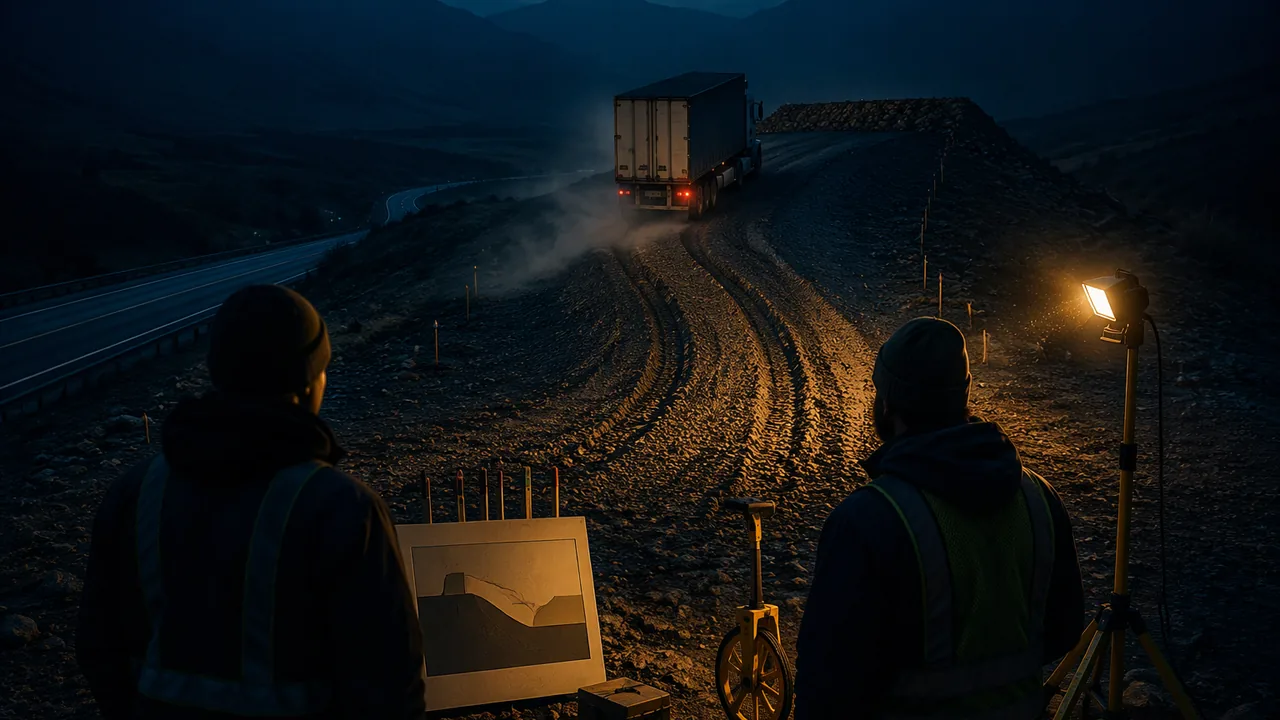
break the design of a runaway-truck escape ramp into sub-problems, model each with Newton’s second law and kinematics, and recommend and defend a ramp design with a sensitivity analysis.
Instruction
The design problem. A state transportation department is considering a new runaway-truck escape ramp beside a long downgrade on Interstate 70 (you choose the site from three in the task, or supply numbers you can source). Your job is to recommend the ramp’s grade, bed material and length, and to justify them with a Newton’s-law model. Real escape ramps are designed by engineers using published highway design guidance; this is a model of their reasoning, not a substitute for it.
Break the problem into sub-problems (9-12.ETS1.A.2). A ramp is too complex to design all at once, so split it. (1) Design speed: how fast will a runaway truck be moving when it reaches the ramp? (2) Deceleration: what grade and bed material will slow it, and how hard is too hard for the driver and the load? (3) Length: how long must the bed be, with what safety margin? (4) Site constraints: how much land is available, and how steep can the terrain be built? Solve each part with the physics, then check that the parts fit together.
A worked design (illustrative values). Design speed: 80 mph = 35.76 m/s. Grade: 5% up (θ = 2.86°). Bed: loose gravel with μ = 0.25.
- Deceleration: a = 9.8(sin 2.86° + 0.25 cos 2.86°) = 2.94 m/s2, about 0.30g. That is firm but survivable for a belted driver.
- Stopping length: L = 35.762/(2 × 2.94) = 218 m.
- Stopping time: t = v/a = 12.2 s.
- Safety factor: the gravel may be compacted or wet, and the truck may be faster than the design speed, so multiply by 1.25: a design length of about 272 m.
Criteria and constraints. Criteria are what success means: the design truck stops within the bed; deceleration stays below a value you justify; the driver can see and steer into the entrance. Constraints are limits: available length of land, construction cost, how steep the terrain allows, and maintenance (gravel must be raked loose after every use). Trade-offs are unavoidable. A steeper grade shortens the ramp but a truck that stops on it can roll backward, which is one reason real ramps use deep loose beds and why towing is needed after every use.
Test your model. Change one assumption at a time: entry speed ±10 mph, μ from 0.20 to 0.30, grade from 0% to 10%. Which assumption changes the length most? A model you understand is one whose sensitivities you can state.
Limits of the model. Real gravel beds decelerate a truck mainly by letting its wheels sink and plow, which is not exactly sliding friction, and the resistance grows as the wheels sink. That is why μ here is an effective coefficient. Say so in your report.
📖 Read for this lesson
The reading opens over the lesson; close it to come back to exactly where you were. The checks below draw on it.
Formative check
Work through these before moving on. They are not graded — they tell you whether the standard below has landed yet.
Which list best breaks the escape-ramp problem into sub-problems?
At 35.76 m/s on a bed that decelerates trucks at 2.94 m/s2, the stopping length is m and the stop takes s.
Because the truck’s mass cancels in a = g(sin θ + μ cos θ), the same ramp length works for a light pickup and a loaded semi entering at the same speed.
How confident are you that you can break an engineering problem into sub-problems and use Newton’s laws to design and defend a solution?
Unit 2 checkpoint
Do this before you start the task. It covers the whole unit and tells you what to review first.
Which pair is a Newton’s third-law pair?
A net force of 36 N acts on a 12 kg cart. Its acceleration is m/s2.
An object moving at constant velocity must have zero net force on it.
A cart’s a-versus-F graph has slope 2.0 kg−1. What mass was accelerated?
A 10 kg crate with μs = 0.40 stays at rest until the push exceeds N.
Kinetic friction on a sliding block roughly doubles if the block’s contact area doubles at the same load.
On a 30° frictionless incline, what is a sliding block’s acceleration?
A 60 kg person in an elevator accelerating up at 2.0 m/s2 reads N on a scale.
The string tension on a cart pulled by a falling hanger is
A truck entering an escape ramp at twice the speed needs twice the ramp length.
Which best breaks an escape-ramp design into sub-problems (9-12.ETS1.A.2)?
Design Report: A Runaway-Truck Escape Ramp
Task: Recommend a design for a runaway-truck escape ramp on a long Interstate 70 downgrade. Break the problem into at least four sub-problems and solve each with the physics from this unit: a free-body diagram of a truck on your ramp, the deceleration from Newton’s second law, the stopping length and time from kinematics, and a safety factor you justify. State every input and its source or label it illustrative. Graph how your ramp length changes with one assumption (entry speed, grade or μ), explain the trade-offs between grade, length, cost and safety, and state the limits of the friction model for a gravel bed. Safety: never collect data on or beside a highway; maps are the only fieldwork this task needs.
Choose one site. All three earn full credit and are the same difficulty. The design inputs below are illustrative values, chosen so that each site is a different design problem. They are not figures from CDOT, MoDOT or any other agency. You may replace any of them with a value you can source, and if you do you must say which one and cite it.
| Site | Downgrade | Design entry speed | Ramp grade available | Bed material, effective μ | Land available |
|---|---|---|---|---|---|
| A | I-70 westbound from the Eisenhower Tunnel toward Silverthorne (Straight Creek), Colorado | 80 mph = 35.76 m/s | up to 5% up | loose gravel, 0.25 | about 300 m |
| B | I-70 westbound down the west side of Vail Pass, Colorado | 65 mph = 29.06 m/s | up to 8% up | coarse sand, 0.30 | about 180 m |
| C | A long downgrade in the Missouri Ozarks (a hypothetical site invented for this task, not a planned project) | 60 mph = 26.82 m/s | up to 10% up | loose gravel, 0.25 | about 150 m |
Site A is the worked example in the lesson, so use it to check your method: a = 9.8(sin 2.86° + 0.25 cos 2.86°) = 2.94 m/s2, L = 218 m, t = 12.2 s, and 272 m once you apply a 1.25 safety factor, which fits the land available. Sites B and C are yours to work out from the table; both of them also fit their land at a 1.25 factor, so if yours does not, check how you converted the grade into an angle. Nothing in this task requires looking at a map: the table above gives every input. If you want to see a site, any free satellite map or the public USGS topographic viewer (ngmdb.usgs.gov/topoview) will show it, but that is optional. You need only the ramp you design, not the grade of the highway itself.
Submission workflow
- Stage 1 — Plan. Site and scenario, the list of sub-problems, your criteria and constraints (at least three of each), and the equations you will use with every input and its source.
- Stage 2 — Reviewed draft. Redraw your free-body diagram and recompute your deceleration and length a second time from scratch (or have a parent, guardian or other reader recompute them with you), check them against the model table in Lesson 2.4’s reading, and challenge one of your own assumptions; submit the review notes and your revision plan.
- Stage 3 — Revised final. 1,000-1,400 words with the free-body diagram, calculations, a sensitivity graph, the trade-offs and a clear recommendation.
- Stage 4 — Presentation or defense. Five minutes, live or recorded (equal credit): your design, the evidence for it, one trade-off, and answers to two questions about your model.
How it is scored
| Criterion | What proficient looks like |
|---|---|
| Problem decomposition (9-12.ETS1.A.2) | Breaks the design into clear sub-problems, solves each and shows how the solutions fit together. |
| Force model (9-12.PS2.A.1) | Correct free-body diagram and Newton’s-second-law deceleration with components on the grade. |
| Mathematical reasoning (SEP.5, MP.4) | Correct stopping length, time and safety factor with units; numbers are checked. |
| Sensitivity and trade-offs (CCC.4) | Tests how the design responds to changed assumptions and weighs grade, length, cost and safety. |
| Sources and limits (RST.11-12.7) | Every input sourced or labeled illustrative; limits of the friction model stated. |
| Defense (SEP.6) | Explains the design clearly and answers questions with reasoning from the model. |
Designing an Escape Ramp: The Public Record, the Site A Sensitivity Run, and the Limits of the Bed Model
CDOT Mount Vernon emergency escape ramp news release and project page (2024); K. Simpson, The Colorado Sun, Dec. 3, 2023; E. C. Williams and C. F. Horne, ITE Journal, May 1979; 23 U.S.C. 127; RSMo 304.180; all retrieved Nov. 5, 2026. The sensitivity table is SLS model output on illustrative inputs. · SLS original (tables and explanation); cites public government records, statutes and published design values, with brief quotations only. Original: Government documents and statutes public domain or quoted as published; news and journal text quoted briefly with attribution; SLS additions CC BY 4.0
Why this reading. The design report must state criteria and constraints, label every input as sourced or illustrative, graph the sensitivity of the length to one assumption, and state the limits of the friction model. This reading carries the sourced facts an Interstate 70 ramp design can rest on, runs the sensitivity test for Site A so you can see what one looks like before you run your own, and sets out what a gravel bed actually does that the model does not. Sites B and C are left for you to work.
1. What the public record supports
- The design vehicle. Federal law (23 U.S.C. 127) caps gross weight on the Interstate System at 80,000 lb including enforcement tolerances, and Missouri law (RSMo 304.180) sets the same 80,000 lb ceiling (36,287 kg). Because the mass cancels in a = g(sin θ + μ cos θ), the weight limit does not set your length; it sets how much kinetic energy the bed must absorb and how deep the wheels will sink, which is a constraint on the bed’s depth and maintenance rather than on L.
- The ramps exist and are used. The Colorado Sun (Dec. 3, 2023) reported 13 runaway-truck ramps in Colorado, 44 entries in 2022, and 75 uses in five years at the Lower Straight Creek ramp on westbound I-70 below the Eisenhower Tunnel, on “5.5 miles of 7% downhill grade”; the ramp near the bottom of Vail Pass (mile marker 182) had 27 uses in the same period. A design that expects to be used every few weeks in summer must be quick to restore.
- Beds degrade and are rebuilt. CDOT rebuilt the eastbound I-70 Mount Vernon ramp (mile post 257, near Genesee) for $15 million and reopened it June 2, 2024, with three feet of gravel in the arrester bed. The Colorado Sun reported the rebuild increased the aggregate depth to 36 inches “to achieve a faster stop,” and that whether aggregate is soft or frozen hard changes what a stopped truck does. A bed that has compacted, frozen or filled with fines resists less: its effective μ falls. That is a sourced reason for a safety factor and for a maintenance constraint.
- There is no single recipe. A 1979 ITE Journal survey of U.S. ramps (Williams and Horne, from a Tennessee DOT study) reported “no formal design or construction criteria” at the time, with combination gravity-and-arrester ramps from 550 to 2,200 feet long (168 to 671 m), 18 to 50 feet wide, on grades from +2.7 to +26 percent, surfaced with loose gravel or pea gravel 12 inches deep or more. Your design should fall inside a range like that, and you should say why it sits where it does.
- Not sourced. The entry speeds, the available ramp grades and land, and every μ in the task table are illustrative, and Site C is a hypothetical Missouri site. Say so in the report.
2. Site A, worked, and its sensitivity run
Site A: 80 mph = 35.76 m/s, 5 percent up (θ = 2.862°), loose gravel μ = 0.25, about 300 m of land.
- Deceleration a = 9.8(sin 2.862° + 0.25 cos 2.862°) = 9.8(0.04994 + 0.24969) = 2.936 m/s2, which is 0.30 g.
- Stopping length L = 35.762/(2 × 2.936) = 218 m; stopping time v/a = 12.2 s.
- With a 1.25 safety factor: 272 m, inside the 300 m available.
Now change one input at a time and hold the others at the design values:
| One assumption changed | Stopping length L (m), no safety factor |
|---|---|
| Entry speed 70 mph (31.29 m/s) | 167 |
| Entry speed 80 mph (35.76 m/s), the design | 218 |
| Entry speed 90 mph (40.23 m/s) | 276 |
| μ 0.20 at 5% | 261 |
| μ 0.25 at 5%, the design | 218 |
| μ 0.30 at 5% | 187 |
| Grade 0% at μ 0.25 | 261 |
| Grade 5% at μ 0.25, the design | 218 |
| Grade 10% at μ 0.25 | 187 |
Three things to read off. Speed is the most dangerous assumption: 10 mph over the design speed adds 58 m, because L grows with v2, and a 1.25 factor on 218 m (272 m) does not quite cover a 90 mph entry (276 m). The bed coefficient is next: a compacted bed at μ = 0.20 needs 44 m more, which is the physics behind CDOT rebuilding the Mount Vernon bed deeper. The grade is the weakest lever available here: going from 5 to 10 percent saves 30 m, about the same as raising μ by 0.05. Your report needs one such table for your own site, one graph of it, and a sentence saying which assumption you would spend money to pin down.
3. Criteria and constraints, in the language of the rubric
Criteria (what success means, and can be scored): the design truck stops inside the bed; the deceleration stays below a value you justify (Site A’s 0.30 g is gentle; a belted driver tolerates far more, but an unsecured load may not); the driver can see the entrance in time to steer into it. Constraints (limits you may not break): the land available in the task table; the steepest grade the terrain allows; the cost of excavation and gravel, which grows with length; and maintenance, since the Colorado record shows beds are used often and rebuilt. A trade-off is where a criterion and a constraint pull against each other: a steeper grade shortens the bed but a truck stopped on a steep bed can roll back, and a longer, flatter bed costs land and gravel.
4. What the bed really does
The model treats the gravel as a surface with a friction coefficient. A real arrester bed is deep loose aggregate, and a truck’s wheels sink into it and plow. The resistance comes mostly from displacing gravel, it grows as the wheels sink deeper, and it depends on the gravel’s size, roundness, cleanliness and moisture, which is why ramp beds are raked, cleaned and renewed after use. Two consequences for your report. First, μ here is an effective coefficient that stands in for a process the model does not describe, so it is uncertain by more than the ±0.05 in the table. Second, the resistance is not constant along the bed: it is weakest at the entrance, before the wheels have sunk, which argues for a deeper bed near the start, or a longer bed, rather than a steeper one. State both as limits of the model.
Your turn (Stage 1 support)
- For your site (B or C), convert the grade to an angle both ways (tan−1 and the small-angle shortcut) and record the difference in L.
- Compute a, L and the stopping time for your site and check that L × 1.25 fits the land. If it does not, the task says to recheck your angle conversion.
- Build a nine-row sensitivity table like the one above for your site and graph the column you think matters most.
- List three criteria and three constraints for your site, naming which ones the public record above supports and which are illustrative.
Sources: CDOT project page, Eastbound I-70 Mount Vernon Emergency Escape Ramp Reconstruction (codot.gov); CDOT news release, “CDOT opens the eastbound I-70 Mount Vernon emergency escape ramp” (June 2024) (codot.gov); Kevin Simpson, “Colorado’s runaway truck ramps, fixtures for decades, see renewed focus in campaign for highway safety,” The Colorado Sun, Dec. 3, 2023 (coloradosun.com); Earl C. Williams and C. Franklin Horne, “Runaway Truck Ramps Are Saving Lives and Reducing Damage,” ITE Journal, May 1979 (NCDOT TEPPL library copy) (connect.ncdot.gov); 23 U.S.C. 127, Vehicle weight limitations, Interstate System (Legal Information Institute, Cornell Law School) (law.cornell.edu); Revised Statutes of Missouri, section 304.180, Regulations as to weight (Missouri Revisor of Statutes, effective Aug. 28, 2023) (revisor.mo.gov); USGS topoView (public topographic maps, for viewing a site) (ngmdb.usgs.gov)