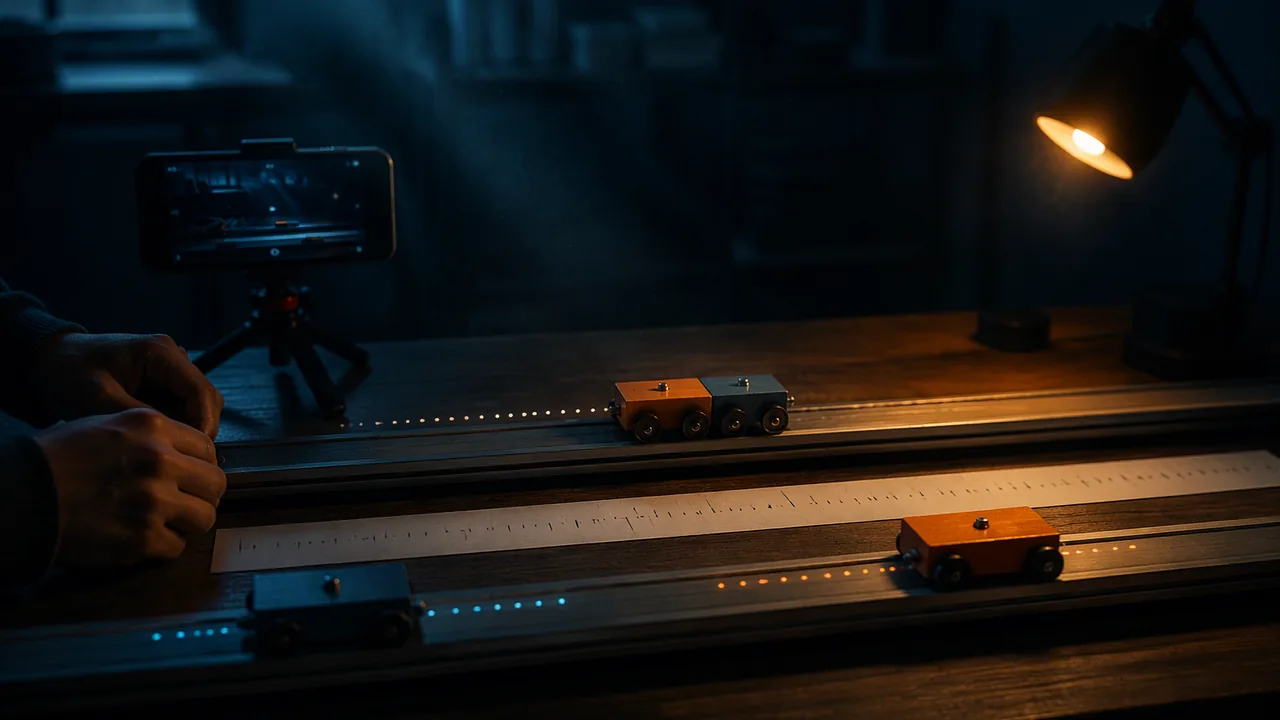
measure velocities from phone video, compute total momentum before and after sticking and bouncing collisions, and judge whether the difference is within my measurement uncertainty.
Instruction
Conservation of momentum
Choose a system: here, two carts on a track. If the net external force on the system is zero (or negligible), the total momentum of the system does not change, whatever happens inside it:
mAvA + mBvB = mAv′A + mBv′B
Primes mark velocities after the collision. Velocity carries a sign: choose one direction along the track as positive, and a cart moving the other way has negative velocity and negative momentum. Today you test this claim with your own measurements (9-12.PS2.A.2).
Measuring velocity with a phone
Film the track from the side with a meter stick in view. Most phones record at 30 frames per second, and slow-motion modes at 120 or 240. Step through the video frame by frame, note a cart’s position at two frames, and divide:
v = Δx / (number of frames ÷ frame rate)
Example: in the illustrative trial below, cart A moved 0.192 m in 9 frames at 30 frames per second. The time is 9/30 = 0.300 s, so vA = 0.192 / 0.300 = 0.64 m/s. Measure just before and just after contact, because friction slows the carts a little the whole time they roll.
Worked example: a sticking collision
Cart A (0.512 kg) rolls at 0.64 m/s into cart B (0.498 kg) at rest. Velcro makes them stick, and together they move 0.096 m in 9 frames, so v′ = 0.096/0.300 = 0.32 m/s.
- Momentum before: 0.512 × 0.64 + 0.498 × 0 = 0.3277 kg·m/s.
- Momentum after: (0.512 + 0.498) × 0.32 = 1.010 × 0.32 = 0.3232 kg·m/s.
- Percent difference: |0.3232 − 0.3277| / 0.3277 × 100% = 1.4%.
A second illustrative trial with bouncing (magnet or rubber-band) bumpers: A at 0.60 m/s hits B at rest; afterward A creeps forward at 0.02 m/s and B moves at 0.58 m/s. Before: 0.3072 kg·m/s. After: 0.512 × 0.02 + 0.498 × 0.58 = 0.2991 kg·m/s, a difference of 2.6%.
Is a small difference “conserved”?
No measurement is exact, so compare the difference with your uncertainty. If you can read a position to about ±0.5 cm, a 19.2 cm displacement carries about 2.6% uncertainty, and every velocity you compute inherits it. A percent difference of a few percent is consistent with conservation; a difference of 20% means something outside the system pushed on the carts or a measurement went wrong. Longer displacements (more frames) shrink the relative uncertainty.
Common mistakes
- Dropping the sign: a cart that bounces backward has negative momentum. Adding speeds instead of velocities makes momentum look “created”.
- Measuring velocity far from the collision, where friction has already changed it.
- Forgetting that the stuck pair’s mass is mA + mB.
📖 Read for this lesson
The reading opens over the lesson; close it to come back to exactly where you were. The checks below draw on it.
Lab: Collision Carts and Phone Video: Is Total Momentum Conserved?
Question. When two carts (or toy cars) collide on a level track, is the total momentum just after the collision equal to the total momentum just before, for both bouncing and sticking collisions?
Materials
- Two similar toy cars or toy trucks with free-rolling wheels
- A level track: a smooth floor, a board, or a length of vinyl rain gutter for marbles
- Meter stick or tape measure taped along the track as a scale
- Phone or tablet camera (slow-motion mode if available) on a stack of books as a tripod
- Kitchen scale (grams)
- Velcro strips or a ball of modeling clay (sticking bumper); rubber bands or small magnets taped on (bouncing bumper)
- Washers or coins and tape to change a cart’s mass
- Safety glasses or goggles for you and anyone watching
- Wear goggles at the track: a car or a washer can flip off during a collision.
- Push carts gently by hand, never with a launcher or a ramp steeper than a few centimeters, and keep the lane clear of feet.
- Keep fingers out from between carts as they close; stop a moving cart from behind or with a block at the end of the track.
- Tape added masses firmly and pick up washers and marbles from the floor so no one slips.
Procedure
- Measure and record the mass of each cart, including bumpers and tape, in kilograms.
- Tape the meter stick along the track and set the camera level with the track, 1-2 m away, so the scale and both carts are in frame. Film a test run and check that the scale is readable.
- Sticking trials: put Velcro or clay on the facing ends. With cart B at rest, give cart A a gentle push. Film at least 10 frames before and 10 frames after the collision. Do 3 trials.
- Bouncing trials: replace the Velcro with rubber-band or magnet bumpers and repeat 3 trials with B at rest.
- Change the mass: tape washers to cart B (about double its mass) and repeat one sticking and one bouncing trial.
- For each video, step frame by frame. Just before contact, read cart A’s position at two frames about 6-10 frames apart; just after contact, do the same for each cart. Compute each velocity as distance divided by (frames / frame rate), with a sign.
- Compute total momentum before and after and the percent difference, and record everything in the table.
Data
| Trial | Type | mA (kg) | mB (kg) | vA (m/s) | vB (m/s) | v′A (m/s) | v′B (m/s) | p before (kg·m/s) | p after (kg·m/s) | % difference |
|---|---|---|---|---|---|---|---|---|---|---|
| Illustrative 1 | stick | 0.512 | 0.498 | 0.64 | 0 | 0.32 | 0.32 | 0.3277 | 0.3232 | 1.4 |
| Illustrative 2 | bounce | 0.512 | 0.498 | 0.60 | 0 | 0.02 | 0.58 | 0.3072 | 0.2991 | 2.6 |
| 1 | ||||||||||
| 2 | ||||||||||
| 3 |
The two illustrative rows show the format and are not real measurements. Keep at least 8 trials of your own.
Analysis
- Claim, evidence, reasoning: state whether your data support conservation of total momentum. Cite your mean percent difference for sticking and for bouncing trials, and explain why the carts form a nearly isolated system during the collision.
- Estimate the uncertainty in one velocity from how precisely you can read positions in the video (for example ±0.5 cm over the distance you used). Is your percent difference larger or smaller than that uncertainty? What does that tell you?
- Identify two sources of error (friction before and after contact, a tilted track, parallax from a camera that is not level, a cart touching the track wall) and say which direction each would push your ‘after’ momentum.
- Compare the doubled-mass trials with the equal-mass trials. Did conservation hold equally well? Why might heavier carts give a better or worse result?
If you cannot do this lab in person: Use the PhET Collision Lab (Explore 1D screen): set ball 1 to 0.50 kg at 0.60 m/s and ball 2 to 0.50 kg at rest, run trials at elasticity 0%, 50% and 100%, record the velocities before and after, and complete the same table. No track or device? Use this lesson’s frame-record reading: eight collisions filmed at 30 frames per second and read frame by frame, enough to complete the table and every analysis question.
Formative check
Work through these before moving on. They are not graded — they tell you whether the standard below has landed yet.
In a video at 30 frames per second, a cart moves 0.240 m in 12 frames. What is its speed?
A 0.512 kg cart at 0.64 m/s sticks to a 0.498 kg cart at rest. Momentum is conserved, so the pair moves at m/s.
If cart A bounces backward after the collision, its momentum afterward should be entered as a negative number.
How confident are you that you can measure velocities from video and test whether total momentum is conserved within my uncertainty?
Practice
Work these on paper or in your notebook, then open Check your answer. Aim for all of Fluency and Application; try at least one Challenge.
Printable version: this unit’s practice workbook (PDF)
Fluency
Build speed and accuracy with the core skill.
- A 1200 kg object moving at 20 m/s collides and sticks to a 2200 kg object moving at −5.0 m/s (same line; positive is the first object’s direction). Find the total momentum and the velocity just after the collision.
Check your answer
Answer: total momentum 13,000 kg·m/s; final velocity 3.82 m/sMomentum is conserved: m1v1 + m2v2 = (m1 + m2)v. - A 1500 kg object moving at 8 m/s collides and sticks to a 1400 kg object moving at 4.0 m/s (same line; positive is the first object’s direction). Find the total momentum and the velocity just after the collision.
Check your answer
Answer: total momentum 17,600 kg·m/s; final velocity 6.07 m/sMomentum is conserved: m1v1 + m2v2 = (m1 + m2)v. - In a 30 fps video, a cart moves 0.180 m in 8 frames. Find its velocity.
Check your answer
Answer: 0.675 m/st = 8/30 = 0.267 s; v = 0.180/0.267 = 0.675 m/s. - A 0.50 kg cart at 0.80 m/s sticks to a 0.75 kg cart at rest. Find the velocity afterward.
Check your answer
Answer: 0.320 m/s(0.50)(0.80) = 1.25v, v = 0.320 m/s. - A 0.60 kg cart moving right at 0.90 m/s meets a 0.40 kg cart moving left at 0.50 m/s, and they stick. Find the velocity of the pair.
Check your answer
Answer: 0.34 m/s to the rightRight positive: 0.60(0.90) + 0.40(−0.50) = 0.34 kg·m/s = 1.00v, so v = 0.34 m/s.
Application
Use the skill in context. Show your reasoning.
- Equal 0.50 kg carts: A at 0.70 m/s hits B at rest with a magnetic bumper. Afterward A moves at 0.05 m/s forward. Predict B’s velocity.
Check your answer
Answer: 0.65 m/s forward0.5(0.70) = 0.5(0.05) + 0.5vB; vB = 0.65 m/s. - A student measures total momentum 0.320 kg·m/s before and 0.311 after a sticking collision. The velocity readings carry about ±3% uncertainty. Does the result support conservation?
Check your answer
Answer: Yes: 2.8% difference is within ±3%|0.311 − 0.320|/0.320 = 2.8%, smaller than the measurement uncertainty. - A student adds speeds instead of velocities for a collision where cart A bounces backward. Explain what error this makes in the ‘after’ momentum.
Check your answer
Answer: It makes the after-total too largeA backward velocity is negative; treating it as positive adds momentum instead of subtracting it, so momentum appears to be created.
Challenge
Stretch problems. Expect to think before you write.
- Two carts, 0.80 kg and 0.050 kg, sit at rest joined by a compressed spring. Released, the small one moves off at 2.0 m/s. Find the large cart’s velocity and the total momentum after.
Check your answer
Answer: −0.125 m/s (opposite direction); total momentum 00 = 0.050(2.0) + 0.80v, v = −0.125 m/s. The momenta are equal and opposite.
Review
Keep earlier skills sharp.
- What net force gives a 1.2 kg object an acceleration of 1.5 m/s2?
Check your answer
Answer: 1.80 NFnet = ma. - A net force of 180 N acts on a 60 kg object. What is its acceleration?
Check your answer
Answer: 3.00 m/s2a = Fnet/m. - A cart starts from rest and reaches 0.60 m/s after rolling 0.45 m. What was its acceleration?
Check your answer
Answer: 0.40 m/s2v2 = 2aΔx, so a = 0.36/0.90.
Collision Cart Frame Record: Eight Trials Read Frame by Frame, Two of Them the Lesson’s
SLS original frame-by-frame position readings for eight cart collisions (30 fps, meter-stick scale), including the lesson’s two illustrative trials; constructed teaching data, not measurements · SLS original (CC BY 4.0); constructed teaching data, labeled illustrative
Why this reading. The lab’s own alternative route depends on a video set someone else supplies. It should not. Here is a frame record for eight collisions, two of which are the lesson’s illustrative trials so you can check your method against its worked numbers, plus sticking, bouncing and doubled-mass trials, so every analysis question, including the doubled-mass comparison and the uncertainty estimate, can be answered without a track. The readings are constructed; treat them as illustrative.
How to read the table
Video at 30.00 fps. The meter stick’s zero is at the left of the frame; positions are the front edge of cart A and the rear edge of cart B, read to about ±0.002 m (a fifth of a centimeter, which is what a sharp video and a large scale allow; ±0.005 m is more typical). Contact happens between frames 11 and 13 in every trial. “Before” readings are at frames 0 and 9; “after” readings at frames 15 and 24. Nine frames is 0.300 s, so every velocity is a displacement divided by 0.300 s. Cart A’s direction is positive. Cart A: 0.512 kg. Cart B: 0.498 kg, or 0.996 kg with washers taped on (trials 7 and 8).
| Trial | Type | mA (kg) | mB (kg) | A, frame 0 (m) | A, frame 9 (m) | A (or pair), frame 15 (m) | A (or pair), frame 24 (m) | B, frame 15 (m) | B, frame 24 (m) |
|---|---|---|---|---|---|---|---|---|---|
| 1 (lesson) | stick | 0.512 | 0.498 | 0.100 | 0.292 | 0.410 | 0.506 | same | same |
| 2 (lesson) | bounce | 0.512 | 0.498 | 0.100 | 0.280 | 0.402 | 0.408 | 0.430 | 0.604 |
| 3 | stick | 0.512 | 0.498 | 0.120 | 0.285 | 0.400 | 0.482 | same | same |
| 4 | stick | 0.512 | 0.498 | 0.090 | 0.303 | 0.420 | 0.527 | same | same |
| 5 | bounce | 0.512 | 0.498 | 0.110 | 0.308 | 0.395 | 0.404 | 0.440 | 0.630 |
| 6 | bounce | 0.512 | 0.498 | 0.100 | 0.262 | 0.398 | 0.401 | 0.432 | 0.594 |
| 7 | stick | 0.512 | 0.996 | 0.100 | 0.286 | 0.400 | 0.462 | same | same |
| 8 | bounce | 0.512 | 0.996 | 0.100 | 0.274 | 0.405 | 0.357 | 0.440 | 0.552 |
Worked: trial 1
Before: cart A moves 0.292 − 0.100 = 0.192 m in 0.300 s, vA = 0.640 m/s; B is at rest. After: the stuck pair moves 0.506 − 0.410 = 0.096 m in 0.300 s, v′ = 0.320 m/s. Momentum before: 0.512 × 0.640 = 0.3277 kg·m/s. After: 1.010 × 0.320 = 0.3232 kg·m/s. Percent difference 1.4%. Prediction if momentum is exactly conserved: v′ = 0.3277/1.010 = 0.324 m/s, against 0.320 read from the video.
Worked: trial 2
Before: 0.180 m in 0.300 s, vA = 0.600 m/s. After: A moves 0.006 m (0.020 m/s, still forward); B moves 0.174 m (0.580 m/s). Before: 0.3072; after 0.512 × 0.020 + 0.498 × 0.580 = 0.2991; difference 2.6%.
Summary of all eight
Computed from the readings above. Do the arithmetic for at least three trials yourself before you use this table; a sign error in trial 8 is the one most people make.
| Trial | Type | vA (m/s) | v′A (m/s) | v′B (m/s) | p before (kg·m/s) | p after | % difference |
|---|---|---|---|---|---|---|---|
| 1 (lesson) | stick | 0.640 | 0.320 | 0.320 | 0.3277 | 0.3232 | 1.4 |
| 2 (lesson) | bounce | 0.600 | 0.020 | 0.580 | 0.3072 | 0.2991 | 2.6 |
| 3 | stick | 0.550 | 0.273 | 0.273 | 0.2816 | 0.2761 | 2.0 |
| 4 | stick | 0.710 | 0.357 | 0.357 | 0.3635 | 0.3602 | 0.9 |
| 5 | bounce | 0.660 | 0.030 | 0.633 | 0.3379 | 0.3308 | 2.1 |
| 6 | bounce | 0.540 | 0.010 | 0.540 | 0.2765 | 0.2740 | 0.9 |
| 7 | stick | 0.620 | 0.207 | 0.207 | 0.3174 | 0.3117 | 1.8 |
| 8 | bounce | 0.580 | -0.160 | 0.373 | 0.2970 | 0.2899 | 2.4 |
In trial 8 cart A’s frame-24 reading (0.357 m) is less than its frame-15 reading (0.405 m): A bounced backward off the heavier cart, so v′A is negative and its momentum is subtracted. Enter it as a speed and the “after” total comes out 0.2 kg·m/s too high, an apparent 60% gain, which is how “momentum was created” gets into a lab report.
Uncertainty
Each position is read to ±0.002 m, so a displacement of two readings is uncertain by about ±0.003 m. On the 0.192 m before-displacement of trial 1 that is 1.6%; on the 0.096 m after-displacement it is 3.1%; on trial 2’s 0.006 m after-displacement for cart A it is 50%, though that cart carries so little momentum that it barely matters to the total. A percent difference of 1 to 3% between totals is therefore consistent with conservation; the two doubled-mass trials, with their larger changes in velocity, are where the reading precision bites hardest. Systematic effects sit on top: rolling friction slows both carts by roughly 0.01 m/s over the 0.3 s between readings, and it slows the after-readings as well as the before-readings, so the “after” total tends to come out low.
Your turn
- Compute velocities, momenta and percent difference for trials 3, 5 and 7 from the readings and compare with the summary table.
- Mean percent difference for the three equal-mass sticking trials and for the three equal-mass bouncing trials: state your claim about conservation with those two numbers as evidence, and explain why the carts are nearly an isolated system during the 0.03 s of contact.
- Propagate the ±0.002 m reading uncertainty through trial 7’s after-velocity. Is its 1.8% difference inside that uncertainty?
- Compare trials 7 and 8 with trials 1 and 2. Did conservation hold as well with the heavier target? Give a reason a heavier cart might help (more momentum per centimeter of displacement) and one reason it might hurt (more friction, a bumper that compresses more).