calculate momentum and impulse, read impulse as the area under a force-time graph, and explain why a longer stopping time means a smaller average force.
Instruction
The phenomenon
In August 2020 Missouri changed its motorcycle helmet law. Missouri law (Revised Statutes of Missouri section 302.020) now requires every motorcycle rider or passenger under 26, and any rider on an instruction permit, to wear protective headgear while the motorcycle is moving; riders 26 and older may choose. (This is a paraphrase; read the current text at revisor.mo.gov.) The Missouri Department of Transportation (MoDOT) reports that unhelmeted motorcyclist deaths in Missouri rose from 11 in 2019 to 73 in 2023, while all motorcyclist deaths rose from 121 to 171. Missouri has no statewide helmet law for young bicycle riders; MoDOT’s 2024 safety agenda asks lawmakers to require one for riders under 18. Cars carry crumple zones and airbags for the same physical reason a helmet works. A helmet liner is a few centimeters of foam. How can so little material turn a skull fracture into a headache? The answer is a single idea: impulse.
Momentum
An object’s momentum is its mass times its velocity: p = mv. It is a vector, so its direction is the direction of motion, and its unit is kg·m/s. A 1,500 kg car at 2 m/s and a 60 kg sprinter at 50 m/s would have the same momentum, 3,000 kg·m/s, but no sprinter runs 50 m/s; that is why a slow car is still dangerous.
From Newton’s second law to impulse
Write Newton’s second law with acceleration as a change in velocity: Fnet = ma = mΔv/Δt. Multiply both sides by Δt:
FnetΔt = mΔv = Δp
The left side is the impulse J, measured in N·s (the same unit as kg·m/s). To stop a moving head, the ground or the helmet must deliver an impulse equal to the head’s whole momentum. That number is fixed by the mass and the speed. What we can choose is how long the stop takes. Stretch Δt, and the average force F = Δp/Δt shrinks in proportion.
Worked example: a head hitting pavement
Take a 5.0 kg head (illustrative; an adult head is roughly this mass) moving at 6.0 m/s, about the speed reached after falling 1.84 m, and inside the 5.8-6.2 m/s range at which the federal motorcycle-helmet standard (FMVSS 218) drops a helmeted headform onto a flat steel anvil. Its momentum is 5.0 × 6.0 = 30 kg·m/s, so stopping it needs an impulse of 30 N·s.
- Bare head on concrete, stopping in about 1.0 ms (illustrative): F = 30 / 0.0010 = 30,000 N. The deceleration is 6.0 / 0.0010 = 6,000 m/s2, about 612 g.
- Helmeted head, foam crushing so the stop takes 6.0 ms: F = 30 / 0.0060 = 5,000 N, a deceleration of 1,000 m/s2 or about 102 g.
Six times the stopping time gives one-sixth the average force. The U.S. Consumer Product Safety Commission bicycle-helmet standard (16 CFR 1203) fails a helmet if the peak acceleration of the test headform exceeds 300 g. At constant deceleration, staying under 300 g = 2,940 m/s2 from 6.0 m/s needs at least 6.0 / 2,940 = 2.04 ms and 6.1 mm of stopping distance. The motorcycle-helmet standard (49 CFR 571.218), the “DOT” label Missouri riders look for, allows a peak of 400 g but also fails a helmet if the acceleration stays above 200 g for more than 2.0 ms in total, or above 150 g for more than 4.0 ms. A constant 400 g stop from 6.0 m/s would take at least 1.53 ms and 4.6 mm. Real forces are not constant, so the peak sits above the average, which is why liners are thicker than these minimums.
Force-time graphs
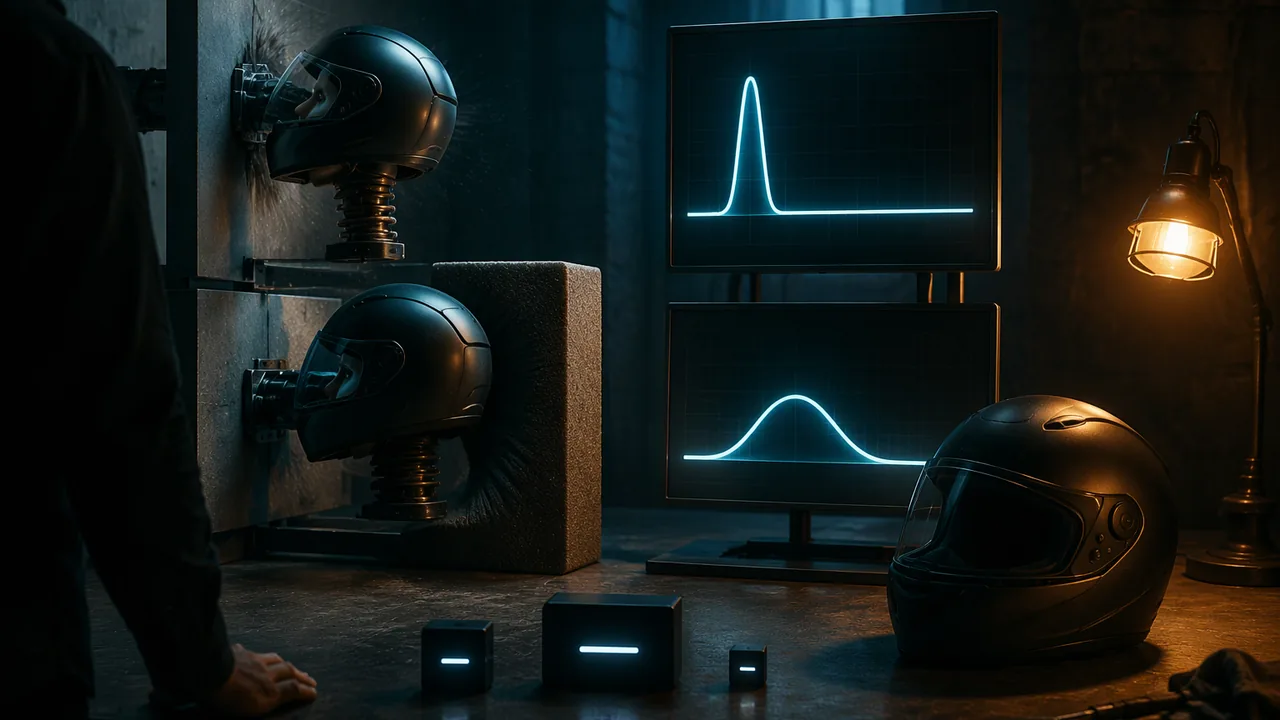
A real impact force rises and falls. On a force-time graph, the area under the curve is the impulse. The two pulses below enclose the same area, 30 N·s. Without a helmet the pulse is a tall spike: a triangle 1 ms wide must peak at 2 × 30 / 0.001 = 60,000 N. With the helmet the triangle is 6 ms wide and peaks at 10,000 N.
Airbags do the same thing
A 70 kg occupant in a car moving at 13.4 m/s (30 mph) has 938 kg·m/s of momentum. Belt and airbag stretching the stop to 0.12 s give an average force of 7,817 N, about 11.4 times body weight, spread over the chest and face. Hitting the dashboard in 0.012 s gives 78,167 N, ten times more, on a small area (stopping times illustrative). The National Highway Traffic Safety Administration (NHTSA) estimates that in 2017 frontal airbags saved 81 lives in Missouri (2,790 nationwide) and seat belts saved 309 (14,955 nationwide).
Common misconceptions
- “The helmet reduces the momentum change.” No: the head still goes from 6.0 m/s to zero. The helmet reduces the force by stretching the time.
- “A bouncy helmet would be better.” A bounce reverses the velocity, so Δp is larger, not smaller. Good liners crush instead of springing back.
- “Force and momentum are the same thing.” Momentum is what an object has; force is the rate at which momentum changes.
📖 Read for this lesson
The reading opens over the lesson; close it to come back to exactly where you were. The checks below draw on it.
Formative check
Work through these before moving on. They are not graded — they tell you whether the standard below has landed yet.
The same egg is dropped from the same height onto a tile floor and onto a folded towel. Compare the change in momentum of the egg in the two cases.
A 5.0 kg head moving at 6.0 m/s is stopped by a helmet in 6 ms. What is the average force on the head?
On a force-time graph, the area under the curve equals the , which equals the change in .
Write three questions about bicycle or motorcycle helmets, airbags or crumple zones that you could answer with measurements this unit. For each, name what you would measure (mass, speed, stopping time, stopping distance, peak force) and what tool you could use (phone slow-motion video, meter stick, kitchen scale).
How confident are you that you can use impulse = FΔt = Δp and a force-time graph to explain why a helmet reduces the force on a rider’s head?
Practice
Work these on paper or in your notebook, then open Check your answer. Aim for all of Fluency and Application; try at least one Challenge.
Printable version: this unit’s practice workbook (PDF)
Fluency
Build speed and accuracy with the core skill.
- A net force of 4500 N gives an object an acceleration of 3 m/s2. What is its mass?
Check your answer
Answer: 1,500.00 kgm = Fnet/a. - What net force gives a 2 kg object an acceleration of 0.5 m/s2?
Check your answer
Answer: 1.00 NFnet = ma. - Find the kinetic energy of a 60 kg object moving at 20 m/s.
Check your answer
Answer: 12,000 JKE = ½mv2. - Find the kinetic energy of a 0.15 kg object moving at 20 m/s.
Check your answer
Answer: 30.0 JKE = ½mv2. - Find the momentum of a 0.145 kg baseball moving at 40 m/s.
Check your answer
Answer: 5.8 kg·m/sp = mv = 0.145 × 40. - Find the momentum of a 1,400 kg car at 15 m/s.
Check your answer
Answer: 21,000 kg·m/sp = mv. - A force-time graph for a kick is a triangle with peak 900 N and duration 0.020 s. Find the impulse, and the speed of a 0.43 kg ball kicked from rest.
Check your answer
Answer: 9.0 N·s; 20.9 m/sArea = ½(900)(0.020) = 9.0 N·s = Δp, so v = 9.0/0.43 = 20.9 m/s.
Application
Use the skill in context. Show your reasoning.
- A 0.145 kg baseball arrives at a bat at 30 m/s and leaves in the opposite direction at 40 m/s. Contact lasts 1.0 ms. Find the impulse and the average force.
Check your answer
Answer: 10.15 N·s; 10,150 NTake the outgoing direction as positive: Δp = 0.145(40 − (−30)) = 10.15 N·s. F = 10.15/0.0010 = 10,150 N. - A 70 kg occupant moving at 13.4 m/s is stopped by an airbag in 0.10 s. Find the average force and compare it with body weight.
Check your answer
Answer: 9,380 N, about 13.7 times body weightF = mv/Δt = 70 × 13.4/0.10 = 9,380 N; weight 686 N. - A 0.50 kg ball hits a wall at 4.0 m/s. Compare its momentum change if it sticks with if it bounces straight back at 4.0 m/s. Which pushes harder on the wall for the same contact time?
Check your answer
Answer: 2.0 vs 4.0 kg·m/s; the bounceSticking: Δp = 0.50 × 4.0. Bouncing: the velocity reverses, so Δp = 0.50 × 8.0, twice as much, and so twice the average force.
Challenge
Stretch problems. Expect to think before you write.
- A helmet test requires the average deceleration of a 4.5 kg headform from 5.5 m/s to stay below 250g (an illustrative target). Assuming constant deceleration, find the minimum stopping time and crush distance.
Check your answer
Answer: 2.24 ms; 6.2 mma = 250 × 9.8 = 2,450 m/s2. t = v/a = 2.24 ms. d = v2/(2a) = 6.2 mm. Real pulses peak above average, so liners must be thicker.
Review
Keep earlier skills sharp.
- An object starts at 10 m/s and accelerates at 3 m/s2 for 11 s. How far does it travel?
Check your answer
Answer: 291.5 md = v0t + ½at2. - An object starts at 12 m/s and accelerates at 2 m/s2 for 5 s. How far does it travel?
Check your answer
Answer: 85.0 md = v0t + ½at2.
What a Helmet and an Airbag Must Do: Missouri’s Helmet Law, the Federal Test Limits, and the Missouri Lives-Saved Count
RSMo 302.020 (revisor.mo.gov, effective Aug. 28, 2020); MoDOT/MHTC, SAFER: Safer Access for Everyone on the Roadways (2024, modot.org/media/44627); 16 CFR 1203.12 and 1203.17, 49 CFR 571.218 S5.1 and S7.1.4, 49 CFR 571.208 (all via Cornell LII); NHTSA, Lives Saved in 2017 by Restraint Use and Minimum-Drinking-Age Laws, DOT HS 812 683 (March 2019), Table 2; all retrieved Nov. 5, 2026; force-time tables are SLS illustrative · Public domain (Missouri statute and United States government regulations and publications, quoted as published); SLS additions CC BY 4.0
Why this reading. The lesson explains a safety law with one idea, impulse, and quotes federal helmet limits of 300 g and 400 g. Your question board has to name what you would measure and with what. This reading gives you Missouri’s helmet law as written, the Missouri Department of Transportation’s own count of what happened after the 2020 change, the tests a bicycle helmet and a motorcycle helmet must pass with their actual drop speeds and headform mass, the parallel test a car’s occupant protection must pass, and the federal count of lives saved in Missouri by airbags, belts and helmets, so that your questions can be about measurable things. The force-time tables at the end are illustrative and reproduce the lesson’s two pulses.
1. The Missouri law
“Every person under twenty-six years of age who is operating or riding as a passenger on any motorcycle or motortricycle, as defined in section 301.010, upon any highway of this state shall wear protective headgear at all times the vehicle is in motion; except that, any person twenty-six years of age or older operating any motorcycle or motortricycle who has been issued an instruction permit shall wear protective headgear at all times the vehicle is in motion.”
— Revised Statutes of Missouri section 302.020.2 (effective August 28, 2020). The same subsection adds that “No political subdivision of this state shall impose a protective headgear requirement” on motorcycle riders, and subsection 3 sets the penalty for not wearing required headgear as an infraction with a fine “not to exceed twenty-five dollars.”
Before that date, Missouri required a helmet for every motorcycle rider. Missouri has no statewide helmet law for bicycle riders of any age.
2. What MoDOT counted afterward
In its 2024 policy report SAFER: Safer Access for Everyone on the Roadways, the Missouri Department of Transportation (MoDOT) and the Missouri Highways and Transportation Commission wrote that “In August 2020, Missouri’s mandatory all-rider helmet law was repealed,” and gave these Missouri figures:
| Measure | 2019 | 2023 |
|---|---|---|
| Unhelmeted motorcyclist fatalities | 11 | 73 |
| All motorcyclist fatalities | 121 | 171 (a record) |
| Share of motorcyclist deaths that were unhelmeted (computed) | 9.1% | 42.7% |
The report also states that “Motorcycle helmets reduce the risk of head injury by 69% and reduce the risk of death by 42%,” that Missouri had 991 traffic deaths in 2023 with 64% of the vehicle occupants killed unbuckled, and it asks lawmakers both to reinstate the all-rider motorcycle helmet law and to “require all bicycle riders under the age of 18 to wear a helmet.” A count of deaths before and after a law change shows a correlation; traffic volume, the number of riders and licensing also changed over those years, which is why MoDOT describes the helmet change as one factor among several. The physics in this unit explains why a helmet changes the outcome of a single impact.
3. The CPSC test a bicycle helmet must pass (16 CFR Part 1203)
Every bicycle helmet sold in the United States must meet this rule. Section 1203.12 sets the requirement: “The peak acceleration of any impact shall not exceed 300 g when the helmet is tested” by the impact-attenuation procedure. Section 1203.17 sets the procedure: a helmet is fitted on a metal headform, the whole drop assembly has a mass of “5.0±0.1 kg (11.00±0.22 lb),” and it is dropped in guided free fall onto three steel anvils. The flat anvil is struck at an impact velocity of 6.2 m/s ±3 percent, which typically requires “a minimum drop height of 2 meters”; the hemispherical and curbstone anvils at 4.8 m/s ±3 percent, from about 1.2 m. An accelerometer on the headform records the pulse.
Turn that into the lesson’s quantities. A 5.0 kg headform at 6.2 m/s has momentum 31 N·s, so the anvil must deliver an impulse of 31 N·s whatever the helmet does. To keep the peak under 300 g = 300 × 9.8 = 2,940 m/s2, a constant deceleration would need at least Δt = 6.2/2,940 = 2.11 ms and a stopping distance of v2/(2a) = 6.5 mm. A real pulse is not constant, so its peak is well above its average; that is why liners are 20 to 30 mm thick, not 7. Check: 6.2 m/s is the speed after falling 6.22/(2 × 9.8) = 1.96 m, which is where the 2 m drop height comes from.
4. The test a motorcycle helmet must pass (49 CFR 571.218, FMVSS 218)
The “DOT” standard named in MoDOT’s proposal is Federal Motor Vehicle Safety Standard 218. Its impact test (S7.1.4) drops a helmeted headform onto a hemispherical anvil at 5.0 to 5.4 m/s and onto a flat anvil at 5.8 to 6.2 m/s. Section S5.1 sets three limits on the measured pulse: “(a) Peak accelerations shall not exceed 400g; (b) Accelerations in excess of 200g shall not exceed a cumulative duration of 2.0 milliseconds; and (c) Accelerations in excess of 150g shall not exceed a cumulative duration of 4.0 milliseconds.” Limits (b) and (c) are about time: a helmet cannot pass by keeping the peak just under 400 g if the force stays high for long. At the lesson’s 6.0 m/s, a constant 400 g (3,920 m/s2) stop would last 6.0/3,920 = 1.53 ms over 6.02/(2 × 3,920) = 4.6 mm.
5. The parallel test for a car (49 CFR 571.208, FMVSS 208) and the lives-saved count
Federal Motor Vehicle Safety Standard 208 requires a car to protect test dummies in a frontal crash into a fixed rigid barrier at “any speed, up to and including 56 km/h (35 mph).” The dummy’s chest acceleration must not exceed 60 g “except for intervals whose cumulative duration is not more than 3 milliseconds” (S6.3), and chest deflection must stay within 63 mm (S6.4(b)), alongside head and neck criteria. Each limit is a measurement of the kind this unit teaches: an acceleration, a time, a distance. The 60 g chest limit is one-fifth of the bicycle helmet’s 300 g head limit, because the chest is not a skull and a car crash lasts far longer than a helmet impact.
NHTSA’s National Center for Statistics and Analysis estimated the lives saved by restraints in 2017, nationally and state by state (Traffic Safety Facts DOT HS 812 683, March 2019):
| Device | Lives saved in 2017, national | In Missouri |
|---|---|---|
| Seat belts (occupants 5 and older) | 14,955 | 309 |
| Frontal air bags (occupants 13 and older) | 2,790 | 81 |
| Child restraints (age 4 and younger) | 325 | 9 |
| Motorcycle helmets (all ages) | 1,872 | 60 |
| Additional lives savable at 100% belt use | 2,549 | 103 |
| Additional lives savable at 100% helmet use | 749 | 8 |
Notice the last row. In 2017 Missouri still required every motorcycle rider to wear a helmet, so NHTSA estimated that only 8 more Missouri lives could have been saved by universal helmet use. Hold the frontal-airbag count beside the lesson’s arithmetic: 938 kg·m/s of momentum stopped in 0.12 s instead of 0.012 s (both times illustrative) is 7,800 N spread over a chest instead of 78,000 N on a dashboard edge.
6. Two pulses, same area (illustrative)
The lesson draws two triangular force pulses that both deliver 30 N·s to a 5.0 kg head moving at 6.0 m/s. Here they are as tables, sampled so you can integrate them yourself. Area = ½ × base × peak.
Bare head on concrete, 1.0 ms pulse:
| t (ms) | F (N) |
|---|---|
| 0.00 | 0 |
| 0.25 | 30,000 |
| 0.50 | 60,000 |
| 0.75 | 30,000 |
| 1.00 | 0 |
Helmeted head, 6.0 ms pulse:
| t (ms) | F (N) |
|---|---|
| 0.0 | 0 |
| 1.0 | 3,333 |
| 2.0 | 6,667 |
| 3.0 | 10,000 |
| 4.0 | 6,667 |
| 5.0 | 3,333 |
| 6.0 | 0 |
Bare: ½ × 0.0010 s × 60,000 N = 30 N·s. Helmet: ½ × 0.0060 s × 10,000 N = 30 N·s. Peak deceleration bare: 60,000/5.0 = 12,000 m/s2 = 1,224 g; helmet: 2,000 m/s2 = 204 g, under the 300 g limit with margin. The average force is half the peak for a triangle, which is the lesson’s 30,000 N and 5,000 N.
Your turn
- Integrate both tables with the trapezoid rule (sum of average force in each interval times the interval) and confirm the two areas.
- The CPSC flat-anvil test uses 6.2 m/s and 5.0 kg. Recompute the lesson’s bare-head and helmeted numbers for that speed and mass. Does the helmeted pulse still pass 300 g? Would it pass the motorcycle standard’s 400 g peak limit?
- Use MoDOT’s numbers: by what factor did unhelmeted motorcyclist deaths change from 2019 to 2023, and by what factor did all motorcyclist deaths change? Explain why the second number matters before you credit the whole change to the law.
- Write three measurable questions for the question board, each naming a quantity in this reading (a speed, a mass, a stopping time, a peak acceleration) and the tool you would use.
Sources: Revisor of Missouri, Section 302.020 RSMo (revisor.mo.gov); MoDOT / Missouri Highways and Transportation Commission, SAFER: Safer Access for Everyone on the Roadways (2024) (modot.org); 16 CFR 1203.12, Test requirements (Cornell LII) (law.cornell.edu); 16 CFR 1203.17, Impact attenuation test (Cornell LII) (law.cornell.edu); 49 CFR 571.218, Standard No. 218; Motorcycle helmets (Cornell LII) (law.cornell.edu); 49 CFR 571.208, Standard No. 208; Occupant crash protection (Cornell LII) (law.cornell.edu); NHTSA, Lives Saved in 2017 by Restraint Use and Minimum-Drinking-Age Laws (DOT HS 812 683) (crashstats.nhtsa.dot.gov)