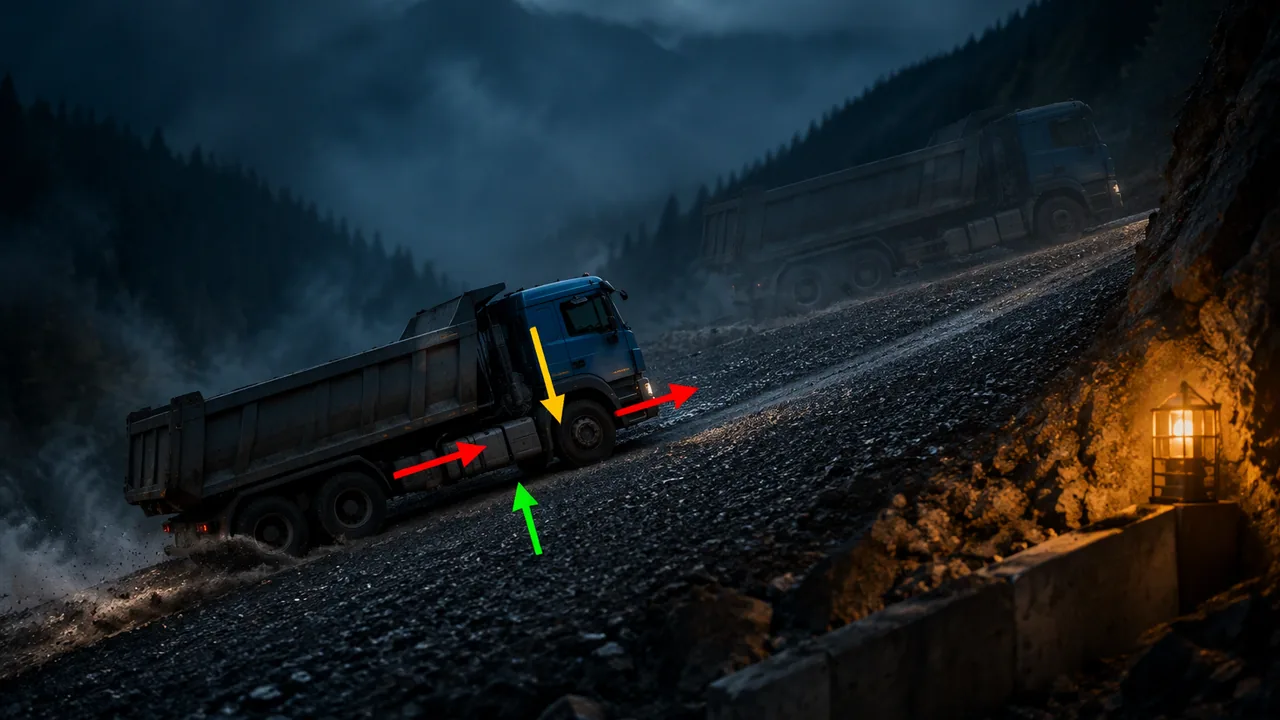
resolve forces on inclines into components, apply Newton’s second law to connected objects and accelerating frames, and build a model for the stopping length of a runaway-truck escape ramp.
Instruction
One method for every problem. Choose the object or system. Draw its free-body diagram. Choose axes, ideally with one axis along the acceleration. Resolve every force into components along those axes. Write Fnet = ma separately for each axis, then solve. The examples below use that method on the situations an escape-ramp designer needs.
Inclines. On a slope at angle θ, tilt your axes to match it. The weight mg splits into mg sin θ down the slope and mg cos θ into the slope. The normal force balances the perpendicular part, FN = mg cos θ. Worked example: a 10 kg box on a 25° ramp has components (10)(9.8)(sin 25°) = 41.4 N along the slope and 88.8 N into it. Without friction it slides down at g sin 25° = 4.14 m/s2. That is the model you tested with the Unit 1 ramp.
The escape-ramp model. A truck entering an uphill gravel ramp has two backward forces along the slope: the component of its weight, mg sin θ, and the resistance of the gravel, which we model as friction μFN = μmg cos θ. Newton’s second law gives a deceleration
a = g(sin θ + μ cos θ)
and, with v2 = v02 − 2aL from Unit 1, the stopping length L = v02/(2a). The mass cancels, which is why one ramp works for a pickup and a loaded semi. Worked example (illustrative values): a truck enters at 31 m/s (69 mph) on a 10% upgrade (θ = 5.71°) with an effective gravel coefficient μ = 0.25 (illustrative; real arrester beds are characterized by field tests). Then a = 9.8(sin 5.71° + 0.25 cos 5.71°) = 3.41 m/s2 and L = 312/(2 × 3.41) = 141 m. On level gravel the same truck would need 196 m. Each part of the design (the grade, the bed material, the length) can be treated as a separate sub-problem.
Connected objects: the Atwood machine. Masses of 3.0 kg and 2.0 kg hang on either side of a light pulley. Treat both as one system moving along the string. The net force is the difference in weights, (3.0 − 2.0)(9.8) = 9.8 N, and the mass being accelerated is 5.0 kg, so a = 1.96 m/s2. For the tension, look at one mass: for the 2.0 kg side, T − 19.6 = 2.0(1.96), so T = 23.52 N, between the two weights as it must be.
Contact forces. Push a 4 kg block with 24 N so that it pushes a 2 kg block ahead of it on a frictionless floor. The whole system accelerates at 24/6 = 4.0 m/s2. The front block needs 2 × 4.0 = 8 N, so the blocks push on each other with 8 N (a third-law pair), not 24 N.
Apparent weight. A 60 kg student stands on a bathroom scale in an elevator. The scale reads the normal force. At rest, FN = mg = 588 N. Accelerating upward at 1.5 m/s2, FN − mg = ma, so FN = 60(9.8 + 1.5) = 678 N, and a scale calibrated in kilograms reads 69.2 kg. Accelerating downward at 1.5 m/s2, it reads 498 N (50.8 kg). The student’s mass never changed.
Misconceptions. (1) The normal force on a slope is not mg; it is mg cos θ. (2) Use the angle of the slope, and check with a limiting case: at θ = 0 the component along the slope must vanish. (3) Tension in a rope holding an accelerating mass is not equal to that mass’s weight.
📖 Read for this lesson
The reading opens over the lesson; close it to come back to exactly where you were. The checks below draw on it.
Formative check
Work through these before moving on. They are not graded — they tell you whether the standard below has landed yet.
A truck enters an escape ramp at 31 m/s. With the ramp’s deceleration of 3.41 m/s2, how long must the ramp be?
A 10 kg box sits on a 25° incline. The component of its weight along the incline is N, and the normal force is N.
A 60 kg student in an elevator accelerating upward at 1.5 m/s2 pushes on the scale with 678 N.
Build a spreadsheet model of escape-ramp length. Column A: entry speed from 20 to 40 m/s in steps of 2. Columns B-D: stopping length L = v2/[2g(sin θ + μ cos θ)] for grades of 0%, 5% and 10% with μ = 0.25. Graph all three. Then answer: which change shortens the ramp more, raising the grade from 5% to 10% or raising μ from 0.25 to 0.35? Show the numbers. (Graph paper and a calculator are fine if you do not have a spreadsheet.)
How confident are you that you can use free-body diagrams and components to model inclines, connected objects and escape ramps?
Practice
Work these on paper or in your notebook, then open Check your answer. Aim for all of Fluency and Application; try at least one Challenge.
Printable version: this unit’s practice workbook (PDF)
Fluency
Build speed and accuracy with the core skill.
- In a right triangle, an acute angle is 30° and the hypotenuse is 19. Find the side opposite the angle. Round to the nearest tenth.
Check your answer
Answer: 9.5sin 30° = opp/19 - In a right triangle, an acute angle is 30° and the adjacent leg is 33. Find the opposite leg. Round to the nearest tenth.
Check your answer
Answer: 19.1tan 30° = opp/33 - A 10 kg box is pushed with 25 N to the right against 5 N of friction. Find the net force and the acceleration.
Check your answer
Answer: net force 20 N to the right; a = 2.00 m/s2Add forces as vectors: the net force is the applied force minus friction. - A 4 kg box is pushed with 60 N to the right against 19 N of friction. Find the net force and the acceleration.
Check your answer
Answer: net force 41 N to the right; a = 10.25 m/s2Add forces as vectors: the net force is the applied force minus friction. - A 15 kg box sits on a 20° incline. Find the components of its weight parallel and perpendicular to the incline.
Check your answer
Answer: 50.3 N and 138.1 Nmg sin 20° = 50.3 N; mg cos 20° = 138.1 N. - The same box slides down with μk = 0.20. What is its acceleration?
Check your answer
Answer: 1.51 m/s2a = g(sin 20° − 0.20 cos 20°) = 1.51 m/s2. - A 55 kg student rides an elevator that accelerates downward at 2.0 m/s2. What does a scale under the student read in newtons?
Check your answer
Answer: 429 NFN = m(g − a) = 55(7.8) = 429 N.
Application
Use the skill in context. Show your reasoning.
- An Atwood machine holds 5.0 kg and 3.0 kg. Find the acceleration and the string tension.
Check your answer
Answer: a = 2.45 m/s2; T = 36.75 Na = (5.0 − 3.0)(9.8)/8.0 = 2.45 m/s2. For the 3.0 kg mass: T = 3.0(9.8 + 2.45) = 36.75 N. - An escape ramp has an 8% upgrade and gravel with effective μ = 0.30 (illustrative). A truck enters at 28 m/s. Find the deceleration and the stopping length.
Check your answer
Answer: 3.71 m/s2; 106 mθ = tan−10.08 = 4.57°. a = 9.8(sin θ + 0.30 cos θ) = 3.71 m/s2. L = 282/(2a) = 106 m. - Explain why the escape-ramp length does not depend on the truck’s mass in the model a = g(sin θ + μ cos θ).
Check your answer
Answer: Mass cancelsBoth backward forces (mg sin θ and μmg cos θ) are proportional to m, and so is the inertia, so a is the same for any mass.
Challenge
Stretch problems. Expect to think before you write.
- A 2.0 kg block on a table (μk = 0.25) is tied over a pulley to a hanging 1.0 kg mass. Find the acceleration and the tension.
Check your answer
Answer: a = 1.63 m/s2; T = 8.17 NSystem: a = (1.0 × 9.8 − 0.25 × 2.0 × 9.8)/3.0 = 1.63 m/s2. Hanging mass: T = 1.0(9.8 − 1.63) = 8.17 N.
Review
Keep earlier skills sharp.
- A car moving at 4 m/s speeds up at 4 m/s2 for 7 s. What is its final speed?
Check your answer
Answer: 32.0 m/sv = v0 + at. - A car moving at 2 m/s speeds up at 4 m/s2 for 3 s. What is its final speed?
Check your answer
Answer: 14.0 m/sv = v0 + at.
The Escape-Ramp Model, Run: Stopping Length Against Speed, Grade and Bed, With Check Values
SLS original model output: L = v^2 / [2g(sin theta + mu cos theta)] evaluated for entry speeds 20-40 m/s, grades 0/5/10 percent and mu 0.25 and 0.35, plus worked check cases; the coefficient values are illustrative · SLS original (CC BY 4.0); model output from illustrative inputs
Why this reading. The workshop asks you to build a spreadsheet model of ramp length and then to answer a comparison question from it, and says graph paper and a calculator are fine if you have no spreadsheet. Sixty-six evaluations of a formula by calculator is not physics; it is typing. Here is the model already run at the grid the lesson specifies, with the formula shown, so you can check your own spreadsheet against it row by row or, if you have no spreadsheet, graph these values and spend your time on the comparison. Every input is the lesson’s; μ = 0.25 and 0.35 are illustrative effective coefficients for loose beds.
The model
A truck entering an upward bed at speed v is slowed by the component of its weight along the slope, mg sin θ, and by the bed’s resistance, modeled as μmg cos θ. Newton’s second law along the slope gives a = g(sin θ + μ cos θ), the mass cancels, and v2 = v02 − 2aL with v = 0 gives
L = v02 / [2g(sin θ + μ cos θ)]
A grade of p percent means tan θ = p/100, so θ = tan−1(p/100): 5 percent is 2.862° and 10 percent is 5.711°. Using sin θ = p/100 instead of the true sine changes L by less than 0.5 percent at these grades, but say which you used, because anyone recomputing your numbers, including you in the reviewed-draft stage, will otherwise see a mystery in the third figure.
Worked checks
- 31 m/s, 10 percent, μ = 0.25: a = 9.8(sin 5.711° + 0.25 cos 5.711°) = 9.8(0.09950 + 0.24876) = 3.413 m/s2; L = 961/(2 × 3.413) = 141 m. The lesson’s 141 m.
- 31 m/s on level gravel: a = 9.8 × 0.25 = 2.45 m/s2; L = 961/4.9 = 196 m.
- 35.76 m/s (80 mph), 5 percent, μ = 0.25 (the Lesson 2.5 worked design): a = 2.936 m/s2, L = 218 m, stopping time v/a = 12.2 s.
The model output
| Entry speed (m/s) | L, 0% grade, μ 0.25 (m) | L, 5% grade, μ 0.25 (m) | L, 10% grade, μ 0.25 (m) | L, 5% grade, μ 0.35 (m) |
|---|---|---|---|---|
| 20 | 82 | 68 | 59 | 51 |
| 22 | 99 | 82 | 71 | 62 |
| 24 | 118 | 98 | 84 | 74 |
| 26 | 138 | 115 | 99 | 86 |
| 28 | 160 | 133 | 115 | 100 |
| 30 | 184 | 153 | 132 | 115 |
| 32 | 209 | 174 | 150 | 131 |
| 34 | 236 | 197 | 169 | 148 |
| 36 | 264 | 221 | 190 | 166 |
| 38 | 295 | 246 | 212 | 184 |
| 40 | 327 | 272 | 234 | 204 |
Reading the table
Every column is a parabola in v: doubling the entry speed from 20 to 40 m/s quadruples the length in each column (68 to 272 m at 5 percent). The comparison the lesson asks for is between two ways of shortening the ramp at a fixed speed. At 30 m/s: raising the grade from 5 to 10 percent takes L from 153 to 132 m, a saving of 21 m (14 percent); raising μ from 0.25 to 0.35 at 5 percent takes it from 153 to 115 m, a saving of 38 m (25 percent). The bed matters more than the grade, and the reason is in the denominator: sin θ rises by 0.050 when the grade doubles, while μ cos θ rises by 0.100 when μ goes up by 0.10. Check that the percentage saving is the same in every row of the table; it must be, because v2 cancels from the ratio.
Other check values for the workshop
| Case | Quantity | Value |
|---|---|---|
| 10 kg box on a 25° incline | weight component along slope; normal force | 41.4 N; 88.8 N |
| Same box, no friction | acceleration down the slope | 4.14 m/s2 |
| Atwood machine, 3.0 kg and 2.0 kg | acceleration; tension | 1.96 m/s2; 23.5 N |
| 4 kg block pushing 2 kg block, 24 N | acceleration; contact force between blocks | 4.0 m/s2; 8 N |
| 60 kg student, elevator accelerating up 1.5 m/s2 | scale reading | 678 N (69.2 kg on a kg scale) |
| Same student, accelerating down 1.5 m/s2 | scale reading | 498 N (50.8 kg) |
Your turn
- Build the spreadsheet (or use this table) and graph L against v for the three grades at μ = 0.25. Describe the shape and say why the curves spread apart as v grows.
- Answer the lesson’s question with numbers from the 30 m/s row and then from the 40 m/s row: which change shortens the ramp more, and is the answer the same at both speeds?
- Add a column for 10 percent grade with μ = 0.35 and find the entry speed at which that ramp would be exactly 150 m long.
- The model treats the bed as sliding friction. Real gravel lets the wheels sink and resists more as they sink. Would that make the real stopping length longer or shorter than the table says for the same μ, and what does that do to the safety factor you choose in Lesson 2.5?
Sources: NIST, standard acceleration of gravity g_n = 9.80665 m/s^2 (exact) (physics.nist.gov)