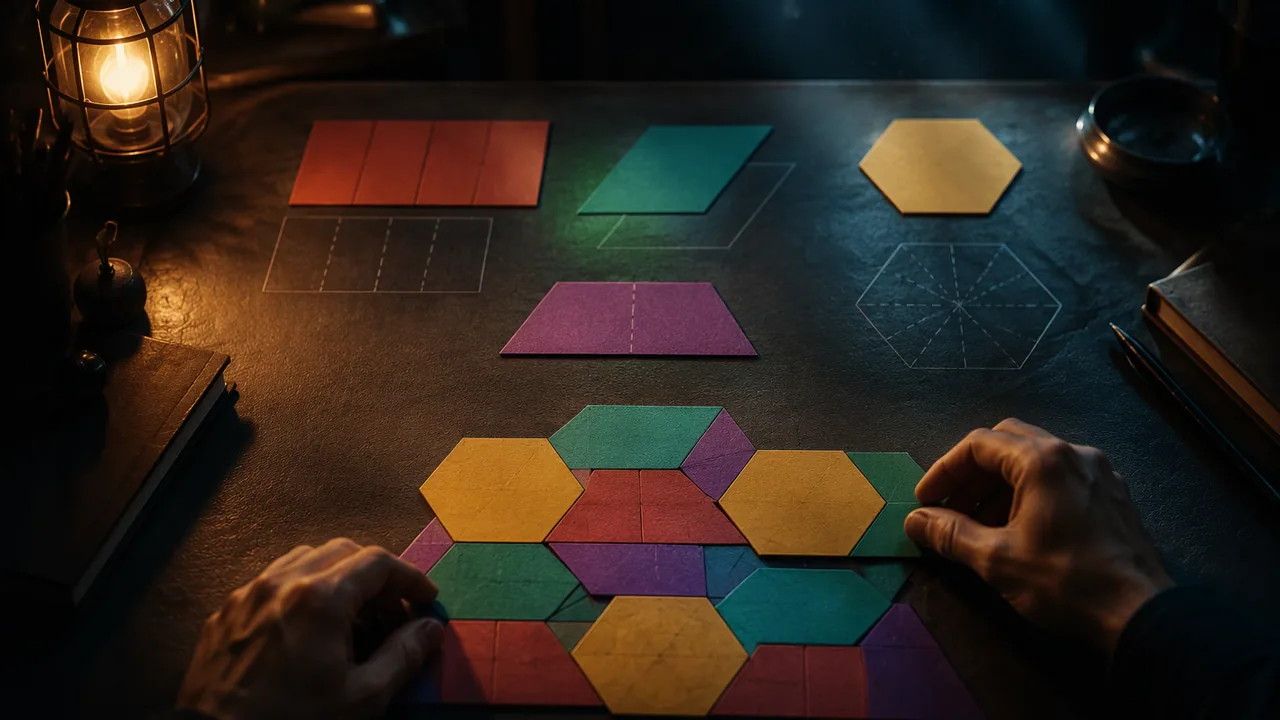
describe every rotation and reflection that carries a rectangle, parallelogram, isosceles trapezoid or regular polygon onto itself, and use symmetry to analyze and build a design.
Instruction
A rigid transformation carries a figure onto itself when the image lands exactly on the original, vertex on vertex and side on side. These transformations are the figure’s symmetries. Designers use them constantly: a logo with 5-fold rotational symmetry reads as balanced from every direction; a tile that is symmetric across a line can be flipped during installation without anyone noticing.
Rectangle (not a square). Two reflections: across the line joining the midpoints of the long sides, and across the line joining the midpoints of the short sides. One non-trivial rotation: 180° about the point where the diagonals cross. A rectangle is not symmetric across its diagonal: reflecting across a diagonal sends a long side onto a line where a short side is, so the image does not match.
Parallelogram (not a rectangle or rhombus). No line symmetry at all, but it has a 180° rotation about the intersection of its diagonals. That fact is the transformational reason why opposite sides and opposite angles of a parallelogram are congruent, which you will prove in Unit 2.
Isosceles trapezoid. One reflection, across the line through the midpoints of the two parallel sides. No rotation other than 360°.
Regular n-gon. A regular polygon with n sides has n lines of symmetry and n rotations: through multiples of 360°/n (counting 0°, the identity). A regular hexagon has rotations of 0°, 60°, 120°, 180°, 240° and 300°, and six reflection lines. When n is odd, each line of symmetry passes through a vertex and the midpoint of the opposite side; when n is even, half the lines pass through two opposite vertices and half through the midpoints of two opposite sides. A regular pentagon, for example, has rotations by 72°, and five lines each through a vertex.
Modeling with symmetry. Suppose you are designing a round medallion with six identical petals. Start with the regular hexagon construction from Lesson 1.1. Draw one petal between the center and one vertex. Every other petal is the image of the first under a rotation of 60°, 120° and so on about the center. If you also want the design to be symmetric across a line, make the first petal symmetric across its own axis. The design then has 12 symmetries: six rotations and six reflections.
Mapping one figure to another. The same thinking lets you specify a sequence of transformations. If motif M sits in one corner of a tile and motif N in the opposite corner, and N is M turned upside down, a single rotation of 180° about the tile’s center carries M to N. If N is M flipped left-to-right, the move is a reflection across the vertical midline. Being precise means naming the center and angle of each rotation, the line of each reflection, and the vector of each translation.
Workshop. Choose three real designs: a flag, a hubcap, a quilt block, a tribal or cultural pattern, a company logo. For each, list every symmetry precisely, and note any place where the design almost has a symmetry but breaks it (lettering often does). Then sketch an original motif with a symmetry group you choose in advance.
📖 Read for this lesson
The reading opens over the lesson; close it to come back to exactly where you were. The checks below draw on it.
Formative check
Work through these before moving on. They are not graded — they tell you whether the standard below has landed yet.
Which transformation carries a non-rectangular parallelogram onto itself?
A regular pentagon is carried onto itself by rotations that are multiples of degrees, and it has lines of symmetry.
A rectangle that is not a square is symmetric across its diagonals.
Pick a real design (a flag, hubcap, quilt block or logo). List every symmetry precisely, naming the center and angle of each rotation and the line of each reflection. Point out one feature that breaks a symmetry the design almost has.
How confident are you that you can list every rotation and reflection that carries a given polygon onto itself?
Practice
Work these on paper or in your notebook, then open Check your answer. Aim for all of Fluency and Application; try at least one Challenge.
Printable version: this unit’s practice workbook (PDF)
Fluency
Build speed and accuracy with the core skill.
- Find the image of (0, −8) under the translation (x, y) → (x − 4, y + 5).
Check your answer
Answer: (−4, −3) - Find the image of (3, −4) under a rotation of 180° about the origin.
Check your answer
Answer: (−3, 4) - Find the image of (6, −1) under a reflection over the y-axis.
Check your answer
Answer: (−6, −1) - List every rotation (including 0°) and count the lines of symmetry of a square.
Check your answer
Answer: Rotations 0°, 90°, 180°, 270°; 4 lines of symmetry (2 diagonals, 2 midlines). - How many lines of symmetry does a rectangle that is not a square have, and what is its non-trivial rotation?
Check your answer
Answer: 2 lines (the two midlines); a 180° rotation about the center. - What is the smallest positive rotation that carries a regular octagon onto itself?
Check your answer
Answer: 45°360° ÷ 8. - Describe every symmetry of an isosceles trapezoid that is not a rectangle.
Check your answer
Answer: One reflection, across the line through the midpoints of the two parallel sides (plus the identity). - A parallelogram that is not a rectangle or rhombus: list its symmetries.
Check your answer
Answer: Only the 180° rotation about the intersection of its diagonals (plus the identity). - How many lines of symmetry does a regular pentagon have, and through what points does each pass?
Check your answer
Answer: 5; each passes through a vertex and the midpoint of the opposite side.
Application
Use the skill in context. Show your reasoning.
- A hubcap has 5 identical spokes and no other markings. Find every rotation (between 0° and 360°) that carries it onto itself.
Check your answer
Answer: 0°, 72°, 144°, 216°, 288°Multiples of 360°/5. - Which capital letters of H, N, S, A and X have 180° rotational symmetry? Which have a vertical line of symmetry?
Check your answer
Answer: 180° rotation: H, N, S, X. Vertical line: H, A, X. - A square tile has a motif M in its top-left corner. Specify the single transformation that places a copy in the bottom-right corner turned upside down, and the one that places a mirror-image copy in the top-right corner.
Check your answer
Answer: Bottom-right, upside down: rotation of 180° about the tile’s center. Top-right mirror image: reflection across the vertical midline.
Challenge
Stretch problems. Expect to think before you write.
- A regular pentagon is rotated 72° counterclockwise about its center seven times. What single rotation between 0° and 360° has the same effect?
Check your answer
Answer: 144°7 × 72° = 504°, and 504° − 360° = 144°.
Review
Keep earlier skills sharp.
- Solve: −8x + 2 = 26
Check your answer
Answer: x = −3Subtract 2 from both sides: −8x = 24. Divide by −8. - Solve: −5x − 5 = −30
Check your answer
Answer: x = 5Add 5 to both sides: −5x = −25. Divide by −5. - Find the slope of the line through (−4, 2) and (−6, −2).
Check your answer
Answer: m = 2m = (−2 − 2) ÷ (−6 − (−4)) = 2 - A right triangle has legs 7 and 2. Find the hypotenuse exactly.
Check your answer
Answer: √53c2 = 72 + 22 = 53.
Three Designs Given Exactly: The Missouri Flag, a Pinwheel Block and a Five-Lug Hub
Revised Statutes of Missouri section 10.020 (Flag, official — design of), via the Missouri Revisor of Statutes, retrieved 2026-11-03; the pinwheel block and hub pattern are constructed coordinate designs written for this course · SLS original (constructed coordinate designs), with the Missouri flag proportions quoted from RSMo section 10.020
Why this reading. The workshop asks you to take three real designs, list every symmetry precisely and point out where a design almost has a symmetry but breaks it. A picture is not precise enough to argue from: you need the design as numbers. Here are three, given by coordinates so that every claimed symmetry can be checked by applying the rule to the vertices. The Missouri flag proportions are quoted from the state statute that defines the flag; the other two designs are written for this course. Design 3 is the one to use for the open question if you have no design of your own.
Design 1. The Missouri State Flag (RSMo § 10.020)
The statute fixes the proportions. Quoting it: the flag’s “vertical width is to the horizontal length as seven is to twelve”; it has “one red, one white and one blue horizontal stripe of equal width; the red is at the top and the blue at the bottom.” “In the center of the flag there is a band of blue in the form of a circle enclosing the coat of arms”; “The width of the blue band is one-fourteenth of the vertical width of the flag and the diameter of the circle is one-third of the horizontal length of the flag. In the blue band there are set at equal distances from each other twenty-four five-pointed stars.”
Take the length (the fly) as 36 units, with the origin at the lower-left corner and the hoist along the y-axis:
| Element | Statute proportion | Coordinates or size |
|---|---|---|
| Whole flag | width : length = 7 : 12 | rectangle (0, 0) to (36, 21) |
| Blue stripe (bottom) | ⅓ of the width | rectangle (0, 0) to (36, 7) |
| White stripe | ⅓ of the width | rectangle (0, 7) to (36, 14) |
| Red stripe (top) | ⅓ of the width | rectangle (0, 14) to (36, 21) |
| Circle | diameter = ⅓ of the length, at the center | center (18, 10.5), radius 6 |
| Blue band | width = 1/14 of the flag’s width | 21/14 = 1.5, so the band runs from radius 4.5 to radius 6 |
| 24 stars | equal distances apart in the band | centers on the circle of radius 5.25 about (18, 10.5), 360°/24 = 15° apart |
Two checks you can run. The circle reaches from y = 4.5 to y = 16.5, so it crosses both stripe boundaries; it meets the line y = 14 where (x − 18)² + 3.5² = 36, at x = 18 ± √23.75 ≈ 18 ± 4.873. And adjacent star centers are 2(5.25) sin 7.5° ≈ 1.371 units apart, so a star a little narrower than the 1.5-unit band fits without touching its neighbors. The statute fixes the spacing of the stars but not where the ring starts; for this table, put one star center straight above the center, at (18, 15.75). The next one counterclockwise is then at (18 − 5.25 sin 15°, 10.5 + 5.25 cos 15°) ≈ (16.641, 15.571).
Symmetries of the whole flag: none but the identity. Every rigid motion that carries the 36 × 21 rectangle onto itself is one of four (identity, the two midline reflections, the 180° half-turn about (18, 10.5)). The reflection across y = 10.5 and the half-turn both put the red stripe at the bottom, which the statute forbids. The reflection across x = 18 carries every stripe and the circle onto themselves, but the coat of arms inside the circle carries the motto “Salus populi suprema lex esto” and the date MDCCCXX, and reflected letters are not letters. Almost-symmetries worth naming: the stripes and circle alone have exactly two symmetries (the identity and the reflection across x = 18); the 24 star centers alone have 24 rotations (multiples of 15° about (18, 10.5)) and 24 reflection lines through (18, 10.5); and the reflection across x = 18 keeps the star ring only if a star center, or the midpoint between two neighbors, sits on that line. With the starting star at the top, it does. Rotate the ring by 5° and decide whether it still does.
Design 2. A pinwheel quilt block (constructed, illustrative)
A 4 × 4 square from (0, 0) to (4, 4), center (2, 2). Four dark right triangles on a light background:
| Triangle | Vertices |
|---|---|
| T₁ | (0, 0), (2, 0), (2, 2) |
| T₂ | (4, 0), (4, 2), (2, 2) |
| T₃ | (4, 4), (2, 4), (2, 2) |
| T₄ | (0, 4), (0, 2), (2, 2) |
The rotation of 90° counterclockwise about (2, 2) has rule (x, y) → (4 − y, x). Apply it to T₁: (0, 0) → (4, 0), (2, 0) → (4, 2), (2, 2) → (2, 2). That is exactly T₂. Check that it also carries T₂ to T₃. Now reflect across the vertical midline x = 2, rule (x, y) → (4 − x, y): T₁ → (4, 0), (2, 0), (2, 2), which is not one of the four dark triangles. The block has four rotational symmetries and no line of symmetry, which is why a pinwheel sewn as its mirror image is a different block.
Design 3. A five-lug hub with a valve notch (constructed, illustrative)
A disk of radius 6 centered at the origin, five bolt holes of radius 0.5 centered at distance 4 from the origin at angles 90°, 162°, 234°, 306° and 18°:
| Hole | Center (3 d.p.) |
|---|---|
| H₁ | (0, 4) |
| H₂ | (−3.804, 1.236) |
| H₃ | (−2.351, −3.236) |
| H₄ | (2.351, −3.236) |
| H₅ | (3.804, 1.236) |
Without the notch, the pattern has ten symmetries: rotations of 0°, 72°, 144°, 216° and 288° about the origin, and five reflections, each across a line through the origin and one hole. Now add a small valve notch cut into the rim at (0, −6). List the symmetries that survive, with the center and angle of each rotation and the equation of each reflection line, and say in one sentence why one line survives and the other four do not.
Sources: Revised Statutes of Missouri section 10.020, Flag, official — design of (revisor.mo.gov)