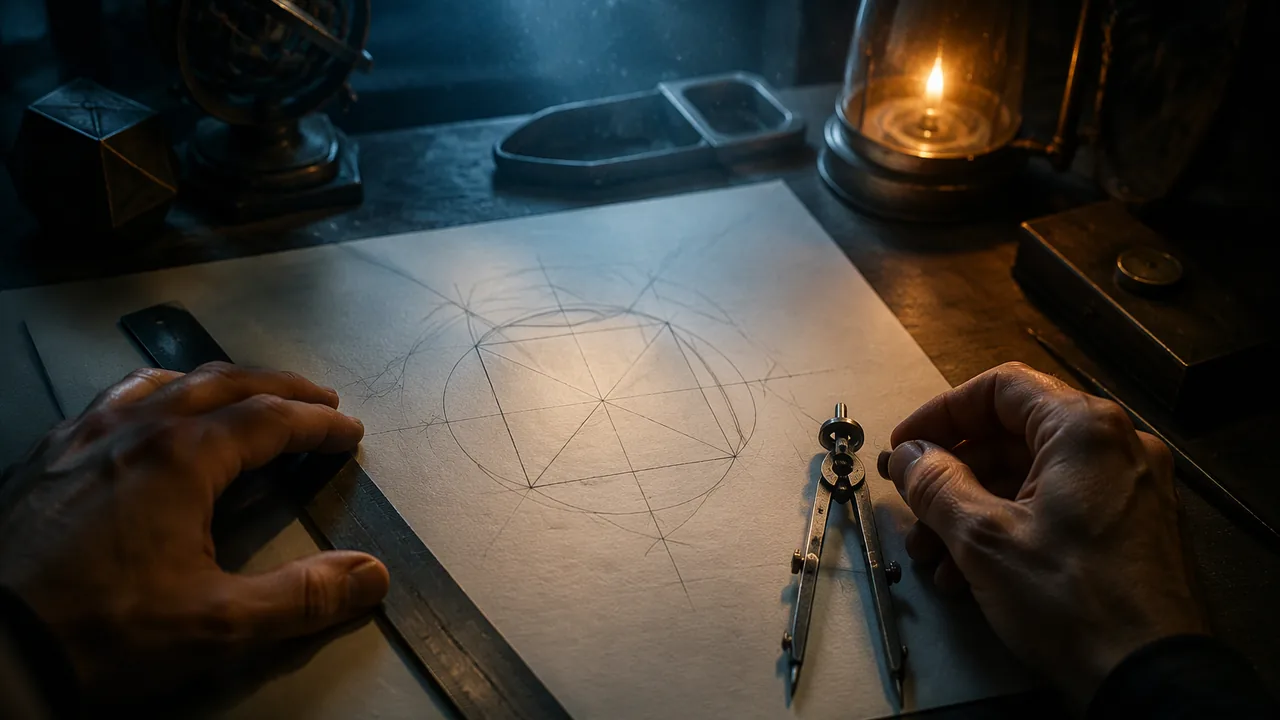
copy a segment and an angle, bisect an angle, construct a perpendicular and a parallel through a given point, and inscribe a square in a circle, justifying each step.
Instruction
This lab builds the rest of the standard construction toolkit. For each one, learn the steps, then learn the reason, because the reason is what you will be asked for.
Copy a segment. To copy AB onto a ray from point P, set the compass to AB and draw an arc centered at P. Where it crosses the ray is Q, and PQ = AB because both are radii of equal circles.
Copy an angle. Given angle A and a ray from P. Draw an arc centered at A crossing both sides at B and C. With the same radius draw an arc centered at P crossing the ray at Q. Set the compass to BC and draw an arc centered at Q, crossing the first arc at R. Draw ray PR. Why: AB = PQ, AC = PR and BC = QR, so triangles ABC and PQR have three pairs of equal sides; once you have the SSS criterion (Unit 2), the angles at A and P are equal.
Bisect an angle. Draw an arc centered at the vertex V crossing the sides at A and B. With any radius larger than half of AB, draw equal arcs centered at A and B meeting at C. Ray VC bisects the angle. Why: VA = VB and AC = BC, so VACB is a kite, and the diagonal from V splits it into two triangles with three equal pairs of sides.
Perpendicular through a point. If P is on line l, draw a circle centered at P crossing l at A and B, then construct the perpendicular bisector of AB; it passes through P. If P is off the line, draw a circle centered at P that crosses l at two points A and B. P is equidistant from A and B, so the perpendicular bisector of AB passes through P.
Parallel through a point. Given line l and point P not on it, draw any line through P crossing l at Q. Copy the angle that this transversal makes with l so that the copy sits at P in the corresponding position. The new line is parallel to l, because corresponding angles are congruent (you will prove this direction and its converse in Unit 2). An alternative: construct a perpendicular to l through P, then a perpendicular to that line at P. Two lines perpendicular to the same line are parallel.
Inscribe a square. Draw a diameter AC of the circle. Construct its perpendicular bisector, which passes through the center O and meets the circle at B and D. ABCD is a square: its diagonals are equal (both are diameters), bisect each other at O and are perpendicular.
Worked check. A classmate bisects an angle by drawing arcs centered at A and B with different radii. Does it work? No. If AC ≠ BC, point C is not on the angle bisector; the two triangles are no longer congruent. Test it in GeoGebra: measure the two angles and they differ.
Lab routine. For each construction: (1) do it with compass and straightedge; (2) repeat it in GeoGebra with only circle, line and intersection tools; (3) drag the given objects to test that it holds; (4) write the justification in one or two sentences, naming the definition or result you used.
📖 Read for this lesson
The reading opens over the lesson; close it to come back to exactly where you were. The checks below draw on it.
Formative check
Work through these before moving on. They are not graded — they tell you whether the standard below has landed yet.
To construct a line through P perpendicular to line l (P not on l), what is the first step?
To inscribe a square, draw a diameter and construct its bisector; the square’s diagonals are both of the circle.
An angle bisector construction still works if the two arcs centered at A and B have different radii.
Construct a line through P parallel to line l in two different ways (copying a corresponding angle, and using two perpendiculars). Explain why each works and which you think is more reliable in GeoGebra, and why.
Simulation & tools
Construction lab: parallel through a point
Open a blank GeoGebra Geometry app. Hide the grid and axes so you cannot measure by eye. Use only Line, Point, Circle with Center through Point, Compass and Intersect.
- Draw line l through two points, and a point P not on l.
- Draw a line through P that crosses l at Q.
- Copy the angle at Q to P in the corresponding position: arc at Q crossing both lines, same-radius arc at P, then use Compass to transfer the chord length and Intersect to find the new point R.
- Draw line PR. Use the Angle tool to measure the angle at Q and the copied angle at P.
- Drag P and the points on l. Record whether PR stays parallel to l and whether the two angle measures stay equal.
Answer: Which pair of equal lengths makes the copied angle congruent to the original? Which theorem (to be proved in Unit 2) then makes PR parallel to l?
Without a device: perform the same steps with compass and straightedge and check the result by measuring both angles with a protractor.
Open GeoGebra ↗ · GeoGebra · free for non-commercial use
How confident are you that you can perform and justify the six standard constructions?
Practice
Work these on paper or in your notebook, then open Check your answer. Aim for all of Fluency and Application; try at least one Challenge.
Printable version: this unit’s practice workbook (PDF)
Fluency
Build speed and accuracy with the core skill.
- Put these steps for bisecting angle V in order: (a) draw ray VC; (b) draw an arc centered at V crossing the sides at A and B; (c) draw equal arcs centered at A and B meeting at C.
Check your answer
Answer: (b), (c), (a) - A circle centered at P crosses line l at A and B, and then the perpendicular bisector of AB is constructed. What has been constructed?
Check your answer
Answer: The line through P perpendicular to l.P is equidistant from A and B, so it lies on the bisector. - When you copy angle A to point P, which three pairs of equal lengths make triangles ABC and PQR congruent?
Check your answer
Answer: AB = PQ, AC = PR (same compass setting) and BC = QR (compass set to BC). - Two lines are each perpendicular to the same line. What is their relationship?
Check your answer
Answer: They are parallel. - An angle of 70° is bisected. What is each part?
Check your answer
Answer: 35° - A 9 cm segment is bisected with the perpendicular-bisector construction. How long is each part?
Check your answer
Answer: 4.5 cm - A square is inscribed in a circle of radius 6 cm. Find the side exactly and the area.
Check your answer
Answer: side 6√2 ≈ 8.49 cm; area 72 cm2The diagonals are diameters of length 12, so side = 12/√2 and area = 122/2. - In the angle-bisector construction, why must the two arcs centered at A and B have the same radius?
Check your answer
Answer: So that AC = BC; then triangles VAC and VBC have three equal pairs of sides and the angles at V match.
Application
Use the skill in context. Show your reasoning.
- A carpenter needs a cut line through a nail hole P parallel to the straight edge of a board. Describe a compass-and-straightedge method and say why it works.
Check your answer
Answer: Draw any line through P crossing the edge at Q, then copy the angle at Q to P in the corresponding position; the new line is parallel.Alternative: construct the perpendicular to the edge through P, then the perpendicular to that line at P; two lines perpendicular to the same line are parallel. - A quilt block is a square inscribed in a circle of radius 10 cm. The four regions between the square and the circle are cut from a contrasting fabric. Find their total area.
Check your answer
Answer: 100π − 200 ≈ 114.16 cm2Circle area 100π; the square’s diagonal is 20, so its area is 202/2 = 200. - You fold a paper angle so that its two sides lie on top of each other, then crease. Explain why the crease bisects the angle.
Check your answer
Answer: The fold is a reflection that carries one side onto the other and fixes the crease, so it carries one half-angle onto the other; reflections preserve angle measure.
Challenge
Stretch problems. Expect to think before you write.
- Describe how to construct a regular octagon inscribed in a circle of radius 10 cm, and find its side length to the nearest hundredth.
Check your answer
Answer: Inscribe a square (two perpendicular diameters), then bisect each right angle at the center; side ≈ 7.65 cmThe eight central angles are 45°. Each side is a chord: 2 × 10 × sin 22.5°. (sin appears in Unit 4; for now, measure in GeoGebra and check later.)
Review
Keep earlier skills sharp.
- Solve: 9x + 3 = 21
Check your answer
Answer: x = 2Subtract 3 from both sides: 9x = 18. Divide by 9. - Solve: −6x + 9 = −21
Check your answer
Answer: x = 5Subtract 9 from both sides: −6x = −30. Divide by −6. - Find the slope of the line through (1, 2) and (−5, −7).
Check your answer
Answer: m = 3/2m = (−7 − 2) ÷ (−5 − 1) = 3/2 - A right triangle has legs 11 and 5. Find the hypotenuse exactly.
Check your answer
Answer: √146c2 = 112 + 52 = 146.
Euclid’s Proposition I.1 in His Own Words, the Hexagon as Exact Coordinates, and a Construction Record With a Flaw
Euclid, The Thirteen Books of Euclid’s Elements, translated by T. L. Heath, vol. 1 (Cambridge University Press, 1908), Book I, Proposition 1 and the enunciations of Propositions 9 to 12, from the Internet Archive scan; the coordinate records are constructed teaching data written for this course · Public domain (Heath’s 1908 translation), with SLS original constructed teaching data
Why this reading. The lesson asks you to justify two constructions “using only definitions,” and to write a justification for the inscribed hexagon that each side equals the radius. The oldest surviving model of exactly that kind of justification is Euclid’s, and it is short enough to read whole. Below is Proposition I.1 as Heath translated it in 1908, with Euclid’s own citations in brackets (Post. is a postulate, Def. a definition, C. N. a common notion); then the statements of the four constructions your next lab builds; then the hexagon as coordinates, so that “each side equals the radius” is something you can verify with arithmetic; and finally a construction record with a flaw in it, for you to find.
Euclid, Elements, Book I, Proposition 1 (Heath, 1908)
On a given finite straight line to construct an equilateral triangle.
Let AB be the given finite straight line. Thus it is required to construct an equilateral triangle on the straight line AB.
With centre A and distance AB let the circle BCD be described; [Post. 3] again, with centre B and distance BA let the circle ACE be described; [Post. 3] and from the point C, in which the circles cut one another, to the points A, B let the straight lines CA, CB be joined. [Post. 1]
Now, since the point A is the centre of the circle CDB, AC is equal to AB. [Def. 15] Again, since the point B is the centre of the circle CAE, BC is equal to BA. [Def. 15] But CA was also proved equal to AB; therefore each of the straight lines CA, CB is equal to AB. And things which are equal to the same thing are also equal to one another; [C. N. 1] therefore CA is also equal to CB. Therefore the three straight lines CA, AB, BC are equal to one another.
Therefore the triangle ABC is equilateral; and it has been constructed on the given finite straight line AB.
Read it against the lesson’s version. Euclid never says the triangle looks equilateral; every equality is charged to Definition 15, which is the definition of a circle, and the final step to the common notion that things equal to the same thing are equal to each other. That is the standard your own justifications are held to.
The four constructions of Lesson 1.2, as Euclid states them
- I.9. “To bisect a given rectilineal angle.”
- I.10. “To bisect a given finite straight line.”
- I.11. “To draw a straight line at right angles to a given straight line from a given point on it.”
- I.12. “To a given infinite straight line, from a given point which is not on it, to draw a perpendicular straight line.”
Match each to the construction in the Lesson 1.2 mini-lecture (I.11 and I.12 are the two cases of “perpendicular through a point”). Notice what Euclid does not list: copying an angle is I.23, and the parallel through a point is I.31, both of which he needs I.4 (SAS) or I.27 to justify. That is why the lesson postpones their full justification to Unit 2.
The inscribed hexagon as coordinates (SLS record)
Circle of radius 5 centered at O(0, 0), starting point V₀ = (5, 0). Stepping the radius around the circle gives:
| Vertex | Coordinates (3 d.p.) | Distance from O | Chord to next vertex |
|---|---|---|---|
| V₀ | (5, 0) | 5 | V₀V₁ = √(2.5² + 4.330²) = √(6.25 + 18.75) = 5 |
| V₁ | (2.5, 4.330) | 5 | 5 |
| V₂ | (−2.5, 4.330) | 5 | 5 |
| V₃ | (−5, 0) | 5 | 5 |
| V₄ | (−2.5, −4.330) | 5 | 5 |
| V₅ | (2.5, −4.330) | 5 | V₅V₀ = 5 |
Verify two of the chords yourself, and verify that V₁ is at distance 5 from O: √(2.5² + 4.330²) = 5. Then write the justification the open question asks for without using any coordinate: V₁ lies on the circle centered at O, so OV₁ = 5 by the definition of a circle; V₁ also lies on the circle centered at V₀ with radius 5, so V₀V₁ = 5 by the same definition. The coordinates are a check on the argument, not a substitute for it.
A construction record with a flaw (SLS record)
A student’s record of the perpendicular bisector of AB, with A(0, 0) and B(5, 0):
- Draw a circle centered at A with radius 4.
- Draw a circle centered at B with radius 3.
- Mark their intersections P and Q. Computed: P(3.2, 2.4) and Q(3.2, −2.4).
- Draw line PQ. It is vertical, so it is perpendicular to AB. Since P and Q are on both circles, they are equidistant from A and B, so PQ is the perpendicular bisector.
Check step 3: PA = √(3.2² + 2.4²) = √(10.24 + 5.76) = 4, and PB = √(1.8² + 2.4²) = √(3.24 + 5.76) = 3. The line PQ is x = 3.2, and it is indeed perpendicular to AB. But the midpoint of AB is (2.5, 0). Find the false sentence in step 4, say which definition it misuses, and state the one change to steps 1 and 2 that makes the record correct. Then say why the lesson’s construction, with both circles through the other endpoint, cannot fail in this way.
Sources: Heath, The Thirteen Books of Euclid’s Elements, vol. 1 (1908), Internet Archive (archive.org)