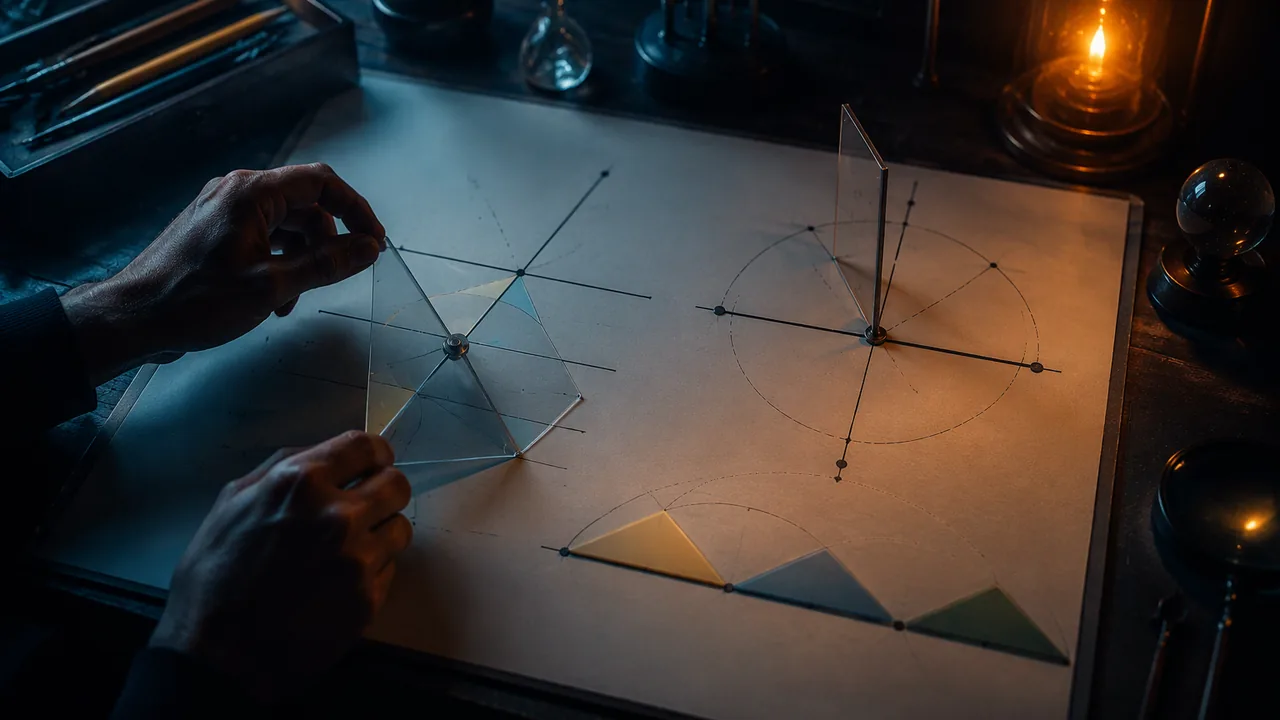
prove the vertical angle theorem, the parallel-line angle theorems, the perpendicular bisector theorem and the triangle angle sum, and find the flaw in an invalid proof.
Instruction
These theorems are the backbone of everything that follows. Each proof below uses only definitions, rigid motions and results proved earlier.
1. Vertical angles are congruent. Two lines cross, forming angles 1, 2, 3 and 4 in order around the point. Angles 1 and 2 form a straight line, so ∠1 + ∠2 = 180°. Angles 2 and 3 also form a straight line, so ∠2 + ∠3 = 180°. Therefore ∠1 + ∠2 = ∠2 + ∠3, and subtracting ∠2 gives ∠1 = ∠3.
2. Parallel lines cut by a transversal: alternate interior angles are congruent. Let lines l and m be parallel, and let transversal t meet l at P and m at Q. Let M be the midpoint of PQ, and rotate the whole picture 180° about M. A 180° rotation takes every line to a parallel line (or to itself), and it takes P to Q. So line l goes to a line through Q parallel to l. There is only one line through Q parallel to l (the parallel postulate), and it is m. The rotation also takes t to itself, since M is on t. So the angle between l and t at P goes to the angle between m and t at Q on the opposite side: the alternate interior angle. Rotations preserve angle measure, so the two angles are congruent. Corresponding angles then follow, because each corresponding angle is vertical to an alternate interior angle.
3. The perpendicular bisector theorem. Every point on the perpendicular bisector of AB is equidistant from A and B. Reflect across the bisector: A goes to B (definition of reflection) and a point P on the line stays fixed, so the reflection takes segment PA to segment PB and PA = PB. Conversely, every point equidistant from A and B is on the bisector. If PA = PB, let M be the midpoint of AB. Then ▵PMA ≅ ▵PMB by SSS, so ∠PMA = ∠PMB. These angles are a linear pair adding to 180°, so each is 90°, and PM is the perpendicular bisector. This is why the construction in Lesson 1.1 works.
4. The angles of a triangle sum to 180°. In ▵ABC, draw the line through C parallel to AB (Lesson 1.2 gives the construction; the parallel postulate says there is exactly one). At C, three angles sit along this line: one alternate interior to ∠A, then ∠C itself, then one alternate interior to ∠B. By theorem 2, the outer two equal ∠A and ∠B. The three angles form a straight line, so ∠A + ∠B + ∠C = 180°.
Critique practice. Here is a flawed proof that alternate interior angles are congruent: “The lines are parallel, so the angles on both sides of the transversal are the same, because the triangle angle sum is 180°.” Two problems. First, it asserts the conclusion instead of proving it. Second, it is circular: our proof of the angle sum used the alternate interior angle theorem, so the angle sum cannot be used to prove it. When you critique a proof, ask of each step: what justifies this, and was that justification proved without using what we are trying to show?
Discourse protocol. Partners take turns presenting a proof aloud. The listener may interrupt only with “What justifies that step?” or “Did you use that before proving it?”
📖 Read for this lesson
The reading opens over the lesson; close it to come back to exactly where you were. The checks below draw on it.
Formative check
Work through these before moving on. They are not graded — they tell you whether the standard below has landed yet.
In the proof that alternate interior angles are congruent, which fact guarantees that the rotated image of line l is line m?
It is valid to use the triangle angle sum theorem to prove that alternate interior angles are congruent, in this course’s order of proofs.
A point P is on the perpendicular bisector of AB if and only if PA = .
Write a flow proof that the angles of a triangle sum to 180°. Then state which earlier theorem each arrow depends on and check that none of them depends on the angle sum itself.
How confident are you that you can prove the line and angle theorems and spot circular reasoning in a proof?
Practice
Work these on paper or in your notebook, then open Check your answer. Aim for all of Fluency and Application; try at least one Challenge.
Printable version: this unit’s practice workbook (PDF)
Fluency
Build speed and accuracy with the core skill.
- Two lines cross. One angle is 118°. Find the other three.
Check your answer
Answer: 62°, 118°, 62°Linear pairs sum to 180°; vertical angles are equal. - Vertical angles measure (4x + 12)° and (6x − 20)°. Find x and the angle.
Check your answer
Answer: x = 16; 76°4x + 12 = 6x − 20. - Parallel lines are cut by a transversal. Alternate interior angles are (3x + 10)° and (5x − 30)°. Find x and the angle.
Check your answer
Answer: x = 20; 70° - Parallel lines are cut by a transversal. Corresponding angles are (2x + 15)° and (4x − 25)°. Find the angle.
Check your answer
Answer: 55° (x = 20) - A triangle’s angles are x, 2x and 3x. Find them.
Check your answer
Answer: 30°, 60°, 90°6x = 180. - Two angles of a triangle are 40° and 65°. Find the exterior angle at the third vertex.
Check your answer
Answer: 105°The third angle is 75°; its exterior angle is 180° − 75° = 105°, the sum of the two remote angles. - P is on the perpendicular bisector of AB. PA = 3x + 2 and PB = 5x − 6. Find PA.
Check your answer
Answer: PA = 14 (x = 4)
Application
Use the skill in context. Show your reasoning.
- Complete the proof. Lines AB and CD meet at E. Prove ∠AEC ≅ ∠BED. Supply the reason for each step: (1) ∠AEC + ∠CEB = 180°; (2) ∠CEB + ∠BED = 180°; (3) ∠AEC + ∠CEB = ∠CEB + ∠BED; (4) ∠AEC = ∠BED.
Check your answer
Answer: (1) Linear pair; (2) linear pair; (3) substitution (both equal 180°); (4) subtraction property of equality.Model proof. Angles AEC and CEB form a straight line, as do CEB and BED, so each pair sums to 180°. Setting the sums equal and subtracting ∠CEB gives ∠AEC = ∠BED. - Identify the flaw. “Lines l and m are parallel. The angles of triangle PQR sum to 180°, so the alternate interior angles at P and Q are congruent.”
Check your answer
Answer: It is circular: our proof of the angle sum uses the alternate interior angle theorem. It also never connects the triangle to the angles in question.Repair: rotate 180° about the midpoint of PQ; the image of l is the unique parallel to l through Q, which is m, and the rotation carries one alternate interior angle onto the other. - Write a flow proof that the angles of ▵ABC sum to 180°, using the line through C parallel to AB.
Check your answer
Answer: The three angles at C along the parallel line equal ∠A, ∠C and ∠B and form a straight angle.Model flow proof. [Line l through C parallel to AB — Parallel postulate] → [angle 1 at C = ∠A — Alternate interior angles] and [angle 3 at C = ∠B — Alternate interior angles]; [angle 1 + ∠C + angle 3 = 180° — Angles on a line]; all arrows → [∠A + ∠B + ∠C = 180° — Substitution].
Challenge
Stretch problems. Expect to think before you write.
- Prove that when parallel lines are cut by a transversal, the two interior angles on the same side of the transversal are supplementary.
Check your answer
Answer: Each is supplementary to the same angle, or one equals the alternate interior partner of the other’s linear-pair angle.Model proof. Let angles 1 and 2 be same-side interior angles, and let angle 3 form a linear pair with angle 2 at the same intersection, so ∠2 + ∠3 = 180°. Angle 3 and angle 1 are alternate interior angles, so ∠3 = ∠1. Substituting, ∠2 + ∠1 = 180°.
Review
Keep earlier skills sharp.
- Find the image of (−2, 7) under a rotation of 90° counterclockwise about the origin.
Check your answer
Answer: (−7, −2) - Find the image of (−2, 3) under a reflection over the line y = x.
Check your answer
Answer: (3, −2) - Which criterion proves two triangles congruent when two angles and the included side match?
Check your answer
Answer: ASA
Four Proofs to Critique: One Circular, One Read Off the Diagram, One Asserted, One Nearly Right
Constructed teaching material written for this course: four student proofs of the lesson’s theorems, each with a specific defect to locate, a dependency table, and angle measures to test the theorems on · SLS original (constructed teaching data)
Why this reading. The discourse protocol allows the listener two interruptions: “What justifies that step?” and “Did you use that before proving it?” Those questions need proofs to be asked of. Here are four, written as students write them, each about one of the lesson’s four theorems. Each has exactly one defect. Find the step, name the kind of defect (circular reasoning, an assumption read from the diagram, a conclusion asserted instead of proved, or a missing justification), and repair it using only what the lesson has established.
Proof 1. Vertical angles are congruent
- Lines AB and CD cross at E, forming ∠AEC, ∠CEB, ∠BED and ∠DEA in order around E. Given.
- ∠AEC + ∠CEB = 180°.
- ∠CEB + ∠BED = 180°. Same reason as step 2.
- ∠AEC + ∠CEB = ∠CEB + ∠BED. Both equal 180°.
- ∠AEC = ∠BED. Subtract ∠CEB from both sides.
Proof 2. Alternate interior angles are congruent
- Lines l and m are parallel; transversal t meets l at P and m at Q. Given.
- Pick a point R on l and a point S on m so that triangle PQR and the angles at P and Q are as in the figure. Construction.
- In triangle PQR, the angles sum to 180°. Triangle angle sum.
- The angle at P between l and t, and the angle at Q between m and t on the other side, are the two angles of the triangle that are not at R, so they are what remains of 180° after the angle at R; since the lines are parallel the angle at R contributes equally to both, so they are equal. Algebra on step 3.
Proof 3. A point equidistant from A and B lies on the perpendicular bisector of AB
- PA = PB. Given.
- Let M be the midpoint of AB. Every segment has a midpoint.
- Draw PM. In the figure, PM is perpendicular to AB. See diagram.
- PM passes through the midpoint of AB and is perpendicular to it, so PM is the perpendicular bisector. Definition of perpendicular bisector.
- P lies on PM, so P is on the perpendicular bisector. ∎
Proof 4. The angles of a triangle sum to 180°
- Triangle ABC. Through C draw the line parallel to AB. Parallel postulate: exactly one such line exists.
- The three angles at C along this line form a straight angle, so they sum to 180°. Definition of a straight angle.
- The outer two of these angles equal ∠A and ∠B respectively, because a line that crosses two parallel lines makes the same angles with both. Parallel lines have the same direction.
- So ∠A + ∠C + ∠B = 180°. ∎
The order of proof in this course
| # | Theorem | May use |
|---|---|---|
| 1 | Vertical angles congruent | definitions; straight angle = 180° |
| 2 | Alternate interior angles congruent (parallel lines) | 1, rotations preserve angle measure, 180° rotation sends a line to a parallel line, parallel postulate |
| 3 | Perpendicular bisector theorem and converse | definition of reflection; SSS; linear pair |
| 4 | Triangle angle sum | 2, parallel postulate, straight angle |
A step in a proof of theorem n may cite only theorems with a smaller number, or definitions and postulates. Check each of the four proofs against this table before you look for anything else; one of them fails the table outright.
Measures to test with
Two parallel lines are cut by a transversal that makes a 52° angle with the first line at P. Eight angles are formed, four at P and four at Q. Using theorems 1 and 2 only, assign a measure to all eight and say which theorem gives each one. Then check: how many of the eight are 52°, and how many are 128°? Finally, in a triangle with ∠A = 52° and ∠B = 61°, use theorem 4 to find ∠C, and identify which angle along the parallel line through C is 61° and why.
What to hand in
For each of the four proofs: the number of the defective step, the kind of defect, and one repaired step (or the missing reason) in your own words. Then write the flow proof of the angle sum the open question asks for, and beside each arrow write the theorem number it depends on. If any arrow points to 4, you have gone in a circle.