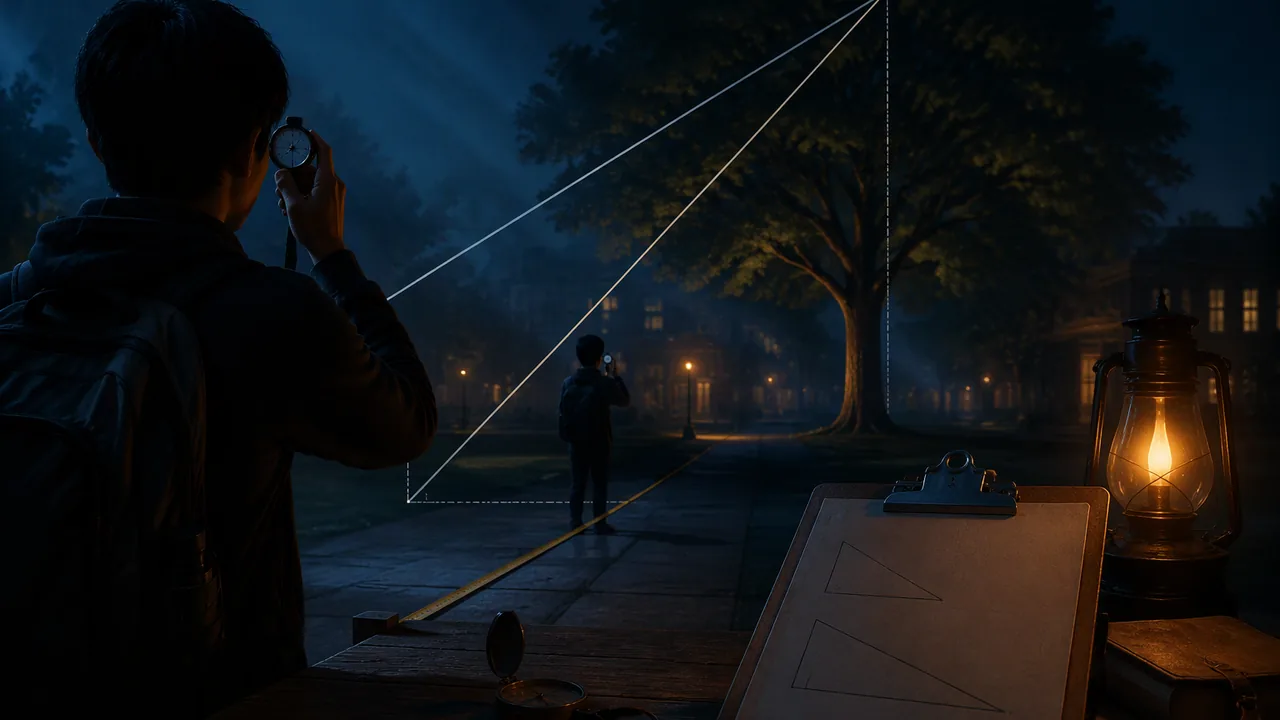
measure an inaccessible height or distance by two independent trigonometric methods, justify each method with the relevant proof, and report the result with an honest uncertainty.
Instruction
Surveyors rarely measure what they want directly. They measure what they can reach, angles and baselines, and compute the rest. This task makes you a surveyor.
Choose a target. A height you cannot climb (a building, a tree, a light pole) or a distance you cannot walk straight across (a field with an obstacle, a pond, a busy street measured from the sidewalk). Safety comes first: stay on school property and off roads.
Tools. A clinometer: a free phone app, or a paper protractor with a string and small weight taped to it (the string hangs vertically; the angle between the string and 90° is the angle of elevation). A tape measure or a pace count you have calibrated.
Two methods. You must compute your target two independent ways.
- Method A, right-triangle trigonometry. Stand at a measured distance from the base, measure the angle of elevation, and use tan, adding your eye height.
- Method B, the Law of Sines (or Cosines). If you cannot reach the base, measure the angle of elevation from two points in line with the target, a known distance d apart. Worked example: d = 20 m, the far angle is 30° and the near angle is 45°. In the triangle formed by the two observation points and the top, the angle at the top is 45° − 30° = 15°, and the near observer’s interior angle is 135°. By the Law of Sines, the distance from the near point to the top is 20 sin 30° / sin 15° ≈ 38.64 m, and the height above eye level is 38.64 sin 45° ≈ 27.32 m. With the special-triangle values, the exact answer is 10(√3 + 1).
Proofs. Your report must include a written proof of whichever law you used in Method B, adapted to your diagram.
Uncertainty. Angles from a paper clinometer are reliable to about ±1°. Recompute your answer with each angle one degree higher and lower and report the range. Compare the ranges from Methods A and B. If they do not overlap, find out why.
Report structure. Target and photo or sketch; measurements in a table; labeled diagrams for both methods; proof; computations with exact forms where possible; uncertainty; comparison and conclusion.
Presentation. Three minutes, live or recorded: your target, your two results, and why you trust one more than the other.
📖 Read for this lesson
The reading opens over the lesson; close it to come back to exactly where you were. The checks below draw on it.
Formative check
Work through these before moving on. They are not graded — they tell you whether the standard below has landed yet.
Right triangle, angle and adjacent side known: find the opposite side
Tap to revealopposite = adjacent × tan θ
Two angles and a side known, non-right triangle
Tap to revealLaw of Sines
Two sides and the included angle known
Tap to revealLaw of Cosines
Two observation points 20 m apart, angles 30° and 45°: height above eye level
Tap to reveal10(√3 + 1) ≈ 27.32 m
Two observers in line with a tower, 20 m apart, measure angles of elevation of 30° (far) and 45° (near). What is the angle at the top of the tower in their triangle?
Stage 1: name your target, describe how you will measure it by each method, and list two safety or accuracy risks and how you will manage them.
How confident are you that you can survey an inaccessible measurement two ways and defend the result with proof and an uncertainty range?
Unit 4 checkpoint
Do this before you start the task. It covers the whole unit and tells you what to review first.
In a right triangle with legs 7 and 24 and hypotenuse 25, what is sin A for the angle opposite 7?
sin 33° = cos °.
The ratio opposite/hypotenuse for a 40° angle is the same in every right triangle with a 40° angle.
A 30-60-90 triangle has hypotenuse 18. The longer leg is:
A 45-45-90 triangle has legs 11. Its hypotenuse is 11√.
A right triangle has legs 9 and 12. What is the angle opposite the side 9, to the nearest tenth?
The area of a triangle with sides 10 and 6 and an included angle of 30° is .
Which law starts a triangle with two sides and the included angle?
When C = 90°, the Law of Cosines becomes the Pythagorean Theorem.
In △ABC, A = 40°, B = 60° and a = 10. Which is b, to the nearest tenth?
Under a 1:12 slope limit, a 24-inch rise needs at least inches of run.
Your calculator must be in degree mode for sin 30° to give 0.5.
Submit: Trigonometric Survey Report and three-minute presentation
Task: Measure an inaccessible height or distance by right-triangle trigonometry and by the Law of Sines or Cosines. Include diagrams, a proof of the law you used, computations, an uncertainty range and a comparison of the two results. If field work is not possible, use the campus measurement set in this lesson’s reading.
Submission workflow
- Stage 1 — Plan. Target, safety check, measurement plan for both methods and blank data table.
- Stage 2 — Peer-reviewed draft. Data, diagrams, computations and proof; a partner re-computes one method independently and checks the proof. Submit a revision note.
- Stage 3 — Revised final. Complete report with uncertainty analysis and comparison.
- Stage 4 — Presentation. Three-minute live or recorded defense of the method and result.
How it is scored
| Criterion | What proficient looks like |
|---|---|
| Right-triangle method (G.SRT.C.7) | Correct model and computation, including eye height; exact values used where special angles occur (G.SRT.C.5 / G.SRT.C.7). |
| Law of Sines or Cosines (enrichment) | Correct triangle, correct law chosen and justified, correct computation. |
| Proof (enrichment) | Valid proof of the law used, adapted to the student’s diagram. |
| Modeling (MP.4, MP.5) | Assumptions stated; instruments used appropriately. |
| Precision (MP.6) | Rounding only at the end; uncertainty range computed and discussed. |
| Presentation | Clear comparison of methods with a reasoned judgment. |
The Campus Measurement Set: One Building, One Field, Every Reading Recorded
Constructed teaching data written for this course: clinometer and tape readings for a campus building from three stations, and for a field crossing with an obstacle, so the survey report can be completed when field work is not possible · SLS original (constructed teaching data)
Why this reading. The task says field work is preferred and a measurement set is the alternative. This is that set: every reading a team would bring back for one building and one field crossing, recorded to the precision the instruments allow. The numbers are constructed for this course and labeled illustrative. Two results are worked so you can see the standard; the two methods do not agree exactly, and explaining why is part of the report.
Target 1: the gymnasium wall, height (illustrative)
Level asphalt. Clinometer: paper protractor with weighted string, read to the nearest degree. Observer’s eye height 1.60 m. Stations S1 and S2 are in a straight line with the base of the wall.
| Station | Horizontal distance to base (tape) | Angle of elevation to parapet |
|---|---|---|
| S1 (near) | 42.0 m | 31° |
| S2 (far) | 67.0 m (S1 to S2 = 25.0 m) | 21° |
Method A, right triangle from S1. Height above eye = 42.0 tan 31° = 42.0 × 0.6009 = 25.24 m; wall = 25.24 + 1.60 = 26.8 m. With 30° and 32°: 42.0 tan 30° + 1.6 = 25.85 m and 42.0 tan 32° + 1.6 = 27.84 m. Range 25.8 to 27.8 m.
Method B, Law of Sines from S1 and S2, as if the base were unreachable. In the triangle S2, S1, top: the angle at the top is 31° − 21° = 10° (the exterior angle at S1 equals the sum of the remote interior angles), the angle at S2 is 21°, and the angle at S1 is 180° − 31° = 149°. Distance S1 to top = 25.0 sin 21° / sin 10° = 25.0 × 0.3584 / 0.1736 = 51.60 m. Height above eye = 51.60 sin 31° = 26.57 m; wall = 28.2 m. Now vary both angles by ±1°: the four combinations (20°, 30°), (22°, 32°), (20°, 32°) and (22°, 30°) give 26.2, 30.2, 23.4 and 35.2 m. Range 23.4 to 35.2 m.
Comparison. The ranges overlap, so the results are consistent, but Method B’s range is six times wider. The reason is the 10° angle at the top: a one-degree error in a 10° angle is a ten percent error in sin 10°, and that error is carried straight into the answer. Method A’s tangent of 31° changes only about four percent per degree. This is why a surveyor makes the two stations far apart. Compute the true angle at S2 to two decimals if the wall is exactly 26.8 m tall (it is about 20.6°), and say what rounding it to 21° did to Method B.
Target 2: width of the practice field across the equipment shed (illustrative)
Points A and B mark the field’s edges; a shed blocks the straight line between them. Station C is clear of the shed.
| Measurement | Value | Precision |
|---|---|---|
| CA | 61.0 m | ±0.1 m |
| CB | 88.0 m | ±0.1 m |
| ∠ACB | 74° | ±1° |
| Second station D, with DA = 30.0 m and ∠DAB = 90° (set with a 3-4-5 rope triangle) | ∠ADB = 72° | ±1° |
Method 1, Law of Cosines at C: AB² = 61.0² + 88.0² − 2(61.0)(88.0) cos 74° = 3,721 + 7,744 − 10,736 × 0.2756 ≈ 8,505.8, so AB ≈ 92.2 m. Method 2, right triangle at D: AB = 30.0 tan 72°. Compute it, then recompute both methods with each angle one degree higher and lower, and explain why the right-triangle method with a 72° angle is more sensitive to a one-degree error than a 45° setup would have been (compare tan 71°, tan 72° and tan 73°).
What the report must include from this set
- Both diagrams, labeled with every number in the tables and nothing that is not in them.
- The proof of the Law of Sines (Target 1) or Cosines (Target 2), with the letters matched to your diagram.
- Computations with exact forms where a special angle appears (there is one 3-4-5 triangle here; there are no 30°, 45° or 60° readings, and you should say so rather than invent one).
- Both ranges, the overlap, and a reasoned choice of which result to trust and why.